Close Modal

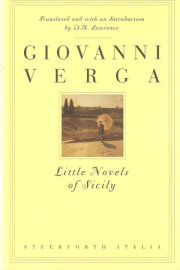
Little Novels of Sicily

Translated by D.H. Lawrence
Paperback
$16.95 US
5-1/16"W x 7-13/16"H | 13 oz | 24 per carton
On sale Oct 27, 2026 | 176 Pages | 9781782697077

See Additional Formats
AVAILABLE AGAIN: a highly anticipated new edition of 12 poetically ironic short stories of 19th-century Sicily by a realist master, translated and introduced by D.H. Lawrence.

“Intoxicating... His finest work... How acutely Verga understood the tragic contradictions that still disturb our modern experience.” —New York Review of Books


First published in a single volume in 1883, the 12 stories collected in this beautiful new paperback edition are drawn from the Sicily of Giovanni Verga's childhood, reported at the time to be the poorest place in Europe. Verga's style is swift, sure, and implacable; he plunges into his stories almost in midbreath, and tells them with a stark economy of words. There's something dark and tightly coiled at the heart of each story, an ironic, bitter resolution that is belied by the deceptive simplicity of Verga's prose, and Verga strikes just when the reader's not expecting it.

Translator D. H. Lawrence surely found echoes of his own upbringing in Verga's sketches of Sicilian life: the class struggle between property owners and tenants, the relationship between men and the land, and the unsentimental, sometimes startlingly lyric evocation of the landscape.

Just as Lawrence veers between loving and despising the industrial North and its people, so too Verga shifts between affection for and ironic detachment from the superstitious, uneducated, downtrodden working poor of Sicily. If Verga reserves pity for anyone or anything, it is the children and the animals, but he doesn't spare them. In his experience, it is the innocents who suffer first and last and always.
"The Little Novels of Sicily have that sense of the wholeness of life, the spare exuberance, the endless inflections and overtones, and the magnificent and thrilling vitality of major literature." -- The New York Times

"In these stories the whole Sicily of the 1860s lives before us . . . and whether his subject be the brutal bloodshed of an abortive revolution or the simple human comedy that can attend even deep mourning, Verga never loses his complete artistic mastery of his material." -- The Times Literary Supplement
Giovanni Verga is one of the great writers of Italian fiction. Verga was born in Catania, Sicily, in 1840, and died in the same city in 1922. As a young man he left Sicily to work at literature and mingle with society in Florence and Milan, but eventually came back to spend his long declining years in his own place. His numerous books include the novelistic masterpiece The House of the Medlar Tree. View titles by Giovanni Verga
He didn't have his monk’s long beard anymore, nor his poor friar’s hood, now that he got himself shaved every Sunday, and went out walking in his grand cassock of fine cloth, with his silk-lined cloak over his arm. And on those occasions when he was looking at his own fields, and his own vineyards, and his own flocks, and his own laborers, with his hands in his pockets and his little pipe in his mouth, if he ever did chance to recall the days when he washed up dishes for the Capucin monks and they out of charity put on him a lay-brother’s long frock, he would make the sign of the cross with his left hand.

Yet if they hadn’t taught him to say mass and to read and write, all out of charity, he would never have succeeded in wedging himself in among the first families of the place, nor in nailing down in his account books the names of all those half-profits peasants who labored and prayed to God and good fortune for him, and then swore like Turks when it came to reckoning day. “Mind what I am, not what I was once,” says the proverb. Who he was, everybody knew, for his mother still did his housecleaning. His Reverence had no family pride, no; and when he went to the baroness’s to play at piquet with her, he had his brother to wait in the anteroom for him, holding the lantern.

His charity began at home, as God Himself enjoins; so he’s taken one of his nieces into his house, not bad-looking, but without a rag to her back, so that she’d never have found the ghost of a husband; and he kept her and maintained her, what’s more he put her in the fine room with glass in the windows, and the bed with bed-curtains, and he wasn’t going to have her work, to ruin her hands with rough jobs. So that everybody thought it a real God’s penalty when the poor creature was seized with scruples, such as will happen to women who have nothing else to do and pass their days in church beating their breasts because they’re in mortal sin – though not when her uncle was there, for he wasn’t one of those priests who like to show themselves on the altar in pomp and splendor before their inamoratas. As for other women, outside their homes it was enough for him to give them a little caress with two fingers on their cheek, paternally, or through the little window of the confession box to give them the benediction after they had rinsed out their consciences and emptied the sack of their own and other people’s sins, by which means he always learned something useful, being a man who speculated in country produce.

Blessed Lord, he didn’t pretend to be a holy man, not he! Holy men died of hunger, like the vicar who celebrated mass even when he wasn’t paid for it, and went round the beggarly houses in a cassock so tattered that it was a scandal to Religion.
His Reverence wanted to get on, and he got on, with the wind full-sail, at first a little bit scuttling, because of that blessed frock which bothered him, so much so that for pitching it into the vegetable garden he had been had up before the Monastic Tribunal, and the confraternity had helped him to get the better of it, so as to be rid of him, because so long as he was in the monastery there were stools and dishes flying at every election of provincials; Father Battistino, a servant of God sturdy as a muleteer, had been half slaughtered, and Father Giammaria, the superior, had lost all his teeth in the fray. His Reverence, himself, kept mum in his cell, after he’d stirred up the fire, and in that way he’d managed to become a reverend, with all his teeth, which were of good use to him; and everybody said to Father Giammaria, who had been the one to take this scorpion into their sleeve, “Good for him!”

But Father Giammaria, good soul, chewing his lips with his bare gums, replied:

“Well, what do you want! He was never cut out for a Capucin friar. He’s like Pope Sixtus, who started by being a swineherd and then became what he was. Didn’t you see what promise he gave as a boy?”

And so Father Giammaria remained superior of the Capucin friars, without a shirt on his back or a cent in his pocket, hearing confession for the love of God, and cooking vegetable soup for the poor.

His Reverence, as a boy, when he saw his brother – the one with the lantern – breaking his back hoeing in the fields, and his sisters unable to find a husband even if they’d give themselves away for nothing, and his mother spinning worsted yarn in the dark so as to save the floating-wick lamp, had said: “I want to be a priest!”

They had sold the mule and the scrap of land in order to send him to school, in the hope that if they got so far as to have a priest in the house, it would be better than the patch of land and the mule. But it took more than that to keep him at the seminary. And so the boy began to buzz round the monastery for them to take him as a novice; and one day when they were expecting the provincial, and there was a lot to do in the kitchen, they called him in to lend a hand. Father Giammaria, who had a good heart, said to him: “You like it here? Then you stop with us.”

And Brother Carmelo, the porter, in the long hours when he had nothing to do, wearying of sitting on the low wall of the cloister knocking his sandals one against the other, put together a bit of a frock for him out of the rags of cassocks that they’d flung on to the fig tree to scare away the sparrows. His mother, his brother, and his sister protested that if he became a friar it was all over with them, and they gave up the money that had gone for his schooling as lost, for they’d never get another halfpenny out of him. But he, who had it in his blood to be a friar, shrugged his shoulders and answered, “You mean to tell me a fellow can’t follow the vocation God has called him to?” Father Giammaria had taken a fancy to him because he was as light as a cat in the kitchen, and the same at all the menial jobs, even in serving at mass, as if he’d never done anything else all his life long, with his eyes lowered and his lips sewed together like a seraph. Now that he no longer served at mass he still kept his lowered eyes and his sewed-up lips, when it was a question of some shady business with the gentry, or when there was occasion for him to bid in the auction of the communal lands, or to take his oath before the magistrate.

He had to take a fat oath, indeed, in 1854, at the altar, in front of the ark that holds the Sacrament, while he was saying holy mass, and people were accusing him of spreading the cholera, and wanting to make him dance for it.

“By this consecrated host that I have in my hand,” said he to the faithful who were kneeling, crouching low on to their heels, “I am innocent, my children! Moreover I promise you the scourge shall cease within a week. Have patience!”

Yes, they had patience; perforce they had patience! Since he was well in with the judge and the force captain, and King Bomba sent him fat chickens at Easter and at Christmas, because he was so much obliged to him, they said; and Bomba had sent him also the counterpoison, in case there did come a serious accident.

An old aunt of his whom he’d had to take under his roof so as to prevent folks talking, and who was no good for anything anymore except to eat the bread of a traitor, had uncorked the bottle for somebody else, and so had caught the cholera out and out; but her own nephew, for fear of raising people’s suspicions, hadn’t been able to administer the counterpoison to her.

“Give me the counterpoison; give me the counterpoison!” pleaded the old woman, who was already as black as coal, without any regard for the doctor and the lawyer who were both there, looking one another in the face embarrassed. His Reverence, with his brazen face, as if it wasn’t his affair, muttered, shrugging his shoulders, “Take no notice of her, she is delirious.”

The counterpoison, if he really had got it, had been sent to him by the king under seal of confession, and he couldn’t give it to anybody. The judge himself had gone to beg it of him on his knees, for his wife who was dying, and he’d got nothing for answer from his Reverence except this:

“You may command me in life and death, dear friend; but in this business, really, I can do nothing for you.”

This was the story as everybody knew it, and since they knew that by dint of intrigues and cleverness he had man-aged to become the intimate friend of the king, of the judge, and of the force captain, and had managed to get a handle over the police, like the intendant himself, so that his reports arrived at Naples without ever passing through the hands of the lieutenant, nobody dared to fall out with him, and when he cast his eye upon an olive garden or piece of tilled land that was for sale, or on a lot of the communal lands that was to be leased out by auction, even the big somebodies of the place, if they dared to bid against him, did it with smooth words and smarmy phrases, offering him a pinch of snuff. Once, with the baron himself, they kept on for half a day haffling and chaffling. The baron played the sugary, and his Reverence, seated in front of him with his gown gathered between his legs, at every higher bid offered him his silver snuff-box, sighing:

“Why, whatever are you thinking of, Baron, my dear sir? Now the donkey’s fallen down, we’ve got to get him up again.”

And so until the lot was knocked down, and the baron gave in, green with bile.

Which the peasants quite approved of, because big dogs always quarrel among themselves over a good bone, and there’s never anything left for poor devils to gnaw. But what made them murmur again was that that servant of God squeezed them worse than the antichrist. Whenever they had to share with him, he had no scruple about laying hold of his neighbor’s property, since he had all the implements of confession in his own hands, and if he fell into mortal sin he could give himself absolution.
Note on Giovanni Verga by D.H. Lawrence 7
His Reverence 11
So Much for the King 24
Don Licciu Papa 34
The Mystery Play 44
Malaria 54
The Orphans 65
Property 75
Story of the Saint Joseph’s Ass 84
Black Bread 101
The Gentry 142
Liberty 153
Across the Sea 163

About

AVAILABLE AGAIN: a highly anticipated new edition of 12 poetically ironic short stories of 19th-century Sicily by a realist master, translated and introduced by D.H. Lawrence.

“Intoxicating... His finest work... How acutely Verga understood the tragic contradictions that still disturb our modern experience.” —New York Review of Books


First published in a single volume in 1883, the 12 stories collected in this beautiful new paperback edition are drawn from the Sicily of Giovanni Verga's childhood, reported at the time to be the poorest place in Europe. Verga's style is swift, sure, and implacable; he plunges into his stories almost in midbreath, and tells them with a stark economy of words. There's something dark and tightly coiled at the heart of each story, an ironic, bitter resolution that is belied by the deceptive simplicity of Verga's prose, and Verga strikes just when the reader's not expecting it.

Translator D. H. Lawrence surely found echoes of his own upbringing in Verga's sketches of Sicilian life: the class struggle between property owners and tenants, the relationship between men and the land, and the unsentimental, sometimes startlingly lyric evocation of the landscape.

Just as Lawrence veers between loving and despising the industrial North and its people, so too Verga shifts between affection for and ironic detachment from the superstitious, uneducated, downtrodden working poor of Sicily. If Verga reserves pity for anyone or anything, it is the children and the animals, but he doesn't spare them. In his experience, it is the innocents who suffer first and last and always.

Praise

"The Little Novels of Sicily have that sense of the wholeness of life, the spare exuberance, the endless inflections and overtones, and the magnificent and thrilling vitality of major literature." -- The New York Times

"In these stories the whole Sicily of the 1860s lives before us . . . and whether his subject be the brutal bloodshed of an abortive revolution or the simple human comedy that can attend even deep mourning, Verga never loses his complete artistic mastery of his material." -- The Times Literary Supplement

Author

Giovanni Verga is one of the great writers of Italian fiction. Verga was born in Catania, Sicily, in 1840, and died in the same city in 1922. As a young man he left Sicily to work at literature and mingle with society in Florence and Milan, but eventually came back to spend his long declining years in his own place. His numerous books include the novelistic masterpiece The House of the Medlar Tree. View titles by Giovanni Verga

Excerpt

He didn't have his monk’s long beard anymore, nor his poor friar’s hood, now that he got himself shaved every Sunday, and went out walking in his grand cassock of fine cloth, with his silk-lined cloak over his arm. And on those occasions when he was looking at his own fields, and his own vineyards, and his own flocks, and his own laborers, with his hands in his pockets and his little pipe in his mouth, if he ever did chance to recall the days when he washed up dishes for the Capucin monks and they out of charity put on him a lay-brother’s long frock, he would make the sign of the cross with his left hand.

Yet if they hadn’t taught him to say mass and to read and write, all out of charity, he would never have succeeded in wedging himself in among the first families of the place, nor in nailing down in his account books the names of all those half-profits peasants who labored and prayed to God and good fortune for him, and then swore like Turks when it came to reckoning day. “Mind what I am, not what I was once,” says the proverb. Who he was, everybody knew, for his mother still did his housecleaning. His Reverence had no family pride, no; and when he went to the baroness’s to play at piquet with her, he had his brother to wait in the anteroom for him, holding the lantern.

His charity began at home, as God Himself enjoins; so he’s taken one of his nieces into his house, not bad-looking, but without a rag to her back, so that she’d never have found the ghost of a husband; and he kept her and maintained her, what’s more he put her in the fine room with glass in the windows, and the bed with bed-curtains, and he wasn’t going to have her work, to ruin her hands with rough jobs. So that everybody thought it a real God’s penalty when the poor creature was seized with scruples, such as will happen to women who have nothing else to do and pass their days in church beating their breasts because they’re in mortal sin – though not when her uncle was there, for he wasn’t one of those priests who like to show themselves on the altar in pomp and splendor before their inamoratas. As for other women, outside their homes it was enough for him to give them a little caress with two fingers on their cheek, paternally, or through the little window of the confession box to give them the benediction after they had rinsed out their consciences and emptied the sack of their own and other people’s sins, by which means he always learned something useful, being a man who speculated in country produce.

Blessed Lord, he didn’t pretend to be a holy man, not he! Holy men died of hunger, like the vicar who celebrated mass even when he wasn’t paid for it, and went round the beggarly houses in a cassock so tattered that it was a scandal to Religion.
His Reverence wanted to get on, and he got on, with the wind full-sail, at first a little bit scuttling, because of that blessed frock which bothered him, so much so that for pitching it into the vegetable garden he had been had up before the Monastic Tribunal, and the confraternity had helped him to get the better of it, so as to be rid of him, because so long as he was in the monastery there were stools and dishes flying at every election of provincials; Father Battistino, a servant of God sturdy as a muleteer, had been half slaughtered, and Father Giammaria, the superior, had lost all his teeth in the fray. His Reverence, himself, kept mum in his cell, after he’d stirred up the fire, and in that way he’d managed to become a reverend, with all his teeth, which were of good use to him; and everybody said to Father Giammaria, who had been the one to take this scorpion into their sleeve, “Good for him!”

But Father Giammaria, good soul, chewing his lips with his bare gums, replied:

“Well, what do you want! He was never cut out for a Capucin friar. He’s like Pope Sixtus, who started by being a swineherd and then became what he was. Didn’t you see what promise he gave as a boy?”

And so Father Giammaria remained superior of the Capucin friars, without a shirt on his back or a cent in his pocket, hearing confession for the love of God, and cooking vegetable soup for the poor.

His Reverence, as a boy, when he saw his brother – the one with the lantern – breaking his back hoeing in the fields, and his sisters unable to find a husband even if they’d give themselves away for nothing, and his mother spinning worsted yarn in the dark so as to save the floating-wick lamp, had said: “I want to be a priest!”

They had sold the mule and the scrap of land in order to send him to school, in the hope that if they got so far as to have a priest in the house, it would be better than the patch of land and the mule. But it took more than that to keep him at the seminary. And so the boy began to buzz round the monastery for them to take him as a novice; and one day when they were expecting the provincial, and there was a lot to do in the kitchen, they called him in to lend a hand. Father Giammaria, who had a good heart, said to him: “You like it here? Then you stop with us.”

And Brother Carmelo, the porter, in the long hours when he had nothing to do, wearying of sitting on the low wall of the cloister knocking his sandals one against the other, put together a bit of a frock for him out of the rags of cassocks that they’d flung on to the fig tree to scare away the sparrows. His mother, his brother, and his sister protested that if he became a friar it was all over with them, and they gave up the money that had gone for his schooling as lost, for they’d never get another halfpenny out of him. But he, who had it in his blood to be a friar, shrugged his shoulders and answered, “You mean to tell me a fellow can’t follow the vocation God has called him to?” Father Giammaria had taken a fancy to him because he was as light as a cat in the kitchen, and the same at all the menial jobs, even in serving at mass, as if he’d never done anything else all his life long, with his eyes lowered and his lips sewed together like a seraph. Now that he no longer served at mass he still kept his lowered eyes and his sewed-up lips, when it was a question of some shady business with the gentry, or when there was occasion for him to bid in the auction of the communal lands, or to take his oath before the magistrate.

He had to take a fat oath, indeed, in 1854, at the altar, in front of the ark that holds the Sacrament, while he was saying holy mass, and people were accusing him of spreading the cholera, and wanting to make him dance for it.

“By this consecrated host that I have in my hand,” said he to the faithful who were kneeling, crouching low on to their heels, “I am innocent, my children! Moreover I promise you the scourge shall cease within a week. Have patience!”

Yes, they had patience; perforce they had patience! Since he was well in with the judge and the force captain, and King Bomba sent him fat chickens at Easter and at Christmas, because he was so much obliged to him, they said; and Bomba had sent him also the counterpoison, in case there did come a serious accident.

An old aunt of his whom he’d had to take under his roof so as to prevent folks talking, and who was no good for anything anymore except to eat the bread of a traitor, had uncorked the bottle for somebody else, and so had caught the cholera out and out; but her own nephew, for fear of raising people’s suspicions, hadn’t been able to administer the counterpoison to her.

“Give me the counterpoison; give me the counterpoison!” pleaded the old woman, who was already as black as coal, without any regard for the doctor and the lawyer who were both there, looking one another in the face embarrassed. His Reverence, with his brazen face, as if it wasn’t his affair, muttered, shrugging his shoulders, “Take no notice of her, she is delirious.”

The counterpoison, if he really had got it, had been sent to him by the king under seal of confession, and he couldn’t give it to anybody. The judge himself had gone to beg it of him on his knees, for his wife who was dying, and he’d got nothing for answer from his Reverence except this:

“You may command me in life and death, dear friend; but in this business, really, I can do nothing for you.”

This was the story as everybody knew it, and since they knew that by dint of intrigues and cleverness he had man-aged to become the intimate friend of the king, of the judge, and of the force captain, and had managed to get a handle over the police, like the intendant himself, so that his reports arrived at Naples without ever passing through the hands of the lieutenant, nobody dared to fall out with him, and when he cast his eye upon an olive garden or piece of tilled land that was for sale, or on a lot of the communal lands that was to be leased out by auction, even the big somebodies of the place, if they dared to bid against him, did it with smooth words and smarmy phrases, offering him a pinch of snuff. Once, with the baron himself, they kept on for half a day haffling and chaffling. The baron played the sugary, and his Reverence, seated in front of him with his gown gathered between his legs, at every higher bid offered him his silver snuff-box, sighing:

“Why, whatever are you thinking of, Baron, my dear sir? Now the donkey’s fallen down, we’ve got to get him up again.”

And so until the lot was knocked down, and the baron gave in, green with bile.

Which the peasants quite approved of, because big dogs always quarrel among themselves over a good bone, and there’s never anything left for poor devils to gnaw. But what made them murmur again was that that servant of God squeezed them worse than the antichrist. Whenever they had to share with him, he had no scruple about laying hold of his neighbor’s property, since he had all the implements of confession in his own hands, and if he fell into mortal sin he could give himself absolution.

Table of Contents

Note on Giovanni Verga by D.H. Lawrence 7
His Reverence 11
So Much for the King 24
Don Licciu Papa 34
The Mystery Play 44
Malaria 54
The Orphans 65
Property 75
Story of the Saint Joseph’s Ass 84
Black Bread 101
The Gentry 142
Liberty 153
Across the Sea 163