Close Modal

The Free Verse Society

Look inside
Hardcover
$19.99 US
5.66"W x 8.28"H x 0.86"D   | 15 oz | 24 per carton
On sale Mar 24, 2026 | 336 Pages | 9781682638408
Age 14 and up | Grade 9 & Up

See Additional Formats
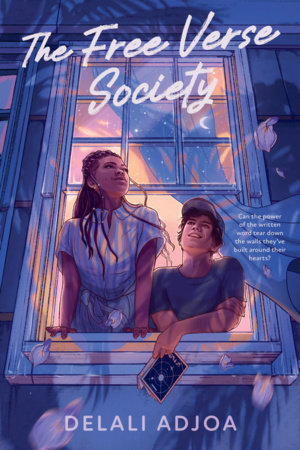
A tender hate-to-love YA romance about two teens who connect through their high school poetry club, where the power of the written word tears down the walls they've built around their hearts.

No one in Delray knows Jae Aƒenyo's story—that she's a teen mom who placed her baby for adoption—and she intends to keep it that way. After moving in with her uncle, Jae is looking for a fresh start. But an accidental run-in with the school's delinquent, Derek Patel, is not exactly what she had in mind. She soon finds a haven in the poetry club—at least, until Derek joins.

Derek Patel is desperately clinging to his old life—where his dad was alive, his mom was healthy, and they lived in an oceanfront estate instead of a run-down pink bungalow. He'll do anything to hide his problems from his friends, including breaking into his old house to keep up the charade that he still lives there. But the house now belongs to the school's lit teacher, who offers him the chance to join the poetry club as a penance.

As the newest members of the club, Jae and Derek are tasked with planning the end-of-semester poetry reading. While Derek is hell-bent on keeping his broken family a secret, Jae is desperate to prove to her uncle that she's more than a walking statistic—which means guarding her heart against Derek, who her uncle thinks is no good.

A poignant exploration of love, loss, and the power of words to draw people together, The Free Verse Society announces the arrival of an important new voice in YA romance.

Perfect for readers who love Forced Proximity, Forbidden Love, Opposites Attract, Hate to Love, the Misunderstood Bad Boy, Opposite Sides of the Tracks, and Reading/Literature Club Bonding!
Adjoa’s debut is as emotionally rich as it is narratively layered. Jae and Derek’s relationship is built with care and realism; their eventual trust is rooted in understanding, a love of creativity, and the shared experience of having non-white fathers who didn’t fully pass on their cultures to their children. . . . A touching, vulnerable romance navigating gut-wrenching conflict to deliver the ultimate relief of catharsis.
—Kirkus Reviews (starred review)

Sharply rendered poems by various characters are interspersed throughout the protagonists’ compelling and unique alternating narration, and Jae and Derek’s electric chemistry leaps off the page.
—Publishers Weekly

Adjoa’s debut has developed complex characters in Jae and Derek and deftly creates empathy for their situations through poetry.
—School Library Journal

Characters’ layers are revealed, their complexity captivating readers with empathy as secrets on both sides unfold and an enemies-to-lovers romance ignites. Secondary characters bring humor into heavy situations. Prose with periodic engaging free verse, this debut pairs brilliantly with Hannah V. Sawyerr’s Truth Is (2025).
—Booklist

The prose itself takes on a lyrical cadence—every line feels as if it was written with meticulous care. The focus on teen autonomy grounds the novel, which manages to avoid becoming preachy as characters, both main and secondary, learn to respect others’ needs and make their own decisions. Hand this to readers looking for a deep and meaningful romance that doesn’t shy away from tough issues.
—Bulletin of the Center for Children’s Books
Delali Adjoa was born in Togo to Ghanaian parents but grew up in Canada, where she traded sunny cottons for wool tuques and snowsuits. She has been chasing warmer weather ever since. Delali writes fiction centered on identity, freedom, and family, and loves the American South for the stories it has buried. She is a graduate of the University of Kentucky and Georgetown University. Instagram: @DelaliWrites.
Chapter One
After months of muggy heat, a cool breeze passes through to say goodbye. It curls around me like a snake, smooth and slow. I clasp the handle of the suitcase by my waist, recounting everything I packed inside like a memory game: clothes and toiletries; a vintage postcard of Georgia, brown around the edges; a photo album; Mom’s faded Bernie Mac tee; and as many books as I could fit inside.
I never paid much attention to the sidewalk, to the way it curves perfectly around the bend. This corner was always a passing-through place, a nowhere on the way to somewhere. To catch the bus for school, for the clinic, or to meet up with Austin Green. Now this is where I’ll pass from one world to the next.
The phone in my pocket vibrates. I pull it out to read the message from Uncle Rowan: Just a few minutes.
Soon, a sleek black Cadillac pauses at the four-way stop before making a turn and pulling up beside me. The windows are tinted so dark they nearly blend in with the body of the car. The engine cuts off, the door opens, and Uncle Rowan’s shiny brown head emerges from the driver’s side. He’s wearing dark sunglasses, and he walks toward me in a gray suit that shimmers like a new quarter in the sun.
He comes close to give me a quick pat on the back and says my name, Janelle, like it’s a greeting. I see the tiredness stained red in the corners of his eyes, from a full day of visiting clients and old friends on the way to pick me up. I have people to see along the way, he’d said. As if they were the ones that made the stagnant hours on the road worthwhile.
I don’t realize my fingers are wrapped tightly around my suitcase until he tries to wrestle it from my fingers.
“Did you cram the whole house in here?” he asks as he opens the trunk and heaves the suitcase inside. He grunts, dusts off his hands as if they’ve gotten dirty, and slams the trunk shut. We both look toward the empty apartment complex, and stupidly, I wave at the time-battered bricks.
Call me if you need me, Mom said this morning before leaving for her nursing shift. But we both know I won’t call. These days our words are so sharp they could cut our own tongues. This is my chance to leave everything behind, including her voice.
Uncle Rowan says, “Let’s get a move on,” and nudges my shoulder.
I open the passenger-side door and pause, one foot hovering over the mat inside. The Georgia dirt clings to my black shoes like a final goodbye. I pull my foot out again and kick the curb, watching the dirt pepper the street.
When I step into the black-and-silver interior of the car, with all its gleaming gadgets, I feel like I’m stepping into the future. And I finally understand what a new car smells like. I’ve never ridden anywhere without the smell of cigarette smoke clinging to the seats, the smell of gasoline thick in the air, the smell of unwashed bodies sitting too close.
“We’ll be home in about eight hours,” Uncle Rowan says.
The word home rattles me. I remember that the place we’re driving away from isn’t home anymore, that it stopped being home a long time ago. Today my family name, my father’s name, feels like a mockery. Aƒenyo. Home is good. A reminder of what’s been broken, what I no longer have.
I wrap my arms around my stomach and listen to Uncle Rowan talk about his legal practice and his new office in the heart of Delray Beach. An easy commute, he says.
I uh-huh and hmm to show interest while I watch the houses with yellowed siding and chain-link fences pass by the window with increasing speed. Then we’re on the highway, where Uncle Rowan sinks back comfortably in his seat and turns on music that makes me think of Afros, bumping hips, and bell bottoms. I’m relieved not to have to fill the silence with small talk.
Quietly, I pull out my copy of The Best American Poetry and try to forget what I’m leaving behind.

About

A tender hate-to-love YA romance about two teens who connect through their high school poetry club, where the power of the written word tears down the walls they've built around their hearts.

No one in Delray knows Jae Aƒenyo's story—that she's a teen mom who placed her baby for adoption—and she intends to keep it that way. After moving in with her uncle, Jae is looking for a fresh start. But an accidental run-in with the school's delinquent, Derek Patel, is not exactly what she had in mind. She soon finds a haven in the poetry club—at least, until Derek joins.

Derek Patel is desperately clinging to his old life—where his dad was alive, his mom was healthy, and they lived in an oceanfront estate instead of a run-down pink bungalow. He'll do anything to hide his problems from his friends, including breaking into his old house to keep up the charade that he still lives there. But the house now belongs to the school's lit teacher, who offers him the chance to join the poetry club as a penance.

As the newest members of the club, Jae and Derek are tasked with planning the end-of-semester poetry reading. While Derek is hell-bent on keeping his broken family a secret, Jae is desperate to prove to her uncle that she's more than a walking statistic—which means guarding her heart against Derek, who her uncle thinks is no good.

A poignant exploration of love, loss, and the power of words to draw people together, The Free Verse Society announces the arrival of an important new voice in YA romance.

Perfect for readers who love Forced Proximity, Forbidden Love, Opposites Attract, Hate to Love, the Misunderstood Bad Boy, Opposite Sides of the Tracks, and Reading/Literature Club Bonding!

Praise

Adjoa’s debut is as emotionally rich as it is narratively layered. Jae and Derek’s relationship is built with care and realism; their eventual trust is rooted in understanding, a love of creativity, and the shared experience of having non-white fathers who didn’t fully pass on their cultures to their children. . . . A touching, vulnerable romance navigating gut-wrenching conflict to deliver the ultimate relief of catharsis.
—Kirkus Reviews (starred review)

Sharply rendered poems by various characters are interspersed throughout the protagonists’ compelling and unique alternating narration, and Jae and Derek’s electric chemistry leaps off the page.
—Publishers Weekly

Adjoa’s debut has developed complex characters in Jae and Derek and deftly creates empathy for their situations through poetry.
—School Library Journal

Characters’ layers are revealed, their complexity captivating readers with empathy as secrets on both sides unfold and an enemies-to-lovers romance ignites. Secondary characters bring humor into heavy situations. Prose with periodic engaging free verse, this debut pairs brilliantly with Hannah V. Sawyerr’s Truth Is (2025).
—Booklist

The prose itself takes on a lyrical cadence—every line feels as if it was written with meticulous care. The focus on teen autonomy grounds the novel, which manages to avoid becoming preachy as characters, both main and secondary, learn to respect others’ needs and make their own decisions. Hand this to readers looking for a deep and meaningful romance that doesn’t shy away from tough issues.
—Bulletin of the Center for Children’s Books

Author

Delali Adjoa was born in Togo to Ghanaian parents but grew up in Canada, where she traded sunny cottons for wool tuques and snowsuits. She has been chasing warmer weather ever since. Delali writes fiction centered on identity, freedom, and family, and loves the American South for the stories it has buried. She is a graduate of the University of Kentucky and Georgetown University. Instagram: @DelaliWrites.

Excerpt

Chapter One
After months of muggy heat, a cool breeze passes through to say goodbye. It curls around me like a snake, smooth and slow. I clasp the handle of the suitcase by my waist, recounting everything I packed inside like a memory game: clothes and toiletries; a vintage postcard of Georgia, brown around the edges; a photo album; Mom’s faded Bernie Mac tee; and as many books as I could fit inside.
I never paid much attention to the sidewalk, to the way it curves perfectly around the bend. This corner was always a passing-through place, a nowhere on the way to somewhere. To catch the bus for school, for the clinic, or to meet up with Austin Green. Now this is where I’ll pass from one world to the next.
The phone in my pocket vibrates. I pull it out to read the message from Uncle Rowan: Just a few minutes.
Soon, a sleek black Cadillac pauses at the four-way stop before making a turn and pulling up beside me. The windows are tinted so dark they nearly blend in with the body of the car. The engine cuts off, the door opens, and Uncle Rowan’s shiny brown head emerges from the driver’s side. He’s wearing dark sunglasses, and he walks toward me in a gray suit that shimmers like a new quarter in the sun.
He comes close to give me a quick pat on the back and says my name, Janelle, like it’s a greeting. I see the tiredness stained red in the corners of his eyes, from a full day of visiting clients and old friends on the way to pick me up. I have people to see along the way, he’d said. As if they were the ones that made the stagnant hours on the road worthwhile.
I don’t realize my fingers are wrapped tightly around my suitcase until he tries to wrestle it from my fingers.
“Did you cram the whole house in here?” he asks as he opens the trunk and heaves the suitcase inside. He grunts, dusts off his hands as if they’ve gotten dirty, and slams the trunk shut. We both look toward the empty apartment complex, and stupidly, I wave at the time-battered bricks.
Call me if you need me, Mom said this morning before leaving for her nursing shift. But we both know I won’t call. These days our words are so sharp they could cut our own tongues. This is my chance to leave everything behind, including her voice.
Uncle Rowan says, “Let’s get a move on,” and nudges my shoulder.
I open the passenger-side door and pause, one foot hovering over the mat inside. The Georgia dirt clings to my black shoes like a final goodbye. I pull my foot out again and kick the curb, watching the dirt pepper the street.
When I step into the black-and-silver interior of the car, with all its gleaming gadgets, I feel like I’m stepping into the future. And I finally understand what a new car smells like. I’ve never ridden anywhere without the smell of cigarette smoke clinging to the seats, the smell of gasoline thick in the air, the smell of unwashed bodies sitting too close.
“We’ll be home in about eight hours,” Uncle Rowan says.
The word home rattles me. I remember that the place we’re driving away from isn’t home anymore, that it stopped being home a long time ago. Today my family name, my father’s name, feels like a mockery. Aƒenyo. Home is good. A reminder of what’s been broken, what I no longer have.
I wrap my arms around my stomach and listen to Uncle Rowan talk about his legal practice and his new office in the heart of Delray Beach. An easy commute, he says.
I uh-huh and hmm to show interest while I watch the houses with yellowed siding and chain-link fences pass by the window with increasing speed. Then we’re on the highway, where Uncle Rowan sinks back comfortably in his seat and turns on music that makes me think of Afros, bumping hips, and bell bottoms. I’m relieved not to have to fill the silence with small talk.
Quietly, I pull out my copy of The Best American Poetry and try to forget what I’m leaving behind.