From one of the world’s foremost neuroscientists and acclaimed author of Descartes’ Error comes a bold new theory of the origins—and consequences—of human consciousness
“Damasio is the closest thing we have in the post-truth era to a great public intellectual.”—Mark Solms, Journal of the American Psychoanalytic Association
“This is not only a significant book. This book is a victory for our species.”—Yo-Yo Ma
Throughout his illustrious decades-long career, Antonio Damasio has been at the leading edge of science’s enduring quest to unravel the mysteries of the human mind. Now, drawing on a lifetime of groundbreaking research as well as the newest findings of neurobiology, Damasio seeks to move the debate about the origins of consciousness from the world of high-level cognition and abstract reasoning into the wondrous realm of interoception—the human body’s own internal monitoring system.
At the heart of his argument is the revolutionary idea that homeostatic feelings—those primal sensations intrinsically tied to our survival such as hunger, thirst, pain, and well-being—are the foundation of conscious experience, not only central to the body’s effort to maintain its physical health but carrying with them the initial glimmers of subjectivity, the very first sense of a “self.” Here Damasio redefines consciousness as a natural solution to the problem of life regulation in complex, vulnerable organisms and along the way wrestles with the notion of sentience in plants and bacteria; considers the social phenomena of politics, religion, and commerce through the perspective of homeostasis; and addresses the rise and risks of artificial intelligence and its mimicry of the conscious mind.
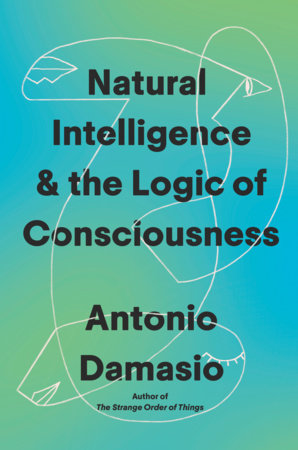
A probing synthesis of neurobiology, evolutionary science, and philosophy from one of the most notable leaders in his field, Natural Intelligence & the Logic of Consciousness offers readers a scientifically rigorous and profound re-examination of what it means to be alive and aware.
“It’s hard to fathom how much is brilliantly packed into this slim volume. It’s like sneaking into one of Damasio's legendary lectures and having the world of the mind, of the body, of consciousness, and experience explained to us in lucid, vivid, wonderfully voiced detail.”—Jorie Graham, author of To 2040
“While ‘brain’ and ‘mind’ have become legitimate topics for scientific examination, we've long looked to artists and philosophers to illuminate ‘feelings’ and ‘consciousness.’ Antonio Damasio's book presents a powerful scientific framework that persuasively encompasses these enigmatic realms.”—Howard Gardner, author of Frames of Mind: The Theory of Multiple Intelligences
"Antonio Damasio succeeds in revealing one of the great mysteries of our age: how consciousness came to be. He explores its making, from sensing to feeling, from natural intelligence to homeostatic feeling, to the precursor for everything we invent, know, experience, and theorize. Through consciousness the material and immaterial are one; through consciousness we understand ourselves. This is not only a significant book. This book is a victory for our species.” —Yo-Yo Ma
“Before presenting his current perspective on consciousness, Antonio Damasio occupied a prominent place in the history of the neurosciences. With his new work on consciousness, however, Damasio enters the history of science, tout court.” —Asier Arias Domínguez, Philosopher, Complutense University of Madrid
“Offers fascinating insights on what the evolution of human consciousness reveals about the development of fields like art, philosophy, and politics. . . . An ambitious and intriguing . . . take on what makes humans human.”—Publishers Weekly
ANTONIO DAMASIO is University Professor, David Dornsife Professor of Neuroscience, Psychology, and Philosophy, and director of the Brain and Creativity Institute at the University of Southern California, Los Angeles. Awards he has received include the Prince of Asturias Prize in Science and Technology, the Grawemeyer Award, the Honda Prize, and the Pessoa and Signoret prizes. In 2017 he received the Freud Medal from the Royal Dutch Academy of Sciences. Damasio is a member of the National Academy of Medicine and a fellow of the American Academy of Arts and Sciences and the Bavarian Academy of Sciences. He is the author of Descartes’ Error, The Feeling of What Happens, Looking for Spinoza, Self Comes to Mind, The Strange Order of Things, and Feeling & Knowing, all of which have been published in translation and are taught in universities throughout the world.
From one of the world’s foremost neuroscientists and acclaimed author of Descartes’ Error comes a bold new theory of the origins—and consequences—of human consciousness
“Damasio is the closest thing we have in the post-truth era to a great public intellectual.”—Mark Solms, Journal of the American Psychoanalytic Association
“This is not only a significant book. This book is a victory for our species.”—Yo-Yo Ma
Throughout his illustrious decades-long career, Antonio Damasio has been at the leading edge of science’s enduring quest to unravel the mysteries of the human mind. Now, drawing on a lifetime of groundbreaking research as well as the newest findings of neurobiology, Damasio seeks to move the debate about the origins of consciousness from the world of high-level cognition and abstract reasoning into the wondrous realm of interoception—the human body’s own internal monitoring system.
At the heart of his argument is the revolutionary idea that homeostatic feelings—those primal sensations intrinsically tied to our survival such as hunger, thirst, pain, and well-being—are the foundation of conscious experience, not only central to the body’s effort to maintain its physical health but carrying with them the initial glimmers of subjectivity, the very first sense of a “self.” Here Damasio redefines consciousness as a natural solution to the problem of life regulation in complex, vulnerable organisms and along the way wrestles with the notion of sentience in plants and bacteria; considers the social phenomena of politics, religion, and commerce through the perspective of homeostasis; and addresses the rise and risks of artificial intelligence and its mimicry of the conscious mind.
A probing synthesis of neurobiology, evolutionary science, and philosophy from one of the most notable leaders in his field, Natural Intelligence & the Logic of Consciousness offers readers a scientifically rigorous and profound re-examination of what it means to be alive and aware.
Praise
“It’s hard to fathom how much is brilliantly packed into this slim volume. It’s like sneaking into one of Damasio's legendary lectures and having the world of the mind, of the body, of consciousness, and experience explained to us in lucid, vivid, wonderfully voiced detail.”—Jorie Graham, author of To 2040
“While ‘brain’ and ‘mind’ have become legitimate topics for scientific examination, we've long looked to artists and philosophers to illuminate ‘feelings’ and ‘consciousness.’ Antonio Damasio's book presents a powerful scientific framework that persuasively encompasses these enigmatic realms.”—Howard Gardner, author of Frames of Mind: The Theory of Multiple Intelligences
"Antonio Damasio succeeds in revealing one of the great mysteries of our age: how consciousness came to be. He explores its making, from sensing to feeling, from natural intelligence to homeostatic feeling, to the precursor for everything we invent, know, experience, and theorize. Through consciousness the material and immaterial are one; through consciousness we understand ourselves. This is not only a significant book. This book is a victory for our species.” —Yo-Yo Ma
“Before presenting his current perspective on consciousness, Antonio Damasio occupied a prominent place in the history of the neurosciences. With his new work on consciousness, however, Damasio enters the history of science, tout court.” —Asier Arias Domínguez, Philosopher, Complutense University of Madrid
“Offers fascinating insights on what the evolution of human consciousness reveals about the development of fields like art, philosophy, and politics. . . . An ambitious and intriguing . . . take on what makes humans human.”—Publishers Weekly
ANTONIO DAMASIO is University Professor, David Dornsife Professor of Neuroscience, Psychology, and Philosophy, and director of the Brain and Creativity Institute at the University of Southern California, Los Angeles. Awards he has received include the Prince of Asturias Prize in Science and Technology, the Grawemeyer Award, the Honda Prize, and the Pessoa and Signoret prizes. In 2017 he received the Freud Medal from the Royal Dutch Academy of Sciences. Damasio is a member of the National Academy of Medicine and a fellow of the American Academy of Arts and Sciences and the Bavarian Academy of Sciences. He is the author of Descartes’ Error, The Feeling of What Happens, Looking for Spinoza, Self Comes to Mind, The Strange Order of Things, and Feeling & Knowing, all of which have been published in translation and are taught in universities throughout the world.