Close Modal

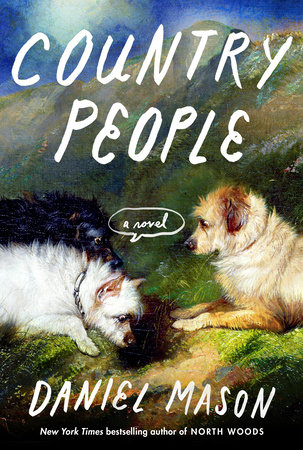
Country People: A GMA Book Club Pick

A Novel

Look inside
Hardcover
$30.00 US
6.4"W x 9.6"H x 1.1"D   | 19 oz | 12 per carton
On sale Jul 07, 2026 | 320 Pages | 9798217197453

See Additional Formats
GOOD MORNING AMERICA BOOK CLUB PICK • A year in the life of a family as they strike out into the unknown (aka Vermont)—a “witty and gorgeous” (The Guardian) novel from Pulitzer Prize finalist Daniel Mason, the bestselling author of North Woods

“Charming . . . a prescription for summer amusement that takes immediate effect . . . There’s so much fine, freewheeling observation and pillowy erudition here, it’s tempting just to sink in.”—The New York Times

Miles Krzelewski is a devoted husband, a doting father beloved for his outlandish bedtime stories, and the proud owner of a truffle-hunting dog in a land with no truffles. He is also a bit lost, twelve years late with his PhD on Russian folktales and increasingly haunted by a sense that he’s become a disappointment to his family. So when his wife, Kate, accepts a visiting professorship at a prestigious college in the faraway forests of Vermont, he decides that this will be the year to finally move forward with his life.

But Miles is a man of many enthusiasms, one who possesses, in Kate’s words, a great capacity “to fall in with anyone, anywhere.” And no sooner does he arrive than he finds himself entangled with a cast of characters as colorful as those of any of his folktales, from a ghostly tree surgeon to a scythe-mad biochemist, from a Shakespearean temptress to a photographer of snowflakes obsessed with chronicling, on thousands of index cards, the world’s delusions in an Inventory of Wrong Ideas.

The new friends, the enchanted woods, the histories: sure, no PhD, but all good fun. Until Miles stumbles upon a bizarre—perhaps ridiculous—local legend, which, he soon suspects, might not be just a legend after all.

Joyous, absurd, and life-affirming, Country People is a luminous exploration of marriage and parenthood, the nature of belief and the power of stories, and the ways in which we find connection in an increasingly fragmented world.
“Charming . . . a prescription for summer amusement that takes immediate effect. . . . lovely if occasionally confounding company, like going in and out of a thick mist. . . . the prose of Country People flows like a babbling brook . . . There’s so much fine, freewheeling observation and pillowy erudition here, it’s tempting just to sink in.”—The New York Times

“The surface structures in Country People may be sugar-spun, but the novel’s foundations are solid, and its roots—the tangled and interconnected web of stories that gave rise to its new stories—are deliciously deep. The esoteric is counterbalanced by the mundane; family life is judged as worthy of investigation as underground caverns; and the whole thing is delivered in prose so witty and gorgeous that it calls to mind Nabokov’s comic masterpiece Pnin, surely another of the book’s literary antecedents. This is, put simply, a joyful book—and the deeper you dig, the more joyful it becomes.”The Guardian

“Satirical but big-hearted and empathetic. . . . Mason is a lively, fluid writer; here he glides smoothly between present and past, myth and everyday detail, skepticism and credulity. He has fun with his characters without making fun of them. . . . It is simply put, very funny. . . . Reading Country People in public I kept having to muffle my LOLs. That’s never a bad sign. The affection that Mason clearly feels for Miles and his brood is infectious.”—The Boston Globe

“Delightful . . . joy-making . . . one of our country’s most gifted novelists, Mason has spun a yarn about parenthood and marriage, storytelling and imagination.”Bookpage, starred review

“My favorite of the year: Country People. . . . has the bright ease of visiting a good old friend. . . . one of those books where nothing happens, and yet everything does.”Chicago Tribune

“The humor—dry, humane, occasionally absurd—is ever-present . . . a cast of small-town figures whose quirks are rendered with generosity rather than satire.”Booklist, starred review

“Mason has fun exploring marriage, friendship, parenthood and the beguiling allure of storytelling and fantasy in this upbeat romp.”—NPR

“A lively cast of local characters.”Harper’s Bazaar

“Wonderful—full of joy—and exactly the kind of reading experience we could all do with right now . . . the book of the summer.”—Mick Herron, bestselling author of Slow Horses

© Sara Houghteling
Daniel Mason was born and raised in Northern California. He studied biology at Harvard, and medicine at the University of California, San Francisco. His first novel, The Piano Tuner, published in 2002, was a national bestseller and has since been published in 27 countries. His other works include A Far Country, The Winter Soldier, and A Registry of My Passage Upon Earth, and his writing has appeared in Harper's Magazine and Lapham's Quarterly. He lives in the San Francisco Bay Area. View titles by Daniel Mason
One

The wife had been offered a one-­year visiting professorship at a college in Vermont, and the husband was married to the wife.

They had two children, a son and a daughter. The plan was for the husband to finish the first draft of his dissertation, which he had been working on for fourteen years, twelve years longer than intended. But a week before they departed, they read an article describing the “child-­care deserts” of rural America, so he knew deep down in his heart that he would be watching their kids.

The truth was that he already knew this, because this is what had happened at their home in the city, which was not a child-­care desert. But the college was prestigious, an exciting opportunity for the family, an adventure.

And he loved deserts! As a boy, he had been to the Grand Canyon, and kept a “Creatures of the Southwest” poster on his wall.

They had driven there from California, because of the dog, whom they couldn’t bear to put in cargo.

In the beginning, the dog sat in the back, between the two children. They had cleared a spot. By Sacramento, the spot was needed for a box of Goldfish crackers the size of the daughter, and the dog had hopped over the divide and settled in the husband’s lap, where it remained. It was assertive and warm, with warm, cadaveric breath, and each time the husband tried to move it, it adopted a posture of such defiant deadweight that he felt as if he were lifting a dog-shaped bag of water. At night, in the motel showers, he could still see the imprint of its talons on his legs.

The wife reminded him that the correct word was “paw,” not a difficult word to remember.

The dog was a breed called a Lagotto Romagnolo, from Italy, which the husband was always embarrassed to share, because it sounded like a luxury sports car, while the truth was the dog had cost the same as every other dog during the pandemic, but it was the first hypoallergenic dog to come off waiting lists in California, Oregon, Arizona, Nevada, and Idaho. Every other dog was taken.

The family had written pleading letters, sat for interviews, submitted videos of their home, videos of their children, and each time they had been rejected by the cabal of profiteering breeders who saw that time of suffering as a moment to assert their superiority over desperate, allergic professionals homebound with their kids.

They had named the dog Giuseppe, after Arcimboldo, after Garibaldi, after Verdi, to honor his Italian roots.

Their son had discovered the breed on the Internet during Zoom school. In addition to not shedding, it had the virtue of being bred for truffle hunting, which meant that at least one member of the family would have a useful skill when society broke down. In online forums, the dog was praised for its gentleness and soft fur and interesting coloration, which changed as it got older, though some people cautioned that unless you ­ really intended it to hunt truffles, what you were buying was an animal genetically selected to go crazy over secret, pungent morsels of which humans were blissfully unaware.


When the wife had received the offer to teach, she was also offered housing in the Visiting Faculty Residence, which on the website of the college appeared to be a light-­filled modern structure, with basketball and tennis courts, and a playground, just on the edge of campus. It seemed, in fact, almost identical to their California faculty apartment, though when the husband studied the photo on the webpage more closely, he noticed that all the cars were twenty years old. This was the first warning sign. The second warning sign was an actual warning, from the grad-­school friend who had helped arrange the invitation: under no terms should they ever stay in the Visiting Faculty Residence, which had been built by an avant-­garde Colombian architect, very famous, revolutionary. As in the tropical country Colombia, she added. As in the one without a winter. The year before, a Finnish scholar had suffered frostbite in her bedroom. As in the Arctic country Finland, she said.

This struck the wife and husband as hyperbolic. Every university had its history of architectural tragedy. How bad could it ­ really get? And the wife, whose California office had beautiful floor- to-­ceiling windows that had been blocked, in the seventies, by a four-­ foot-high “brise-­soleil” of concrete, thought for a bit, as did the husband, who had to ascend three floors from his basement office to reach a bathroom with urinals arranged in a rosette to foster creativity and communication. But what were they to do?

Their friend set out to find who might be on sabbatical, and after some inquiries, they received an email from a professor of economics. What fortune! He was looking for a house sitter. And he wouldn’t charge them anything; he needed someone to look after the place, to watch for leaks, to keep the animals away.

Such generosity, not to mention the casual animal reference, should have been a warning, but for simple city people, it was not.


And so they set out. The wife drove, and the husband, who already had a few moving violations, sat under the dog. In the back were the boy, the girl, the Goldfish crackers, and a pair of potholder looms, gifts from the wife’s mother.

For the husband, the appeal of a potholder loom had remained one of the durable mysteries of parenthood; part of him was proud that, in an age of all-­consuming electronic media and dwindling attention spans, his very bright nine-­ year-­ old child could be occupied for hours making potholders, though he was less certain about his twelve-­year-old. But the loom kept the children occupied until Nebraska, when the seven bags of vibrant multicolored loops ran out.

“Look at the view,” said the wife, when the kids began to complain, though there was no view—it wasn’t that it was monotonous or featureless, or whatever the unimaginative coastal elite might say about the landscape of the extraordinary American heartland, just that the highway had been embedded in said heartland in such a way that they could see nothing but ten feet of grassy verge, for hundreds of miles. They could not agree on a podcast, the books were in the trunk, and although the husband could have climbed back over the seats under normal circumstances, now there was the dog. So the husband told them a story.


The story was one of many stories the husband had encountered in graduate school, where over the past fourteen years his dissertation topic had drifted—­geographically, chronologically, thematically. He’d begun with an obscure troubadour, taken three years to learn that he was obscure for a reason, switched to Rabelais without telling his adviser, then the body in Rabelais, then monsters in Rabelais, then monsters in French folktales, each great fun, but none of
which led anywhere concrete. It might have been pathetic had he not loved the books, the stories, the paths they took him down, the laughter, outsized and impossible. But time was ticking. By then his first adviser had died; his second seemed to have forgotten he existed. Well, perhaps Western Europe was the problem! And, following a year brushing up on college Russian, and another spent falling in love with Chekhov’s early humor, he was ready to begin again, when his son, age three, discovered Thomas the Tank Engine.

All of a sudden, trains were everywhere. How had he never noticed? Could trains in Chekhov be his topic? It was a rich one, and it would give him and the boy a new shared interest. But Tolstoys use of trains was even richer—­lethally so—­and trains led to train stations, and train stations led to rural train stations, led to rural life, and nothing was as magnificent as Tolstoy’s depictions of haying, mushrooming, and beekeeping, and by then his son was on to Legos.

But bees! And hay! Reading Tolstoy, he could almost smell it. So, again, he changed his dissertation, to the world of Tolstoy’s peasants, where he had remained for a full two years, reading Russian folktales as background, before deciding that Russian folktale peasants might be an easier topic, compared with such a famous author who had written such long books.

That was how he got to where he was. Once upon a time. Or, as they said in Russian folktales: In a certain kingdom, in a certain land.

About

GOOD MORNING AMERICA BOOK CLUB PICK • A year in the life of a family as they strike out into the unknown (aka Vermont)—a “witty and gorgeous” (The Guardian) novel from Pulitzer Prize finalist Daniel Mason, the bestselling author of North Woods

“Charming . . . a prescription for summer amusement that takes immediate effect . . . There’s so much fine, freewheeling observation and pillowy erudition here, it’s tempting just to sink in.”—The New York Times

Miles Krzelewski is a devoted husband, a doting father beloved for his outlandish bedtime stories, and the proud owner of a truffle-hunting dog in a land with no truffles. He is also a bit lost, twelve years late with his PhD on Russian folktales and increasingly haunted by a sense that he’s become a disappointment to his family. So when his wife, Kate, accepts a visiting professorship at a prestigious college in the faraway forests of Vermont, he decides that this will be the year to finally move forward with his life.

But Miles is a man of many enthusiasms, one who possesses, in Kate’s words, a great capacity “to fall in with anyone, anywhere.” And no sooner does he arrive than he finds himself entangled with a cast of characters as colorful as those of any of his folktales, from a ghostly tree surgeon to a scythe-mad biochemist, from a Shakespearean temptress to a photographer of snowflakes obsessed with chronicling, on thousands of index cards, the world’s delusions in an Inventory of Wrong Ideas.

The new friends, the enchanted woods, the histories: sure, no PhD, but all good fun. Until Miles stumbles upon a bizarre—perhaps ridiculous—local legend, which, he soon suspects, might not be just a legend after all.

Joyous, absurd, and life-affirming, Country People is a luminous exploration of marriage and parenthood, the nature of belief and the power of stories, and the ways in which we find connection in an increasingly fragmented world.

Praise

“Charming . . . a prescription for summer amusement that takes immediate effect. . . . lovely if occasionally confounding company, like going in and out of a thick mist. . . . the prose of Country People flows like a babbling brook . . . There’s so much fine, freewheeling observation and pillowy erudition here, it’s tempting just to sink in.”—The New York Times

“The surface structures in Country People may be sugar-spun, but the novel’s foundations are solid, and its roots—the tangled and interconnected web of stories that gave rise to its new stories—are deliciously deep. The esoteric is counterbalanced by the mundane; family life is judged as worthy of investigation as underground caverns; and the whole thing is delivered in prose so witty and gorgeous that it calls to mind Nabokov’s comic masterpiece Pnin, surely another of the book’s literary antecedents. This is, put simply, a joyful book—and the deeper you dig, the more joyful it becomes.”The Guardian

“Satirical but big-hearted and empathetic. . . . Mason is a lively, fluid writer; here he glides smoothly between present and past, myth and everyday detail, skepticism and credulity. He has fun with his characters without making fun of them. . . . It is simply put, very funny. . . . Reading Country People in public I kept having to muffle my LOLs. That’s never a bad sign. The affection that Mason clearly feels for Miles and his brood is infectious.”—The Boston Globe

“Delightful . . . joy-making . . . one of our country’s most gifted novelists, Mason has spun a yarn about parenthood and marriage, storytelling and imagination.”Bookpage, starred review

“My favorite of the year: Country People. . . . has the bright ease of visiting a good old friend. . . . one of those books where nothing happens, and yet everything does.”Chicago Tribune

“The humor—dry, humane, occasionally absurd—is ever-present . . . a cast of small-town figures whose quirks are rendered with generosity rather than satire.”Booklist, starred review

“Mason has fun exploring marriage, friendship, parenthood and the beguiling allure of storytelling and fantasy in this upbeat romp.”—NPR

“A lively cast of local characters.”Harper’s Bazaar

“Wonderful—full of joy—and exactly the kind of reading experience we could all do with right now . . . the book of the summer.”—Mick Herron, bestselling author of Slow Horses

Author

© Sara Houghteling
Daniel Mason was born and raised in Northern California. He studied biology at Harvard, and medicine at the University of California, San Francisco. His first novel, The Piano Tuner, published in 2002, was a national bestseller and has since been published in 27 countries. His other works include A Far Country, The Winter Soldier, and A Registry of My Passage Upon Earth, and his writing has appeared in Harper's Magazine and Lapham's Quarterly. He lives in the San Francisco Bay Area. View titles by Daniel Mason

Excerpt

One

The wife had been offered a one-­year visiting professorship at a college in Vermont, and the husband was married to the wife.

They had two children, a son and a daughter. The plan was for the husband to finish the first draft of his dissertation, which he had been working on for fourteen years, twelve years longer than intended. But a week before they departed, they read an article describing the “child-­care deserts” of rural America, so he knew deep down in his heart that he would be watching their kids.

The truth was that he already knew this, because this is what had happened at their home in the city, which was not a child-­care desert. But the college was prestigious, an exciting opportunity for the family, an adventure.

And he loved deserts! As a boy, he had been to the Grand Canyon, and kept a “Creatures of the Southwest” poster on his wall.

They had driven there from California, because of the dog, whom they couldn’t bear to put in cargo.

In the beginning, the dog sat in the back, between the two children. They had cleared a spot. By Sacramento, the spot was needed for a box of Goldfish crackers the size of the daughter, and the dog had hopped over the divide and settled in the husband’s lap, where it remained. It was assertive and warm, with warm, cadaveric breath, and each time the husband tried to move it, it adopted a posture of such defiant deadweight that he felt as if he were lifting a dog-shaped bag of water. At night, in the motel showers, he could still see the imprint of its talons on his legs.

The wife reminded him that the correct word was “paw,” not a difficult word to remember.

The dog was a breed called a Lagotto Romagnolo, from Italy, which the husband was always embarrassed to share, because it sounded like a luxury sports car, while the truth was the dog had cost the same as every other dog during the pandemic, but it was the first hypoallergenic dog to come off waiting lists in California, Oregon, Arizona, Nevada, and Idaho. Every other dog was taken.

The family had written pleading letters, sat for interviews, submitted videos of their home, videos of their children, and each time they had been rejected by the cabal of profiteering breeders who saw that time of suffering as a moment to assert their superiority over desperate, allergic professionals homebound with their kids.

They had named the dog Giuseppe, after Arcimboldo, after Garibaldi, after Verdi, to honor his Italian roots.

Their son had discovered the breed on the Internet during Zoom school. In addition to not shedding, it had the virtue of being bred for truffle hunting, which meant that at least one member of the family would have a useful skill when society broke down. In online forums, the dog was praised for its gentleness and soft fur and interesting coloration, which changed as it got older, though some people cautioned that unless you ­ really intended it to hunt truffles, what you were buying was an animal genetically selected to go crazy over secret, pungent morsels of which humans were blissfully unaware.


When the wife had received the offer to teach, she was also offered housing in the Visiting Faculty Residence, which on the website of the college appeared to be a light-­filled modern structure, with basketball and tennis courts, and a playground, just on the edge of campus. It seemed, in fact, almost identical to their California faculty apartment, though when the husband studied the photo on the webpage more closely, he noticed that all the cars were twenty years old. This was the first warning sign. The second warning sign was an actual warning, from the grad-­school friend who had helped arrange the invitation: under no terms should they ever stay in the Visiting Faculty Residence, which had been built by an avant-­garde Colombian architect, very famous, revolutionary. As in the tropical country Colombia, she added. As in the one without a winter. The year before, a Finnish scholar had suffered frostbite in her bedroom. As in the Arctic country Finland, she said.

This struck the wife and husband as hyperbolic. Every university had its history of architectural tragedy. How bad could it ­ really get? And the wife, whose California office had beautiful floor- to-­ceiling windows that had been blocked, in the seventies, by a four-­ foot-high “brise-­soleil” of concrete, thought for a bit, as did the husband, who had to ascend three floors from his basement office to reach a bathroom with urinals arranged in a rosette to foster creativity and communication. But what were they to do?

Their friend set out to find who might be on sabbatical, and after some inquiries, they received an email from a professor of economics. What fortune! He was looking for a house sitter. And he wouldn’t charge them anything; he needed someone to look after the place, to watch for leaks, to keep the animals away.

Such generosity, not to mention the casual animal reference, should have been a warning, but for simple city people, it was not.


And so they set out. The wife drove, and the husband, who already had a few moving violations, sat under the dog. In the back were the boy, the girl, the Goldfish crackers, and a pair of potholder looms, gifts from the wife’s mother.

For the husband, the appeal of a potholder loom had remained one of the durable mysteries of parenthood; part of him was proud that, in an age of all-­consuming electronic media and dwindling attention spans, his very bright nine-­ year-­ old child could be occupied for hours making potholders, though he was less certain about his twelve-­year-old. But the loom kept the children occupied until Nebraska, when the seven bags of vibrant multicolored loops ran out.

“Look at the view,” said the wife, when the kids began to complain, though there was no view—it wasn’t that it was monotonous or featureless, or whatever the unimaginative coastal elite might say about the landscape of the extraordinary American heartland, just that the highway had been embedded in said heartland in such a way that they could see nothing but ten feet of grassy verge, for hundreds of miles. They could not agree on a podcast, the books were in the trunk, and although the husband could have climbed back over the seats under normal circumstances, now there was the dog. So the husband told them a story.


The story was one of many stories the husband had encountered in graduate school, where over the past fourteen years his dissertation topic had drifted—­geographically, chronologically, thematically. He’d begun with an obscure troubadour, taken three years to learn that he was obscure for a reason, switched to Rabelais without telling his adviser, then the body in Rabelais, then monsters in Rabelais, then monsters in French folktales, each great fun, but none of
which led anywhere concrete. It might have been pathetic had he not loved the books, the stories, the paths they took him down, the laughter, outsized and impossible. But time was ticking. By then his first adviser had died; his second seemed to have forgotten he existed. Well, perhaps Western Europe was the problem! And, following a year brushing up on college Russian, and another spent falling in love with Chekhov’s early humor, he was ready to begin again, when his son, age three, discovered Thomas the Tank Engine.

All of a sudden, trains were everywhere. How had he never noticed? Could trains in Chekhov be his topic? It was a rich one, and it would give him and the boy a new shared interest. But Tolstoys use of trains was even richer—­lethally so—­and trains led to train stations, and train stations led to rural train stations, led to rural life, and nothing was as magnificent as Tolstoy’s depictions of haying, mushrooming, and beekeeping, and by then his son was on to Legos.

But bees! And hay! Reading Tolstoy, he could almost smell it. So, again, he changed his dissertation, to the world of Tolstoy’s peasants, where he had remained for a full two years, reading Russian folktales as background, before deciding that Russian folktale peasants might be an easier topic, compared with such a famous author who had written such long books.

That was how he got to where he was. Once upon a time. Or, as they said in Russian folktales: In a certain kingdom, in a certain land.