Close Modal

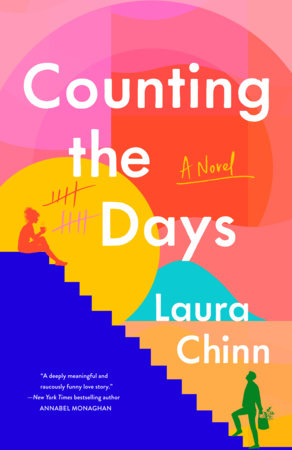
Counting the Days

A Novel

Look inside
Paperback
$20.00 US
5.15"W x 7.97"H x 0.68"D   | 8 oz | 24 per carton
On sale Aug 11, 2026 | 320 Pages | 9798217095568

What begins as a near-midlife crisis transforms into a journey of love and self-acceptance in this sharp, beautifully layered, and funny debut romance from screenwriter and director Laura Chinn.

At thirty-eight years old, Rhea Darby has never been more single in her life. With her best friends all married and having kids, her social calendar is filled with baby showers and birthday parties, petting zoos and bouncy castles. However, she’d much rather be having hot sex with “the one” and getting closer to the perfect life she always envisioned. After being told that her fertility might plummet when she turns thirty-nine, and always having wanted kids of her own, Rhea decides that drastic times call for drastic measures. She has less than a year to find the right guy, or she’ll have to rethink her meticulously crafted vision board of the future.

Apparently, manifestation really works, because she soon meets Danny, a gorgeous gardener who is perfect for her—until Danny reveals he is absolutely morally opposed to having kids. Still, the connection between them is too strong to resist, even as their differences threaten to tear them apart. Rhea realizes she can’t let go of Danny, but is she willing to sacrifice her dreams to keep him?

Counting the Days is an insightful and sexy novel in which the complexities of love and modern womanhood are met with relatable humor and self-acceptance.
“A truly beautiful novel about all the ways the heart yearns for connection, Counting the Days is a deeply meaningful and raucously funny love story.”New York Times bestselling author Annabel Monaghan

“A sweet, thoughtful debut.”—Elissa Sussman, bestselling author of Totally and Completely Fine
© Brooke Nevin
Laura Chinn is the author of Counting the Days and Acne. She also wrote and directed the Searchlight feature film Suncoast, which premiered at the Sundance Film Festival and received a jury prize for Breakthrough Performance. She created and starred in the half-hour comedy series Florida Girls and was a producer and writer on the Fox series The Mick as well as the ABC series High Potential. View titles by Laura Chinn
337 Days

Rhea Darby’s life was perfect in every way.

Inside her five-bedroom Craftsman lived her dashing, emotionally available husband and their three extraordinarily bright children, each one in possession of their father’s thick head of hair and their mother’s delicate features.

Rhea herself boasted quite a few enviable achievements, being the founder of a chain of fashion boutiques and a board member of several local charities. Rhea’s husband was equally admirable: highly successful at his impressive job and incredibly philanthropic.

Their house was the jewel of the neighborhood. The twostory abode loomed over a long walkway dotted with freshly planted annual flowers. The interior: simultaneously warm and intimidating, with wood beams on the ceiling, lush oak floors, and a chef ’s kitchen. Their multiple acres allowed for an expansive, drought-tolerant backyard; a ring of olive trees surrounded a fire pit and a barrel sauna—

Wait, on second thought, there was not a barrel sauna in the backyard . . . or maybe there was. . . .

Am I actually gonna use a barrel sauna? Rhea pondered as her hand hovered over her vision board, holding a magazine cutout of a barrel sauna. She held a glue stick in her other hand like a magic wand, ready to conjure her idealistic future, but she could not decide whether or not to officially include a barrel sauna in her life plan.

As she considered the possibility, she took in her entire vision board approvingly. Her future really was blindingly bright. The many husbands on her board were all various races—skin color did not matter to her, nor did she care about specific facial features—but every one of them had exquisite teeth and a lustrous head of hair. They were active in each photo to symbolize the abundance of energy and lust for life her eventual husband would undoubtedly have.

The children on her board also had various skin colors, since she did not yet know who their father would be. However, they were cut out in groups of three, as she did not have siblings and had always idealized large families. And although she would settle for a house that was not Craftsman style, she knew it had to contain five bedrooms and a chef ’s kitchen, especially since she was going to have three kids. But a barrel sauna? Did she need a barrel sauna?

Her eyes wandered around her six-hundred-square-foot cottage, the low popcorn ceiling, the yellowing walls, the uneven floor; she decided, Screw it, I deserve a barrel sauna, and glued it to the poster board with gumption. The kind of gumption she hoped might fling the sauna off her vision board and into her reality.

Rhea cut an image out of National Geographic: a man sleeping on the street, covered in dirt, with exposed feet. The man signified Rhea’s future desire to assist the less fortunate. She glued him next to an image of a garbage-covered seashore, which signified her future passion for cleaning up the beach.

She felt slightly ashamed about the ratios on her vision board; husbands and children far outnumbered charitable efforts. She had developed an addiction to the small sense of control she felt each time she glued an ideal man or child model to her board, and in her current predicament, she craved a sense of control, no matter how small it was.

According to her doctor, she had about a 30 percent chance of getting pregnant, but he warned, “When you turn thirty-nine, your chances fall off a cliff.

If she met the right man immediately, dated him for a normal amount of time, and eventually got married, her fertility would have already committed suicide, hurtling itself off that cliff to decay on the rocks below. But instead of giving up, she took it as a challenge, because everyone knows that woman whose fertility was given only a few months to live. Yet, she managed to fall in love and procreate with her soulmate within the necessary time frame, and why shouldn’t Rhea Darby get to be that woman?

If her life were a TV show, a countdown would tick away in the lower right-hand corner of the screen, ratcheting up the tension as the days slipped by.

Three hundred and thirty-seven days until she turned thirty-nine.

The audience would tensely watch her biological clock like a timer on a doomsday device. She hated the phrase “biological clock” almost as much as she hated the phrase “geriatric pregnancy,” which had recently been updated to “advanced maternal age,” and she hated the new phrase even more, knowing the medical community had only updated it to protect the fragile feelings of Rhea and all the other dried-up crones.

When she lay awake at night, her mind annihilated by insomnia, she could hear her clock ticking away.

Tick.

Tick.

Tick.

The soundtrack to all the invasive images of her husbandless, childless future flooding her mind: She would have to move to a retirement home earlier than most just so someone would be around to Heimlich her when she inevitably choked on a chocolate-covered almond. Her sad studio unit would contain a sliver of a bed, since she had no one to share it with, and a minifridge, which would remain empty save for one tapioca pudding cup left behind from the previous captive.

While all her friends were spending their summers with their children and grandchildren, Rhea would spend her summers getting into petty fights with her fellow inmates about who rigged the raffle. It was Carol, it was always Carol. Rhea had yet to meet Carol, but she already hated her. Rhea would forcibly push these images out of her mind, but the dull ticking would remain. She knew she was running out of time, but what were her options?

“You should go to a sperm bank!” her dental hygienist suggested.

Rhea’s mouth was full of this woman’s fingers, so she could not say, “I’d rather die.”

If Rhea’s single mother taught her anything, it was don’t be a single mother. When Rhea was in the throes of her lonely childhood, she watched her friends sit down for nightly dinners and go on family vacations, while Rhea’s exhausted mother barely managed to afford rent and fast food. Rhea vowed never to put herself in that position.

However, just in case her dental hygienist was a single mother, and enjoying it more than Rhea’s mother had, Rhea did not want to offend her, so she made a loud, gargling noise that was intended to be, “Great idea!”

“You gotta freeze your eggs, it’ll take the pressure off,” Rhea’s hairstylist suggested.

To which Rhea wanted to reply, “Sure, can I borrow twenty thousand dollars?”

But to not add lack of a savings account to the list of things her hairstylist might pity her for, instead, Rhea said, “Eh, I don’t wanna deal with the bloating and mood swings from all the hormones.”

Rhea had heard about the procedure in gory detail from friends, and she could not believe everyone casually suggested it to all women over thirty as if it were an eye exam. She would have to give herself a shot of synthetic hormones, with what was described as “a very large needle,” every night for weeks. Only to be eventually put under anesthesia so a doctor could stick another needle through her abdomen, into her ovaries, to extract an eerily high number of eggs. All the while putting herself at risk of twisting her ovaries and strangling all her unborn babies. She was not eager to be artificially milked for spawn in a procedure which one friend described as “more uncomfortable than pregnancy and labor.”

However, it was not just the cost or the pain that prevented her from forcing her ovaries to spit out a carton of eggs; the other reason, which Rhea kept even from herself, was that she did not want to take the pressure off.

About

What begins as a near-midlife crisis transforms into a journey of love and self-acceptance in this sharp, beautifully layered, and funny debut romance from screenwriter and director Laura Chinn.

At thirty-eight years old, Rhea Darby has never been more single in her life. With her best friends all married and having kids, her social calendar is filled with baby showers and birthday parties, petting zoos and bouncy castles. However, she’d much rather be having hot sex with “the one” and getting closer to the perfect life she always envisioned. After being told that her fertility might plummet when she turns thirty-nine, and always having wanted kids of her own, Rhea decides that drastic times call for drastic measures. She has less than a year to find the right guy, or she’ll have to rethink her meticulously crafted vision board of the future.

Apparently, manifestation really works, because she soon meets Danny, a gorgeous gardener who is perfect for her—until Danny reveals he is absolutely morally opposed to having kids. Still, the connection between them is too strong to resist, even as their differences threaten to tear them apart. Rhea realizes she can’t let go of Danny, but is she willing to sacrifice her dreams to keep him?

Counting the Days is an insightful and sexy novel in which the complexities of love and modern womanhood are met with relatable humor and self-acceptance.

Praise

“A truly beautiful novel about all the ways the heart yearns for connection, Counting the Days is a deeply meaningful and raucously funny love story.”New York Times bestselling author Annabel Monaghan

“A sweet, thoughtful debut.”—Elissa Sussman, bestselling author of Totally and Completely Fine

Author

© Brooke Nevin
Laura Chinn is the author of Counting the Days and Acne. She also wrote and directed the Searchlight feature film Suncoast, which premiered at the Sundance Film Festival and received a jury prize for Breakthrough Performance. She created and starred in the half-hour comedy series Florida Girls and was a producer and writer on the Fox series The Mick as well as the ABC series High Potential. View titles by Laura Chinn

Excerpt

337 Days

Rhea Darby’s life was perfect in every way.

Inside her five-bedroom Craftsman lived her dashing, emotionally available husband and their three extraordinarily bright children, each one in possession of their father’s thick head of hair and their mother’s delicate features.

Rhea herself boasted quite a few enviable achievements, being the founder of a chain of fashion boutiques and a board member of several local charities. Rhea’s husband was equally admirable: highly successful at his impressive job and incredibly philanthropic.

Their house was the jewel of the neighborhood. The twostory abode loomed over a long walkway dotted with freshly planted annual flowers. The interior: simultaneously warm and intimidating, with wood beams on the ceiling, lush oak floors, and a chef ’s kitchen. Their multiple acres allowed for an expansive, drought-tolerant backyard; a ring of olive trees surrounded a fire pit and a barrel sauna—

Wait, on second thought, there was not a barrel sauna in the backyard . . . or maybe there was. . . .

Am I actually gonna use a barrel sauna? Rhea pondered as her hand hovered over her vision board, holding a magazine cutout of a barrel sauna. She held a glue stick in her other hand like a magic wand, ready to conjure her idealistic future, but she could not decide whether or not to officially include a barrel sauna in her life plan.

As she considered the possibility, she took in her entire vision board approvingly. Her future really was blindingly bright. The many husbands on her board were all various races—skin color did not matter to her, nor did she care about specific facial features—but every one of them had exquisite teeth and a lustrous head of hair. They were active in each photo to symbolize the abundance of energy and lust for life her eventual husband would undoubtedly have.

The children on her board also had various skin colors, since she did not yet know who their father would be. However, they were cut out in groups of three, as she did not have siblings and had always idealized large families. And although she would settle for a house that was not Craftsman style, she knew it had to contain five bedrooms and a chef ’s kitchen, especially since she was going to have three kids. But a barrel sauna? Did she need a barrel sauna?

Her eyes wandered around her six-hundred-square-foot cottage, the low popcorn ceiling, the yellowing walls, the uneven floor; she decided, Screw it, I deserve a barrel sauna, and glued it to the poster board with gumption. The kind of gumption she hoped might fling the sauna off her vision board and into her reality.

Rhea cut an image out of National Geographic: a man sleeping on the street, covered in dirt, with exposed feet. The man signified Rhea’s future desire to assist the less fortunate. She glued him next to an image of a garbage-covered seashore, which signified her future passion for cleaning up the beach.

She felt slightly ashamed about the ratios on her vision board; husbands and children far outnumbered charitable efforts. She had developed an addiction to the small sense of control she felt each time she glued an ideal man or child model to her board, and in her current predicament, she craved a sense of control, no matter how small it was.

According to her doctor, she had about a 30 percent chance of getting pregnant, but he warned, “When you turn thirty-nine, your chances fall off a cliff.

If she met the right man immediately, dated him for a normal amount of time, and eventually got married, her fertility would have already committed suicide, hurtling itself off that cliff to decay on the rocks below. But instead of giving up, she took it as a challenge, because everyone knows that woman whose fertility was given only a few months to live. Yet, she managed to fall in love and procreate with her soulmate within the necessary time frame, and why shouldn’t Rhea Darby get to be that woman?

If her life were a TV show, a countdown would tick away in the lower right-hand corner of the screen, ratcheting up the tension as the days slipped by.

Three hundred and thirty-seven days until she turned thirty-nine.

The audience would tensely watch her biological clock like a timer on a doomsday device. She hated the phrase “biological clock” almost as much as she hated the phrase “geriatric pregnancy,” which had recently been updated to “advanced maternal age,” and she hated the new phrase even more, knowing the medical community had only updated it to protect the fragile feelings of Rhea and all the other dried-up crones.

When she lay awake at night, her mind annihilated by insomnia, she could hear her clock ticking away.

Tick.

Tick.

Tick.

The soundtrack to all the invasive images of her husbandless, childless future flooding her mind: She would have to move to a retirement home earlier than most just so someone would be around to Heimlich her when she inevitably choked on a chocolate-covered almond. Her sad studio unit would contain a sliver of a bed, since she had no one to share it with, and a minifridge, which would remain empty save for one tapioca pudding cup left behind from the previous captive.

While all her friends were spending their summers with their children and grandchildren, Rhea would spend her summers getting into petty fights with her fellow inmates about who rigged the raffle. It was Carol, it was always Carol. Rhea had yet to meet Carol, but she already hated her. Rhea would forcibly push these images out of her mind, but the dull ticking would remain. She knew she was running out of time, but what were her options?

“You should go to a sperm bank!” her dental hygienist suggested.

Rhea’s mouth was full of this woman’s fingers, so she could not say, “I’d rather die.”

If Rhea’s single mother taught her anything, it was don’t be a single mother. When Rhea was in the throes of her lonely childhood, she watched her friends sit down for nightly dinners and go on family vacations, while Rhea’s exhausted mother barely managed to afford rent and fast food. Rhea vowed never to put herself in that position.

However, just in case her dental hygienist was a single mother, and enjoying it more than Rhea’s mother had, Rhea did not want to offend her, so she made a loud, gargling noise that was intended to be, “Great idea!”

“You gotta freeze your eggs, it’ll take the pressure off,” Rhea’s hairstylist suggested.

To which Rhea wanted to reply, “Sure, can I borrow twenty thousand dollars?”

But to not add lack of a savings account to the list of things her hairstylist might pity her for, instead, Rhea said, “Eh, I don’t wanna deal with the bloating and mood swings from all the hormones.”

Rhea had heard about the procedure in gory detail from friends, and she could not believe everyone casually suggested it to all women over thirty as if it were an eye exam. She would have to give herself a shot of synthetic hormones, with what was described as “a very large needle,” every night for weeks. Only to be eventually put under anesthesia so a doctor could stick another needle through her abdomen, into her ovaries, to extract an eerily high number of eggs. All the while putting herself at risk of twisting her ovaries and strangling all her unborn babies. She was not eager to be artificially milked for spawn in a procedure which one friend described as “more uncomfortable than pregnancy and labor.”

However, it was not just the cost or the pain that prevented her from forcing her ovaries to spit out a carton of eggs; the other reason, which Rhea kept even from herself, was that she did not want to take the pressure off.