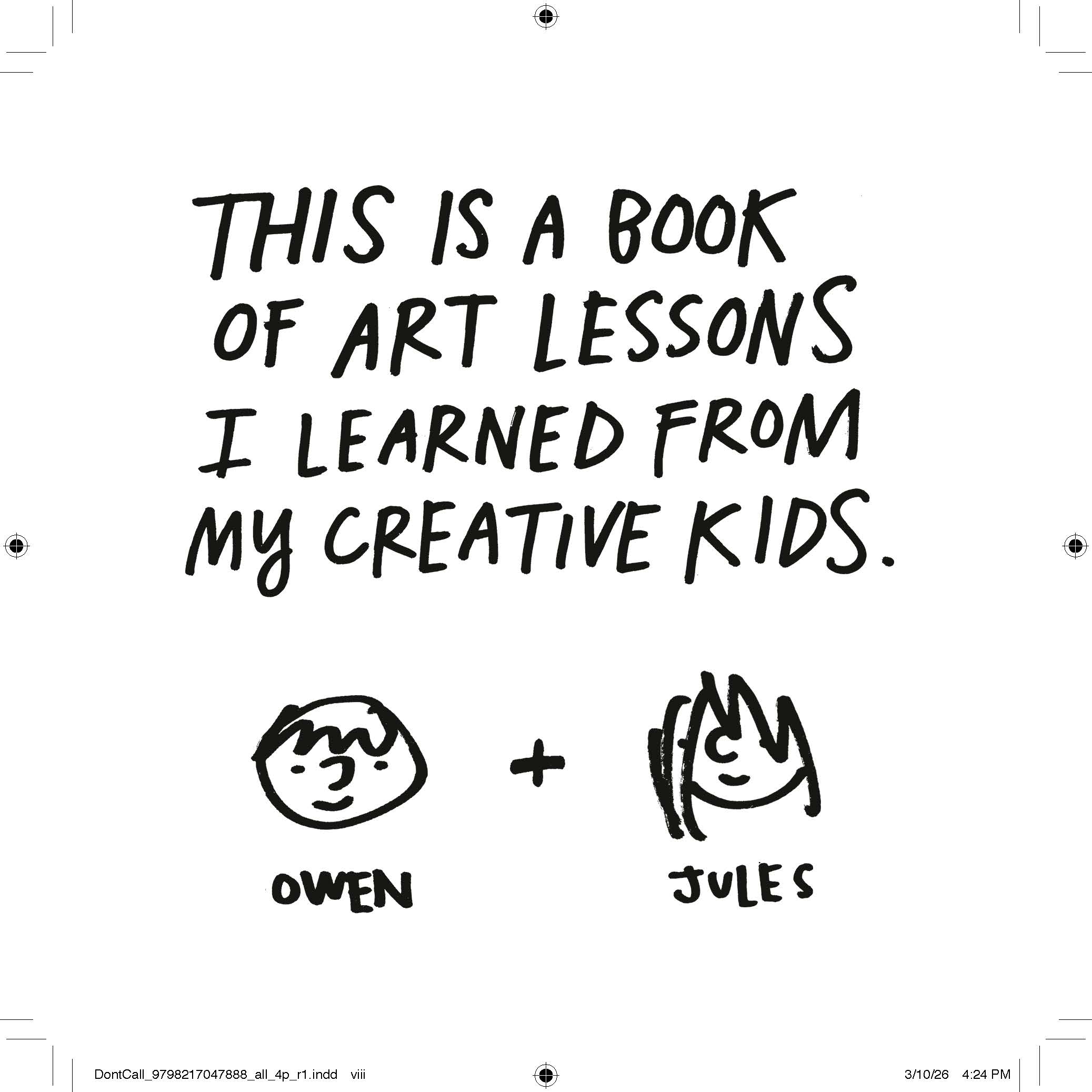
I never went to art school, but being around my kids was more inspiring than any art school I can imagine. By the time my boys were toddlers, they drew like two pint-sized Picassos. They worked the way I dreamed of working: without fear or hesitation, just wild energy, raw passion, and a lightness of touch.
They schooled me, all right--you could even say they unschooled me. I had assumed, as their dad and the author of
Steal Like an Artist and other books about creativity that have sold millions of copies around the world, that I would be their teacher and they would be my students. It soon became clear that the opposite was true: I had way more to learn from them than they had to learn from me.
So, I apprenticed myself to beginners. I was the studio assistant now, and things went smoothly as long as I knew my place. My job was to fetch art supplies, fix snacks, and soothe tantrums. Anytime I tried to give them pointers or tell them what to do, it backfired on me. I learned to keep my mouth shut and my eyes open. Occasionally, they let me join the fun, but they certainly didn't need anybody to teach them how to be creative. What they needed was for me to be there when called upon but otherwise stay out of their way.
Whenever I shared the stuff they made online, readers kept asking me when I was going to write a book about creativity for kids.
"Kids don't need a book!" I'd protest. "We need a book so we can be more like them!"
This is that book.
As I was learning to love and care for these little artists in my life, I started wondering why I didn't show myself the same love and care. It was the thought I had when I read parenting books: Why are we doing all this stuff for our kids but not ourselves? Why aren't we all taking time to play? Why aren't we all letting ourselves get bored? Why aren't we all limiting our screen time and going outside?
One day I was listening to an interview with the musician Fiona Apple, and she admitted that she reads a lot of parenting books, not because she plans on having kids but because she wants to learn how to parent herself. "So, you're the parent and the child?" the interviewer asked.
"Well, I mean, you always have to be," Apple said. "Everybody has to be for themselves, I think."
In this book, I'm going to help you learn how to treat yourself with the care of a loving parent so that the wild, creative kid who still lives in you can come out and play.
I want to emphasize here that you do not need to have kids or want to have kids or even like kids to read this book! But if you do have kids in your life, you can think of this book as a parenting book in disguise. All of the lessons here can be used as strategies to help support a kid's creativity. (I hope you'll learn them for yourself first, so you can set a good example.)
At some point in your creative life, you might discover that, in the words of Murray Stein, you are your "own worst enemy, harshest critic, and severest taskmaster." You can lose touch with all that energy, joy, and freedom you felt when you were just starting out. Whether you've failed to achieve your goals or had success beyond your wildest dreams, it's easy to get bored, stuck, or find yourself just going through the motions. You feel washed up. Burned-out. Like you'll never make anything good again.
Being around my kids liberated me from so many of these feelings. These are the lessons I learned. I hope they will help you.
When they were little, my kids were great at making art because they weren't worrying about making art.
Trying to make art is the easiest way to keep yourself from actually making art. When you're trying to make art, your head is full of all kinds of instructions about what is and isn't art and what you should and shouldn't do. But if you don't call it art, you take all the pressure off. Now you can just make stuff.
If you're not worried about making art, then you don't have to worry about any art critics. Little kids don't have a critic in their heads until we put one there. Once an inner critic takes up residence, we say all kinds of horrible things to ourselves that we would never say to others. Our inner art critic asks us who we think we are, what we think we're doing, where we get the nerve, why we even bother, when we are going to get serious and get a real job, how we expect to make a living, when we are going to do something original, and why we expect anyone to ever care about this absolute crap we are producing.
"Were we to meet this figure socially, this accusatory character, this internal critic, this unrelenting fault-finder, we would think there was something wrong with him," writes Adam Phillips. "He would just be boring and cruel. We might think that something terrible had happened to him, that he was living in the aftermath, in the fallout, of some catastrophe. And we would be right."
Luckily, art critics are only interested in art. If you don't call it art, the critics won't care what you're doing, and they'll leave you alone.
Now you can do whatever you want.
In the beginning, we don't know enough to know that we don't know what we're doing. Kids don't know what can't be done until someone tells them they can't do it. The impossible is still possible.
In his book The Element, Sir Ken Robinson told a story about a six-year-old girl in a drawing lesson. Her teacher asked what she was drawing. "Without looking up, the girl said, 'I'm drawing a picture of God.' Surprised, the teacher said, 'But nobody knows what God looks like.' The girl said, 'They will in a minute.' "
This is the proper creative spirit-if only we could maintain it!
Trouble begins when someone tells us, or we discover on our own, that we don't know what we're doing. We start worrying whether what we're doing is any good and whether we're any good.
Many people stop at this point. The people who don't stop become artists.
When you don't know what you're doing but you've decided to do it anyway, you're willing to try anything. You fail a lot, but you occasionally stumble into brilliance. The filmmaker Orson Welles made his masterpiece Citizen Kane when he was twenty-five years old. Asked how he managed to make such an artful film at a young age, he emphasized the role of his ignorance. "I didn't know that there were things you couldn't do," Welles said. "It's only when you know something about a profession that you're timid or careful." Welles and his crew did seemingly impossible things "simply by not knowing that they were impossible."
The trouble with this fertile mode of not knowing is that if you stick with it long enough, you start to know what you're doing. Other people notice that you know what you're doing and ask you to do more of it. Suddenly, you go from being unknown to known,
or what we call "successful": the world thinks you know what you're doing and rewards you for it.
But knowing is very dangerous for the creative person. Because the minute you know what you are doing is the minute things start to get boring. You either start boring others or, more likely, you start boring yourself.
"I've heard people say that it takes 10,000 hours to master your style or your line or something," says the cartoonist Gareth Brookes, "but to be honest I think it takes 10,000 hours to become boring and mediocre. The moment you master something is the moment you stop being creative."
People who are able to stay creative their whole lives know that the minute they start knowing, it is time to go back to not knowing. They know that, as tempting as it is, if they remain in the safe, comfortable, and often lucrative mode of knowing, it will be nearly impossible to discover anything truly new.
As I write these words, one of the greatest rappers of our time is walking around playing a wooden flute. André Benjamin, aka André 3000, became wildly successful as one-half of the legendary hip-hop duo Outkast. But he turned away from rapping, saying no to millions of dollars and braving the disappointment of legions of fans in order to explore his love of wind instruments. His explanation? Mastery got boring. "I'd rather go amateur interesting than master boring," he said. When he first played the flute, he said it was like listening to himself "be a baby at something." It was an irresistible feeling. It was not knowing. (And what do you know-when he finally released his first album with wind instruments, it was nominated for three Grammy Awards.)
If you are currently in the not knowing mode--if the world doesn't make any sense right now and you have no idea what you're doing--you're in the right place! Stay there. Keep making stuff.
See what happens.
Some precocious children and wise teenagers get the sense that the adults around them only pretend to know what they're doing. They are exactly right.
The moment I held my firstborn, I realized just how much I didn't know. To be a parent is to be a perpetual amateur. In the original sense of the French word-"one who loves"-all you can do is show up and love the kid. The minute you think you have things figured out, the kid changes on you, and suddenly you have to try to figure things out all over again. This goes on for as long as the time you get together. If you get another kid to hang out with, you think, Well, maybe what I learned with the last one will help with this one. Wrong! Turns out that every kid is different. So now you're winging it all over again.
In this way, being a parent is not unlike being an artist. You never get it figured out, and you never know for sure what you're doing. Your last project won't do your next one for you. What worked last time isn't guaranteed to work this time. This is true for all artists, even the great ones.
"Nobody knows anything," said the screenwriter William Goldman about Hollywood. "Not one person in the entire motion picture field knows for a certainty what's going to work. Every time out it's a guess-and, if you're lucky, an educated one."
As it is for Hollywood, so it is for all the arts, and the whole world, while we're at it. An individual human simply doesn't live long enough to know much of relatively anything. The writer Ernest Hemingway put it this way: "We are all apprentices in a craft where no one ever becomes a master."
The discovery that nobody knows anything can be frightening but also incredibly liberating, if you take it to heart. If nobody knows anything, you might have a shot at doing the things that you want to do after all. If nobody knows anything, you can figure things out on your own and do things your way. If nobody knows anything, nobody can tell you what to do.
I saw a sign on a playground once that read:
YOUR CHILDREN ARE FINE WITHOUT
ADVICE OR SUGGESTIONS.
I suggest you make a copy of this sign and hang it wherever you do your creative work:
YOU ARE FINE WITHOUT
ADVICE OR SUGGESTIONS.
We fill our heads with instructions of all kinds, always seeking out advice and suggestions from others. We buy books, attend courses, and read articles. We scroll social media for life hacks and tips from influencers. We compare our behind-the-scenes life to the crafted images our peers and strangers post online. If only we could just find the right instructions, we think, we could really know how to live.
But who can have any fun with a bunch of instructions in your head? It's like being a kid at the playground with a helicopter parent shouting at you to "Look out! Don't do that! Stop! Be careful! You're going to get hurt!" Or it's like buying one of those new branded LEGO sets, which are the equivalent of having kids build IKEA furniture. "Just follow the ninety-nine confusing steps we've laid out for you and you'll wind up with exactly what's on the box!"
Resist seeking out too much instruction from others. Try to figure things out on your own.
What we learn on our own goes deeper and sticks with us longer than what we've been taught. The brilliant jazz pianist Bill Evans told his brother, Harry, that he could teach him in two minutes the musical tricks he was looking for, but Bill didn't want to deprive Harry of the pleasure of finding it out for himself. If you tell a student too much, Evans said, "you take his motivation away, because he hasn't discovered anything."
Besides, those who really seem to know what they're doing can't necessarily tell you how they do it. Paul McCartney, one of the greatest songwriters to ever live, is adamant that he does not know how songwriting works. In fact, that's the first thing he tells students when he is asked to teach: "I don't know how to do this. You would think I do, but it's not one of these things you ever know how to do."
Even the teachers who can tell you exactly what they know and what they're doing can't tell you exactly what you should do. No matter how good your teacher is, the learning must be done by you.
When we're forced to learn things on our own, we make our own discoveries. Decades before YouTube tutorials, the guitarist Adrian Belew taught himself to play guitar by listening to records. Because he was unaware of all the studio trickery involved in many of his favorite recordings of guitarists like Jeff Beck or Jimi Hendrix, he found a way to reproduce the sounds without any effects pedals or fancy gear. From those experiments, he said he was "left with an urge to make the guitar sound like things it shouldn't be able to sound like." Belew would not necessarily be Belew if he had all the information at his fingertips that young musicians have today.
Our world is awash in information. What it's lacking is wonder. We think we need more information, when what we really need is to spend more time figuring things out on our own, fumbling about, exploring, getting lost, playing through our frustrations, and discovering something of our own.
Copyright © 2026 by Austin Kleon. All rights reserved. No part of this excerpt may be reproduced or reprinted without permission in writing from the publisher.