Close Modal

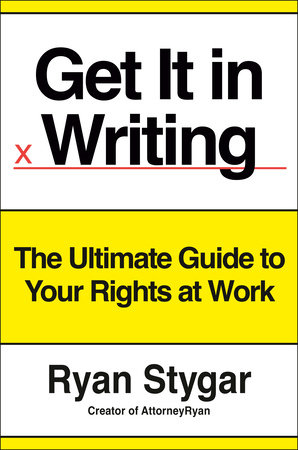
Get It in Writing

The Ultimate Guide to Your Rights at Work

Look inside
Hardcover (Paper-over-Board, no jacket)
$29.00 US
6.25"W x 9.3"H x 1.2"D   | 19 oz | 12 per carton
On sale May 12, 2026 | 384 Pages | 9798217044221

From Attorney Ryan, the most well-known labor lawyer in America, the complete guide to workers’ rights that your boss doesn’t want you to read

Life for working people is getting harder and more expensive. While employers clamp down with return-to-office mandates, productivity trackers, and layoffs, employees are struggling to keep up with daily expenses. Meanwhile, workers are expected to make huge sacrifices "for the good of the company." But what do they get in return? A surprise meeting with HR followed by a swift and unceremonious termination.

For too long, we’ve accepted the status quo. But you deserve better. In Get It in Writing, Attorney Ryan Stygar, a former firefighter who became a workers' rights attorney, teaches you everything you need to know about how to get what you’re owed at work. Each chapter is filled with practical, easy-to-understand advice. In plain English, he breaks down the answers to all your biggest questions around labor law, including:

  • “Does At Will employment really mean I have no rights?”
  • “What do I do if my boss is bullying me?”
  • “What if I’m too injured to keep working?”
  • “Am I getting paid correctly?”
  • “What if I report my creepy manager and no one believes me?”

Most people are, understandably, afraid to deal with employment problems because their whole livelihood is at stake. But we can’t let bad bosses use fear to control us. Armed with Get It in Writing, you will have the tools to claim your basic rights: fair pay, fair treatment, and the time and accommodations you need when life goes off script. With Attorney Ryan's expertise, millions of working people are winning back what is rightfully theirs. It’s time for you to join them.
“They say you don’t know what you don’t know. This book changes that. Be prepared to enjoy a confidence that isn’t just a feeling—it’s a right.”
Jefferson Fisher, bestselling author of The Next Conversation

“This book breaks down the complex process of pursuing a legal claim against an employer into clear, actionable steps. There’s no gatekeeping here, and Stygar empowers workers with practical guidance on how to protect themselves, cover their bases, and stand up to corporate America.”
Paige Sparks, plaintiff employment lawyer and owner of Sparks Legal

“Everyone who works for a living should read this book! In Get It in Writing, Ryan Stygar pulls back the curtain on how workplaces really operate and what your boss hopes you don’t know. This book is packed with clear explanations, real stories from the front lines, and practical scripts you can actually use. It’s not about being litigious; it’s about being informed.”
Zachary Rubin, MD, author of All About Allergies

“Everyone deserves to know their rights in the workplace, and Attorney Ryan breaks everything down in a way that’s easy to understand. A great guide to have by your side!”
Laura Whaley, business owner, content creator at @loewhaley, and public figure

“This book is a lifesaver for anyone needing to advocate for themselves in the workplace! Stygar may be an attorney and go-to expert in the field of employment law, but there’s no confusing legalese here—Get It in Writing is an easy-to-understand guide for any worker.”
Erin McGoff, founder of AdvicewithErin and author of The Secret Language of Work

“Working people in America are always in danger of finding themselves on the wrong side of a power imbalance that takes money out of their pockets and leaves them feeling disrespected on the job. Knowing your rights is the first step toward fighting back. Get It in Writing is a great primer for any worker who wants to deal with the boss as an equal.”
Hamilton Nolan, author of The Hammer: Power, Inequality, and the Struggle for the Soul of Labor

Get It in Writing doesn’t just explain your rights: It arms you with the exact language to use in emails, meetings, and HR conversations. It’s the practical companion to salary transparency I’ve been waiting for!”
Hannah Williams, founder of Salary Transparent Street, Forbes 30 Under 30 honoree, and TIME100 creator

“To anyone who fears retaliation if they speak up against unfair working conditions: You need this book. Stygar expertly explains your legal rights and recourse while introducing you to the everyday baristas, personal trainers, salespeople, and more who did fight back—and won.”
— Claudia Salinas, criminal justice advocate and staff attorney at the Innocence Center
© Eder Escamilla
Ryan Stygar is an attorney, a former firefighter, and a leading voice in the field of labor and employment law who has gained a massive following online as @AttorneyRyan. Through his videos, he empowers working-class people by educating them about their rights. Stygar is the founder and lead counsel of Centurion Trial Attorneys, where he and his staff work daily to protect employees from abusive labor practices. He was born and raised in San Diego, California, where he currently resides. View titles by Ryan Stygar
Chapter 1

At-Will Employment and Wrongful Termination

Fire At Will!

Let's go back a few pages to the opening story of this book. When I worked as an EMT, I was told on my very first day that my employment was at will. Wrinkled Polo's description-"You can be replaced any time, for any reason, even for no reason"-scared me.

I had no money, no power, and it seemed to me that my employer held all the cards. I know I'm not the only one to have felt this way; it's a common sentiment. But the fear is not proportionate to the threat. You have rights and you can enforce them; you just have to understand the rules first. That information is what I was missing, and it's something I want you to have.

Most people in the US are employed at will. But most people don't actually know what that means! This basic terminology is crucial for understanding your rights at work. Let's dive in.

At-Will Employment

So, what is at-will employment? At-will employment means that you can be fired for any legal reason, including no reason, with or without notice, and it is the standard in most US states. No cause is required; you can be legally terminated from an at-will position even if the reason is objectively unfair. At will is also the default condition, meaning that if you do not have a contract specifying otherwise, then you are probably an at-will employee.

At-will states may go with a different name depending on where you live. For example, your employer might use a phrase like fire at will state, or even (incorrectly) right-to-work state. Whatever the name, the at-will rule is the same. Every state in the United States is an at-will state-except Montana. Under the Montana Wrongful Discharge from Employment Act, employers generally must have "good cause" to terminate an employee (once the employee has finished an established probationary period).

As a starting point, most terminations are legal. However, there are many exceptions to the at-will presumption. The key to every wrongful termination case-a concept we'll tackle later in this chapter-is proving your termination was one of those exceptions!

Right-to-Work States

At-will and right-to-work states are not the same thing. Right to work is a phrase often mistakenly used by employers who mean to say at will. But right-to-work laws only mean that employees cannot be required to join a labor union to qualify for a job. Additionally, in some right-to-work states, employees cannot be required to pay dues to a union if they opt out of membership. As of the writing of this book, twenty-five states have right-to-work laws.

So, since every state (except Montana) is an at-will state, that means every right-to-work state is also an at-will state. But not every at-will state is a right-to-work state. Being a right-to-work state has nothing to do with why an employer might legally fire you. If your boss says something like "This is a right-to-work state, which means I don't need a reason to fire you," they are simply wrong.

Why Do the States Have Different Rules?

Let's take a quick detour to clear something up, because knowing why the states have different rules will put you one step ahead of a slimy supervisor.

Many bad bosses will say something like "Your rights depend on what state you're in" to downplay your legally entitled labor protections. It is true that your rights will vary somewhat from state to state. However, and more important, it is also true that federal laws apply to all fifty states, including laws about labor protections. Federal law provides the basic rules that all states must follow. However, states are free to enact laws on a wider range of issues than the federal government. Generally, the Tenth Amendment of the Constitution allows states to make their own rules so long as they do not conflict with federal law. This is why each of the states have slightly different laws, even though federal law still applies equally to all states.

So, what happens when state laws and federal laws disagree?

Here is the basic rule that will guide you in most situations. When state and federal law are in conflict, federal law prevails; but if the state law provides more labor protections than federal law, then generally the state law prevails.

States can have different laws where federal law is silent. States may add protections on top of federal rules but cannot undermine those rules. For example, the federal minimum wage is $7.25 per hour as of the writing of this book. States may not make a law for a minimum wage lower than $7.25 per hour. However, states are free to make their minimum wage higher if they choose to. If a state does not enact its own minimum wage, then the federal minimum wage applies.

Exceptions to At Will

Let's get back to at will. The default presumption is that your termination is legal. But if an exception applies, then the termination is not legal.

What are the exceptions to the at-will presumption? At-will employment is no excuse to break the law. There are several situations in which it is illegal to terminate you even if you are an at-will employee. Even if you signed a contract saying you can be fired for "any" reason, it is still illegal to fire you for illegal reasons.

I'm not saying these laws will stop you from getting fired. Just like how a stop sign won't magically make cars stop. What I'm saying is that if you are fired for an illegal reason, you can have legal recourse and could be owed significant compensation once your case is proved. Typically, being fired for an illegal reason (a.k.a. an exception to the at-will presumption) falls under one of the following:

You were terminated in violation of applicable state, federal, or local law.

You were terminated because of a protected characteristic (such as your disability, gender, race, etc.).

Your termination violated the terms of a contract between you and the employer. (In this case, you would have both a breach of contract claim and a wrongful termination claim.)

You were terminated for making a whistleblower complaint.

You were terminated after exercising a protected legal right.

Your termination didn't violate a specific law, but it went against an established and substantial public policy.

Being fired for one of these reasons is called wrongful termination.

What Is Wrongful Termination?

Wrongful termination is a fancy way of saying that you have been fired for an illegal reason. Wrongful termination is illegal in all fifty states, including the forty-nine at-will states. In addition to the reasons for illegal termination above, here are some of the most common forms of wrongful termination I see:

You requested medical leave under FMLA and then got removed from the schedule.

You got fired for requesting reasonable accommodations for your disability.

You got fired after refusing to go on a date with the boss.

You were terminated for discussing your wages.

You were "laid off" while on maternity leave under FMLA.

You were fired after reporting harassment, discrimination, or other unlawful conduct.

You were fired because a new manager doesn't want someone of your race or gender or with your disability on their team.

Your boss overheard you speaking of your same-sex partner and fired you for "not being a culture fit."

You requested extra breaks to accommodate your pregnancy and got pulled from the schedule.

Your boss asked you to "massage the numbers" on a government report. You refused, so you were fired for being "insubordinate."

You were fired after reporting a safety concern to OSHA.

You recently turned sixty-one years old. Your boss started dropping hints that you're "too slow," then laid you off.

You were fired for cooperating in an investigation against your employer.

You reported your boss for touching you inappropriately, and you got removed from the schedule.

From these examples, you can see there is a general formula to look for: You were fired because of a protected characteristic or for engaging in a legally protected activity.

Protected characteristics include your race, national origin, gender, disability, religion, LGBTQ+ identity, or age. Protected activities include (but are not limited to):

Reporting sexual harassment

Making a whistleblower complaint

Filing a report of safety violations to OSHA

Taking protected leave under the Family and Medical Leave Act

Requesting accommodation for your disability

Discussing pay and work conditions with coworkers

Cooperating in a US Department of Labor investigation against your employer

Reporting acts of discrimination based on age, race, gender, national origin, religion, or other protected characteristics

Taking time off to perform military service, such as National Guard drills

Requesting accommodations for pregnancy

Case Study: Wrongful Termination

Griselda was in tears when we began our call.

"I don't know what to do," she began. "I lost my baby. I lost my job. But a friend said you could help."

What Griselda went through was devastating. She'd been working as a cashier at a fast-food restaurant. When she became pregnant, her manager refused to let her keep water near her workstation. As the pregnancy progressed, Griselda asked for a stool to sit on while she worked.

That request was denied. Management claimed it was a "tripping hazard."

To make matters worse, Griselda began to suffer from severe back and abdominal pain. One day, she noticed she was bleeding in her pants.

A few hours later, she learned she had miscarried.

Griselda called out sick because she needed a few days to recover from the loss of her pregnancy. But in a move that is all too common in the US, her manager simply pulled her off the schedule. When she asked to come back to work, management said she had been fired for being "unreliable."

Outrageous.

It was clear that Griselda was fired because she had been pregnant, because she requested accommodations for her pregnancy, and because she needed time off to recover from a medical condition. Still, she was worried she had no case.

"They said I was fired because I'm unreliable? And that's legal, isn't it?"

"Yes, they can say that, but it doesn't make it true," I replied. "Firing an unreliable employee is legal, but it's not legal to fire someone just because they are pregnant."

I signed Griselda as a client on a contingency basis. We sued her prior employer for wrongful termination, discrimination, retaliation, and a number of other violations. I am happy to report that after a few months of litigation, we got Griselda a substantial money settlement.

Why Did Griselda Win?

Laws against wrongful termination do not prevent wrongful termination. Just as a posted speed limit does not make speeding impossible. Rather, it gives you recourse if your employer breaks the law.

In this case, Griselda won even though her employer lied about the reason she was fired. Here were a few factors that helped us win:

Griselda informed her manager via text message that she was pregnant, so it was impossible for them to deny they knew she was pregnant.

Griselda requested to have water and a stool at her workstation via text message. This was a request for accommodation under the Pregnant Workers Fairness Act, and it was a legally protected request.

Griselda refused to sign any exit paperwork that could have waived her rights. She talked to a few lawyers first, and ultimately chose my office. (It was an honor to fight for her!)

Unfortunately, I see dozens of cases like Griselda's every year. But hers highlights an important issue-wrongful termination takes many forms. And it is still illegal even if the employer lies about why you were fired.

But overcoming the lies bad bosses tell isn't always simple. Let's talk about it in more detail so you can protect yourself if it happens to you.

What If the Employer Lies About the Reason You Got Fired?

In Griselda's case, her employer lied about why she was fired. They said it was due to her being "unreliable," but really, they fired her because of her pregnancy, which is illegal.

One of the most common and important employment law questions I get is what to do if an employer lies about why you are being fired. Many people reasonably believe that if an employer lies about the reason you were fired (e.g., downsizing, layoffs, poor performance, lack of work, etc.), there is nothing you can do.

Fortunately, this is not correct.

If someone is arrested on suspicion of robbing a store, will the police simply let them loose if they say they didn't do it? Of course not! There will be an investigation and a process for determining the facts, and ultimately a jury will decide who is lying and who is telling the truth.

In an employment case, it is common for employers to lie about the reason you were fired. Some will simply say it was "downsizing" or "lack of work." Others may say, "It's at-will employment, so I don't have to give the reason." I've seen every excuse you can think of. (I've also seen a few reasons no one would ever think of. I once had a case where the defendants claimed my client was fired because she was a "witch." She was not a witch; she just had tattoos.)

But if the real reason for termination was illegal, then we can prove it and win our case.

I understand this is very different from what you may have been told in the past. So I want to be very clear. Just because your boss . . .

Says you are fired "at will"

Lies about why they fired you

Refuses to give a reason for your termination

Removes you from the work schedule against your will

Calls it a "layoff"

. . . doesn't mean you don't have a case. Once we make an allegation of wrongful termination, supported by at least some proof (like Griselda's text messages), then the boss has a serious problem on their hands.

The employer would be unwise to simply scream "At will!" and do nothing. The employer will need to put up a defense to show that what they did was legal. This becomes harder and harder for them the more evidence you have.

Remember, every lawsuit is a battle of evidence and credibility.

No employer will admit they broke the law. I have never had an employer say "I fired your client because they are Asian" or "Your client reported sexual harassment, so I fired them." Often, the employer will concoct a cover story-a pretext for the termination. Again, this does not automatically ruin your case. It is a natural and expected reaction to an accusation.

But what does pretext look like, and how can you fight it?

About

From Attorney Ryan, the most well-known labor lawyer in America, the complete guide to workers’ rights that your boss doesn’t want you to read

Life for working people is getting harder and more expensive. While employers clamp down with return-to-office mandates, productivity trackers, and layoffs, employees are struggling to keep up with daily expenses. Meanwhile, workers are expected to make huge sacrifices "for the good of the company." But what do they get in return? A surprise meeting with HR followed by a swift and unceremonious termination.

For too long, we’ve accepted the status quo. But you deserve better. In Get It in Writing, Attorney Ryan Stygar, a former firefighter who became a workers' rights attorney, teaches you everything you need to know about how to get what you’re owed at work. Each chapter is filled with practical, easy-to-understand advice. In plain English, he breaks down the answers to all your biggest questions around labor law, including:

  • “Does At Will employment really mean I have no rights?”
  • “What do I do if my boss is bullying me?”
  • “What if I’m too injured to keep working?”
  • “Am I getting paid correctly?”
  • “What if I report my creepy manager and no one believes me?”

Most people are, understandably, afraid to deal with employment problems because their whole livelihood is at stake. But we can’t let bad bosses use fear to control us. Armed with Get It in Writing, you will have the tools to claim your basic rights: fair pay, fair treatment, and the time and accommodations you need when life goes off script. With Attorney Ryan's expertise, millions of working people are winning back what is rightfully theirs. It’s time for you to join them.

Praise

“They say you don’t know what you don’t know. This book changes that. Be prepared to enjoy a confidence that isn’t just a feeling—it’s a right.”
Jefferson Fisher, bestselling author of The Next Conversation

“This book breaks down the complex process of pursuing a legal claim against an employer into clear, actionable steps. There’s no gatekeeping here, and Stygar empowers workers with practical guidance on how to protect themselves, cover their bases, and stand up to corporate America.”
Paige Sparks, plaintiff employment lawyer and owner of Sparks Legal

“Everyone who works for a living should read this book! In Get It in Writing, Ryan Stygar pulls back the curtain on how workplaces really operate and what your boss hopes you don’t know. This book is packed with clear explanations, real stories from the front lines, and practical scripts you can actually use. It’s not about being litigious; it’s about being informed.”
Zachary Rubin, MD, author of All About Allergies

“Everyone deserves to know their rights in the workplace, and Attorney Ryan breaks everything down in a way that’s easy to understand. A great guide to have by your side!”
Laura Whaley, business owner, content creator at @loewhaley, and public figure

“This book is a lifesaver for anyone needing to advocate for themselves in the workplace! Stygar may be an attorney and go-to expert in the field of employment law, but there’s no confusing legalese here—Get It in Writing is an easy-to-understand guide for any worker.”
Erin McGoff, founder of AdvicewithErin and author of The Secret Language of Work

“Working people in America are always in danger of finding themselves on the wrong side of a power imbalance that takes money out of their pockets and leaves them feeling disrespected on the job. Knowing your rights is the first step toward fighting back. Get It in Writing is a great primer for any worker who wants to deal with the boss as an equal.”
Hamilton Nolan, author of The Hammer: Power, Inequality, and the Struggle for the Soul of Labor

Get It in Writing doesn’t just explain your rights: It arms you with the exact language to use in emails, meetings, and HR conversations. It’s the practical companion to salary transparency I’ve been waiting for!”
Hannah Williams, founder of Salary Transparent Street, Forbes 30 Under 30 honoree, and TIME100 creator

“To anyone who fears retaliation if they speak up against unfair working conditions: You need this book. Stygar expertly explains your legal rights and recourse while introducing you to the everyday baristas, personal trainers, salespeople, and more who did fight back—and won.”
— Claudia Salinas, criminal justice advocate and staff attorney at the Innocence Center

Author

© Eder Escamilla
Ryan Stygar is an attorney, a former firefighter, and a leading voice in the field of labor and employment law who has gained a massive following online as @AttorneyRyan. Through his videos, he empowers working-class people by educating them about their rights. Stygar is the founder and lead counsel of Centurion Trial Attorneys, where he and his staff work daily to protect employees from abusive labor practices. He was born and raised in San Diego, California, where he currently resides. View titles by Ryan Stygar

Excerpt

Chapter 1

At-Will Employment and Wrongful Termination

Fire At Will!

Let's go back a few pages to the opening story of this book. When I worked as an EMT, I was told on my very first day that my employment was at will. Wrinkled Polo's description-"You can be replaced any time, for any reason, even for no reason"-scared me.

I had no money, no power, and it seemed to me that my employer held all the cards. I know I'm not the only one to have felt this way; it's a common sentiment. But the fear is not proportionate to the threat. You have rights and you can enforce them; you just have to understand the rules first. That information is what I was missing, and it's something I want you to have.

Most people in the US are employed at will. But most people don't actually know what that means! This basic terminology is crucial for understanding your rights at work. Let's dive in.

At-Will Employment

So, what is at-will employment? At-will employment means that you can be fired for any legal reason, including no reason, with or without notice, and it is the standard in most US states. No cause is required; you can be legally terminated from an at-will position even if the reason is objectively unfair. At will is also the default condition, meaning that if you do not have a contract specifying otherwise, then you are probably an at-will employee.

At-will states may go with a different name depending on where you live. For example, your employer might use a phrase like fire at will state, or even (incorrectly) right-to-work state. Whatever the name, the at-will rule is the same. Every state in the United States is an at-will state-except Montana. Under the Montana Wrongful Discharge from Employment Act, employers generally must have "good cause" to terminate an employee (once the employee has finished an established probationary period).

As a starting point, most terminations are legal. However, there are many exceptions to the at-will presumption. The key to every wrongful termination case-a concept we'll tackle later in this chapter-is proving your termination was one of those exceptions!

Right-to-Work States

At-will and right-to-work states are not the same thing. Right to work is a phrase often mistakenly used by employers who mean to say at will. But right-to-work laws only mean that employees cannot be required to join a labor union to qualify for a job. Additionally, in some right-to-work states, employees cannot be required to pay dues to a union if they opt out of membership. As of the writing of this book, twenty-five states have right-to-work laws.

So, since every state (except Montana) is an at-will state, that means every right-to-work state is also an at-will state. But not every at-will state is a right-to-work state. Being a right-to-work state has nothing to do with why an employer might legally fire you. If your boss says something like "This is a right-to-work state, which means I don't need a reason to fire you," they are simply wrong.

Why Do the States Have Different Rules?

Let's take a quick detour to clear something up, because knowing why the states have different rules will put you one step ahead of a slimy supervisor.

Many bad bosses will say something like "Your rights depend on what state you're in" to downplay your legally entitled labor protections. It is true that your rights will vary somewhat from state to state. However, and more important, it is also true that federal laws apply to all fifty states, including laws about labor protections. Federal law provides the basic rules that all states must follow. However, states are free to enact laws on a wider range of issues than the federal government. Generally, the Tenth Amendment of the Constitution allows states to make their own rules so long as they do not conflict with federal law. This is why each of the states have slightly different laws, even though federal law still applies equally to all states.

So, what happens when state laws and federal laws disagree?

Here is the basic rule that will guide you in most situations. When state and federal law are in conflict, federal law prevails; but if the state law provides more labor protections than federal law, then generally the state law prevails.

States can have different laws where federal law is silent. States may add protections on top of federal rules but cannot undermine those rules. For example, the federal minimum wage is $7.25 per hour as of the writing of this book. States may not make a law for a minimum wage lower than $7.25 per hour. However, states are free to make their minimum wage higher if they choose to. If a state does not enact its own minimum wage, then the federal minimum wage applies.

Exceptions to At Will

Let's get back to at will. The default presumption is that your termination is legal. But if an exception applies, then the termination is not legal.

What are the exceptions to the at-will presumption? At-will employment is no excuse to break the law. There are several situations in which it is illegal to terminate you even if you are an at-will employee. Even if you signed a contract saying you can be fired for "any" reason, it is still illegal to fire you for illegal reasons.

I'm not saying these laws will stop you from getting fired. Just like how a stop sign won't magically make cars stop. What I'm saying is that if you are fired for an illegal reason, you can have legal recourse and could be owed significant compensation once your case is proved. Typically, being fired for an illegal reason (a.k.a. an exception to the at-will presumption) falls under one of the following:

You were terminated in violation of applicable state, federal, or local law.

You were terminated because of a protected characteristic (such as your disability, gender, race, etc.).

Your termination violated the terms of a contract between you and the employer. (In this case, you would have both a breach of contract claim and a wrongful termination claim.)

You were terminated for making a whistleblower complaint.

You were terminated after exercising a protected legal right.

Your termination didn't violate a specific law, but it went against an established and substantial public policy.

Being fired for one of these reasons is called wrongful termination.

What Is Wrongful Termination?

Wrongful termination is a fancy way of saying that you have been fired for an illegal reason. Wrongful termination is illegal in all fifty states, including the forty-nine at-will states. In addition to the reasons for illegal termination above, here are some of the most common forms of wrongful termination I see:

You requested medical leave under FMLA and then got removed from the schedule.

You got fired for requesting reasonable accommodations for your disability.

You got fired after refusing to go on a date with the boss.

You were terminated for discussing your wages.

You were "laid off" while on maternity leave under FMLA.

You were fired after reporting harassment, discrimination, or other unlawful conduct.

You were fired because a new manager doesn't want someone of your race or gender or with your disability on their team.

Your boss overheard you speaking of your same-sex partner and fired you for "not being a culture fit."

You requested extra breaks to accommodate your pregnancy and got pulled from the schedule.

Your boss asked you to "massage the numbers" on a government report. You refused, so you were fired for being "insubordinate."

You were fired after reporting a safety concern to OSHA.

You recently turned sixty-one years old. Your boss started dropping hints that you're "too slow," then laid you off.

You were fired for cooperating in an investigation against your employer.

You reported your boss for touching you inappropriately, and you got removed from the schedule.

From these examples, you can see there is a general formula to look for: You were fired because of a protected characteristic or for engaging in a legally protected activity.

Protected characteristics include your race, national origin, gender, disability, religion, LGBTQ+ identity, or age. Protected activities include (but are not limited to):

Reporting sexual harassment

Making a whistleblower complaint

Filing a report of safety violations to OSHA

Taking protected leave under the Family and Medical Leave Act

Requesting accommodation for your disability

Discussing pay and work conditions with coworkers

Cooperating in a US Department of Labor investigation against your employer

Reporting acts of discrimination based on age, race, gender, national origin, religion, or other protected characteristics

Taking time off to perform military service, such as National Guard drills

Requesting accommodations for pregnancy

Case Study: Wrongful Termination

Griselda was in tears when we began our call.

"I don't know what to do," she began. "I lost my baby. I lost my job. But a friend said you could help."

What Griselda went through was devastating. She'd been working as a cashier at a fast-food restaurant. When she became pregnant, her manager refused to let her keep water near her workstation. As the pregnancy progressed, Griselda asked for a stool to sit on while she worked.

That request was denied. Management claimed it was a "tripping hazard."

To make matters worse, Griselda began to suffer from severe back and abdominal pain. One day, she noticed she was bleeding in her pants.

A few hours later, she learned she had miscarried.

Griselda called out sick because she needed a few days to recover from the loss of her pregnancy. But in a move that is all too common in the US, her manager simply pulled her off the schedule. When she asked to come back to work, management said she had been fired for being "unreliable."

Outrageous.

It was clear that Griselda was fired because she had been pregnant, because she requested accommodations for her pregnancy, and because she needed time off to recover from a medical condition. Still, she was worried she had no case.

"They said I was fired because I'm unreliable? And that's legal, isn't it?"

"Yes, they can say that, but it doesn't make it true," I replied. "Firing an unreliable employee is legal, but it's not legal to fire someone just because they are pregnant."

I signed Griselda as a client on a contingency basis. We sued her prior employer for wrongful termination, discrimination, retaliation, and a number of other violations. I am happy to report that after a few months of litigation, we got Griselda a substantial money settlement.

Why Did Griselda Win?

Laws against wrongful termination do not prevent wrongful termination. Just as a posted speed limit does not make speeding impossible. Rather, it gives you recourse if your employer breaks the law.

In this case, Griselda won even though her employer lied about the reason she was fired. Here were a few factors that helped us win:

Griselda informed her manager via text message that she was pregnant, so it was impossible for them to deny they knew she was pregnant.

Griselda requested to have water and a stool at her workstation via text message. This was a request for accommodation under the Pregnant Workers Fairness Act, and it was a legally protected request.

Griselda refused to sign any exit paperwork that could have waived her rights. She talked to a few lawyers first, and ultimately chose my office. (It was an honor to fight for her!)

Unfortunately, I see dozens of cases like Griselda's every year. But hers highlights an important issue-wrongful termination takes many forms. And it is still illegal even if the employer lies about why you were fired.

But overcoming the lies bad bosses tell isn't always simple. Let's talk about it in more detail so you can protect yourself if it happens to you.

What If the Employer Lies About the Reason You Got Fired?

In Griselda's case, her employer lied about why she was fired. They said it was due to her being "unreliable," but really, they fired her because of her pregnancy, which is illegal.

One of the most common and important employment law questions I get is what to do if an employer lies about why you are being fired. Many people reasonably believe that if an employer lies about the reason you were fired (e.g., downsizing, layoffs, poor performance, lack of work, etc.), there is nothing you can do.

Fortunately, this is not correct.

If someone is arrested on suspicion of robbing a store, will the police simply let them loose if they say they didn't do it? Of course not! There will be an investigation and a process for determining the facts, and ultimately a jury will decide who is lying and who is telling the truth.

In an employment case, it is common for employers to lie about the reason you were fired. Some will simply say it was "downsizing" or "lack of work." Others may say, "It's at-will employment, so I don't have to give the reason." I've seen every excuse you can think of. (I've also seen a few reasons no one would ever think of. I once had a case where the defendants claimed my client was fired because she was a "witch." She was not a witch; she just had tattoos.)

But if the real reason for termination was illegal, then we can prove it and win our case.

I understand this is very different from what you may have been told in the past. So I want to be very clear. Just because your boss . . .

Says you are fired "at will"

Lies about why they fired you

Refuses to give a reason for your termination

Removes you from the work schedule against your will

Calls it a "layoff"

. . . doesn't mean you don't have a case. Once we make an allegation of wrongful termination, supported by at least some proof (like Griselda's text messages), then the boss has a serious problem on their hands.

The employer would be unwise to simply scream "At will!" and do nothing. The employer will need to put up a defense to show that what they did was legal. This becomes harder and harder for them the more evidence you have.

Remember, every lawsuit is a battle of evidence and credibility.

No employer will admit they broke the law. I have never had an employer say "I fired your client because they are Asian" or "Your client reported sexual harassment, so I fired them." Often, the employer will concoct a cover story-a pretext for the termination. Again, this does not automatically ruin your case. It is a natural and expected reaction to an accusation.

But what does pretext look like, and how can you fight it?