IntroductionAs a society, mostly in the West, we have done this weird thing with death. Instead of seeing it as a natural part of life, we don’t like to talk about death, we avoid it, we rebel against it. We see the attributes of death—skeletons, the Grim Reaper—as symbols of rebellion, heavy metal music, Halloween.
Death used to scare me so much. In fact, when I was about eight years old I had this devastating nightmare about a skeleton chasing me. The concept of death was frightening, electrifying in a way I still can’t tangibly explain. It reminds me of the magic of being able to feel wind but not see it. You can see other objects moving in the wind—the trees, people’s coats, the grass—but wind itself is invisible.
Death feels the same. Skeletons feel the same too. For the longest time I avoided these thoughts and conversations. The idea of not being around felt heartbreaking. But I only have life because of death. The cycle in which it all continues is as real as it is macabre. I only have the ability to type these words because of my skeleton, yet I can’t see it. There is magic in the invisible, and there is no need to fear what’s coming, even if we never understand it.
But what if we could see skeletons for what they are? The very thing that upholds us, keeps us grounded, keeps us connected. What if, instead of being terrifying or overly cutesy, we recognized our skeletons for the poignant powerhouses they truly are: a normal part of our everyday life? At the end of the day, we’re all made from the same bones.
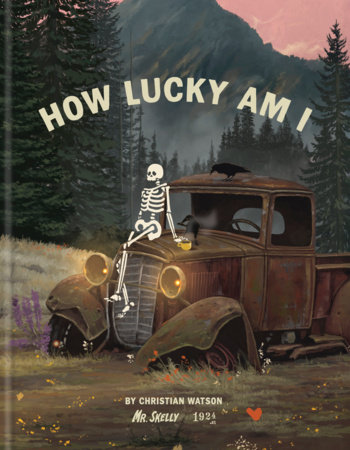
I first started drawing Mr. Skelly for my children, as a way to talk to them about death, life, and love. The character grew and grew in my mind, and I decided I wanted to pair the drawing with a contrasting statement: “Life is too short to not be at peace.” I drew Mr. Skelly lying in a field of flowers, surrounded by a beautiful sky.
I removed his jaw because I’m missing a front tooth, and I thought softening this feature made him feel more approachable. I shared the image online and before I knew it, tens of millions of people around the world had found solace in this pairing.
Artists tend to create what they feel, and when something resonates with people, we listen. I had no idea how special Mr. Skelly would become for me.
So, I have set out on a funny, seemingly impossible, quest of rebranding death as not scary, not something to glorify or seek out, but something to accept and embrace. A mission to see skeletons not as hardcore, death-bringing symbols, but as softened versions of who we are and who we are all guaranteed to become.
So that I can live better today, I try my best to recognize anything that could come tomorrow and learn to make my peace with death. When you do, you’ll often find it’s the very thing that makes you realize how rich your life truly is, how lucky you actually are.
How lucky am I? It’s a question that calls my thoughts to action. To try to answer intentionally. In what ways can I count all the little, seemingly unimportant miracles that happen each day, often unnoticed, and make my day what it is?
The hardships, the magic, and the challenges—how lucky am I to face them? How lucky am I to start a new day, to try and fail again? How lucky am I to have been here at all?
How lucky.
I hope so much that you find some comfort, joy, and hope in the coming pages as we go on this journey together.
Copyright © 2026 by Christian Watson. All rights reserved. No part of this excerpt may be reproduced or reprinted without permission in writing from the publisher.