Close Modal

Killer on the Road

Look inside
Paperback
$18.00 US
5.2"W x 7.99"H x 0.79"D   | 10 oz | 24 per carton
On sale Dec 02, 2025 | 272 Pages | 9798217007882

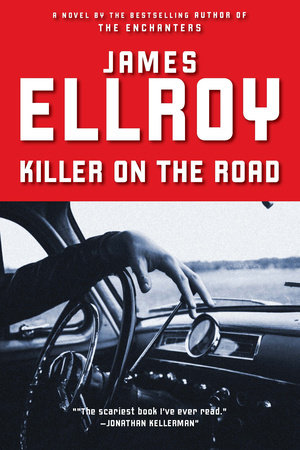
James Ellroy's deep dive into the psyche of a serial killer who recounts his life in the shadows, a tale of American madness and obsession.

"The scariest book I've ever read." —Jason Kellerman

Even as a child, Martin Michael Plunkett was no ordinary boy. Extreme parental indifference marked him as an outcast. In his head, Plunkett crafted a second life, remaking himself in the guise of his favorite comic book villain. His mind fixated on dark thoughts and twisted imaginings. A heart of evil was burnished—and Plunkett grew up to become a psychotic murderer.

This chilling tale is written as the reflections of an unrepentant criminal. As Plunkett serves four consecutive life sentences in solitary at Sing Sing, he reminisces on his discovery of his disturbing passions and the dark heart of America. Killer on the Road is an exploration of the mind of a perfectly crafted psychopath: a mix of clinical vision, genius intellect, and an empty conscience. Plunkett is the killer on the road.
© Marion Ettlinger
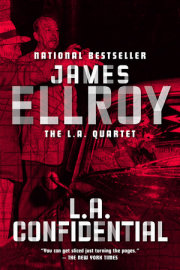
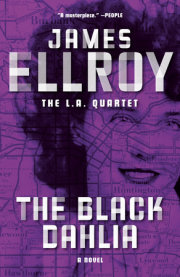
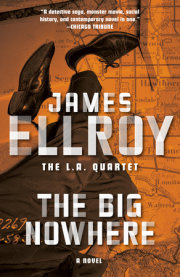
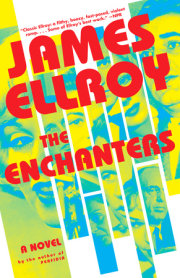
JAMES ELLROY was born in Los Angeles. He is the author of the Underworld U.S.A. Trilogy: American Tabloid, The Cold Six Thousand, and Blood’s A Rover; and the L.A. Quartet novels: The Black Dahlia, The Big Nowhere, L.A. Confidential, and White Jazz. He is also the author of two other Freddy Otash novels, Widespread Panic and The Enchanters. He was awarded the 2022 Los Angeles Times Robert Kirsch Award for lifetime achievement. He lives in Colorado. View titles by James Ellroy
Chapter 1

Dusenberry’s estimated body count was low, and Warden Wardlow’s stone metaphor only partly accurate. Inanimate objects can yield blood, but if the transfusion is to take, the letting must be sanctioned by the object’s deepest and most logical volition. Even Milt Alpert, that eminently decent expediter of literature, had to cloak the announcement of our collaboration with justification-heavy sloganeering and words I never said. He cannot accept the fact that he will be earning 10 percent of a valediction in blood. That I feel no remorse and seek no absolution is incomprehensible to him.

A more farsighted person in my situation would seize this narrative opportunity and bend it toward the manipulation of the mental-health profession and liberal legal establishment—people susceptible to cheap visions of redemption. Since I have no expectations of ever leaving this prison, I will not do that—it is simply dishonest. Nor will I cop a psychological plea by juxtaposing my acts against the alleged absurdity of twentieth-century American life. By passing through conscious gauntlets of silence and will, by creating my own vacuum-packed reality, I was able to exist outside standard environmental influences to an exceptional degree—the prosaic pain of growing up and being American did not take hold; I transmogrified it into something more very early. Thus I stand by my deeds. They are indigenous solely to me.

Here in my cell, I have everything I need to bring my valediction to life: world-class typewriter, blank paper, police documents procured by my agent. Along the back wall there is a Rand-McNally map of America, and beside my bunk a box of plastic-topped pins. As this manuscript grows, I will use those pins to mark the places where I murdered people.

But above all, I have my mind; my silence. There is a dynamic to the marketing of horror: serve it up with a hyperbolic flourish that distances even as it terrifies, then turn on the literal or figurative lights, inducing gratitude for the cessation of a nightmare that was too awful to be true in the first place. I will not observe that dynamic. I will not let you pity me. Charles Manson, babbling in his cell, deserves pity; Ted Bundy, protesting his innocence in order to attract correspondence from lonely women, deserves contempt. I deserve awe for standing inviolate at the end of the journey I am about to describe, and since the force of my nightmare prohibits surcease, you will give it to me.

2

Guidebooks misrepresent Los Angeles as a sun-kissed amalgam of beaches, palm trees and the movies. The literary establishment fatuously attempts to penetrate that exterior and serves up the L.A. basin as a melting pot of desperate kitsch, violent illusion and variegated religious lunacy. Both designations hold elements of truth based on convenience. It is easy to love the place at first glance and even easier to hate it when you get to sense the people who live there. But to know it, you have to come from the neighborhoods, the inner-city enclaves that the guidebooks never mention and artists dismiss in their haste to paint with broad, satiric strokes.

These places require resourcefulness; they will not give up their secrets to observers—only to inspired residents. I gave my youthful stomping ground such implacable attention that it reciprocated in full. There was nothing about that quiet area on the edge of Hollywood that I didn’t know.

Beverly Boulevard on the south; Melrose Avenue on the north. Rossmore and Wilshire Country Club marking the west border, a demarcation line between money and only the dream of it. Western Avenue and its profusion of bars and liquor stores standing sentry at the east gate—keeping undesirable school districts, Mexicans and homosexuals at bay. Six blocks from north to south; seventeen from east to west. Small wood-frame and Spanish-style houses; tree-lined streets without stoplights. A courtyard apartment building rumored to be filled with prostitutes and illegal aliens; an elementary school; the debatable presence of a “fuck pad” where U.S.C. football players brought girls to watch ’50’s-vintage porno films. A small universe of secrets.

I lived with my father and mother in a salmon-colored miniature of the Santa Barbara Mission, two stories with a tarpaper roof and a mock mission bell. My father worked as a draftsman at an airplane plant and gambled cautiously—he usually won. My mother clerked at an insurance company and spent her leisure hours staring at traffic on Beverly Boulevard.

I realize now that both my parents had furious, and furiously separate, mental lives. They were together for the first seven years of my life, and early on I remember designating them as my custodians and nothing else. Their lack of affection, to me and to each other, registered inchoately as freedom—dimly I perceived their elliptical approach to parenthood as a neglect that I could capitalize on. They did not possess the passion to abuse me or to love me. I know today that they armed me with the equivalent of enough childhood brutality to fuel an army.

Early in 1953, the air-raid sirens stationed throughout the neighborhood went off accidentally, and my father, convinced that a Russian A-bomb attack was imminent, led my mother and me up to the roof to await the arrival of the Big One. He brought a fifth of bourbon with him, because he wanted to toast the mushroom cloud he expected to rise over downtown L.A., and when the Big One never appeared, he was drunk and disappointed. My mother made one of her rare verbal offerings, this one to allay her husband’s depression over the world not being blown to hell. He raised his hand to hit her, then hesitated and slugged down the rest of the bottle. Mother went downstairs to her traffic-watching chair, and I started checking science books out of the library. I wanted to see what mushroom clouds looked like.

That night signaled the beginning of the end of my parents’ marriage. The air-raid scare created a bomb-shelter boom in the neighborhood, and my father, disgusted by the backyard construction, took to spending his weekends on the roof, drinking and observing the spectacle. I watched him get angrier and angrier, and I wanted to ease his pain, make him less of a pent-up observer. Somehow I got the notion to give him the “Wham-O” stainless steel slingshot I had found on a bus bench at Oakwood and Western.

My father loved the gift, and took to shooting ball bearings at the above-ground sections of the shelters. Soon his aim became excellent, and seeking more challenging targets, he started assassinating the crows who perched on the telephone wires that ran along the alley in back of our house. Once he even caught a scurrying rat from forty-six feet and eight inches away. I recall the distance because my father, proud of the feat, paced it off in yards, then calibrated the remainder with a metal drafting rule.

Early in ’54, I learned that my parents were going to get divorced. My father took me up to the roof to tell me. I had seen it coming, and knew from the “Paul Coates Confidential” T.V. program that many “Post war marriages” were headed for Splitsville.

“Why?” I asked.

My father toed the gravel on the roof; it looked like he was tracing A-bomb clouds. “Well . . . ​I’m thirty-four years old, and your mother and I don’t get along; and if I give her much more time I’ll have shot my good years; and if I do that I might as well pack it in. We can’t let that happen, can we?”

“No.”

“That’s my Marty. I’ll be moving to Michigan, but you and your mother will keep the house, and I’ll be writing to you, and I’ll be sending money.”

I knew from the Coates show that divorce was an expensive proposition, and sensed that my father must have had a big stash of gambling money put away to facilitate his move to Splitsville. He seemed to pick up my thoughts and added, “You’ll be well looked after, don’t you worry about that.”

“I won’t worry.”

“Good.” My father took a finger sight on a fat bluejay sitting atop our next-door neighbor’s garage. “You know your mother is, well . . . ​you know.”

I wanted to scream “nutty,” “crazy,” “fruitcake” and “couch case,” but didn’t want him to know I knew. “She’s sensitive?” I ventured.

My father shook his head slowly; I knew he knew I knew. “Yeah, sensitive. Just try to take her with a grain of salt. Get a good education and try to be your own man, and you’ll make yourself heard from.”

On that prophetic note, my father stuck out his hand. We shook, and five minutes later he walked out the door. I never saw him again.

3

All my mother required was that I maintain a reasonable degree of silence and not burden her with questions about what she was thinking. Implicit in that was her desire for me to remain moderate in school, at play and at home. If she considered the dictate to be punishment, she was wrong: I could go anywhere I wanted in my head.

Like the rest of the neighborhood kids, I went to Van Ness Avenue Elementary, obeyed, and laughed and hurt at silly things. But other children found their hurt/joy in outside stimuli, while I found mine reflected off a movie screen that fed from what surrounded me, edited for my own inside-the-brain viewing by a steel-sharp mental device that always knew exactly what I needed to keep from being bored.

The screenings ran this way:

Miss Conlan or Miss Gladstone would be standing by the blackboard, unctuously proclaiming. They would start to fade visually commensurate with my growing boredom, and involuntarily, my eyes would start to trawl for something to keep me mentally awake.

The taller children were seated at the back of the room, and from my far left-hand corner desk I had a perfect forward/diagonal viewing path, one that allowed me profile shots of all my classmates. With teacher sight/noise reduced to a minimum, the faces of the other children blurred together, forming new ones; snatches of whispered conversations came together until all manner of boy/girl hybrids were declaring their devotion to me.

Being loved in a vacuum was like a reverie; street noise sounded like music. But abrupt movement from within the room, or the clatter of books on the hallway outside would turn it all bad. Pieter, the tall blond boy who sat next to me grades three to six, would go from adoring confidant to monster, the noise level determining the grotesqueness of his features.

After long frightened moments, I would seize the front of the room, zero in on either the blackboard writing or the teacher’s monologue, and if I thought I could get away with it, interject some sort of comment. This calmed me and elicited full-face looks from the other children, sparking a part of my brain that thrived on producing swift, cruel caricature. Soon pretty Judy Rosen had Claire Curtis’s big buck teeth; booger-eating Bobby Greenfield was feeding snot balls to Roberta Roberts, dropping them over the cashmere sweaters she wore to school every day, regardless of the weather. I would laugh to myself, only occasionally out loud. And I kept wondering how far I could take it—if I could refine the device to the point where even bad noise couldn’t hurt me.

As for hurt: only other children were then capable of making me feel vulnerable, and even as early as eight or nine that queasy sense of being captive to irrational needs for union was physical—a prescient jolt of the terror and despair that sexual pursuits result in. I fought the need by denial, by sticking to myself and affecting a truculent mien that brooked no nonsense from other kids. In a recent People magazine article, a half-dozen of my old neighborhood contemporaries offered comments on me as a child. “Weird,” “strange” and “withdrawn” were the adjectives used most frequently. Kenny Rudd, who lived across the street from me, and who now designs computer basketball games, came closest to the truth: “The word was: Don’t _____ with Marty, he’s psycho. I don’t know, but I think maybe he was more scared than anything else.”

Bravo, Kenny, although I’m glad you and your cretinous comrades didn’t know that simple fact when we were children. My strangeness revulsed you and gave you someone to loathe from a safe distance—but had you sensed what it was hiding, you would have exploited my fear and tortured me for it. Instead, you left me alone and eased my discovery of my physical surroundings.

From 1955 to 1959, I charted my immediate topography, coming away with an extraordinary collection of facts: the red brick apartment house on Beachwood between Clinton and Melrose had a pet burial ground in back; the strip of recently constructed “bachelor hideaways” on Beverly and Norton were built out of rotted lumber, cut-rate stucco mix and “beaver-board”; the apocryphal “fuck pad” was in reality a bungalow court on Raleigh Drive, where a U.S.C. prof took college boys for homosexual liaisons. On trash-collection days, Mr. Eklund up the street switched his gin bottles with the sherry bottles from Mrs. Nulty’s trash two doors down. The reason for the switch eluded me, although I knew they were having an affair. The Bergstroms, Seltenrights and Monroes had a nude pool party at the Seltenright house on Ridgewood in July of ’58, and it sparked an affair between Laura Seltenright and Bill Bergstrom—Laura rolling her eyes to heaven at her first glance of Bill’s outsize bratwurst.

And the projectionist at the Clinton Theatre sold “pep pills” to members of the Hollywood High swim team; and the “Phantom Homo” who had cruised the neighborhood for young boys for over a decade was one Timothy J. Costigan of Saticoy Street in Van Nuys. The Burgerville stand on Western served ground horse in its chili—I heard the owner talking to the man who delivered it one night when they thought no one was listening. I knew all these things—and for a long time just knowing them was enough.

Years came and went. My mother and I continued. Her silence went from stunning to mundane; mine from strained to easy as my mental resourcefulness grew. Then, in my last year of junior high, school officials finally noticed that I spoke only when spoken to. This led them to force me to see a child psychiatrist.

He impressed me as a condescending man with an unnatural attraction to children. His office was filled with a not-too-subtle arrangement of toys—stuffed animals and dolls interspersed with plastic machine guns and soldier sets. I knew immediately that I was smarter than he.

About

James Ellroy's deep dive into the psyche of a serial killer who recounts his life in the shadows, a tale of American madness and obsession.

"The scariest book I've ever read." —Jason Kellerman

Even as a child, Martin Michael Plunkett was no ordinary boy. Extreme parental indifference marked him as an outcast. In his head, Plunkett crafted a second life, remaking himself in the guise of his favorite comic book villain. His mind fixated on dark thoughts and twisted imaginings. A heart of evil was burnished—and Plunkett grew up to become a psychotic murderer.

This chilling tale is written as the reflections of an unrepentant criminal. As Plunkett serves four consecutive life sentences in solitary at Sing Sing, he reminisces on his discovery of his disturbing passions and the dark heart of America. Killer on the Road is an exploration of the mind of a perfectly crafted psychopath: a mix of clinical vision, genius intellect, and an empty conscience. Plunkett is the killer on the road.

Author

© Marion Ettlinger
JAMES ELLROY was born in Los Angeles. He is the author of the Underworld U.S.A. Trilogy: American Tabloid, The Cold Six Thousand, and Blood’s A Rover; and the L.A. Quartet novels: The Black Dahlia, The Big Nowhere, L.A. Confidential, and White Jazz. He is also the author of two other Freddy Otash novels, Widespread Panic and The Enchanters. He was awarded the 2022 Los Angeles Times Robert Kirsch Award for lifetime achievement. He lives in Colorado. View titles by James Ellroy

Excerpt

Chapter 1

Dusenberry’s estimated body count was low, and Warden Wardlow’s stone metaphor only partly accurate. Inanimate objects can yield blood, but if the transfusion is to take, the letting must be sanctioned by the object’s deepest and most logical volition. Even Milt Alpert, that eminently decent expediter of literature, had to cloak the announcement of our collaboration with justification-heavy sloganeering and words I never said. He cannot accept the fact that he will be earning 10 percent of a valediction in blood. That I feel no remorse and seek no absolution is incomprehensible to him.

A more farsighted person in my situation would seize this narrative opportunity and bend it toward the manipulation of the mental-health profession and liberal legal establishment—people susceptible to cheap visions of redemption. Since I have no expectations of ever leaving this prison, I will not do that—it is simply dishonest. Nor will I cop a psychological plea by juxtaposing my acts against the alleged absurdity of twentieth-century American life. By passing through conscious gauntlets of silence and will, by creating my own vacuum-packed reality, I was able to exist outside standard environmental influences to an exceptional degree—the prosaic pain of growing up and being American did not take hold; I transmogrified it into something more very early. Thus I stand by my deeds. They are indigenous solely to me.

Here in my cell, I have everything I need to bring my valediction to life: world-class typewriter, blank paper, police documents procured by my agent. Along the back wall there is a Rand-McNally map of America, and beside my bunk a box of plastic-topped pins. As this manuscript grows, I will use those pins to mark the places where I murdered people.

But above all, I have my mind; my silence. There is a dynamic to the marketing of horror: serve it up with a hyperbolic flourish that distances even as it terrifies, then turn on the literal or figurative lights, inducing gratitude for the cessation of a nightmare that was too awful to be true in the first place. I will not observe that dynamic. I will not let you pity me. Charles Manson, babbling in his cell, deserves pity; Ted Bundy, protesting his innocence in order to attract correspondence from lonely women, deserves contempt. I deserve awe for standing inviolate at the end of the journey I am about to describe, and since the force of my nightmare prohibits surcease, you will give it to me.

2

Guidebooks misrepresent Los Angeles as a sun-kissed amalgam of beaches, palm trees and the movies. The literary establishment fatuously attempts to penetrate that exterior and serves up the L.A. basin as a melting pot of desperate kitsch, violent illusion and variegated religious lunacy. Both designations hold elements of truth based on convenience. It is easy to love the place at first glance and even easier to hate it when you get to sense the people who live there. But to know it, you have to come from the neighborhoods, the inner-city enclaves that the guidebooks never mention and artists dismiss in their haste to paint with broad, satiric strokes.

These places require resourcefulness; they will not give up their secrets to observers—only to inspired residents. I gave my youthful stomping ground such implacable attention that it reciprocated in full. There was nothing about that quiet area on the edge of Hollywood that I didn’t know.

Beverly Boulevard on the south; Melrose Avenue on the north. Rossmore and Wilshire Country Club marking the west border, a demarcation line between money and only the dream of it. Western Avenue and its profusion of bars and liquor stores standing sentry at the east gate—keeping undesirable school districts, Mexicans and homosexuals at bay. Six blocks from north to south; seventeen from east to west. Small wood-frame and Spanish-style houses; tree-lined streets without stoplights. A courtyard apartment building rumored to be filled with prostitutes and illegal aliens; an elementary school; the debatable presence of a “fuck pad” where U.S.C. football players brought girls to watch ’50’s-vintage porno films. A small universe of secrets.

I lived with my father and mother in a salmon-colored miniature of the Santa Barbara Mission, two stories with a tarpaper roof and a mock mission bell. My father worked as a draftsman at an airplane plant and gambled cautiously—he usually won. My mother clerked at an insurance company and spent her leisure hours staring at traffic on Beverly Boulevard.

I realize now that both my parents had furious, and furiously separate, mental lives. They were together for the first seven years of my life, and early on I remember designating them as my custodians and nothing else. Their lack of affection, to me and to each other, registered inchoately as freedom—dimly I perceived their elliptical approach to parenthood as a neglect that I could capitalize on. They did not possess the passion to abuse me or to love me. I know today that they armed me with the equivalent of enough childhood brutality to fuel an army.

Early in 1953, the air-raid sirens stationed throughout the neighborhood went off accidentally, and my father, convinced that a Russian A-bomb attack was imminent, led my mother and me up to the roof to await the arrival of the Big One. He brought a fifth of bourbon with him, because he wanted to toast the mushroom cloud he expected to rise over downtown L.A., and when the Big One never appeared, he was drunk and disappointed. My mother made one of her rare verbal offerings, this one to allay her husband’s depression over the world not being blown to hell. He raised his hand to hit her, then hesitated and slugged down the rest of the bottle. Mother went downstairs to her traffic-watching chair, and I started checking science books out of the library. I wanted to see what mushroom clouds looked like.

That night signaled the beginning of the end of my parents’ marriage. The air-raid scare created a bomb-shelter boom in the neighborhood, and my father, disgusted by the backyard construction, took to spending his weekends on the roof, drinking and observing the spectacle. I watched him get angrier and angrier, and I wanted to ease his pain, make him less of a pent-up observer. Somehow I got the notion to give him the “Wham-O” stainless steel slingshot I had found on a bus bench at Oakwood and Western.

My father loved the gift, and took to shooting ball bearings at the above-ground sections of the shelters. Soon his aim became excellent, and seeking more challenging targets, he started assassinating the crows who perched on the telephone wires that ran along the alley in back of our house. Once he even caught a scurrying rat from forty-six feet and eight inches away. I recall the distance because my father, proud of the feat, paced it off in yards, then calibrated the remainder with a metal drafting rule.

Early in ’54, I learned that my parents were going to get divorced. My father took me up to the roof to tell me. I had seen it coming, and knew from the “Paul Coates Confidential” T.V. program that many “Post war marriages” were headed for Splitsville.

“Why?” I asked.

My father toed the gravel on the roof; it looked like he was tracing A-bomb clouds. “Well . . . ​I’m thirty-four years old, and your mother and I don’t get along; and if I give her much more time I’ll have shot my good years; and if I do that I might as well pack it in. We can’t let that happen, can we?”

“No.”

“That’s my Marty. I’ll be moving to Michigan, but you and your mother will keep the house, and I’ll be writing to you, and I’ll be sending money.”

I knew from the Coates show that divorce was an expensive proposition, and sensed that my father must have had a big stash of gambling money put away to facilitate his move to Splitsville. He seemed to pick up my thoughts and added, “You’ll be well looked after, don’t you worry about that.”

“I won’t worry.”

“Good.” My father took a finger sight on a fat bluejay sitting atop our next-door neighbor’s garage. “You know your mother is, well . . . ​you know.”

I wanted to scream “nutty,” “crazy,” “fruitcake” and “couch case,” but didn’t want him to know I knew. “She’s sensitive?” I ventured.

My father shook his head slowly; I knew he knew I knew. “Yeah, sensitive. Just try to take her with a grain of salt. Get a good education and try to be your own man, and you’ll make yourself heard from.”

On that prophetic note, my father stuck out his hand. We shook, and five minutes later he walked out the door. I never saw him again.

3

All my mother required was that I maintain a reasonable degree of silence and not burden her with questions about what she was thinking. Implicit in that was her desire for me to remain moderate in school, at play and at home. If she considered the dictate to be punishment, she was wrong: I could go anywhere I wanted in my head.

Like the rest of the neighborhood kids, I went to Van Ness Avenue Elementary, obeyed, and laughed and hurt at silly things. But other children found their hurt/joy in outside stimuli, while I found mine reflected off a movie screen that fed from what surrounded me, edited for my own inside-the-brain viewing by a steel-sharp mental device that always knew exactly what I needed to keep from being bored.

The screenings ran this way:

Miss Conlan or Miss Gladstone would be standing by the blackboard, unctuously proclaiming. They would start to fade visually commensurate with my growing boredom, and involuntarily, my eyes would start to trawl for something to keep me mentally awake.

The taller children were seated at the back of the room, and from my far left-hand corner desk I had a perfect forward/diagonal viewing path, one that allowed me profile shots of all my classmates. With teacher sight/noise reduced to a minimum, the faces of the other children blurred together, forming new ones; snatches of whispered conversations came together until all manner of boy/girl hybrids were declaring their devotion to me.

Being loved in a vacuum was like a reverie; street noise sounded like music. But abrupt movement from within the room, or the clatter of books on the hallway outside would turn it all bad. Pieter, the tall blond boy who sat next to me grades three to six, would go from adoring confidant to monster, the noise level determining the grotesqueness of his features.

After long frightened moments, I would seize the front of the room, zero in on either the blackboard writing or the teacher’s monologue, and if I thought I could get away with it, interject some sort of comment. This calmed me and elicited full-face looks from the other children, sparking a part of my brain that thrived on producing swift, cruel caricature. Soon pretty Judy Rosen had Claire Curtis’s big buck teeth; booger-eating Bobby Greenfield was feeding snot balls to Roberta Roberts, dropping them over the cashmere sweaters she wore to school every day, regardless of the weather. I would laugh to myself, only occasionally out loud. And I kept wondering how far I could take it—if I could refine the device to the point where even bad noise couldn’t hurt me.

As for hurt: only other children were then capable of making me feel vulnerable, and even as early as eight or nine that queasy sense of being captive to irrational needs for union was physical—a prescient jolt of the terror and despair that sexual pursuits result in. I fought the need by denial, by sticking to myself and affecting a truculent mien that brooked no nonsense from other kids. In a recent People magazine article, a half-dozen of my old neighborhood contemporaries offered comments on me as a child. “Weird,” “strange” and “withdrawn” were the adjectives used most frequently. Kenny Rudd, who lived across the street from me, and who now designs computer basketball games, came closest to the truth: “The word was: Don’t _____ with Marty, he’s psycho. I don’t know, but I think maybe he was more scared than anything else.”

Bravo, Kenny, although I’m glad you and your cretinous comrades didn’t know that simple fact when we were children. My strangeness revulsed you and gave you someone to loathe from a safe distance—but had you sensed what it was hiding, you would have exploited my fear and tortured me for it. Instead, you left me alone and eased my discovery of my physical surroundings.

From 1955 to 1959, I charted my immediate topography, coming away with an extraordinary collection of facts: the red brick apartment house on Beachwood between Clinton and Melrose had a pet burial ground in back; the strip of recently constructed “bachelor hideaways” on Beverly and Norton were built out of rotted lumber, cut-rate stucco mix and “beaver-board”; the apocryphal “fuck pad” was in reality a bungalow court on Raleigh Drive, where a U.S.C. prof took college boys for homosexual liaisons. On trash-collection days, Mr. Eklund up the street switched his gin bottles with the sherry bottles from Mrs. Nulty’s trash two doors down. The reason for the switch eluded me, although I knew they were having an affair. The Bergstroms, Seltenrights and Monroes had a nude pool party at the Seltenright house on Ridgewood in July of ’58, and it sparked an affair between Laura Seltenright and Bill Bergstrom—Laura rolling her eyes to heaven at her first glance of Bill’s outsize bratwurst.

And the projectionist at the Clinton Theatre sold “pep pills” to members of the Hollywood High swim team; and the “Phantom Homo” who had cruised the neighborhood for young boys for over a decade was one Timothy J. Costigan of Saticoy Street in Van Nuys. The Burgerville stand on Western served ground horse in its chili—I heard the owner talking to the man who delivered it one night when they thought no one was listening. I knew all these things—and for a long time just knowing them was enough.

Years came and went. My mother and I continued. Her silence went from stunning to mundane; mine from strained to easy as my mental resourcefulness grew. Then, in my last year of junior high, school officials finally noticed that I spoke only when spoken to. This led them to force me to see a child psychiatrist.

He impressed me as a condescending man with an unnatural attraction to children. His office was filled with a not-too-subtle arrangement of toys—stuffed animals and dolls interspersed with plastic machine guns and soldier sets. I knew immediately that I was smarter than he.