
NOW AVAILABLE
Sign in and order your Wish List!
Retailers, sign in here with your PRH Self-Service email and password to enjoy new Wish List features, like saving and ordering your list.

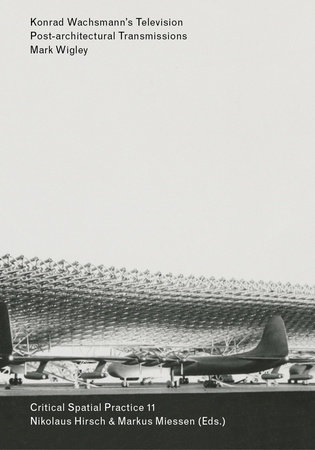
In this provocative intellectual biography, architectural historian Mark Wigley makes the surprising claim that the thinking behind modernist architect Konrad Wachsmann's legendary projects was dominated by the idea of television. Investigating the archives of one of the most influential designers of the twentieth century, Wigley scrutinizes Wachsmann's design, research, and teaching, closely reading a succession of unseen drawings, models, photographs, correspondence, publications, syllabi, reports, and manuscripts to argue that Wachsmann is an anti-architect—a student of some of the most influential designers of the 1920s who dedicated thirty-five post–Second World War years to the disappearance of architecture.
Wachsmann turned architecture against itself. His hypnotic projects for a new kind of space were organized around the thought that television enables a different way of living together. While architecture is typically embarrassed by television, preferring to act as if it never happened, Wachsmann fully embraced it. He dissolved buildings into pulsating mirages that influenced the experimental avant-gardes of the 1960s and 1970s; but Wigley demonstrates that this work was even more extreme than the experiments it inspired. Wigley's forensic analysis of a career shows that Wachsmann developed one of the most compelling manifestos of what architecture would need to become in the age of ubiquitous electronics.
In this provocative intellectual biography, architectural historian Mark Wigley makes the surprising claim that the thinking behind modernist architect Konrad Wachsmann's legendary projects was dominated by the idea of television. Investigating the archives of one of the most influential designers of the twentieth century, Wigley scrutinizes Wachsmann's design, research, and teaching, closely reading a succession of unseen drawings, models, photographs, correspondence, publications, syllabi, reports, and manuscripts to argue that Wachsmann is an anti-architect—a student of some of the most influential designers of the 1920s who dedicated thirty-five post–Second World War years to the disappearance of architecture.
Wachsmann turned architecture against itself. His hypnotic projects for a new kind of space were organized around the thought that television enables a different way of living together. While architecture is typically embarrassed by television, preferring to act as if it never happened, Wachsmann fully embraced it. He dissolved buildings into pulsating mirages that influenced the experimental avant-gardes of the 1960s and 1970s; but Wigley demonstrates that this work was even more extreme than the experiments it inspired. Wigley's forensic analysis of a career shows that Wachsmann developed one of the most compelling manifestos of what architecture would need to become in the age of ubiquitous electronics.