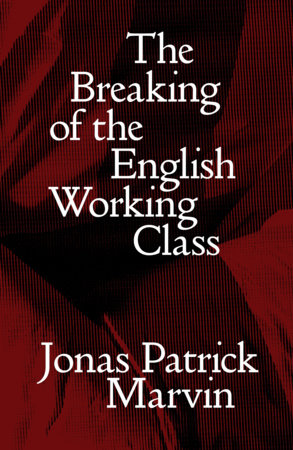
What has become of the English working class in the twenty-first century?
After a decades-long absence, class is once again central to our understanding of ailing Britain. But what does it mean to be working class today? As Jonas Patrick Marvin shows, questions of class have often been replaced by talk of race and geography. Meanwhile, a collective identity capable of pushing for change has become increasingly weakened and sidelined.
Retelling the story of the working class over the last forty years — from Thatcher’s war against the unions to New Labour neoliberalism – Marvin shows how power and capital have combined to shatter a radical identity into many parts: white, male, northerner, homeowner, immigrant, unemployed, disabled. These fragments are then set in conflict against each other. Blending political analysis with an account of his own experiences of class in London and the rustbelt Midlands, Marvin shows how the working class have been demonised and managed into impotence.
The working class is more than just an identity. As Marvin argues, it embodies a collective will to demand change, one that can — and must — be rekindled.
"A profound navigation of heartbreak, fury, and radical horizon, The Breaking of the English Working Class announces Jonas Marvin as a vital political voice – as well as a beautiful writer" —China Mieville, author of A Spectre, Haunting: On the Communist Manifesto
"A breath-taking phenomenology of class life in twenty-first century Britain. From the potbanks of the Potteries to the gig economy’s algorithmic discipline, from mass unemployment to managed abandonment, Jonas Marvin charts the tragedy of the British working-class and its decomposition — and possible revival — with impressive empirical and theoretical rigour. This is socialist history at its best, a history that seeks to retrieve from the rubble of past defeats the means of future victories." - Richard Seymour, author of Disaster Nationalism
"A reminder that class remains central to British capitalism. Marvin persuasively argues that so-called "left behind" areas of the UK are at the forefront of new modes of exploitation, and shows the relatively better off their likely futures. Unless we urgently forge a new class politics that embraces the diverse realities of lived working class experience that can take capital and its representatives on." - Phil Burton Cartledge, author of The Party's Over
Jonas Patrick Marvin is a writer, researcher and campaigner based in Stoke-on-Trent. He regularly contributes to Salvage and Novara Media and is a host of the popular podcast Life of the Party.
Preface Chapter One: Marx in the Potteries Chapter Two: Disorganised Abandonment Chapter Three: The Personal Society Chapter Four: The Long 90s Were Really Long Chapter Five: Whither Gravediggers? Conclusion: Good Life Syndrome
What has become of the English working class in the twenty-first century?
After a decades-long absence, class is once again central to our understanding of ailing Britain. But what does it mean to be working class today? As Jonas Patrick Marvin shows, questions of class have often been replaced by talk of race and geography. Meanwhile, a collective identity capable of pushing for change has become increasingly weakened and sidelined.
Retelling the story of the working class over the last forty years — from Thatcher’s war against the unions to New Labour neoliberalism – Marvin shows how power and capital have combined to shatter a radical identity into many parts: white, male, northerner, homeowner, immigrant, unemployed, disabled. These fragments are then set in conflict against each other. Blending political analysis with an account of his own experiences of class in London and the rustbelt Midlands, Marvin shows how the working class have been demonised and managed into impotence.
The working class is more than just an identity. As Marvin argues, it embodies a collective will to demand change, one that can — and must — be rekindled.
Praise
"A profound navigation of heartbreak, fury, and radical horizon, The Breaking of the English Working Class announces Jonas Marvin as a vital political voice – as well as a beautiful writer" —China Mieville, author of A Spectre, Haunting: On the Communist Manifesto
"A breath-taking phenomenology of class life in twenty-first century Britain. From the potbanks of the Potteries to the gig economy’s algorithmic discipline, from mass unemployment to managed abandonment, Jonas Marvin charts the tragedy of the British working-class and its decomposition — and possible revival — with impressive empirical and theoretical rigour. This is socialist history at its best, a history that seeks to retrieve from the rubble of past defeats the means of future victories." - Richard Seymour, author of Disaster Nationalism
"A reminder that class remains central to British capitalism. Marvin persuasively argues that so-called "left behind" areas of the UK are at the forefront of new modes of exploitation, and shows the relatively better off their likely futures. Unless we urgently forge a new class politics that embraces the diverse realities of lived working class experience that can take capital and its representatives on." - Phil Burton Cartledge, author of The Party's Over
Author
Jonas Patrick Marvin is a writer, researcher and campaigner based in Stoke-on-Trent. He regularly contributes to Salvage and Novara Media and is a host of the popular podcast Life of the Party.
Preface Chapter One: Marx in the Potteries Chapter Two: Disorganised Abandonment Chapter Three: The Personal Society Chapter Four: The Long 90s Were Really Long Chapter Five: Whither Gravediggers? Conclusion: Good Life Syndrome