Close Modal

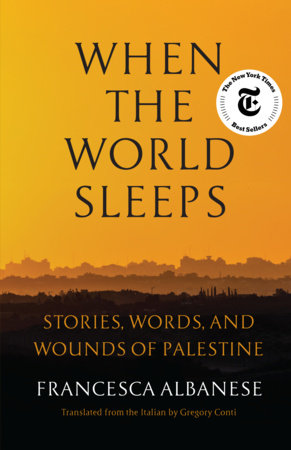
When the World Sleeps

Stories, Words, and Wounds of Palestine

Translated by Gregory Conti
Hardcover
$28.99 US
5.71"W x 8.53"H x 0.92"D   | 14 oz | 12 per carton
On sale Apr 28, 2026 | 256 Pages | 9781635426038

The first woman to serve as United Nations Special Rapporteur for the Occupied Palestinian Territory conveys the spirit of a people through 10 unforgettable stories of resilience and humanity.

Francesca Albanese is the most lucid voice against Israel’s apartheid policies in Gaza and the West Bank, a voice that has been heard around the world when it comes to speaking the truth about the Palestinian genocide. In the wake of October 7, 2023, and Israel’s retaliatory war, the renowned Italian jurist has become a lightning rod for her staunch defense of human rights. 

Reflecting on her years living in Jerusalem and her personal and professional journey toward understanding the Palestinian struggle, Albanese pays tribute to 10 people whose profoundly affecting stories opened her eyes, from Hind Rajab, a young Palestinian girl killed by Israeli forces, to the remarkable Jewish scholars who acted as Albanese’s mentors: forensic architect Eyal Weizman, trauma expert Gabor Maté, and Holocaust historian Alon Confino.

When the World Sleeps is a courageous testimony of the harsh reality that Palestinians face. It raises critical questions about the past, present, and future of Palestine: What are the consequences of the occupation? Where is a refugee’s home? In what conditions do Palestinians live? With the uncertain end of the war, will there be a Palestinian state? Will Palestinians have the right to self-determination, and will they be able to live in peace, free at last from the coercion of Israel?
“Incisive, heart-wrenching…an indispensable, at times deeply sickening, overview of the situation on the ground in Palestine.” —Publishers Weekly (starred review)

“Albanese’s chronicle humanizes the history that led to the October 7 attacks and the decimation that continues via a resonating chorus of global voices…The urgent necessity of Albanese’s reports is inarguable.” —Booklist

“A trenchant call for justice in the face of ‘the ferocity suffered by the Palestinian population.’” —Kirkus Reviews

“Braving a tidal wave of calumny, Francesca Albanese has not only upheld international law during a nihilistic assault on it by leaders of the world’s democracies. She has also helped keep alive the idea of individual conscience during an extensive moral and intellectual breakdown among writers and journalists. With its bold and lucid truths about the rich and powerful, and profound compassion for their victims, When the World Sleeps reminds us, in a dark time, of a still achievable nobility of the life of the mind.” —Pankaj Mishra, author of The World After Gaza

“Francesca Albanese is an outstanding international civil servant, a passionate jurist, and a formidable champion of Palestinian rights. Her humanity shines through everything she writes, notably her reports to the UN. In this book she writes with characteristic generosity of spirit about the people who helped her open her eyes and act for Palestine. A remarkable book by a brilliant, energetic, and exceptionally courageous woman.” —Avi Shlaim, emeritus professor of International Relations at Oxford University and author of Genocide in Gaza: Israel’s Long War on Palestine.

When the World Sleeps is a work of legal witnessing written from inside the collapse of the international order. Drawing on international law, lived encounters, interviews, and personal testimony, Francesca Albanese traces what it means to keep invoking law under conditions of emergency—even as legal institutions repeatedly fail to act. The book reflects a sustained engagement that refuses distance or safety, and a willingness to speak plainly within institutions structured to absorb and neutralize critique. Attentive to colonial relations without reducing the analysis solely to them, Albanese exposes the genocide in Gaza not as a failure of knowledge but of political will. In doing so, the book gives voice to what many already fearfully know: that international law can no longer rely on silent leadership, and must be upheld from the ground up or not at all. This is a necessary book to read, even for those who disagree with Albanese’s terms of engagement—perhaps especially so.” —Yael Berda, associate professor at The Hebrew University of Jerusalem and author of Living Emergency: Israel’s Permit Regime in the Occupied West Bank

“The voice of Francesca Albanese is as uncompromising in its commitment to human justice, as relentless in its appeal to our common humanity, and as courageous in face of slander, disdain, and suppression, as once the voice of the prophets.” —Göran Rosenberg, author of Israel, a Personal History
© LaPresse / Alamy
Francesca Albanese is the United Nations Special Rapporteur on the Occupied Palestinian Territory. A jurist, lecturer, and scholar, she has more than a decade of experience in human rights. She has worked with the UN Office of the High Commissioner for Human Rights and the UN Relief and Works Agency for Palestine Refugees in the Near East. In these roles, she has advised the United Nations, governments, and civil society in the Middle East, North Africa, and the Asia-Pacific region. View titles by Francesca Albanese
Hind

What is childhood in Palestine?


End of january 2024. Hind Rajab is six years old. She is curled up in the backseat of her uncle’s car, hunched together with four cousins. As soon as the umpteenth evacuation order arrived in the western area of Gaza, her mother and brothers fled on foot, but since it is raining and cold, her uncles have put her in the car with them.
It is early afternoon; the exploding bombs can be heard even inside the car, which seems to be stuck in a traffic jam. Something is not right. The uncles sense that, they’re agitated, talking frenetically. Not far from a gas station near Tel al-Hawa, the car happens onto a barrage of fire from Israeli artillery. Then a surreal cold. Hind looks around: No one is talking, and they are all slumped over. With her hands surely shaking, she takes the phone from between the fingers of her fifteen-year-old cousin Layan, who was hit while she was talking to the relief workers from the Red Crescent. Hind explains that “the others are dead or maybe they’re sleeping” and begs for help. “The tank is right next to me. It’s moving. Will you come to get me? I’m so afraid.”
On the other end of the line, the aide — struggling to control her fear, because she knows the risk that Hind is facing — answers with affection, “Habibti” (Honey), and stays on the phone with her so she won’t be alone.
After three hours on the phone — the time it took her colleagues from the Red Crescent to coordinate with the Israeli authorities to locate the car and get permission to rescue the little girl — the aide reassures Hind that two rescuers are on their way to help her. The recording of that heartrending conversation, with the little girl’s life hanging by a thread, has been conserved for history and hopefully, one day, for the judges who will punish those responsible for the massacre in which Hind was killed by the Israeli army.
Twelve days later, Hind’s lifeless body would be found in the car that was riddled with more than three hundred bullet holes, not far from the ambulance that contained the dead bodies of her rescuers, who had been killed by the Israeli army. The investigation by the British team from Forensic Architecture led by Eyal Weizman, after reconstructing the distances and the dynamics of the gunfire, demonstrated that it is “not plausible” that the Israeli soldiers who shot at the car from the tank could not have seen that the car was occupied by civilians, including the little girls.

Hind’s story has become a symbol of the brutality of the Israeli assault on the population of Gaza in the days following October 7, 2023. But Hind was killed more than three months after October 7th, when Israel had already killed ten thousand children. How is it possible to tolerate all this killing? And how is it possible that still today — as I am completing the revision of this book at the end of August 2025 — when the number of dead children has come to exceed twenty thousand, of whom more than one thousand were less than one year old, that impunity continues to reign and the death machine set in motion by Israel has not been stopped?
The answer lies in decades of narrative manipulation that has distorted the perception of the balance of power between Israelis and Palestinians.
In recent decades, this narrative has led many to believe that the Palestinians are to blame for their situation, that they are an existential threat to Israel. Even the children? Yes, even them, and maybe especially them, because in the logic of the Israeli assault begun on October 7th, every Palestine life is seen as a potential future danger to the survival of Israel.
Hind’s story, as atrocious as it is, is not an unusual one in Palestine. Mohammed Tamimi was two years old when, a few months before October 7, 2023, the Israeli occupation forces — formally known as the Israel Defense Forces — shot him in the head while he was in a car with his father in the occupied West Bank. No one has been held responsible, as usual.
This is childhood in Palestine.

In Jerusalem, next to the garden of the house where my Max and I lived, there was a small hill with a huge, incredible, generous mulberry tree, which bore fruit for months on end. A purple carpet of fallen mulberries always formed under that tree, and children often came to gather them.
Just below the house there was a low stone wall with a piece of metal fencing, which must have been added to the wall years before, temporarily, but had been left in place. The children, by repeatedly slipping under the fence to come and get mulberries, had made their own passageway. One fine day, I saw them and said: “Hi guys, when you want mulberries, if you knock on my door I’ll open it, so you don’t have to go under the fence.” Most of them didn’t understand me, because almost none of them spoke English, except for a little boy with dark eyes, whom I had already noticed in the area with his friends and twin sister.
“Hi,” I repeated then, addressing him directly. “I know you are from this neighborhood, I have seen you playing a lot of times. When you want mulberries, don’t worry, just call us, so you don’t risk hurting yourselves by slipping under the fence.”
His answer, respectful but firm, left me stunned.
“No, thank you,” he told me. “There’s no need to leave the gate open for us. We will continue to take them like this, slipping under the fence, as we have always done.”
At eleven, little Mohammed already seemed very assertive to me. His family had been one of the first in the Sheikh Jarrah neighborhood to have their house expropriated by Israeli settlers — armed civilians who populate the colonies (“settlements” in common parlance) in the West Bank and East Jerusalem with the support of the army. Rifqa, the grandmother of Mohammed and his twin sister, Muna, had taken refuge there in 1948 after being driven out of Haifa (now in Israel). At the end of a long legal battle, in 2009 the main complex of their property was occupied by Israeli settlers, while the El-Kurd family had to build, in the garden, an extension of the house where all the family members were forced to live.
Mohammed’s reaction surprised me, because it is not obvious that a child of eleven — or seven, twelve, fourteen — has that kind of awareness of their rights, of their space, their identity. But for the Palestinians who have grown up under occupation, as well as for the millions of them born in the refugee camps scattered throughout Palestine, that’s how it is. Generations of people have grown up seeing their land, day after day, continuously pulled out from under their feet like a carpet, fueling an endless struggle for housing, for dignity, for everything that should be taken for granted in childhood. Palestinians have their childhood stripped away from them, they become adults with the bodies of children already burdened by worries, anxieties, fears, responsibilities that should not be part of their lives at that age.
That is why, as UN Special Rapporteur on human rights in the Occupied Palestinian Territory, I decided in 2023 to dedicate my third report to children, using a word from the English language that vividly describes the Palestinian reality: unchilding, or “deprived of childhood.” The choice of this theme was rooted in the hope that showing what life was really like for a child in Palestine, along with statistical and legal information, could help the public better understand the gravity of the situation.
When I conducted my research, everything was different from today: The report was presented two weeks after October 7, 2023, but it had been finished two weeks earlier. The situation was already terrible.
At that point in the autumn, the figures for Palestinian children killed by Israel in fifteen years (from 2008 to September 2023) were brutal: more than one thousand four hundred. Each of them, a small universe erased forever. From October 7, 2023 to March 2025, these already gruesome numbers have increased tenfold.
In Gaza, in August 2024, Mohammed Abu al-Qumsan was requesting birth certificates for his three-day-old twins, when he received a call: Your apartment has been bombed, your children and your wife are in the hospital. There was nothing that could be done for them. Dead before even opening their eyes to life.
This is childhood, in Palestine.
In 2023, not having received the necessary authorizations from the Israeli government to conduct my research in the Occupied Palestinian Territory in preparation of the report for the UN General Assembly of that autumn, I decided to take an alternative approach. With the support of Palestinian civil society and other collaborators, we created focus groups that allowed me to interview Palestinian children online.
At the time, I was on vacation with my family in Sicily, with my children’s grandparents (my in-laws). Every afternoon, after having lunch with my children and taking a quick dip in the sea, I got ready to go up to the beach-club terrace, where, with my computer plugged into one of the few available power sockets, I began the meetings that lasted for several hours.
The groups of children and adolescents interviewed soon proved to be well structured and disciplined. Divided by age and geographical location, both my young interlocutors and their parents and companions were enthusiastic to have the opportunity to share their experiences and accounts with me. Gathered around a table, or sitting on chairs sometimes taller than they were (as for the children in Jenin), they were all very attentive in front of the screen. Somebody translated, even though, especially in Gaza, most of the children spoke English well and so I could interact directly, without the need for mediation.
Those encounters put me in front of an authentic miracle of life, vitality, and tenderness, a setting in which energy and hope seemed to persist despite adversity. In the midst of all the difficulties of the permanent occupation, of the incessant wars in Gaza, where the de facto state of siege made everyone prisoners of a ghetto, along with the devastating proximity of Israeli colonies in the West Bank, and constant attacks by soldiers and settlers, the children I met that summer demonstrated an extraordinary ability to preserve fundamental values. Above all, their love for school. And then their manners and care for their appearance, especially in front of strangers. The boys wore elegant shirts for the occasion with their hair well combed and stiffened with gel, and the girls were in colorful dresses, their long hair gathered in a scarf or hanging free down to their shoulders; their voices spoke to me of a great thirst for knowledge and a burning desire for the future.
This, too, is childhood in Palestine.

One aspect that struck me deeply, especially in the beginning, taught me something about myself and the prejudices that we sometimes involuntarily carry with us: The children were extremely prepared when it came to less personal and more general topics. Whether they were talking about problems related to water supply, education, or freedom of movement, they talked about the violations they suffered with a language so precise and assertive that it seemed almost artificial, constructed. “They sound like little lawyers,” I thought. But I soon realized that there was nothing strange about their ability to argue and interact. “They are not my children, who go to school, play, and lead a protected and cushioned life,” I told myself, realizing that those kids were used to hurtful and scary experiences, so it was understandable that for them talking about human rights could turn into a cry for life, an impassioned demand for answers.
How is it possible that this is happening to us, when on paper so many rights should be guaranteed for everyone? It is a question that resonates strongly among Palestinian children, a call to a justice that often seems to be unreachable. While my eight-year-old son has to worry only about memorizing the multiplication tables, the children of Palestine learn and speak the language of law to express their claim to their lives, their humanity. So, paradoxically, it was precisely because they had to defend their right to exist, to be children, that at times they became their own advocates, carrying an incredible burden on their shoulders.
An ancient burden, which has been borne by their society for generations: It is for this reason, I believe, that in their innocence they also demonstrated such a deep-seated awareness of injustice. It takes superhuman courage for a child to face the awareness of oppression: that state of permanent war, being separated from all the other Palestinians in the world, not being able to travel, or even dream about the simplest things in life.
For me, on those Sicilian summer days it was paradoxical to move a few meters from the world around me — a world in which my most important questions were “Have the children eaten?,” “What have they been doing?,” “Who is fighting with whom?,” “Who has eaten two ice creams behind my back?” — to spend every afternoon with the children of Gaza City, Khan Yunis, Jerusalem, Bethlehem, Nablus, Ramallah, or Masafer Yatta, and let myself be absorbed in another, completely different dimension.
On some rare occasions it also happened that my son, Giordano, who was six years old at the time, with the spontaneity typical of his age, would come over to see who I was talking to, unmindful of being in a bathing suit. I remember that one day a child asked me: “Why isn’t he dressed?”
“Because we are at the seaside,” I replied. But that day I was talking with children who had never been to the sea, who had been trapped in the West Bank since they were born. We had many more meetings with children living in the West Bank than with those in the Gaza Strip, because the logistics were more difficult in Gaza: It was difficult, for example, to organize buses to pick them up or have them accompanied by their parents, often because of the hundreds of checkpoints, fixed and mobile, created by the Israeli army to “monitor” the movements of Gazans. We had to organize many different dates, each with groups of only four or five children whose members often changed from time to time. They would be waiting for me, sitting composed, excited, and prepared with what they wanted to tell me. I let them speak. I had already collected data on wars, attacks, the destruction of houses, hospitals, schools, evictions, killings, arrests, and so I wanted them above all to talk about their lives: their homes, their games, their travels, their families, so that the report I was drawing up would be “theirs,” and speak, as much as possible, in their voices.
The focus groups never lasted less than a couple of hours; toward the end, after we had gotten to know each other for a while, I felt ready to ask, “Is there anything that scares you?” Inevitably, everyone talked about death. The greatest fear of these children was of dying or losing their parents. Second on the list, being arrested; third, “that they’ll knock down my house.” These are the most frequent fears of Palestinian children. This is how they grow up. That alone seems to me to be an unfathomable brutality.
“We have to fight for the right to breathe, to stay here, to stay in our land without having to suffer every day,” said Rawan, eleven years old. And Aladdin, fourteen: “We always have to run away from some danger, if it’s not the soldiers, it’s the settlers.”
In the descriptions of the children and young people I spoke to, I heard an infinite number of stories where violence and fear were expressed in myriad ways: the violence of checkpoints, the loss of Dad’s job, being slapped, beaten, stripped naked in public, the threats of someone taking your land or forcing your parents to humiliate themselves, the suffering for the lack of parents at home, because, if they are arrested or killed, then you have to grow up with some relative, near or far, who certainly loves you, but is neither Mom nor Dad.
That’s what Palestinian children’s daily lives were like, even before October 7, 2023. “They were bombing us from all sides, they were everywhere, we were very afraid that our parents could die,” Yasmine, sixteen, told me, who at that point had already experienced five wars in Gaza. And this is the story of Samer, eleven years old: “My father was killed near a settlement by soldiers. They said he was violent . . . Not only did I lose the most important person in my life but they also came to take our house. First I became an orphan, then they left me homeless.” Fares, age twelve, said: “Last year the soldiers attacked my school three or four times. They launched tear gas canisters and fired live ammunition. Many of the teachers and my classmates couldn’t breathe.”
This is childhood in Palestine.

About

The first woman to serve as United Nations Special Rapporteur for the Occupied Palestinian Territory conveys the spirit of a people through 10 unforgettable stories of resilience and humanity.

Francesca Albanese is the most lucid voice against Israel’s apartheid policies in Gaza and the West Bank, a voice that has been heard around the world when it comes to speaking the truth about the Palestinian genocide. In the wake of October 7, 2023, and Israel’s retaliatory war, the renowned Italian jurist has become a lightning rod for her staunch defense of human rights. 

Reflecting on her years living in Jerusalem and her personal and professional journey toward understanding the Palestinian struggle, Albanese pays tribute to 10 people whose profoundly affecting stories opened her eyes, from Hind Rajab, a young Palestinian girl killed by Israeli forces, to the remarkable Jewish scholars who acted as Albanese’s mentors: forensic architect Eyal Weizman, trauma expert Gabor Maté, and Holocaust historian Alon Confino.

When the World Sleeps is a courageous testimony of the harsh reality that Palestinians face. It raises critical questions about the past, present, and future of Palestine: What are the consequences of the occupation? Where is a refugee’s home? In what conditions do Palestinians live? With the uncertain end of the war, will there be a Palestinian state? Will Palestinians have the right to self-determination, and will they be able to live in peace, free at last from the coercion of Israel?

Praise

“Incisive, heart-wrenching…an indispensable, at times deeply sickening, overview of the situation on the ground in Palestine.” —Publishers Weekly (starred review)

“Albanese’s chronicle humanizes the history that led to the October 7 attacks and the decimation that continues via a resonating chorus of global voices…The urgent necessity of Albanese’s reports is inarguable.” —Booklist

“A trenchant call for justice in the face of ‘the ferocity suffered by the Palestinian population.’” —Kirkus Reviews

“Braving a tidal wave of calumny, Francesca Albanese has not only upheld international law during a nihilistic assault on it by leaders of the world’s democracies. She has also helped keep alive the idea of individual conscience during an extensive moral and intellectual breakdown among writers and journalists. With its bold and lucid truths about the rich and powerful, and profound compassion for their victims, When the World Sleeps reminds us, in a dark time, of a still achievable nobility of the life of the mind.” —Pankaj Mishra, author of The World After Gaza

“Francesca Albanese is an outstanding international civil servant, a passionate jurist, and a formidable champion of Palestinian rights. Her humanity shines through everything she writes, notably her reports to the UN. In this book she writes with characteristic generosity of spirit about the people who helped her open her eyes and act for Palestine. A remarkable book by a brilliant, energetic, and exceptionally courageous woman.” —Avi Shlaim, emeritus professor of International Relations at Oxford University and author of Genocide in Gaza: Israel’s Long War on Palestine.

When the World Sleeps is a work of legal witnessing written from inside the collapse of the international order. Drawing on international law, lived encounters, interviews, and personal testimony, Francesca Albanese traces what it means to keep invoking law under conditions of emergency—even as legal institutions repeatedly fail to act. The book reflects a sustained engagement that refuses distance or safety, and a willingness to speak plainly within institutions structured to absorb and neutralize critique. Attentive to colonial relations without reducing the analysis solely to them, Albanese exposes the genocide in Gaza not as a failure of knowledge but of political will. In doing so, the book gives voice to what many already fearfully know: that international law can no longer rely on silent leadership, and must be upheld from the ground up or not at all. This is a necessary book to read, even for those who disagree with Albanese’s terms of engagement—perhaps especially so.” —Yael Berda, associate professor at The Hebrew University of Jerusalem and author of Living Emergency: Israel’s Permit Regime in the Occupied West Bank

“The voice of Francesca Albanese is as uncompromising in its commitment to human justice, as relentless in its appeal to our common humanity, and as courageous in face of slander, disdain, and suppression, as once the voice of the prophets.” —Göran Rosenberg, author of Israel, a Personal History

Author

© LaPresse / Alamy
Francesca Albanese is the United Nations Special Rapporteur on the Occupied Palestinian Territory. A jurist, lecturer, and scholar, she has more than a decade of experience in human rights. She has worked with the UN Office of the High Commissioner for Human Rights and the UN Relief and Works Agency for Palestine Refugees in the Near East. In these roles, she has advised the United Nations, governments, and civil society in the Middle East, North Africa, and the Asia-Pacific region. View titles by Francesca Albanese

Excerpt

Hind

What is childhood in Palestine?


End of january 2024. Hind Rajab is six years old. She is curled up in the backseat of her uncle’s car, hunched together with four cousins. As soon as the umpteenth evacuation order arrived in the western area of Gaza, her mother and brothers fled on foot, but since it is raining and cold, her uncles have put her in the car with them.
It is early afternoon; the exploding bombs can be heard even inside the car, which seems to be stuck in a traffic jam. Something is not right. The uncles sense that, they’re agitated, talking frenetically. Not far from a gas station near Tel al-Hawa, the car happens onto a barrage of fire from Israeli artillery. Then a surreal cold. Hind looks around: No one is talking, and they are all slumped over. With her hands surely shaking, she takes the phone from between the fingers of her fifteen-year-old cousin Layan, who was hit while she was talking to the relief workers from the Red Crescent. Hind explains that “the others are dead or maybe they’re sleeping” and begs for help. “The tank is right next to me. It’s moving. Will you come to get me? I’m so afraid.”
On the other end of the line, the aide — struggling to control her fear, because she knows the risk that Hind is facing — answers with affection, “Habibti” (Honey), and stays on the phone with her so she won’t be alone.
After three hours on the phone — the time it took her colleagues from the Red Crescent to coordinate with the Israeli authorities to locate the car and get permission to rescue the little girl — the aide reassures Hind that two rescuers are on their way to help her. The recording of that heartrending conversation, with the little girl’s life hanging by a thread, has been conserved for history and hopefully, one day, for the judges who will punish those responsible for the massacre in which Hind was killed by the Israeli army.
Twelve days later, Hind’s lifeless body would be found in the car that was riddled with more than three hundred bullet holes, not far from the ambulance that contained the dead bodies of her rescuers, who had been killed by the Israeli army. The investigation by the British team from Forensic Architecture led by Eyal Weizman, after reconstructing the distances and the dynamics of the gunfire, demonstrated that it is “not plausible” that the Israeli soldiers who shot at the car from the tank could not have seen that the car was occupied by civilians, including the little girls.

Hind’s story has become a symbol of the brutality of the Israeli assault on the population of Gaza in the days following October 7, 2023. But Hind was killed more than three months after October 7th, when Israel had already killed ten thousand children. How is it possible to tolerate all this killing? And how is it possible that still today — as I am completing the revision of this book at the end of August 2025 — when the number of dead children has come to exceed twenty thousand, of whom more than one thousand were less than one year old, that impunity continues to reign and the death machine set in motion by Israel has not been stopped?
The answer lies in decades of narrative manipulation that has distorted the perception of the balance of power between Israelis and Palestinians.
In recent decades, this narrative has led many to believe that the Palestinians are to blame for their situation, that they are an existential threat to Israel. Even the children? Yes, even them, and maybe especially them, because in the logic of the Israeli assault begun on October 7th, every Palestine life is seen as a potential future danger to the survival of Israel.
Hind’s story, as atrocious as it is, is not an unusual one in Palestine. Mohammed Tamimi was two years old when, a few months before October 7, 2023, the Israeli occupation forces — formally known as the Israel Defense Forces — shot him in the head while he was in a car with his father in the occupied West Bank. No one has been held responsible, as usual.
This is childhood in Palestine.

In Jerusalem, next to the garden of the house where my Max and I lived, there was a small hill with a huge, incredible, generous mulberry tree, which bore fruit for months on end. A purple carpet of fallen mulberries always formed under that tree, and children often came to gather them.
Just below the house there was a low stone wall with a piece of metal fencing, which must have been added to the wall years before, temporarily, but had been left in place. The children, by repeatedly slipping under the fence to come and get mulberries, had made their own passageway. One fine day, I saw them and said: “Hi guys, when you want mulberries, if you knock on my door I’ll open it, so you don’t have to go under the fence.” Most of them didn’t understand me, because almost none of them spoke English, except for a little boy with dark eyes, whom I had already noticed in the area with his friends and twin sister.
“Hi,” I repeated then, addressing him directly. “I know you are from this neighborhood, I have seen you playing a lot of times. When you want mulberries, don’t worry, just call us, so you don’t risk hurting yourselves by slipping under the fence.”
His answer, respectful but firm, left me stunned.
“No, thank you,” he told me. “There’s no need to leave the gate open for us. We will continue to take them like this, slipping under the fence, as we have always done.”
At eleven, little Mohammed already seemed very assertive to me. His family had been one of the first in the Sheikh Jarrah neighborhood to have their house expropriated by Israeli settlers — armed civilians who populate the colonies (“settlements” in common parlance) in the West Bank and East Jerusalem with the support of the army. Rifqa, the grandmother of Mohammed and his twin sister, Muna, had taken refuge there in 1948 after being driven out of Haifa (now in Israel). At the end of a long legal battle, in 2009 the main complex of their property was occupied by Israeli settlers, while the El-Kurd family had to build, in the garden, an extension of the house where all the family members were forced to live.
Mohammed’s reaction surprised me, because it is not obvious that a child of eleven — or seven, twelve, fourteen — has that kind of awareness of their rights, of their space, their identity. But for the Palestinians who have grown up under occupation, as well as for the millions of them born in the refugee camps scattered throughout Palestine, that’s how it is. Generations of people have grown up seeing their land, day after day, continuously pulled out from under their feet like a carpet, fueling an endless struggle for housing, for dignity, for everything that should be taken for granted in childhood. Palestinians have their childhood stripped away from them, they become adults with the bodies of children already burdened by worries, anxieties, fears, responsibilities that should not be part of their lives at that age.
That is why, as UN Special Rapporteur on human rights in the Occupied Palestinian Territory, I decided in 2023 to dedicate my third report to children, using a word from the English language that vividly describes the Palestinian reality: unchilding, or “deprived of childhood.” The choice of this theme was rooted in the hope that showing what life was really like for a child in Palestine, along with statistical and legal information, could help the public better understand the gravity of the situation.
When I conducted my research, everything was different from today: The report was presented two weeks after October 7, 2023, but it had been finished two weeks earlier. The situation was already terrible.
At that point in the autumn, the figures for Palestinian children killed by Israel in fifteen years (from 2008 to September 2023) were brutal: more than one thousand four hundred. Each of them, a small universe erased forever. From October 7, 2023 to March 2025, these already gruesome numbers have increased tenfold.
In Gaza, in August 2024, Mohammed Abu al-Qumsan was requesting birth certificates for his three-day-old twins, when he received a call: Your apartment has been bombed, your children and your wife are in the hospital. There was nothing that could be done for them. Dead before even opening their eyes to life.
This is childhood, in Palestine.
In 2023, not having received the necessary authorizations from the Israeli government to conduct my research in the Occupied Palestinian Territory in preparation of the report for the UN General Assembly of that autumn, I decided to take an alternative approach. With the support of Palestinian civil society and other collaborators, we created focus groups that allowed me to interview Palestinian children online.
At the time, I was on vacation with my family in Sicily, with my children’s grandparents (my in-laws). Every afternoon, after having lunch with my children and taking a quick dip in the sea, I got ready to go up to the beach-club terrace, where, with my computer plugged into one of the few available power sockets, I began the meetings that lasted for several hours.
The groups of children and adolescents interviewed soon proved to be well structured and disciplined. Divided by age and geographical location, both my young interlocutors and their parents and companions were enthusiastic to have the opportunity to share their experiences and accounts with me. Gathered around a table, or sitting on chairs sometimes taller than they were (as for the children in Jenin), they were all very attentive in front of the screen. Somebody translated, even though, especially in Gaza, most of the children spoke English well and so I could interact directly, without the need for mediation.
Those encounters put me in front of an authentic miracle of life, vitality, and tenderness, a setting in which energy and hope seemed to persist despite adversity. In the midst of all the difficulties of the permanent occupation, of the incessant wars in Gaza, where the de facto state of siege made everyone prisoners of a ghetto, along with the devastating proximity of Israeli colonies in the West Bank, and constant attacks by soldiers and settlers, the children I met that summer demonstrated an extraordinary ability to preserve fundamental values. Above all, their love for school. And then their manners and care for their appearance, especially in front of strangers. The boys wore elegant shirts for the occasion with their hair well combed and stiffened with gel, and the girls were in colorful dresses, their long hair gathered in a scarf or hanging free down to their shoulders; their voices spoke to me of a great thirst for knowledge and a burning desire for the future.
This, too, is childhood in Palestine.

One aspect that struck me deeply, especially in the beginning, taught me something about myself and the prejudices that we sometimes involuntarily carry with us: The children were extremely prepared when it came to less personal and more general topics. Whether they were talking about problems related to water supply, education, or freedom of movement, they talked about the violations they suffered with a language so precise and assertive that it seemed almost artificial, constructed. “They sound like little lawyers,” I thought. But I soon realized that there was nothing strange about their ability to argue and interact. “They are not my children, who go to school, play, and lead a protected and cushioned life,” I told myself, realizing that those kids were used to hurtful and scary experiences, so it was understandable that for them talking about human rights could turn into a cry for life, an impassioned demand for answers.
How is it possible that this is happening to us, when on paper so many rights should be guaranteed for everyone? It is a question that resonates strongly among Palestinian children, a call to a justice that often seems to be unreachable. While my eight-year-old son has to worry only about memorizing the multiplication tables, the children of Palestine learn and speak the language of law to express their claim to their lives, their humanity. So, paradoxically, it was precisely because they had to defend their right to exist, to be children, that at times they became their own advocates, carrying an incredible burden on their shoulders.
An ancient burden, which has been borne by their society for generations: It is for this reason, I believe, that in their innocence they also demonstrated such a deep-seated awareness of injustice. It takes superhuman courage for a child to face the awareness of oppression: that state of permanent war, being separated from all the other Palestinians in the world, not being able to travel, or even dream about the simplest things in life.
For me, on those Sicilian summer days it was paradoxical to move a few meters from the world around me — a world in which my most important questions were “Have the children eaten?,” “What have they been doing?,” “Who is fighting with whom?,” “Who has eaten two ice creams behind my back?” — to spend every afternoon with the children of Gaza City, Khan Yunis, Jerusalem, Bethlehem, Nablus, Ramallah, or Masafer Yatta, and let myself be absorbed in another, completely different dimension.
On some rare occasions it also happened that my son, Giordano, who was six years old at the time, with the spontaneity typical of his age, would come over to see who I was talking to, unmindful of being in a bathing suit. I remember that one day a child asked me: “Why isn’t he dressed?”
“Because we are at the seaside,” I replied. But that day I was talking with children who had never been to the sea, who had been trapped in the West Bank since they were born. We had many more meetings with children living in the West Bank than with those in the Gaza Strip, because the logistics were more difficult in Gaza: It was difficult, for example, to organize buses to pick them up or have them accompanied by their parents, often because of the hundreds of checkpoints, fixed and mobile, created by the Israeli army to “monitor” the movements of Gazans. We had to organize many different dates, each with groups of only four or five children whose members often changed from time to time. They would be waiting for me, sitting composed, excited, and prepared with what they wanted to tell me. I let them speak. I had already collected data on wars, attacks, the destruction of houses, hospitals, schools, evictions, killings, arrests, and so I wanted them above all to talk about their lives: their homes, their games, their travels, their families, so that the report I was drawing up would be “theirs,” and speak, as much as possible, in their voices.
The focus groups never lasted less than a couple of hours; toward the end, after we had gotten to know each other for a while, I felt ready to ask, “Is there anything that scares you?” Inevitably, everyone talked about death. The greatest fear of these children was of dying or losing their parents. Second on the list, being arrested; third, “that they’ll knock down my house.” These are the most frequent fears of Palestinian children. This is how they grow up. That alone seems to me to be an unfathomable brutality.
“We have to fight for the right to breathe, to stay here, to stay in our land without having to suffer every day,” said Rawan, eleven years old. And Aladdin, fourteen: “We always have to run away from some danger, if it’s not the soldiers, it’s the settlers.”
In the descriptions of the children and young people I spoke to, I heard an infinite number of stories where violence and fear were expressed in myriad ways: the violence of checkpoints, the loss of Dad’s job, being slapped, beaten, stripped naked in public, the threats of someone taking your land or forcing your parents to humiliate themselves, the suffering for the lack of parents at home, because, if they are arrested or killed, then you have to grow up with some relative, near or far, who certainly loves you, but is neither Mom nor Dad.
That’s what Palestinian children’s daily lives were like, even before October 7, 2023. “They were bombing us from all sides, they were everywhere, we were very afraid that our parents could die,” Yasmine, sixteen, told me, who at that point had already experienced five wars in Gaza. And this is the story of Samer, eleven years old: “My father was killed near a settlement by soldiers. They said he was violent . . . Not only did I lose the most important person in my life but they also came to take our house. First I became an orphan, then they left me homeless.” Fares, age twelve, said: “Last year the soldiers attacked my school three or four times. They launched tear gas canisters and fired live ammunition. Many of the teachers and my classmates couldn’t breathe.”
This is childhood in Palestine.