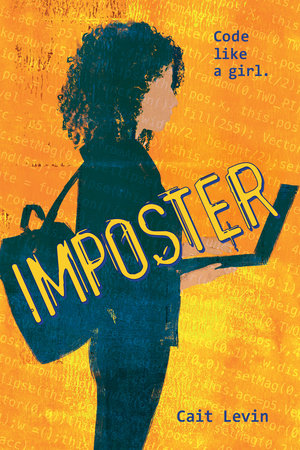
A high school sophomore learns how to code—and how to fight back against gender discrimination.
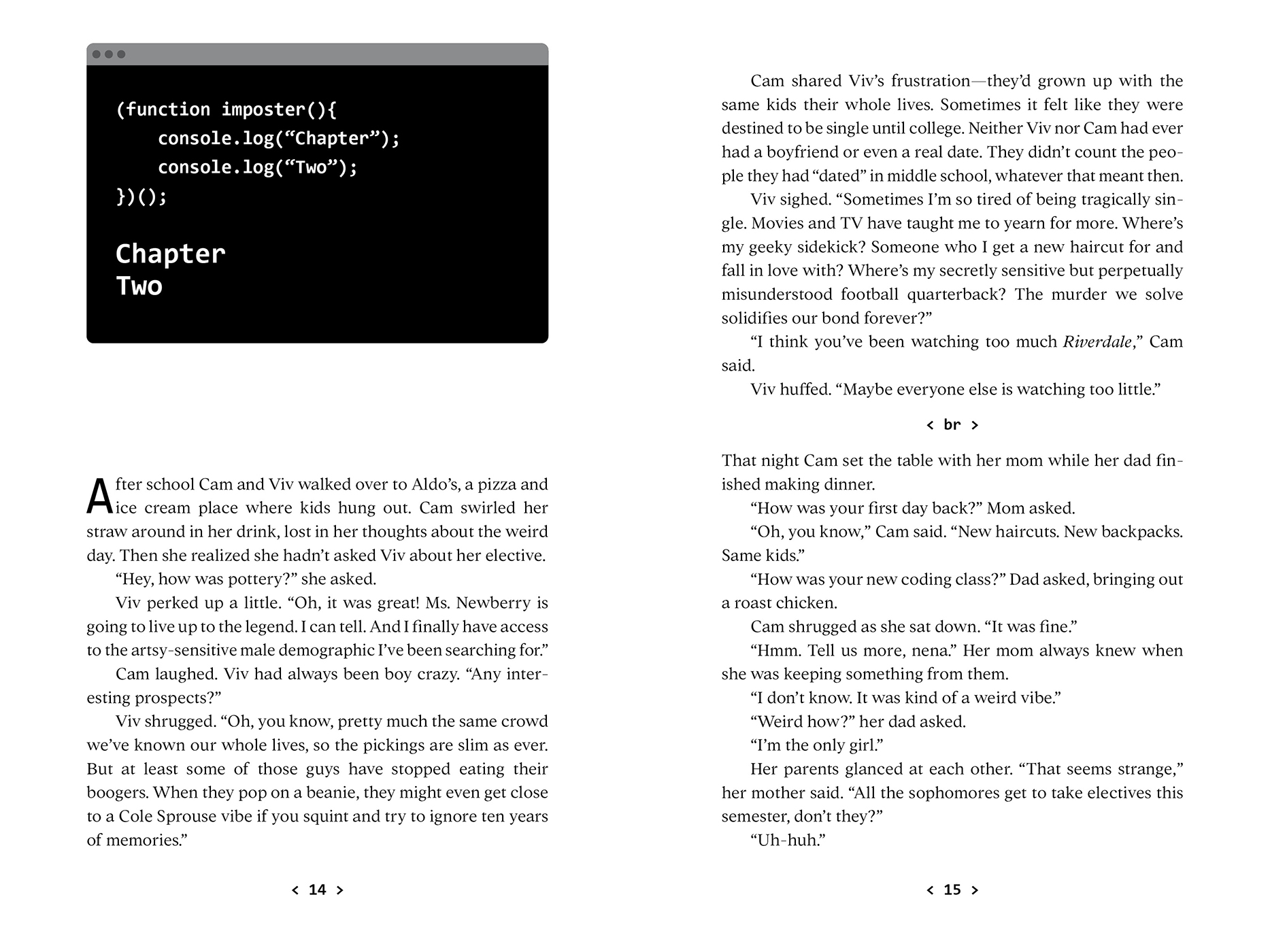
Cameron Goldberg, whose Jewish parents are Panamanian and American (implied white), and her best friend, Vivian Knix, finally get to enroll in electives now that they’re entering 10th grade. Cam, a maker who loves to tinker, has chosen Introduction to Computer Science, but when she finds she’s the only girl in the class, and even the teacher is surprised to see her there, she starts to realize just how unwelcoming tech can be to women. Determined, she and classmate Jackson design a game that features a woman main character who fights—literally—the forces of prejudice she faces in the industry. Cam and Viv also join an all-boys competitive robotics team, where their significant contributions are ultimately celebrated, although they endure repeated discrimination, especially from one of the club’s copresidents. This affirming debut shines a light on the ways women and girls are often made to feel like imposters in STEM fields. With believable dialogue, snappy pacing, and clever use of coding elements for chapter headings and section breaks (the latter are denoted by "br"), Levin’s novel is a thoroughly engaging read that gives powerful voice to an important issue without coming across as preachy.
An inspiring, unapologetically feminist takedown of misogyny in STEM culture.
—Kirkus Reviews
Sophomore Cam is excited about the computer science class she can finally take. But she is the only girl in the class, and the boys are not shy about letting her know that she is not welcome. The teacher barely acknowledges her and does nothing to stop the unpleasantness. Cam is determined to stick it out, especially when she reads about the difficulties women face in STEM fields. She combats her situation by pairing with Jackson, the other sophomore, for a class project, and they create a game that reflects the issues Cam reads about. Then she joins the RoboSub team with her friend Viv. As she expands her skill set, she starts to receive the respect and recognition she deserves. Cam is feisty and fun, even when her imposter syndrome takes hold. Best friend Viv is assertive and confident, especially when she can operate in her wheelhouse, marketing. The other characters are familiar: supportive parents, teachers (both dedicated and not), and boys who can accept a girl into coding. For STEM girls everywhere.
—Booklist
Cameron, a high school sophomore who loves building tech things, finally gets the chance to take a computer science class, but overcoming biases prove more challenging than the curriculum. As the only girl in the class, Cam experiences imposter syndrome, doubting her abilities and fearing that the rest of the class will find her to be a fraud, despite the fact that she is smart and learns to code on her own. She and her best friend Vivian join the RoboSub Team, where Viv finds her niche as the PR and fundraising chair, and Cam works with the electrical team. Cam is driven to research women in STEM fields, and what she discovers inspires her to create a video game with moody, game-obsessed Jackson for their class project. This leads to more trouble, and accusations of discrimination, but Cam is eventually cleared and encouraged to start a chapter of Girls Who Code at her school. The author’s connection to RoboNation, sponsor of the RoboSub competition, brings authenticity to the story; however, discrimination in tech fields is the sole conflict in the book. While the characters are diverse, well-defined, and likable, they sometimes resemble one-dimensional caricatures. There is no sex or drug use in the plot, only mild romance; there is mention of alcohol consumption with repercussions; there is frequent use of profanity. VERDICT Reluctant readers, especially girls in middle and high school who are interested in STEM, will appreciate this tenacious heroine who believes in herself and doesn’t give up when faced with discrimination.
—School Library Journal
Cait Levin’s Imposter is far more than a novel—it’s a testament to the transformative power of STEM education and an ode to the courage and tenacity of young innovators. Told through the eyes of Cam, a high school student navigating the challenges of joining her school’s RoboSub team, this story is a moving reminder of the grit, perseverance, and camaraderie that define the RoboNation community.
Cam’s story echoes the experiences of so many students who come through RoboNation programs, from RoboSub to SeaPerch, and everything in between. It’s about finding strength in the face of adversity, learning to lean on your community, and discovering that success isn’t just about winning a competition.
—Alicia Gavin, Director of Communications and Marketing at RoboNation
Imposter is emotionally resonant. Levin expertly captures the anxiety of the unfortunate realities of gender inequities in STEM balanced with the joy of friendship, the thrill of learning something new, and the triumph of taking a stand against injustice.
—Erin Bond, Code.org engineer