Close Modal

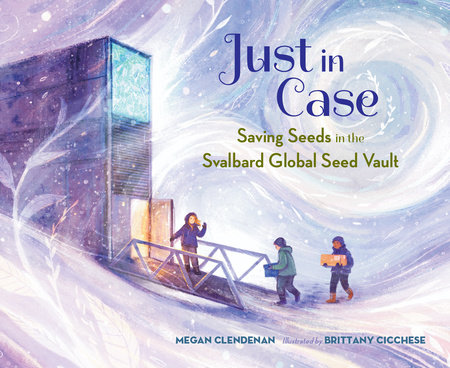
Just in Case

Saving Seeds in the Svalbard Global Seed Vault

Illustrated by Brittany Cicchese
Look inside
Hardcover
$17.99 US
11.44"W x 9.31"H x 0.43"D   | 17 oz | 30 per carton
On sale Oct 14, 2025 | 32 Pages | 9781623544805
Age 5-8 years | Grades K-3
Reading Level: Lexile 850L

additional book photo
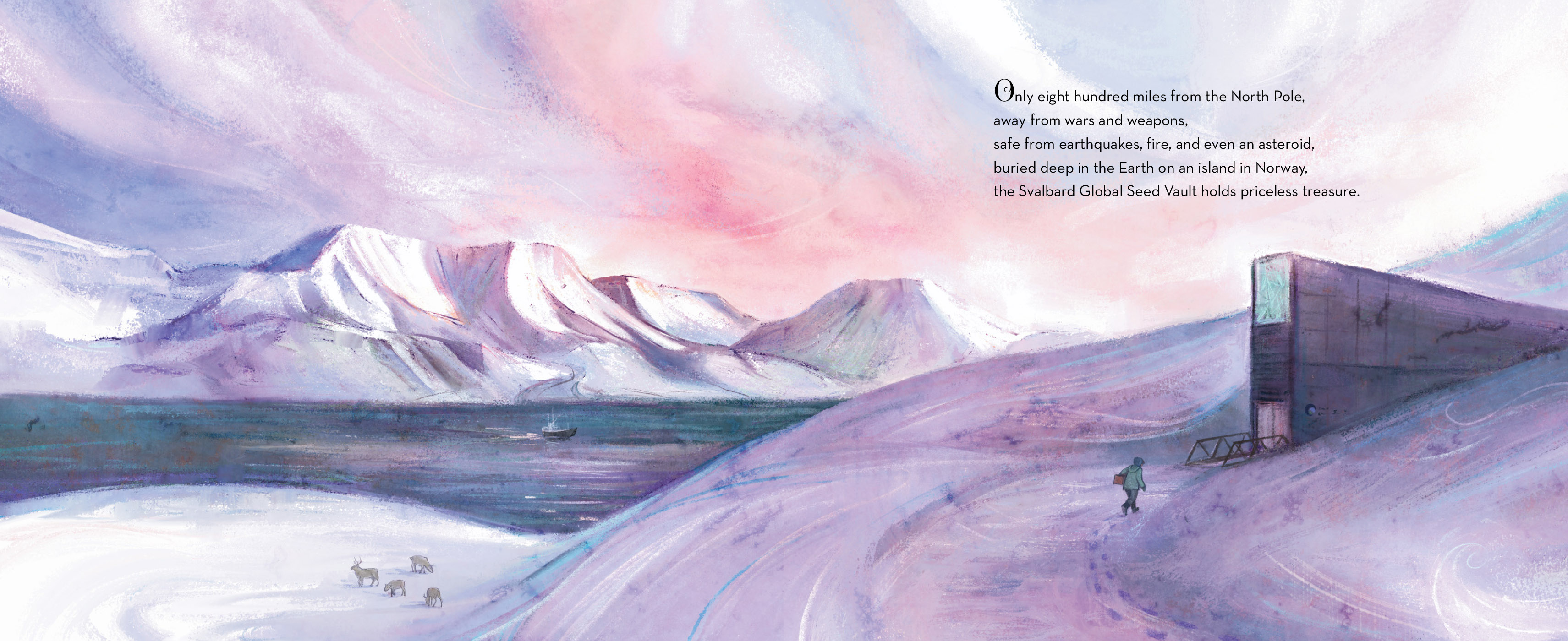
Psst . . . Guess what? 800 miles from the North Pole, buried deep in a mountain, the Svalbard Seed Vault holds priceless treasure. Seeds!

Perfect for 5-8-year-old future conservationists, this is a fascinating glimpse into unique conservation, highlighting the importance of natural resources and protecting planet Earth.


On the Arctic island of Spitsbergen in Norway, polar bears roam and there are no gardens, forests, or fields. But buried deep underground, the Svalbard Seed Bank protects more than 580 million seeds with plenty of room for more.

How and why was the vault built? What's it like inside? How does the vault protect the seeds? Learn about the rescue of the greatest treasure on earth--seeds for our food.

An inside look into the storage and history of one of our most important natural resources and how this collection can save our future.
  • SELECTION | 2026
    NSTA-CBC - Outstanding Science Trade Book
  • AWARD | 2026
    NCTE Orbis Pictus Award for Outstanding Nonfiction for Children
♦ While much has been written about endangered animals, this story about endangered seeds will draw in young readers. It focuses on a vault in the far northern reaches of Norway, a protective space drilled into the side of a mountain. Flowing language combined with supplementary text clearly explains a modern predicament: climate change has caused crops that once thrived to fail, and farmers often choose to use the same seeds repeatedly to ensure the success of their harvests. Unused seeds can become extinct unless they are preserved for possible future use. Although there are many other seed banks, the Svalbard vault was created to house millions of seed copies from all over the world. The frigid temperature, remote location, and recognition that Norway is a peaceful country make the location ideal. Striking artwork depicts the blue and silver of the icy landscape as well as the warm colors of the distant lands from which many seeds originate. Additional resources are included as well as suggestions for young readers to participate in efforts to preserve biodiversity.
VERDICT This tale has an unusual ecological theme that makes seed preservation not only an essential task, but sacred one. A must-have story for all libraries.
School Library Journal, starred review

♦ Deep in the earth, protected by multiple sensors and systems, the Svalbard Global Seed Vault on an icy Arctic island ensures that the “priceless treasure” of more than 580 million seeds is kept safe from extinction. In this engaging picture book, Clendenan uses simple, clear language to explain why and how the world’s seeds are being preserved at such great effort and expense. The text consists of large type, with easily read words and sentences, and with frequent accompanying boxes of information in smaller type adding more detailed information, making the book good both for reading aloud and for those who are interested in learning more at a slightly higher level. In the digital art, Cicchese uses a palette of blues, whites, and purples to show the frozen land in its beauty, contrasting it with warm colors when portraying the various locations around the world where the seeds were originally, lovingly planted and saved. The book doesn’t shy away from why we need to take such good care to protect the seeds, including threats from natural disasters and acts of war, but the tone in words and pictures remains calm and reassuring. Back matter includes further information on the topic, an author’s note, and well-chosen resources for kids.
The Horn Book, starred review

In Svalbard, Norway, lies buried treasure.
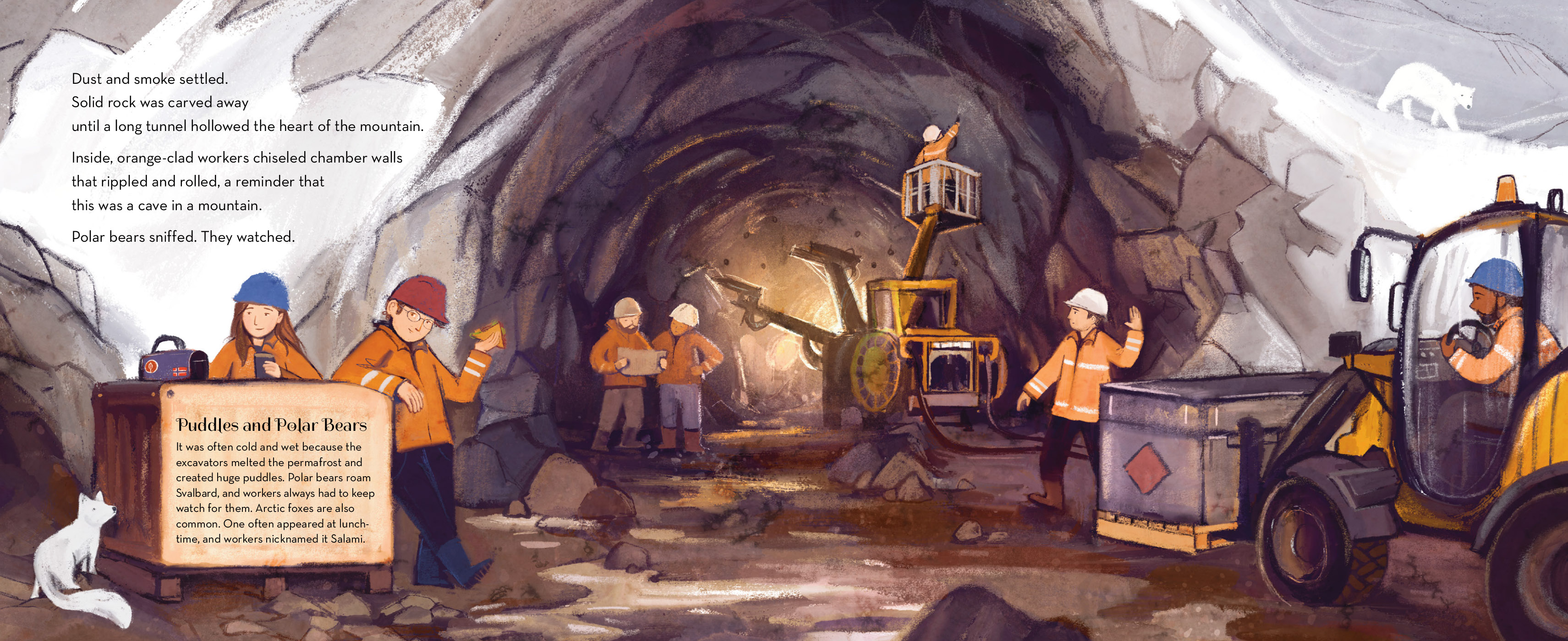
Worries about climate change, war, and extinction led to the construction of the Svalbard Global Seed Vault. Here, on an Arctic island, in “the belly of a mountain,” duplicates from seed banks around the world are stored, preserved for the future, should the need for them arise. Clendenan carefully outlines the purpose and creation of this protected collection. Her relatively simple text is accompanied by sidebars offering more detail on the challenges of transporting seeds, the difficulty of constructing the vault (workers had to be vigilant for roaming polar bears), and more. Ciccese’s appealing illustrations signal the Arctic cold with shades of blue; a diverse workforce is bundled up against the frigid temperatures. In scenes depicting warmer climates, reds, greens, and browns abound as an equally diverse set of humans collect seeds, plant them, and enjoy the crops. Clendenan stresses that this is a truly international project: “Inside the vault, a walk down the aisles becomes a walk through the world.” Younger readers may not entirely understand the need for the collection but will surely be engaged by the process; construction enthusiasts will especially appreciate the spreads focusing on the machines from around the world brought to this isolated place to bore into the mountain. Even the seed packets are designed to be nearly indestructible.
A fascinating tale of conservation at its most creative.
Kirkus Reviews


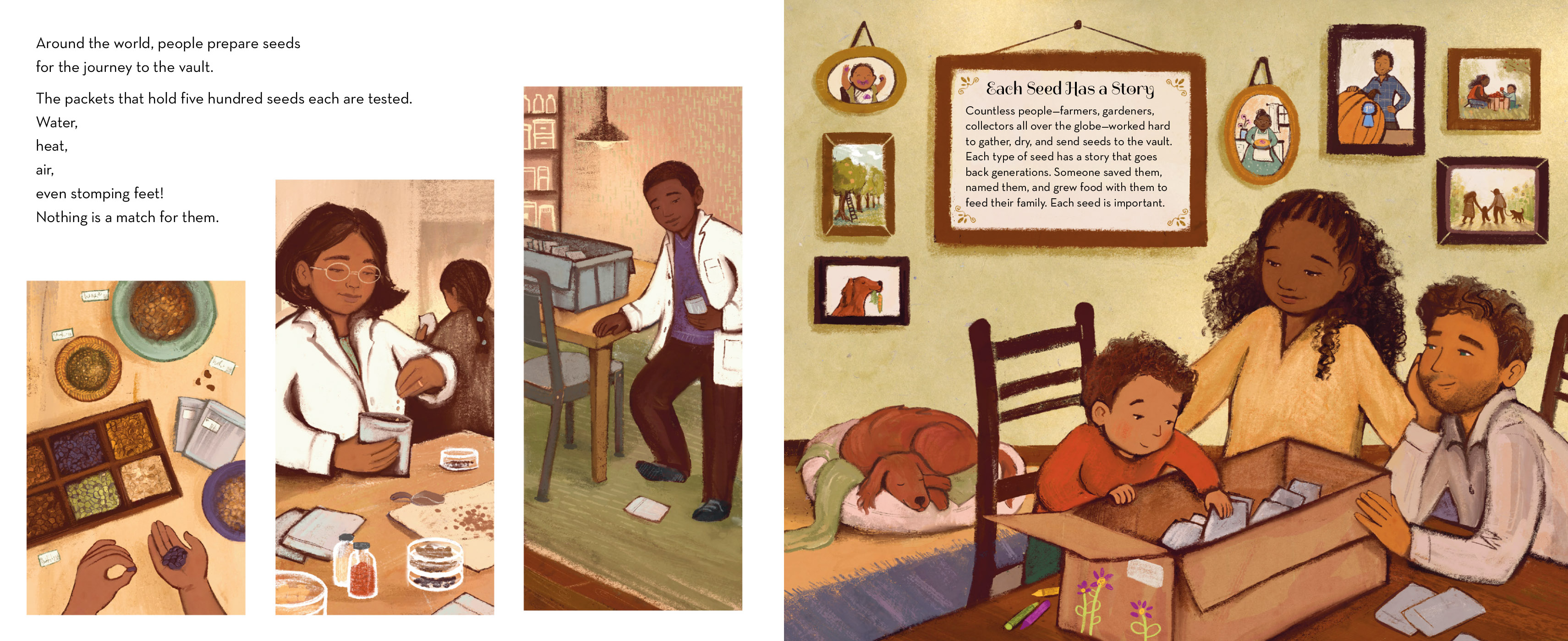
The critical importance of seed-saving is the focal point of this interesting picture book profile of the Svalbard Global Seed Vault and the “priceless treasure” it protects. Outlining the development of the remote vault, from planning and construction to the logistics of making seed deposits, early narration carefully balances context (“Seeds are.../ history./ And they are the future”) and utility (“Seeds need a safe,/ just in case”), while inset boxes provide facts. Cicchese’s digital artwork takes the blended appearance of oil pastels across documentary-style scenes (of a family growing produce, a construction crew toiling). Clendenan’s tone turns wonder-filled as text concludes with recognition of the global service Svalbard provides “for you, for me,/ for everybody.” Characters are portrayed with various skin tones. Back matter includes an author’s note.
Publishers Weekly
Megan Clendenan studied sociology, English, and environmental planning and has worked for nonprofit organizations focused on environmental law, women’s empowerment, mental health, and urban food security. As a children’s book author, she loves writing nonfiction that explores the connections between history, society, and the environment. She is the author of Design Like Nature: Biomimicry for a Healthy Planet, Fresh Air, Clean Water: Our Right to a Healthy Environment, and Cities: How Humans Live Together. She lives near Vancouver, British Columbia, with her family and two fuzzy orange cats. This is her first picture book.

Brittany Cicchese enjoys capturing emotion above all else, from expressive portraits to moody illustrations. She is the illustrator of The Kitten Story: A Mostly True Tale and No More Señora Mimí. When Brittany isn't sketching or writing, you can find her working at the library, reading a good fantasy or sci-fi book, or hiking around the beautiful Rocky Mountains. Brittany lives in Denver, Colorado. www.brittanycicchese.com

Classroom Activities for Just in Case

Classroom activities supplement discussion and traditional lessons with group projects and creative tasks. Can be used in pre-existing units and lessons, or as stand-alone.

(Please note: the guide displayed here is the most recently uploaded version; while unlikely, any page citation discrepancies between the guide and book is likely due to pagination differences between a book’s different formats.)

Photos

additional book photo

About

Psst . . . Guess what? 800 miles from the North Pole, buried deep in a mountain, the Svalbard Seed Vault holds priceless treasure. Seeds!

Perfect for 5-8-year-old future conservationists, this is a fascinating glimpse into unique conservation, highlighting the importance of natural resources and protecting planet Earth.


On the Arctic island of Spitsbergen in Norway, polar bears roam and there are no gardens, forests, or fields. But buried deep underground, the Svalbard Seed Bank protects more than 580 million seeds with plenty of room for more.

How and why was the vault built? What's it like inside? How does the vault protect the seeds? Learn about the rescue of the greatest treasure on earth--seeds for our food.

An inside look into the storage and history of one of our most important natural resources and how this collection can save our future.

Awards

  • SELECTION | 2026
    NSTA-CBC - Outstanding Science Trade Book
  • AWARD | 2026
    NCTE Orbis Pictus Award for Outstanding Nonfiction for Children

Praise

♦ While much has been written about endangered animals, this story about endangered seeds will draw in young readers. It focuses on a vault in the far northern reaches of Norway, a protective space drilled into the side of a mountain. Flowing language combined with supplementary text clearly explains a modern predicament: climate change has caused crops that once thrived to fail, and farmers often choose to use the same seeds repeatedly to ensure the success of their harvests. Unused seeds can become extinct unless they are preserved for possible future use. Although there are many other seed banks, the Svalbard vault was created to house millions of seed copies from all over the world. The frigid temperature, remote location, and recognition that Norway is a peaceful country make the location ideal. Striking artwork depicts the blue and silver of the icy landscape as well as the warm colors of the distant lands from which many seeds originate. Additional resources are included as well as suggestions for young readers to participate in efforts to preserve biodiversity.
VERDICT This tale has an unusual ecological theme that makes seed preservation not only an essential task, but sacred one. A must-have story for all libraries.
School Library Journal, starred review

♦ Deep in the earth, protected by multiple sensors and systems, the Svalbard Global Seed Vault on an icy Arctic island ensures that the “priceless treasure” of more than 580 million seeds is kept safe from extinction. In this engaging picture book, Clendenan uses simple, clear language to explain why and how the world’s seeds are being preserved at such great effort and expense. The text consists of large type, with easily read words and sentences, and with frequent accompanying boxes of information in smaller type adding more detailed information, making the book good both for reading aloud and for those who are interested in learning more at a slightly higher level. In the digital art, Cicchese uses a palette of blues, whites, and purples to show the frozen land in its beauty, contrasting it with warm colors when portraying the various locations around the world where the seeds were originally, lovingly planted and saved. The book doesn’t shy away from why we need to take such good care to protect the seeds, including threats from natural disasters and acts of war, but the tone in words and pictures remains calm and reassuring. Back matter includes further information on the topic, an author’s note, and well-chosen resources for kids.
The Horn Book, starred review

In Svalbard, Norway, lies buried treasure.
Worries about climate change, war, and extinction led to the construction of the Svalbard Global Seed Vault. Here, on an Arctic island, in “the belly of a mountain,” duplicates from seed banks around the world are stored, preserved for the future, should the need for them arise. Clendenan carefully outlines the purpose and creation of this protected collection. Her relatively simple text is accompanied by sidebars offering more detail on the challenges of transporting seeds, the difficulty of constructing the vault (workers had to be vigilant for roaming polar bears), and more. Ciccese’s appealing illustrations signal the Arctic cold with shades of blue; a diverse workforce is bundled up against the frigid temperatures. In scenes depicting warmer climates, reds, greens, and browns abound as an equally diverse set of humans collect seeds, plant them, and enjoy the crops. Clendenan stresses that this is a truly international project: “Inside the vault, a walk down the aisles becomes a walk through the world.” Younger readers may not entirely understand the need for the collection but will surely be engaged by the process; construction enthusiasts will especially appreciate the spreads focusing on the machines from around the world brought to this isolated place to bore into the mountain. Even the seed packets are designed to be nearly indestructible.
A fascinating tale of conservation at its most creative.
Kirkus Reviews


The critical importance of seed-saving is the focal point of this interesting picture book profile of the Svalbard Global Seed Vault and the “priceless treasure” it protects. Outlining the development of the remote vault, from planning and construction to the logistics of making seed deposits, early narration carefully balances context (“Seeds are.../ history./ And they are the future”) and utility (“Seeds need a safe,/ just in case”), while inset boxes provide facts. Cicchese’s digital artwork takes the blended appearance of oil pastels across documentary-style scenes (of a family growing produce, a construction crew toiling). Clendenan’s tone turns wonder-filled as text concludes with recognition of the global service Svalbard provides “for you, for me,/ for everybody.” Characters are portrayed with various skin tones. Back matter includes an author’s note.
Publishers Weekly

Author

Megan Clendenan studied sociology, English, and environmental planning and has worked for nonprofit organizations focused on environmental law, women’s empowerment, mental health, and urban food security. As a children’s book author, she loves writing nonfiction that explores the connections between history, society, and the environment. She is the author of Design Like Nature: Biomimicry for a Healthy Planet, Fresh Air, Clean Water: Our Right to a Healthy Environment, and Cities: How Humans Live Together. She lives near Vancouver, British Columbia, with her family and two fuzzy orange cats. This is her first picture book.

Brittany Cicchese enjoys capturing emotion above all else, from expressive portraits to moody illustrations. She is the illustrator of The Kitten Story: A Mostly True Tale and No More Señora Mimí. When Brittany isn't sketching or writing, you can find her working at the library, reading a good fantasy or sci-fi book, or hiking around the beautiful Rocky Mountains. Brittany lives in Denver, Colorado. www.brittanycicchese.com

Additional Materials

Classroom Activities for Just in Case

Classroom activities supplement discussion and traditional lessons with group projects and creative tasks. Can be used in pre-existing units and lessons, or as stand-alone.

(Please note: the guide displayed here is the most recently uploaded version; while unlikely, any page citation discrepancies between the guide and book is likely due to pagination differences between a book’s different formats.)

New Year, New Readers: Children’s Books That Inspire Realistic Resolutions

By Jaliza Burwell, Charlesbridge The new year is a perfect time for young readers and the adults who champion them to set meaningful intentions. We’re pleased to highlight titles that offer more than entertainment—they spark action, nurture confidence, and encourage curiosity. Below are three powerful categories of books that align naturally with the “New Year,

Read more