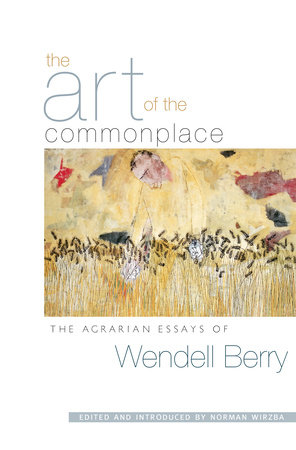
Gathering twenty essays that offer an agrarian alternative to our dominant urban culture, The Art of the Commonplace is Wendell Berry "speaking with calm and sanity out of the wilderness" (The Washington Post Book World)
Grouped around five themes—an agrarian critique of culture, agrarian fundamentals, agrarian economics, agrarian religion, and geobiography—the essays collected here in The Art of the Commonplace promote a clearly defined and compelling vision important to all people dissatisfied with the stress, anxiety, disease, and destructiveness of contemporary American culture.
Why is agriculture becoming culturally irrelevant, and at what cost? What are the forces of social disintegration and how might they be reversed? How might men and women live together in ways that benefit both? And, how does the corporate takeover of social institutions and economic practices contribute to the destruction of human and natural environments?
Through his staunch support of local economies, his defense of farming communities, and his call for family integrity, Berry emerges as the champion of responsibilities and priorities that serve the health, vitality and happiness of the whole community of creation.
"Here is a human being speaking with calm and sanity out of the wilderness. We would do well to hear him." —The Washington Post Book World
WENDELL BERRY, an essayist, novelist, and poet, has been honored with the T. S. Eliot Prize, the Aiken Taylor Award for Modern American Poetry, the John Hay Award of the Orion Society, and the Dayton Literary Peace Prize Richard C. Holbrooke Distinguished Achievement Award, among other distinctions. In 2010, he was awarded the National Humanities Medal by President Barack Obama, and in 2016, he was the recipient of the Ivan Sandrof Life Achievement Award from the National Book Critics Circle. Berry lives with his wife, Tanya Berry, on their farm in Henry County, Kentucky.
Gathering twenty essays that offer an agrarian alternative to our dominant urban culture, The Art of the Commonplace is Wendell Berry "speaking with calm and sanity out of the wilderness" (The Washington Post Book World)
Grouped around five themes—an agrarian critique of culture, agrarian fundamentals, agrarian economics, agrarian religion, and geobiography—the essays collected here in The Art of the Commonplace promote a clearly defined and compelling vision important to all people dissatisfied with the stress, anxiety, disease, and destructiveness of contemporary American culture.
Why is agriculture becoming culturally irrelevant, and at what cost? What are the forces of social disintegration and how might they be reversed? How might men and women live together in ways that benefit both? And, how does the corporate takeover of social institutions and economic practices contribute to the destruction of human and natural environments?
Through his staunch support of local economies, his defense of farming communities, and his call for family integrity, Berry emerges as the champion of responsibilities and priorities that serve the health, vitality and happiness of the whole community of creation.
Praise
"Here is a human being speaking with calm and sanity out of the wilderness. We would do well to hear him." —The Washington Post Book World
Author
WENDELL BERRY, an essayist, novelist, and poet, has been honored with the T. S. Eliot Prize, the Aiken Taylor Award for Modern American Poetry, the John Hay Award of the Orion Society, and the Dayton Literary Peace Prize Richard C. Holbrooke Distinguished Achievement Award, among other distinctions. In 2010, he was awarded the National Humanities Medal by President Barack Obama, and in 2016, he was the recipient of the Ivan Sandrof Life Achievement Award from the National Book Critics Circle. Berry lives with his wife, Tanya Berry, on their farm in Henry County, Kentucky.