Close Modal

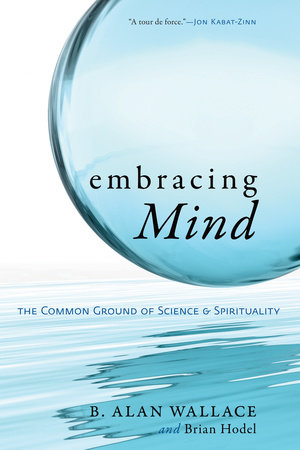
Embracing Mind

The Common Ground of Science and Spirituality

Look inside
Paperback
$24.95 US
5.99"W x 8.94"H x 0.64"D   | 13 oz | 12 per carton
On sale Dec 23, 2008 | 272 Pages | 9781590306833

What is Mind? For this ancient question we are still seeking answers. B. Alan Wallace and Brian Hodel propose a science of the mind based on the contemplative wisdom of Buddhism, Hinduism, Taoism, Christianity, and Islam.

The authors begin by exploring the history of science, showing how science tends to ignore the mind, even while it is understood to be the very instrument through which we comprehend the world of nature. They then propose a contemplative science of mind based on the sophisticated techniques of meditation that have been practiced for thousands of years in the great spiritual traditions. The final section presents meditations that are of universal relevance—to scientists and people of all faiths—for revealing new dimensions of consciousness and human flourishing.

Embracing Mind moves us beyond the dogmatic debates between theists and atheists over Intelligent Design and Neo-Darwinism, and it returns us to the vital core of science and spirituality: deepening our experience of reality as a whole.

“This book shows clearly and compellingly how Buddhism and other spiritual traditions may help enrich our understanding of the mind and its role in nature, without reducing it merely to a material function or property of the brain.”—H. H. the Dalai Lama

“Any scientist serious about his or her avocation will find this book a thought-provoking and rewarding read. Wallace and Hodel make a very reasonable point: since the mind is a primary instrument that allows scientific theory and understanding to occur, should not a thorough and rigorous study of all aspects of that instrument itself be undertaken in order to better assess scientific theory and understanding? This provocative and beautifully written book is absorbing and well worth reading for anyone interested in delving into the nature of things.”—Elizabeth Blackburn, Recipient of the Albert Lasker Award for Medical Research

“In these few pages Wallace and Hodel cover the whole spectrum of Buddhism and science—from the moving narrative of Alan's life through the fallacies of scientific materialism, and on to the heart of the ancient Buddhist science of consciousness and how it speaks to the modern sciences of the mind. An invaluable introduction to the story of science and Buddhist contemplative inquiry.”—Philip Clayton, Ingraham Professor, Claremont School of Theology, and co-editor of the Oxford Handbook of Religion and Science “A tour de force.”—Jon Kabat-Zinn, PhD, Professor of Medicine emeritus, University of Massachusetts Medical School, and author of Coming to Our Senses
B. Alan Wallace has authored, translated, edited, and contributed to more than forty books on Tibetan Buddhism, science, and culture. With fourteen years as a Buddhist monk, he earned a BA in physics and the philosophy of science and then a PhD in religious studies. After teaching in the Department of Religious Studies at the University of California, Santa Barbara, he founded the Santa Barbara Institute for Consciousness Studies (http://sbinstitute.com) to explore the integration of scientific approaches and contemplative methods.

About

What is Mind? For this ancient question we are still seeking answers. B. Alan Wallace and Brian Hodel propose a science of the mind based on the contemplative wisdom of Buddhism, Hinduism, Taoism, Christianity, and Islam.

The authors begin by exploring the history of science, showing how science tends to ignore the mind, even while it is understood to be the very instrument through which we comprehend the world of nature. They then propose a contemplative science of mind based on the sophisticated techniques of meditation that have been practiced for thousands of years in the great spiritual traditions. The final section presents meditations that are of universal relevance—to scientists and people of all faiths—for revealing new dimensions of consciousness and human flourishing.

Embracing Mind moves us beyond the dogmatic debates between theists and atheists over Intelligent Design and Neo-Darwinism, and it returns us to the vital core of science and spirituality: deepening our experience of reality as a whole.


Praise

“This book shows clearly and compellingly how Buddhism and other spiritual traditions may help enrich our understanding of the mind and its role in nature, without reducing it merely to a material function or property of the brain.”—H. H. the Dalai Lama

“Any scientist serious about his or her avocation will find this book a thought-provoking and rewarding read. Wallace and Hodel make a very reasonable point: since the mind is a primary instrument that allows scientific theory and understanding to occur, should not a thorough and rigorous study of all aspects of that instrument itself be undertaken in order to better assess scientific theory and understanding? This provocative and beautifully written book is absorbing and well worth reading for anyone interested in delving into the nature of things.”—Elizabeth Blackburn, Recipient of the Albert Lasker Award for Medical Research

“In these few pages Wallace and Hodel cover the whole spectrum of Buddhism and science—from the moving narrative of Alan's life through the fallacies of scientific materialism, and on to the heart of the ancient Buddhist science of consciousness and how it speaks to the modern sciences of the mind. An invaluable introduction to the story of science and Buddhist contemplative inquiry.”—Philip Clayton, Ingraham Professor, Claremont School of Theology, and co-editor of the Oxford Handbook of Religion and Science “A tour de force.”—Jon Kabat-Zinn, PhD, Professor of Medicine emeritus, University of Massachusetts Medical School, and author of Coming to Our Senses

Author

B. Alan Wallace has authored, translated, edited, and contributed to more than forty books on Tibetan Buddhism, science, and culture. With fourteen years as a Buddhist monk, he earned a BA in physics and the philosophy of science and then a PhD in religious studies. After teaching in the Department of Religious Studies at the University of California, Santa Barbara, he founded the Santa Barbara Institute for Consciousness Studies (http://sbinstitute.com) to explore the integration of scientific approaches and contemplative methods.

Live Inspired with Compendium: Now Available from PRH!

Exciting news! Compendium has joined the Penguin Random House family, bringing a proven line of bestselling, sentiment-driven gifts to our extensive and ever-growing catalog. Since 1985, Compendium has been creating meaningful moments with beautiful, thoughtfully made gifts that center connection and celebrate occasions both big and small. From greeting cards to inspirational books to impulse-friendly add-ons, Compendium

Read more