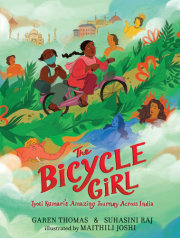
PrologueJyoti and her father, Mohan ji, sail through the blazing heat on a hot pink fuchsia “girl’s” bike. Any tassel streamers it might once have had are long since lost. A black wire-mesh basket hangs from the handlebars, which perspire with sweat from Jyoti’s burned yet raw hands. She pedals fast among a sea of other cyclists traveling in the same direction—away. Jyoti is the only girl among them.
Her thighs and rear are sore and blistered. Her back is bent, frozen in a crooked hunch. Still the girl refuses to let on that she’s in excruciating pain. Mohan ji has a wounded leg, so he is unable to pedal or take on any of the burden of their difficult journey. Jyoti does not complain, though—it doesn’t occur to her to be frustrated right now. Instead, she wills her thighs and feet to push down harder on the pedals so the wheels revolve faster. She must outpace the cloud of disease roiling across the land and get home before it descends as fog to earth, enveloping them all.
In the distance is the Taj Mahal. They’ve already ridden for one or two days, taking brief, four-hour breaks at night, rising before dawn to cover more ground. Jyoti marvels at its majesty and wants to stop for rest and bask in its glory. She glances back at her father—they share a look. As kindred spirits, words pass between them, unspoken. They wonder if they would be welcome there, since they’re not wanted in so many other places. They’re Hindus, but they’re also Dalits—who historically have faced more discrimination than even Muslims in India.
After silently reflecting on these sad and sobering truths, they buck up, settle back onto their uncomfortable seat, and cycle on as the Taj Mahal slips into the haze.
Starting from a StandstillJyoti and Mohan ji have survived the first COVID-19 lockdown in Gurugram but don’t know when this second one will end. It is nighttime, and they’re beginning to panic. Gurugram is a crowded metropolis almost 1,200 kilometers (about 750 miles) from their tiny rural village of Sirhulli. It is a satellite city of Delhi in the North Indian state of Haryana, where a hodgepodge of rich, poor, working class, and migrants from all over the country converge to conduct business, thrive, or just try to survive. Over three decades, Gurugram has evolved from an area of mainly fields and crops, which farmers harvested and sold at premiums to builders and multinational globetrotters, to a city known for its numerous call centers and automobile factories. Many are already asleep in the smaller villages that make up the city—where run-down shanties compete with imposing, glass, high-rise housing, including some of the most expensive and luxurious real estate in the entire nation. Meanwhile, countless others are awake, murmuring about being stuck in place with no money or food due to this new, unfamiliar virus. It’s infecting people the world over, spreading faster than science can keep up. And they can’t last much longer under these conditions. Far from home and frightened, migrant workers who’ve traveled across the country to work menial labor jobs and send money back to struggling families are making the difficult decision to abandon the city and get home by any mode of transportation they can find. But planes and trains are grounded, buses aren’t running, and the government has offered no other solutions to ensure their safe passage.
People on foot scurry along and share the news that the lockdown has been extended yet again. Law enforcement will enforce curfews. Anyone not inside their houses by dusk will face unknown punishments, as though nightfall ushers in the hour of vampires and zombies.
It is around 8 p.m. The landlord has just shut off Mohan ji’s electricity, and he and Jyoti are down to their last bag of rice. The landlord is demanding additional rent; otherwise, he wants them out. After the first lockdown was announced in March 2020, Jyoti and Mohan ji watched as people fled the city. Men and women had gathered what they could of their meager belongings and taken off, some on foot, others on bicycles mounted with their wares and children. If they were going to be sequestered in close quarters with limited human contact, at least families could be reunited in the comfort of their own homes.
Jyoti helps her father trudge the short distance to the house of a Muslim man, “Mullah ji,” who plans to head out that night in the direction of their village. “Time is up,” he tells them. He and his family are going back to Darbhanga, which is only 17 kilometers from Sirhulli. “Will you join us?”
Jyoti leaps at the chance, relieved. “Sure!” Had her father, or pita, fully recovered from the hit-and-run incident that injured his leg, they would have left much sooner, back when her mata, Phulo, was still in Gurugram caring for Mohan ji. Leaving seems like the answer to
their prayers. Finally they can get out of this town and reunite with Mata and Jyoti’s younger siblings in the one-room hut they inherited years ago from their grandfather. Although Jyoti’s eldest sister, Pinki, is married and no longer lives there, home is still close quarters and overcrowded.
But, Jyoti figures, anything is better than this—standing around in a foreign place, waiting for worse to come. Jyoti cannot wait to get back.
“Where is your bike?” Mullah ji asks.
Jyoti is confused. She doesn’t have a bike. She wonders if he has a work truck or some kind of vehicle they could fit in.
“No,” he tells her. He and his family will be riding their bikes. “I suggest you get one, too, and carry your pita on the back.”
Jyoti’s mind spins over and over. Can she really travel all that way, towing her father, who tips the scales at almost 115 kilograms (about 250 pounds)? She’d ridden him around only once before, when he was 50 kilograms (100 pounds) lighter and she was only 40 kilograms (90 pounds). And that was a very short distance to Kamtaul—about 10 kilometers. But what other choice does she have? She does not want them to be left behind in Gurugram, nearly out of money in a foreign city. The landlord already wants to toss her father out in the street for being behind on rent and utilities, since both his injury and lockdown prevent him from working.
Copyright © 2026 by Suhasini Raj and Garen Thomas. All rights reserved. No part of this excerpt may be reproduced or reprinted without permission in writing from the publisher.