Close Modal

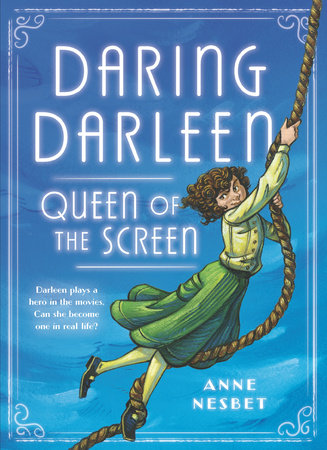
Daring Darleen, Queen of the Screen

Paperback
$9.99 US
6.06"W x 8.25"H x 0.94"D   | 12 oz | 18 per carton
On sale Apr 12, 2022 | 368 Pages | 9781536223064
Age 8-12 years | Grades 3-7
Reading Level: Lexile 880L | Fountas & Pinnell X

See Additional Formats
When a publicity stunt goes terribly wrong, twelve-year-old Darleen Darling, star of the silent film era, must defeat villains both on screen and off in this edge-of-your-seat adventure.

Lights! Camera! Kidnapping?

It’s 1914, and Darleen Darling’s film adventures collide with reality when a fake kidnapping set up by her studio becomes all too real. Suddenly Darleen finds herself in the hands of dastardly criminals who have just nabbed Miss Victorine Berryman, the poor-little-rich-girl heiress of one of America’s largest fortunes. Soon real life starts to seem like a bona fide adventure serial, complete with dramatic escapes, murderous plots, and a runaway air balloon. Will Darleen and Victorine be able to engineer their own happily-ever-after, or will the villains be victorious?
  • AWARD | 2020
    Publishers Weekly Best Children's Book of the Year
In fittingly episodic chapters packed with smart dialogue, plucky characters, and dastardly villains, the girls must continuously save themselves from kidnappers out to steal Victorine's fortune at any cost. As Darleen continues to uphold her acting duties throughout the shenanigans, readers learn early tricks of the trade, with an appearance by groundbreaking filmmaker Alice Guy Blaché adding to the fun...Just like Darleen—a spunky blend of darling and daring.
—Kirkus Reviews (starred review)

Film studies professor Nesbet writes her intrepid heroine with swashbuckling verve and sweet familial affection, incorporating extensive knowledge of early-20th-century filmmaking into a well-paced, gripping tale of staying true to oneself while stretching limitations.
—Publishers Weekly (starred review)

Nesbet’s new novel has all of the elements of classic old-fashioned adventure tales...A rollicking vintage adventure. Recommend to movie fans and readers who enjoy escapades of the past, with lots of twists and tangles.
—School Library Journal (starred review)

Nesbet's (The Orphan Band of Springdale, 2018) deftly researched historical novel, set against a seldom-featured backdrop, has a comforting, old-fashioned feel. Spunky Darleen's story is buoyed by lively prose and crisp characterizations, and readers will be thrilled to join the adventure.
—Booklist (starred review)

Nesbet, a University Professor of Film and Media Studies, draws from her research a wealth of historical detail about film production at the time. An excellent suggestion for precocious readers and film history buffs alike.
—School Library Connection

Fabulous female characters, tender friendships, a fascinating setting, and a page-turning plot, all in one. Anne Nesbet has a brilliant lightness of style that makes the whole book sparkle.
—Ann Braden, author of The Benefits of Being an Octopus

Daring Darleen, Queen of the Screen has that rare combination of rich historical detail, page-turning action, and engaging (vibrant! ebullient!) voice that keeps you up way past your bedtime. Come for the fascinating window into early silent films; stay for narrow escapes, family secrets, nefarious villains, and a deep, authentic friendship between two resourceful girls who bond over lost mothers, the promise of the future, and good cocoa.”
—J. Anderson Coats, author of The Green Children of Woolpit and R Is for Rebel

This charming romp will delight discriminating readers who appreciate narrow escapes, true blue friendships, and the restorative properties of butterscotch.
—Bulletin of the Center for Children's Books

Nesbet re-creates the pace and melodrama of early films in her prose: “Oh, do be cautious! I’m afraid they’re dangerous, desperate men.” The strong character development and rich historical setting elevate the novel beyond period froth...By the end, Darleen discovers that she really is brave and that she can take control of her future.
—The Horn Book
Anne Nesbet is the author of the historical middle-grade novels Cloud and Wallfish and The Orphan Band of Springdale, as well as three fantasy novels for middle-graders. Her books have received numerous accolades, including multiple starred reviews and appearances on many best book and notables lists. A professor at the University of California, Berkeley, Anne Nesbet lives with her family in the San Francisco Bay Area.
Sometimes the real danger is not what you thought it would be at all. Real danger likes to curl itself up small and hide away just out of sight so that it can catch you by surprise.
Darleen had not yet had this insight at the time our story begins. She was busy dangling off the edge of a cliff, hundreds of feet above a wild river. What’s more, her nose was prickling unpleasantly in the cold, and a masked 
villain was brandishing a knife and threatening to send her plummeting down into the churning waves below.
Under ordinary circumstances, that would be enough danger for anyone. But Darleen’s circumstances were not in the least bit ordinary.
 
For instance: it was Darleen’s own uncles who had just tied her up in those large and showy ropes and lowered her (feet first, thank goodness) right over the lip of the rocky cliffs, and while they did so, they had said incongruous things like “There you go, dear! Safe as houses!”
Safe as houses!
Perhaps not, thought Darleen.
She was twisting slightly as the rope shifted in the wind (not a pleasant feeling), so she kept catching glimpses of birds sailing above the shining river so very far below her dangling self, and then other glimpses, when the rope turned, of the crinkly rocks of the cliff only inches from her cold nose, and occasionally even third or fourth glimpses of redheaded Uncle Charlie with his megaphone, shouting directions from the out-jutting boulder where her Uncle Dan (whose hair was the color of his voice: a quiet brown) was cranking the little handle on the side of the great box on legs that was the moving-picture camera.
A camera makes everything it looks at un-ordinary! And yet Darleen had been doing something quite ordinary and everyday (for her) as she dangled from her rope: she had been worrying about her Papa.
Her Papa had made her a tasty bowl of oatmeal and jam that morning. “Strength for my chickee,” he liked to say before long filming days. And he had tied a ribbon in her hair with his clever, callused, loving hands. They had eaten their breakfast as they always did, seated at the scarred old table in the kitchen of their tiny house in Fort Lee, under the old photo of Papa and Mama and baby Darleen, all huddled together like birds in the happiest of nests, and her father had said what he always said before they went off to the Matchless studios, across the street (where once there had been cornfields, in Papa’s farming years): 
“Feet on the ground, my darling Dar! Don’t fly away!”
“Yes, Papa,” she had promised, as she did every day. “Feet on the ground” was their family motto: Papa’s heart had lost too much of itself already when Mama had flown away due to inflammation of the lungs.
Sometimes when Darleen was younger and shorter, she would pull a chair over to the kitchen wall and climb up to stare at that photograph of the Darlings taken so many years ago, in 1906 or 1907. The three of them were posed in front of scenery with palm trees painted on it, her Papa in a borrowed jacket and hat, her Mama in a stiff sort of dress, softened by bunches of lace around her throat, and a very happy, very small Darleen perched on a stool in front of them, holding on to her parents’ hands. Darleen never spent much time staring at her younger self, who looked like a mound of ruffles topped off with an extra portion of light brown curls. It was the other two faces that called to her so: the one belonging to her Papa, so young and so glad and so obviously trying not to laugh (because it would have blurred the photograph), and the face of her Mama, whose eyes were brimming with love and yet always seemed a little sad, too, as if she already knew that she would fly away one day and leave two hearts aching from the lack of her.
You would never think that the woman with the sad and loving eyes had once been a dancer on tightropes in the circus! But she had! She had been Loveliest Luna Lightfoot (that’s what the old posters said, rolled up in the corner of the broom closet), and she had come down from those high places to marry Papa and become Darleen’s dear Mama and try to grow roses around their little farmhouse in Fort Lee. She had done that out of love: kept her feet on the ground.
And now only Darleen was left to stay true to that promise, and to keep the wounded pieces of her father’s heart bound carefully together.
But it occurred to her now that this current business of dangling from a cliff did not seem much at all like keeping her feet on the ground. She didn’t mind on her own behalf — to be honest, Darleen was tired of everything in her life being always “safe as houses”— but suddenly she found herself thinking, What would Papa say when he saw the pictures emerging from the chemical vats in his laboratory that evening or tomorrow? This was Episode Six of The Dangers of Darleen, and her father, truth be told, hadn’t much cared for any part of Episodes One through Five. He didn’t even like her walking on the tops of trains or jumping from car to car. And that had really, truly been safe as houses compared with dangling above the Hudson River.

About

When a publicity stunt goes terribly wrong, twelve-year-old Darleen Darling, star of the silent film era, must defeat villains both on screen and off in this edge-of-your-seat adventure.

Lights! Camera! Kidnapping?

It’s 1914, and Darleen Darling’s film adventures collide with reality when a fake kidnapping set up by her studio becomes all too real. Suddenly Darleen finds herself in the hands of dastardly criminals who have just nabbed Miss Victorine Berryman, the poor-little-rich-girl heiress of one of America’s largest fortunes. Soon real life starts to seem like a bona fide adventure serial, complete with dramatic escapes, murderous plots, and a runaway air balloon. Will Darleen and Victorine be able to engineer their own happily-ever-after, or will the villains be victorious?

Awards

  • AWARD | 2020
    Publishers Weekly Best Children's Book of the Year

Praise

In fittingly episodic chapters packed with smart dialogue, plucky characters, and dastardly villains, the girls must continuously save themselves from kidnappers out to steal Victorine's fortune at any cost. As Darleen continues to uphold her acting duties throughout the shenanigans, readers learn early tricks of the trade, with an appearance by groundbreaking filmmaker Alice Guy Blaché adding to the fun...Just like Darleen—a spunky blend of darling and daring.
—Kirkus Reviews (starred review)

Film studies professor Nesbet writes her intrepid heroine with swashbuckling verve and sweet familial affection, incorporating extensive knowledge of early-20th-century filmmaking into a well-paced, gripping tale of staying true to oneself while stretching limitations.
—Publishers Weekly (starred review)

Nesbet’s new novel has all of the elements of classic old-fashioned adventure tales...A rollicking vintage adventure. Recommend to movie fans and readers who enjoy escapades of the past, with lots of twists and tangles.
—School Library Journal (starred review)

Nesbet's (The Orphan Band of Springdale, 2018) deftly researched historical novel, set against a seldom-featured backdrop, has a comforting, old-fashioned feel. Spunky Darleen's story is buoyed by lively prose and crisp characterizations, and readers will be thrilled to join the adventure.
—Booklist (starred review)

Nesbet, a University Professor of Film and Media Studies, draws from her research a wealth of historical detail about film production at the time. An excellent suggestion for precocious readers and film history buffs alike.
—School Library Connection

Fabulous female characters, tender friendships, a fascinating setting, and a page-turning plot, all in one. Anne Nesbet has a brilliant lightness of style that makes the whole book sparkle.
—Ann Braden, author of The Benefits of Being an Octopus

Daring Darleen, Queen of the Screen has that rare combination of rich historical detail, page-turning action, and engaging (vibrant! ebullient!) voice that keeps you up way past your bedtime. Come for the fascinating window into early silent films; stay for narrow escapes, family secrets, nefarious villains, and a deep, authentic friendship between two resourceful girls who bond over lost mothers, the promise of the future, and good cocoa.”
—J. Anderson Coats, author of The Green Children of Woolpit and R Is for Rebel

This charming romp will delight discriminating readers who appreciate narrow escapes, true blue friendships, and the restorative properties of butterscotch.
—Bulletin of the Center for Children's Books

Nesbet re-creates the pace and melodrama of early films in her prose: “Oh, do be cautious! I’m afraid they’re dangerous, desperate men.” The strong character development and rich historical setting elevate the novel beyond period froth...By the end, Darleen discovers that she really is brave and that she can take control of her future.
—The Horn Book

Author

Anne Nesbet is the author of the historical middle-grade novels Cloud and Wallfish and The Orphan Band of Springdale, as well as three fantasy novels for middle-graders. Her books have received numerous accolades, including multiple starred reviews and appearances on many best book and notables lists. A professor at the University of California, Berkeley, Anne Nesbet lives with her family in the San Francisco Bay Area.

Excerpt

Sometimes the real danger is not what you thought it would be at all. Real danger likes to curl itself up small and hide away just out of sight so that it can catch you by surprise.
Darleen had not yet had this insight at the time our story begins. She was busy dangling off the edge of a cliff, hundreds of feet above a wild river. What’s more, her nose was prickling unpleasantly in the cold, and a masked 
villain was brandishing a knife and threatening to send her plummeting down into the churning waves below.
Under ordinary circumstances, that would be enough danger for anyone. But Darleen’s circumstances were not in the least bit ordinary.
 
For instance: it was Darleen’s own uncles who had just tied her up in those large and showy ropes and lowered her (feet first, thank goodness) right over the lip of the rocky cliffs, and while they did so, they had said incongruous things like “There you go, dear! Safe as houses!”
Safe as houses!
Perhaps not, thought Darleen.
She was twisting slightly as the rope shifted in the wind (not a pleasant feeling), so she kept catching glimpses of birds sailing above the shining river so very far below her dangling self, and then other glimpses, when the rope turned, of the crinkly rocks of the cliff only inches from her cold nose, and occasionally even third or fourth glimpses of redheaded Uncle Charlie with his megaphone, shouting directions from the out-jutting boulder where her Uncle Dan (whose hair was the color of his voice: a quiet brown) was cranking the little handle on the side of the great box on legs that was the moving-picture camera.
A camera makes everything it looks at un-ordinary! And yet Darleen had been doing something quite ordinary and everyday (for her) as she dangled from her rope: she had been worrying about her Papa.
Her Papa had made her a tasty bowl of oatmeal and jam that morning. “Strength for my chickee,” he liked to say before long filming days. And he had tied a ribbon in her hair with his clever, callused, loving hands. They had eaten their breakfast as they always did, seated at the scarred old table in the kitchen of their tiny house in Fort Lee, under the old photo of Papa and Mama and baby Darleen, all huddled together like birds in the happiest of nests, and her father had said what he always said before they went off to the Matchless studios, across the street (where once there had been cornfields, in Papa’s farming years): 
“Feet on the ground, my darling Dar! Don’t fly away!”
“Yes, Papa,” she had promised, as she did every day. “Feet on the ground” was their family motto: Papa’s heart had lost too much of itself already when Mama had flown away due to inflammation of the lungs.
Sometimes when Darleen was younger and shorter, she would pull a chair over to the kitchen wall and climb up to stare at that photograph of the Darlings taken so many years ago, in 1906 or 1907. The three of them were posed in front of scenery with palm trees painted on it, her Papa in a borrowed jacket and hat, her Mama in a stiff sort of dress, softened by bunches of lace around her throat, and a very happy, very small Darleen perched on a stool in front of them, holding on to her parents’ hands. Darleen never spent much time staring at her younger self, who looked like a mound of ruffles topped off with an extra portion of light brown curls. It was the other two faces that called to her so: the one belonging to her Papa, so young and so glad and so obviously trying not to laugh (because it would have blurred the photograph), and the face of her Mama, whose eyes were brimming with love and yet always seemed a little sad, too, as if she already knew that she would fly away one day and leave two hearts aching from the lack of her.
You would never think that the woman with the sad and loving eyes had once been a dancer on tightropes in the circus! But she had! She had been Loveliest Luna Lightfoot (that’s what the old posters said, rolled up in the corner of the broom closet), and she had come down from those high places to marry Papa and become Darleen’s dear Mama and try to grow roses around their little farmhouse in Fort Lee. She had done that out of love: kept her feet on the ground.
And now only Darleen was left to stay true to that promise, and to keep the wounded pieces of her father’s heart bound carefully together.
But it occurred to her now that this current business of dangling from a cliff did not seem much at all like keeping her feet on the ground. She didn’t mind on her own behalf — to be honest, Darleen was tired of everything in her life being always “safe as houses”— but suddenly she found herself thinking, What would Papa say when he saw the pictures emerging from the chemical vats in his laboratory that evening or tomorrow? This was Episode Six of The Dangers of Darleen, and her father, truth be told, hadn’t much cared for any part of Episodes One through Five. He didn’t even like her walking on the tops of trains or jumping from car to car. And that had really, truly been safe as houses compared with dangling above the Hudson River.