Close Modal

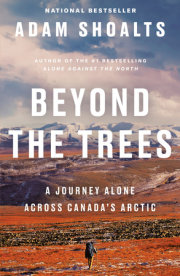
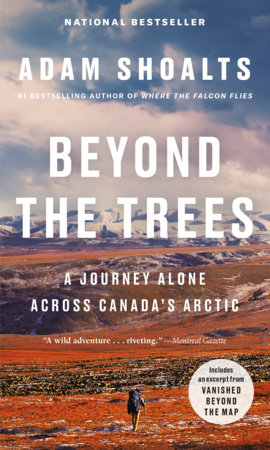
Beyond the Trees

A Journey Alone Across Canada's Arctic

Mass Market Paperback
$9.99 US
4-1/8"W x 6-7/8"H | 7 oz | 48 per carton
On sale Jul 14, 2026 | 416 Pages | 9781037804243

See Additional Formats

Winner of the Legislative Assembly of Ontario's 2016 Young Authors Award 
Winner of the 2017 Louise de Kiriline Award for Nonfiction


Adam Shoalts was no stranger to the wilderness. He had hacked his way through jungles, stared down bears and climbed mountains. But, one spot on the map called out to him irresistibly. Cutting through the forbidding landscape of the Hudson Bay Lowlands is a river no hunter, no explorer, has left any record of paddling. It was this river that Shoalts was obsessively determined to explore.    

What Shoalts discovered as he paddled downriver appeared in no satellite imagery or map: a series of waterfalls that could easily have killed him. Just as astonishing was the media reaction when he got back to civilization. He was crowned "Canada's Indiana Jones" and was feted by the Royal Canadian Geographical Society and congratulated by the governor general. Shoalts had proved that the world is bigger than we think.         

Gripping and often poetic, Alone Against the North is a classic adventure story of single-minded obsession, physical hardship, and the restless sense of wonder that every explorer has in common. Shoalts's story makes it clear that the world can become known only by setting out into the unfamiliar, where every step is different from the one before and something you may never have imagined lies around the next curve in the river.

  • WINNER | 2017
    Louise de Kiriline Lawrence Award for English Non-Fiction
  • WINNER | 2016
    Legislative Assembly of Ontario - Young Authors Award
  • SHORTLIST | 2020
    Louise de Kiriline Lawrence Award for English Non-Fiction
Winner of the Legislative Assembly of Ontario's 2016 Young Authors Award
Winner of the 2017 Louise de Kiriline Award for Nonfiction


“Rare insight into the heart and mind of an explorer, and the insatiable hunger for the unknown that both inspires and drives one to the edge. Adam Shoalts, twenty-first-century explorer, calmly describes the things he has endured that would drive most people to despair, or even madness.”
—Col. Chris Hadfield, astronaut, author, space station commander

“Adam Shoalts is Canada’s Indiana Jones—portaging in the north, dodging scary rapids, plunging into darkness, and surviving to tell the tale.”
Toronto Star

“Adam Shoalts has captured the world’s imagination with his discovery of uncharted waterfalls.”
—The Royal Canadian Geographical Society

“Move over Jacques Cartier, Christopher Columbus, and Sir Francis Drake—Adam Shoalts is this century’s explorer.”
The Hamilton Spectator

“Doing things the easy way has never been my style. There is no adventure in that! In Alone Against the North, Adam Shoalts does nothing the easy way. He travels to places no one has ever seen before and as a result comes back with an amazing story. As gripping to read as it must’ve been exciting to live!”
—Les Stroud, Survivorman

"Explorer Adam Shoalts's remarkable solo foray into the quietly dangerous and mysterious Hudson Bay Lowlands is the kind of incredible effort that fosters legends."
The Winnipeg Free Press

“Anyone who thinks exploration is dead should read this book (Alone Against the North).”
—John Geiger, author, CEO of the Royal Canadian Geographical Society

“While the book is a nail-biting chronicle of polar-bear encounters, brutal swarms of black flies and surprise tumbles down waterfalls, Shoalts also vividly describes an area of the country most of us will never witness.”
Metro (Toronto)

“His narrative is both humourous and honest, and at times intensely gripping.”
St. Catharines Standard

“Keeping up with the Kardashian's? Give me a break. Just try keeping up with this guy.”
—Cabin14.ca Blog

“It (Alone Against the North) is a story of brutal perseverance and stamina which few adventurers could equal.”
Life in Quebec Magazine

“Shoalts is a fearless adventurer. . . . Alone Against the North is a rip-roaring yarn.”
The Great Canadian Bucket List

“My first impression of Adam Shoalts, author of Alone Against the North, was that he was a wacko. . . . But after delving into his remarkable, page-turner of a book about canoeing Canada’s north, I realized that Shoalts is . . . a highly intelligent individual.”
—Nicolas Ross, What’s Not to Hike? blog

“Shoalts’s love of nature, cool professionalism, and almost archaically romantic spirit draw us into his adventures. . . . Shoalts is a knowledgeable and observant guide.”
—Quill and Quire
© Adam Shoalts
ADAM SHOALTS is a historian, archaeologist, geographer, and Westaway Explorer-in-
Residence at the Royal Canadian Geographical Society. Shoalts holds a PhD from McMaster University where his research examined the influence Indigenous oral traditions had on fur traders in the subarctic and Pacific Northwest. He is also the author of the national bestsellers Alone Against the North, A History of Canada in Ten Maps, Beyond the Trees, The Whisper on the Night Wind, and Where the Falcon Flies. He enjoys long walks in the woods. Follow his adventures on Facebook and Instagram. View titles by Adam Shoalts
My passion was paddling wild rivers and lakes, and wandering silently through quiet forests, indulging my curiosity about plants, trees, and the mystery and enchantment of the natural world. Adventures I’d had and would continue to do so, because it came with the terrain of wandering alone through wild places. But I didn’t anticipate making any particularly long journeys in the Arctic.

Then, in the spring of 2010, I happened to visit a local nature club in the Short Hills—a region of wooded, rolling hills, tumbling streams, and waterfalls south of Lake Ontario—which put in motion a chain of events that led to my becoming windbound alone on an arctic lake. No doubt that’s a common occurrence stemming from nature club meetings, and a prudent reason to avoid them. As far as nature clubs went, this one had a youngish membership, the average age being barely more than mid-seventies.

It was there at the nature club’s meeting hall, after my presentation on canoe tripping had wrapped up, that I first heard the word “sesquicentennial” used in a sentence. I’d been chatting with a white-haired man, a retired professor of chemistry.

“Well, you know,” he said, “2017 is going to be Canada’s sesquicentennial.”

“Oh,” I said, nodding. In fact I hadn’t known this.

He kept looking at me, apparently awaiting a further response.

I wasn’t sure what “sesquicentennial” even meant.

“The 150th anniversary of Canada’s Confederation,” he elaborated.

“That’s right,” I replied.

“It’s sure to be a big deal. Huge celebrations,” he said with emphasis. “I remember the Centennial celebrations back in 1967. We went to Expo 67 in Montreal for that. ’Course, that would’ve been well before your time.”

The connection between my canoe trips and a 150th anniversary, which was still seven years away, wasn’t immediately obvious to me.

“It’ll be a very big occasion,” the old man resumed. “Have you given any thought to doing something special for it?”

“Er, no, I haven’t.”

He shook his head, evidently dismayed at the lamentable failure of my education. “Back in ’67 I remember there were people who canoed across Canada. Maybe you should think of doing something similar in 2017? There’s bound to be lots of funding opportunities and groups interested in that kind of thing.”

“Well, anything’s possible,” I said.

Still, 2017 seemed a long way off, and I thought it unlikely that something as obscure as a sesquicentennial would attract much notice beyond the ordinary July 1 fireworks. I soon put it out of my mind and returned to paddling wild rivers, observing plants and animals, wandering the woods, and, for a while, pursuing a passion I’d developed for the study of rare mosses found on certain rocks, especially the species ptychomitrium incurvum.

But a few years later, the old professor’s supposition proved correct. As 2017 neared, “Canada 150” seemed to crop up more and more in conversations and news stories.

A great many plans were underway. There would be public infrastructure projects. Free access to national parks. A ship travelling around Canada with a hundred and fifty passengers chosen from across the country. Trees planted in every province and territory. Tulips bedded in Ottawa’s public gardens (300,000 of them, a unique species) that resembled the country’s flag. An actual flag (a massive one) raised to the top of a pole (fourteen storeys high). Eventually, the federal government would fund nearly six thousand of these Canada 150 initiatives.

Meanwhile, over three years had passed since my encounter with the old professor at the nature club. I recalled what he’d said about the Centennial canoe trip. Maybe, I thought to myself, another cross-Canada canoe journey might, in some small way, inspire people to care more about the fate of the country’s ever-diminishing wild places. I decided to look up what exactly had been done in 1967. It was fortuitous perhaps, that I did so at a time when I was under one of those spells of wanderlust and adventure that had a habit of stealing over me whenever I was shut up inside for too long.

It turned out that ten teams of canoeists had paddled from central Alberta to Montreal. Dubbed “The Centennial Voyageur Canoe Pageant,” the journey involved ten people per team; six at a time would paddle on alternating days while the other four rested. The route included stops in cities and towns along the way, where parties and fanfare greeted the paddlers’ arrival. By starting east of the Rockies and ending in Montreal, the hardest portages and upstream travel were avoided. When it was all over it took 104 days to complete and covered 5,283 kilometres, ending in celebration at Expo 67.

Now that’s a remarkable journey, I thought to myself as I sat in my cluttered study on the ground floor of a rundown Victorian house I rented. And to recreate it fifty years later would be quite a thing. But nowadays, given that Canada’s a lot less wild than it was in 1967, I figured somebody could probably retrace that canoe route and stop in at a Tim Hortons every third day. What could I do in 2017 that hadn’t already been done?

I stared at the map of Canada on the wall above my desk (a dangerous thing—staring at maps, that is). What if, I wondered, I shifted the canoe route north? Roughly, say, two thousand kilometres north, beyond the trees to the tundra?

Unlike the 1967 route, a canoe journey that far north wouldn’t have a line of cities or towns to break up the journey and allow for resupply, not to mention hot showers and human encouragement. Instead of travelling through farmland and cottage country, it’d mean travelling across arctic terrain. The elements would be much harsher, with sub-zero temperatures, snow, bitterly cold winds, shifting ice floes, and probably no Tim Hortons. If something went wrong, help would be far away and a long time coming. To further complicate matters, there was no easy or obvious water route across the mainland Canadian Arctic. Four major watersheds would have to be crossed, meaning a lot of overland and arduous upstream travel would be required.

I suppose it was a mad idea. On the other hand, it was exactly the kind of undertaking that appealed to me, or at least appealed to me in my more adventurous moods. After all, as I often remarked to myself, you only live once.

About

Winner of the Legislative Assembly of Ontario's 2016 Young Authors Award 
Winner of the 2017 Louise de Kiriline Award for Nonfiction


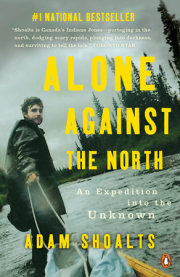
Adam Shoalts was no stranger to the wilderness. He had hacked his way through jungles, stared down bears and climbed mountains. But, one spot on the map called out to him irresistibly. Cutting through the forbidding landscape of the Hudson Bay Lowlands is a river no hunter, no explorer, has left any record of paddling. It was this river that Shoalts was obsessively determined to explore.    

What Shoalts discovered as he paddled downriver appeared in no satellite imagery or map: a series of waterfalls that could easily have killed him. Just as astonishing was the media reaction when he got back to civilization. He was crowned "Canada's Indiana Jones" and was feted by the Royal Canadian Geographical Society and congratulated by the governor general. Shoalts had proved that the world is bigger than we think.         

Gripping and often poetic, Alone Against the North is a classic adventure story of single-minded obsession, physical hardship, and the restless sense of wonder that every explorer has in common. Shoalts's story makes it clear that the world can become known only by setting out into the unfamiliar, where every step is different from the one before and something you may never have imagined lies around the next curve in the river.

Awards

  • WINNER | 2017
    Louise de Kiriline Lawrence Award for English Non-Fiction
  • WINNER | 2016
    Legislative Assembly of Ontario - Young Authors Award
  • SHORTLIST | 2020
    Louise de Kiriline Lawrence Award for English Non-Fiction

Praise

Winner of the Legislative Assembly of Ontario's 2016 Young Authors Award
Winner of the 2017 Louise de Kiriline Award for Nonfiction


“Rare insight into the heart and mind of an explorer, and the insatiable hunger for the unknown that both inspires and drives one to the edge. Adam Shoalts, twenty-first-century explorer, calmly describes the things he has endured that would drive most people to despair, or even madness.”
—Col. Chris Hadfield, astronaut, author, space station commander

“Adam Shoalts is Canada’s Indiana Jones—portaging in the north, dodging scary rapids, plunging into darkness, and surviving to tell the tale.”
Toronto Star

“Adam Shoalts has captured the world’s imagination with his discovery of uncharted waterfalls.”
—The Royal Canadian Geographical Society

“Move over Jacques Cartier, Christopher Columbus, and Sir Francis Drake—Adam Shoalts is this century’s explorer.”
The Hamilton Spectator

“Doing things the easy way has never been my style. There is no adventure in that! In Alone Against the North, Adam Shoalts does nothing the easy way. He travels to places no one has ever seen before and as a result comes back with an amazing story. As gripping to read as it must’ve been exciting to live!”
—Les Stroud, Survivorman

"Explorer Adam Shoalts's remarkable solo foray into the quietly dangerous and mysterious Hudson Bay Lowlands is the kind of incredible effort that fosters legends."
The Winnipeg Free Press

“Anyone who thinks exploration is dead should read this book (Alone Against the North).”
—John Geiger, author, CEO of the Royal Canadian Geographical Society

“While the book is a nail-biting chronicle of polar-bear encounters, brutal swarms of black flies and surprise tumbles down waterfalls, Shoalts also vividly describes an area of the country most of us will never witness.”
Metro (Toronto)

“His narrative is both humourous and honest, and at times intensely gripping.”
St. Catharines Standard

“Keeping up with the Kardashian's? Give me a break. Just try keeping up with this guy.”
—Cabin14.ca Blog

“It (Alone Against the North) is a story of brutal perseverance and stamina which few adventurers could equal.”
Life in Quebec Magazine

“Shoalts is a fearless adventurer. . . . Alone Against the North is a rip-roaring yarn.”
The Great Canadian Bucket List

“My first impression of Adam Shoalts, author of Alone Against the North, was that he was a wacko. . . . But after delving into his remarkable, page-turner of a book about canoeing Canada’s north, I realized that Shoalts is . . . a highly intelligent individual.”
—Nicolas Ross, What’s Not to Hike? blog

“Shoalts’s love of nature, cool professionalism, and almost archaically romantic spirit draw us into his adventures. . . . Shoalts is a knowledgeable and observant guide.”
—Quill and Quire

Author

© Adam Shoalts
ADAM SHOALTS is a historian, archaeologist, geographer, and Westaway Explorer-in-
Residence at the Royal Canadian Geographical Society. Shoalts holds a PhD from McMaster University where his research examined the influence Indigenous oral traditions had on fur traders in the subarctic and Pacific Northwest. He is also the author of the national bestsellers Alone Against the North, A History of Canada in Ten Maps, Beyond the Trees, The Whisper on the Night Wind, and Where the Falcon Flies. He enjoys long walks in the woods. Follow his adventures on Facebook and Instagram. View titles by Adam Shoalts

Excerpt

My passion was paddling wild rivers and lakes, and wandering silently through quiet forests, indulging my curiosity about plants, trees, and the mystery and enchantment of the natural world. Adventures I’d had and would continue to do so, because it came with the terrain of wandering alone through wild places. But I didn’t anticipate making any particularly long journeys in the Arctic.

Then, in the spring of 2010, I happened to visit a local nature club in the Short Hills—a region of wooded, rolling hills, tumbling streams, and waterfalls south of Lake Ontario—which put in motion a chain of events that led to my becoming windbound alone on an arctic lake. No doubt that’s a common occurrence stemming from nature club meetings, and a prudent reason to avoid them. As far as nature clubs went, this one had a youngish membership, the average age being barely more than mid-seventies.

It was there at the nature club’s meeting hall, after my presentation on canoe tripping had wrapped up, that I first heard the word “sesquicentennial” used in a sentence. I’d been chatting with a white-haired man, a retired professor of chemistry.

“Well, you know,” he said, “2017 is going to be Canada’s sesquicentennial.”

“Oh,” I said, nodding. In fact I hadn’t known this.

He kept looking at me, apparently awaiting a further response.

I wasn’t sure what “sesquicentennial” even meant.

“The 150th anniversary of Canada’s Confederation,” he elaborated.

“That’s right,” I replied.

“It’s sure to be a big deal. Huge celebrations,” he said with emphasis. “I remember the Centennial celebrations back in 1967. We went to Expo 67 in Montreal for that. ’Course, that would’ve been well before your time.”

The connection between my canoe trips and a 150th anniversary, which was still seven years away, wasn’t immediately obvious to me.

“It’ll be a very big occasion,” the old man resumed. “Have you given any thought to doing something special for it?”

“Er, no, I haven’t.”

He shook his head, evidently dismayed at the lamentable failure of my education. “Back in ’67 I remember there were people who canoed across Canada. Maybe you should think of doing something similar in 2017? There’s bound to be lots of funding opportunities and groups interested in that kind of thing.”

“Well, anything’s possible,” I said.

Still, 2017 seemed a long way off, and I thought it unlikely that something as obscure as a sesquicentennial would attract much notice beyond the ordinary July 1 fireworks. I soon put it out of my mind and returned to paddling wild rivers, observing plants and animals, wandering the woods, and, for a while, pursuing a passion I’d developed for the study of rare mosses found on certain rocks, especially the species ptychomitrium incurvum.

But a few years later, the old professor’s supposition proved correct. As 2017 neared, “Canada 150” seemed to crop up more and more in conversations and news stories.

A great many plans were underway. There would be public infrastructure projects. Free access to national parks. A ship travelling around Canada with a hundred and fifty passengers chosen from across the country. Trees planted in every province and territory. Tulips bedded in Ottawa’s public gardens (300,000 of them, a unique species) that resembled the country’s flag. An actual flag (a massive one) raised to the top of a pole (fourteen storeys high). Eventually, the federal government would fund nearly six thousand of these Canada 150 initiatives.

Meanwhile, over three years had passed since my encounter with the old professor at the nature club. I recalled what he’d said about the Centennial canoe trip. Maybe, I thought to myself, another cross-Canada canoe journey might, in some small way, inspire people to care more about the fate of the country’s ever-diminishing wild places. I decided to look up what exactly had been done in 1967. It was fortuitous perhaps, that I did so at a time when I was under one of those spells of wanderlust and adventure that had a habit of stealing over me whenever I was shut up inside for too long.

It turned out that ten teams of canoeists had paddled from central Alberta to Montreal. Dubbed “The Centennial Voyageur Canoe Pageant,” the journey involved ten people per team; six at a time would paddle on alternating days while the other four rested. The route included stops in cities and towns along the way, where parties and fanfare greeted the paddlers’ arrival. By starting east of the Rockies and ending in Montreal, the hardest portages and upstream travel were avoided. When it was all over it took 104 days to complete and covered 5,283 kilometres, ending in celebration at Expo 67.

Now that’s a remarkable journey, I thought to myself as I sat in my cluttered study on the ground floor of a rundown Victorian house I rented. And to recreate it fifty years later would be quite a thing. But nowadays, given that Canada’s a lot less wild than it was in 1967, I figured somebody could probably retrace that canoe route and stop in at a Tim Hortons every third day. What could I do in 2017 that hadn’t already been done?

I stared at the map of Canada on the wall above my desk (a dangerous thing—staring at maps, that is). What if, I wondered, I shifted the canoe route north? Roughly, say, two thousand kilometres north, beyond the trees to the tundra?

Unlike the 1967 route, a canoe journey that far north wouldn’t have a line of cities or towns to break up the journey and allow for resupply, not to mention hot showers and human encouragement. Instead of travelling through farmland and cottage country, it’d mean travelling across arctic terrain. The elements would be much harsher, with sub-zero temperatures, snow, bitterly cold winds, shifting ice floes, and probably no Tim Hortons. If something went wrong, help would be far away and a long time coming. To further complicate matters, there was no easy or obvious water route across the mainland Canadian Arctic. Four major watersheds would have to be crossed, meaning a lot of overland and arduous upstream travel would be required.

I suppose it was a mad idea. On the other hand, it was exactly the kind of undertaking that appealed to me, or at least appealed to me in my more adventurous moods. After all, as I often remarked to myself, you only live once.