Close Modal

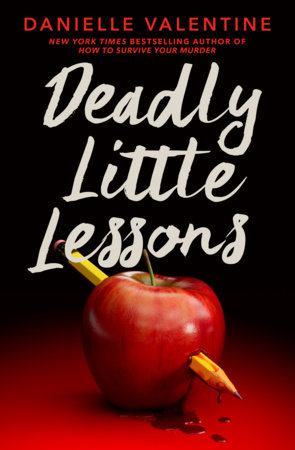
Deadly Little Lessons

Hardcover
$19.99 US
5-1/2"W x 8-1/4"H | 15 oz | 12 per carton
On sale Sep 15, 2026 | 320 Pages | 9780593860410
Age 12 and up | Grade 7 & Up

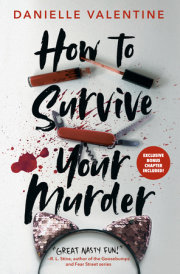
Squid Game meets boarding school in this electric young adult thriller from the New York Times bestselling author of Two Sides to Every Murder and How to Survive Your Murder.

Luminary is more than just a school. It is a test of moral fiber, strength of will, and human resilience.

Lia Michaels can pick any lock and break into most computer systems. But a life of delinquency has her bouncing between foster homes and juvie. So when she applies to Luminary Prep, a new experimental school created to challenge academic conventions, Lia is surprised by the acceptance letter that follows.

With state-of-the-art technology, fancy cafeteria food, and a campus that looks like a painting come to life, Luminary seems to be the break Lia needs. That is, if she can excel in class and be one of only five students who will be allowed to graduate.

But classes at Luminary are . . . odd. And dangerous. There is a death-trap obstacle course in Physics, a Chemistry exam with explosives, and guillotines in Political Science. As students keep vanishing, one by one, Lia starts to wonder if it's not that five students will graduate—but that only five will survive.
Danielle Valentine is the author of How to Survive Your Murder and Delicate Condition, which was adapted into a season of the TV series American Horror Story. Danielle lives outside of New York City with her husband, daughter, and two ornery cats. View titles by Danielle Valentine

Question One:

You are the mayor of a major city, and you know a devastating earthquake is about to hit. You have two choices: A) blow up half the city, which will release the seismic pressure and prevent the earthquake but kill half your population; or B) choose not to intervene, knowing the earthquake will devastate the city, likely resulting in many more casualties. What do you do?

Blue and red lights flash outside the Springfield school district office’s windows about twenty seconds after I break the lock on the office manager’s top drawer and find the notebook where he wrote all his passwords.

Several inventive curse words pop into my head. The final day of the school year was last week, but I wasn’t counting on this place having an alarm system. I mean, who breaks into the school district office? Besides me, of course.

This is disappointing.

I glance over my shoulder, at the open door behind me, the darkened hall. I saw a back door when I snuck inside. I doubt they left it unlocked, but I haven’t found a dead bolt that could hold me since I was six and figured out a straightened-out bobby pin will pop most basic door latches.

If I leave now, I can slip out that way, disappear down an alley before the cops see me, and it’ll be like I was never here. That would certainly be better for my record. But if I do that, all of this will have been for nothing. And I only need a few more minutes . . .

Screw it, I think, hunching back over the notebook. I scan the passwords listed inside until I find springfieldschools.edu.

Username: mosspatrick
Password: Fght&^779!

I snap a photo with my phone about two seconds before a lumbering giant of a man appears at the door. He’s so tall that his spiky, prematurely gray hair brushes the top of the frame, and so wide he has to walk through the door at an angle, just to get his shoulders through.

This is Hank, a local Springfield cop who’s picked me up so many times we’re on a first-name basis. He’s frowning, but that’s not a shock. Hank’s always frowning.

“I don’t suppose you can give me five more minutes?” I ask.

Hank doesn’t look amused. “I’m going to need you to come with me, Lia.”

•••

The weather outside is glorious. Sky the color of pool water. Light breeze. Chirping birds. Idyllic. Except for the part where I’m getting arrested.

Hank cuffs me and frog-marches me to the curb where his cruiser’s parked. He even helps guide me into the back without smacking my head (adorable, as if he doesn’t know how many times I’ve climbed into a cop car). He doesn’t take my phone, but I’m familiar enough with police procedure to know he’ll expect me to hand it over once we reach the station. This “mosspatrick” person might not be the most security savvy, but I can’t imagine how stupid you’d have to be not to change your passwords once you’ve been alerted to a break-in.

Which means I have the length of one car ride to do what I broke in to do.

Luckily for me, I’m only seventeen, and the Springfield precinct uses plastic zip ties to cuff minors. Zip ties are easy to break out of.

Hank slams the back door shut, and while he’s walking around to the driver’s seat, I slip a tube of lipstick out of the pocket of my pleated black-and-white plaid skirt. Steph, this older girl at one of my first foster homes, used to work at a convenience store. Every now and then she’d get the graveyard shift, which meant walking from the store to her car in the middle of the night. This lipstick tube was her secret weapon. Looks totally normal, but unscrew the bottom and it’s actually a teeny tiny pocketknife. She gave it to me when I was like seven, and she noticed these gross old truck drivers catcalling me. It’s one of my most prized possessions.

I take the blade to the zip tie and snap it loose. Hard plastic slithers against my wrists as the binding falls away. Et voilà. I’m free.

Hank glances at the rearview mirror as he’s pulling away from the curb. “Let’s have it, Lia.” His voice conveys a deep, unrelenting exhaustion that might be because of me or might be because of his job in general. “What exactly were you doing?”

I purse my lips like I’m considering how to answer. What I’m really doing is fishing my phone out of my pocket and navigating to the Springfield school district’s website.

Here’s the real answer to his question: I broke in because a woman named Taylor Jennings, who used to work as a housekeeper for my foster family du jour, took the blame for breaking this wildly expensive vase that I’d knocked over while sneaking out of the house.

I hate that Taylor took the blame for something I did, and I really hate that my foster mother, Tammy Randall, fired her for it. I would’ve just fessed up, but Taylor doesn’t want her job back. She wants to send her seven-year-old to a school that doesn’t have metal detectors at all the entrances. I get that. When you don’t have money, a new school can feel like more than the same classes in a different building. It can feel like hope.

At least, that’s what I used to think. Now, I see education for what it is: yet another obstacle the privileged have put in the way of kids like me, something to make it seem like the world is fair.

Anyway, I’ve been trying to hack into the system remotely for the better part of a month, but as far as I can tell, it’s not possible. Or at least no one on Reddit can figure out how to do it. And zoning confirmations are sent out at the beginning of June—next week—so my time’s running out. Today’s excursion was a last resort kind of thing. Obviously, I can’t tell Hank any of that.

Instead, I say, “I like to know which kids in the next generation already have black marks on their permanent records. You never know when you’ll need a pickpocket with small hands.”

Hank watches me in the rearview mirror, one eyebrow raised. He comes across as a tough guy, but he has these deep, basset hound eyes that make it clear he’s a total marshmallow inside. After a moment, he shifts his gaze back to the road and heaves a sigh.

I hold my breath while I log on using mosspatrick’s credentials and navigate through the school district’s website. It’s tricky because I can’t look directly at the screen without giving myself away, but eventually, I find the tab for school zones. Here’s where I get lucky: it’s a spreadsheet. No additional passwords or hoops to jump through. All I have to do is change the entry beside Jennings, Mason from Central Elementary to South Mountain. It’s almost too easy. In a few days, Taylor will get a letter informing her that her son is zoned for the nicest elementary school in the district. The least I can do.

“Are you familiar with the character alignment chart?” Hank asks as I’m slipping my phone back into my skirt pocket.

Okay, that’s . . . unexpected.

“It was created by Gary Gygax, the guy who came up with Dungeons & Dragons,” Hank continues. “The idea is that all characters can be understood based on their moral and ethical alignment. Do they prefer the law or chaos, for instance? Are their actions inspired by good or evil or neither?” Hank’s deep baritone rumbles through the car like a drum.

“You play D&D?” I ask, with a slight grin.

Hank ignores this. “You like to think you’re chaotic evil, Lia. That you do bad things for horrible reasons. I don’t believe that’s true.”

“Okay, Hank,” I mutter, shifting my eyes to the view out the car window: strip malls and fast-food restaurants, banks and cell phone storefronts and beige Toyota after beige Toyota after beige Toyota. Living in Springfield feels like living in an old cartoon, one where the animator has gotten tired of drawing new backgrounds, so they simply recycle the old ones. Everything repeats.

Hank pulls to a stop at a light. The sound of his turn signal blinking is the only sound I hear as I contemplate the next few minutes of my life. If he turns left, we’re only a few blocks from my foster family’s house. But he won’t turn left. He’ll go straight, which will put us at the police station in less than ten minutes. And from there . . . who knows.

I hold my breath, knowing what’s about to happen . . . hating what’s about to happen.

And then Hank turns left.

“You’re not taking me into the station?” I ask, hopeful.

Hank looks at the rearview mirror, once again flashing me those basset hound eyes. “You’ve already used the excuse about looking for pickpockets with small hands, you know,” he says. “I couldn’t figure out exactly what was going on last time, but it seemed to have something to do with helping a little girl who was being bullied in your group home. Do you remember?”

I remember. Her name was Gabby.

Hank pulls to a stop in front of Tammy’s house and comes around to open my door. He smirks when he sees that I’ve gotten out of the zip ties, but doesn’t look surprised. Instead, he shakes his head and fishes something out of his pocket: a business card. “This is my direct line,” he tells me, handing me the card. “Call next time you’re in trouble? I might be able to help you come up with a solution that doesn’t end with you in cuffs.” Glancing at my wrists, he adds, “And it’ll be the metal ones before too long. Those are a lot harder to break out of.”

I stare at his card, hit with an uncharacteristic wave of emotion. I never knew my parents. I’ve been in and out of so many foster homes I can’t even remember all their addresses, and my teachers seem to be engaged in a contest to see who can transfer me out of their classrooms the fastest. Strange as it sounds, Officer Hank Howard might be the most consistent adult figure in my life.

“Hey, Hank,” I call, before he can climb back into the cruiser. He stops and glances back over his shoulder, eyebrows rising. “If I’m not chaotic evil, then what am I?”

“You’re chaotic good, Lia,” Hank says. “You do bad things, but you do them for the right reasons.”

And then he gets into his car and drives away, leaving me to consider where all of my chaotic choices have landed me.

About

Squid Game meets boarding school in this electric young adult thriller from the New York Times bestselling author of Two Sides to Every Murder and How to Survive Your Murder.

Luminary is more than just a school. It is a test of moral fiber, strength of will, and human resilience.

Lia Michaels can pick any lock and break into most computer systems. But a life of delinquency has her bouncing between foster homes and juvie. So when she applies to Luminary Prep, a new experimental school created to challenge academic conventions, Lia is surprised by the acceptance letter that follows.

With state-of-the-art technology, fancy cafeteria food, and a campus that looks like a painting come to life, Luminary seems to be the break Lia needs. That is, if she can excel in class and be one of only five students who will be allowed to graduate.

But classes at Luminary are . . . odd. And dangerous. There is a death-trap obstacle course in Physics, a Chemistry exam with explosives, and guillotines in Political Science. As students keep vanishing, one by one, Lia starts to wonder if it's not that five students will graduate—but that only five will survive.

Author

Danielle Valentine is the author of How to Survive Your Murder and Delicate Condition, which was adapted into a season of the TV series American Horror Story. Danielle lives outside of New York City with her husband, daughter, and two ornery cats. View titles by Danielle Valentine

Excerpt


Question One:

You are the mayor of a major city, and you know a devastating earthquake is about to hit. You have two choices: A) blow up half the city, which will release the seismic pressure and prevent the earthquake but kill half your population; or B) choose not to intervene, knowing the earthquake will devastate the city, likely resulting in many more casualties. What do you do?

Blue and red lights flash outside the Springfield school district office’s windows about twenty seconds after I break the lock on the office manager’s top drawer and find the notebook where he wrote all his passwords.

Several inventive curse words pop into my head. The final day of the school year was last week, but I wasn’t counting on this place having an alarm system. I mean, who breaks into the school district office? Besides me, of course.

This is disappointing.

I glance over my shoulder, at the open door behind me, the darkened hall. I saw a back door when I snuck inside. I doubt they left it unlocked, but I haven’t found a dead bolt that could hold me since I was six and figured out a straightened-out bobby pin will pop most basic door latches.

If I leave now, I can slip out that way, disappear down an alley before the cops see me, and it’ll be like I was never here. That would certainly be better for my record. But if I do that, all of this will have been for nothing. And I only need a few more minutes . . .

Screw it, I think, hunching back over the notebook. I scan the passwords listed inside until I find springfieldschools.edu.

Username: mosspatrick
Password: Fght&^779!

I snap a photo with my phone about two seconds before a lumbering giant of a man appears at the door. He’s so tall that his spiky, prematurely gray hair brushes the top of the frame, and so wide he has to walk through the door at an angle, just to get his shoulders through.

This is Hank, a local Springfield cop who’s picked me up so many times we’re on a first-name basis. He’s frowning, but that’s not a shock. Hank’s always frowning.

“I don’t suppose you can give me five more minutes?” I ask.

Hank doesn’t look amused. “I’m going to need you to come with me, Lia.”

•••

The weather outside is glorious. Sky the color of pool water. Light breeze. Chirping birds. Idyllic. Except for the part where I’m getting arrested.

Hank cuffs me and frog-marches me to the curb where his cruiser’s parked. He even helps guide me into the back without smacking my head (adorable, as if he doesn’t know how many times I’ve climbed into a cop car). He doesn’t take my phone, but I’m familiar enough with police procedure to know he’ll expect me to hand it over once we reach the station. This “mosspatrick” person might not be the most security savvy, but I can’t imagine how stupid you’d have to be not to change your passwords once you’ve been alerted to a break-in.

Which means I have the length of one car ride to do what I broke in to do.

Luckily for me, I’m only seventeen, and the Springfield precinct uses plastic zip ties to cuff minors. Zip ties are easy to break out of.

Hank slams the back door shut, and while he’s walking around to the driver’s seat, I slip a tube of lipstick out of the pocket of my pleated black-and-white plaid skirt. Steph, this older girl at one of my first foster homes, used to work at a convenience store. Every now and then she’d get the graveyard shift, which meant walking from the store to her car in the middle of the night. This lipstick tube was her secret weapon. Looks totally normal, but unscrew the bottom and it’s actually a teeny tiny pocketknife. She gave it to me when I was like seven, and she noticed these gross old truck drivers catcalling me. It’s one of my most prized possessions.

I take the blade to the zip tie and snap it loose. Hard plastic slithers against my wrists as the binding falls away. Et voilà. I’m free.

Hank glances at the rearview mirror as he’s pulling away from the curb. “Let’s have it, Lia.” His voice conveys a deep, unrelenting exhaustion that might be because of me or might be because of his job in general. “What exactly were you doing?”

I purse my lips like I’m considering how to answer. What I’m really doing is fishing my phone out of my pocket and navigating to the Springfield school district’s website.

Here’s the real answer to his question: I broke in because a woman named Taylor Jennings, who used to work as a housekeeper for my foster family du jour, took the blame for breaking this wildly expensive vase that I’d knocked over while sneaking out of the house.

I hate that Taylor took the blame for something I did, and I really hate that my foster mother, Tammy Randall, fired her for it. I would’ve just fessed up, but Taylor doesn’t want her job back. She wants to send her seven-year-old to a school that doesn’t have metal detectors at all the entrances. I get that. When you don’t have money, a new school can feel like more than the same classes in a different building. It can feel like hope.

At least, that’s what I used to think. Now, I see education for what it is: yet another obstacle the privileged have put in the way of kids like me, something to make it seem like the world is fair.

Anyway, I’ve been trying to hack into the system remotely for the better part of a month, but as far as I can tell, it’s not possible. Or at least no one on Reddit can figure out how to do it. And zoning confirmations are sent out at the beginning of June—next week—so my time’s running out. Today’s excursion was a last resort kind of thing. Obviously, I can’t tell Hank any of that.

Instead, I say, “I like to know which kids in the next generation already have black marks on their permanent records. You never know when you’ll need a pickpocket with small hands.”

Hank watches me in the rearview mirror, one eyebrow raised. He comes across as a tough guy, but he has these deep, basset hound eyes that make it clear he’s a total marshmallow inside. After a moment, he shifts his gaze back to the road and heaves a sigh.

I hold my breath while I log on using mosspatrick’s credentials and navigate through the school district’s website. It’s tricky because I can’t look directly at the screen without giving myself away, but eventually, I find the tab for school zones. Here’s where I get lucky: it’s a spreadsheet. No additional passwords or hoops to jump through. All I have to do is change the entry beside Jennings, Mason from Central Elementary to South Mountain. It’s almost too easy. In a few days, Taylor will get a letter informing her that her son is zoned for the nicest elementary school in the district. The least I can do.

“Are you familiar with the character alignment chart?” Hank asks as I’m slipping my phone back into my skirt pocket.

Okay, that’s . . . unexpected.

“It was created by Gary Gygax, the guy who came up with Dungeons & Dragons,” Hank continues. “The idea is that all characters can be understood based on their moral and ethical alignment. Do they prefer the law or chaos, for instance? Are their actions inspired by good or evil or neither?” Hank’s deep baritone rumbles through the car like a drum.

“You play D&D?” I ask, with a slight grin.

Hank ignores this. “You like to think you’re chaotic evil, Lia. That you do bad things for horrible reasons. I don’t believe that’s true.”

“Okay, Hank,” I mutter, shifting my eyes to the view out the car window: strip malls and fast-food restaurants, banks and cell phone storefronts and beige Toyota after beige Toyota after beige Toyota. Living in Springfield feels like living in an old cartoon, one where the animator has gotten tired of drawing new backgrounds, so they simply recycle the old ones. Everything repeats.

Hank pulls to a stop at a light. The sound of his turn signal blinking is the only sound I hear as I contemplate the next few minutes of my life. If he turns left, we’re only a few blocks from my foster family’s house. But he won’t turn left. He’ll go straight, which will put us at the police station in less than ten minutes. And from there . . . who knows.

I hold my breath, knowing what’s about to happen . . . hating what’s about to happen.

And then Hank turns left.

“You’re not taking me into the station?” I ask, hopeful.

Hank looks at the rearview mirror, once again flashing me those basset hound eyes. “You’ve already used the excuse about looking for pickpockets with small hands, you know,” he says. “I couldn’t figure out exactly what was going on last time, but it seemed to have something to do with helping a little girl who was being bullied in your group home. Do you remember?”

I remember. Her name was Gabby.

Hank pulls to a stop in front of Tammy’s house and comes around to open my door. He smirks when he sees that I’ve gotten out of the zip ties, but doesn’t look surprised. Instead, he shakes his head and fishes something out of his pocket: a business card. “This is my direct line,” he tells me, handing me the card. “Call next time you’re in trouble? I might be able to help you come up with a solution that doesn’t end with you in cuffs.” Glancing at my wrists, he adds, “And it’ll be the metal ones before too long. Those are a lot harder to break out of.”

I stare at his card, hit with an uncharacteristic wave of emotion. I never knew my parents. I’ve been in and out of so many foster homes I can’t even remember all their addresses, and my teachers seem to be engaged in a contest to see who can transfer me out of their classrooms the fastest. Strange as it sounds, Officer Hank Howard might be the most consistent adult figure in my life.

“Hey, Hank,” I call, before he can climb back into the cruiser. He stops and glances back over his shoulder, eyebrows rising. “If I’m not chaotic evil, then what am I?”

“You’re chaotic good, Lia,” Hank says. “You do bad things, but you do them for the right reasons.”

And then he gets into his car and drives away, leaving me to consider where all of my chaotic choices have landed me.