Close Modal

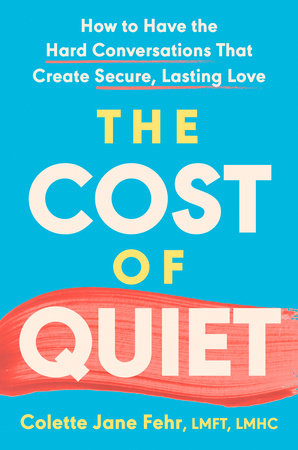
The Cost of Quiet

How to Have the Hard Conversations That Create Secure, Lasting Love

Look inside
Hardcover
$30.00 US
6.26"W x 9.31"H x 0.95"D   | 14 oz | 12 per carton
On sale Feb 03, 2026 | 272 Pages | 9780593852743

An empowering, healing guide that reveals the true cost of avoidant behavior in a relationship—disconnection, disengagement, and divorce—and shows how we can instead learn to speak up and start connecting with the ones we love most.

“I wish I had spoken up sooner."

People think relationships fail because of deal breakers like infidelity, finances, or parenting problems. But the real culprit is often much less dramatic: emotional disconnection after years of staying silent and avoiding conflict. We’re afraid to say what we need because we worry about what will come next.

Avoidant behavior—the need to “keep the peace” rather than dealing with conflict head on—isn’t our fault. Our ingrained attachment wiring urges us to sidestep day-to-day disputes and brush lingering problems under the rug. But silence is a losing proposition in the long term, leading us to self-abandon and essentially “quiet quit” our relationships.

We can make another choice. In The Cost of Quiet, licensed marriage and family therapist Colette Jane Fehr shines a light on the epidemic of avoidant behavior and how to overcome it. Drawing from the latest attachment science and evidence-based therapies she’s used to repair the bond between hundreds of couples, Fehr gives us the tools to approach those we love with openness, honesty, and vulnerability. The ultimate goal: a securely attached relationship that engages with conflict productively, and the confidence that comes from speaking up and being heard—because a good relationship is worth fighting for.
“This book is a must-read for anyone who has ever silenced themselves to keep the peace. Colette Fehr offers a liberating path forward—one rooted in honesty, connection, and the courage to speak up.” —Jessica Baum, LMHC, author of Anxiously Attached and Safe: An Attachment-Informed Guide to Building Secure Relationships

"In The Cost of Quiet, Colette Jane Fehr shines a compassionate light on the hidden toll of avoiding tough conversations. With clarity and heart, she shows that ‘conflict’ isn’t a dirty word and that speaking up with love can deepen connection, foster understanding and even save a marriage. If you want more harmony and happiness in your relationships, this book is a must-read." —Marci Shimoff, #1 New York Times bestselling author of Happy for No Reason and Chicken Soup for the Woman’s Soul

What if the very conversations you’ve been avoiding are the key to deeper, stronger relationships? In The Cost of Quiet, Colette Jane Fehr reveals why conflict, when faced with courage, can be the greatest act of love. This book will change how you connect forever.”
—Marie Forleo, #1 New York Times bestselling author of Everything Is Figureoutable

The Cost of Quiet will give you the courage and clarity you need to finally start speaking up and showing up as your most authentic self. Colette’s brilliant work is the medicine our world has been waiting for, helping countless people discover their power to keep it real and true. In doing so, she reveals the highest and best that love has to offer.” —Katherine Woodward Thomas, New York Times bestselling author of What’s True About You: 7 Steps to Move Beyond Your Painful Past and Manifest Your Brightest Future

“The book's central insight is revolutionary yet simple: staying quiet to ‘keep the peace’ actually creates the very disconnection we're trying to prevent. The Cost of Quiet offers hope that it's never too late to transform both your relationship with yourself and others through the power of truthful, loving communication. This is not just a book; it’s a transformative journey toward personal liberation.” —Dr. Nadine Macaluso, author of Run Like Hell: A Therapist’s Guide to Recognizing, Escaping, and Healing from Trauma Bonds

“Once in a while a book comes along that is so useful and to-the-point that one can only say: Get it now and put it to work for you. In The Cost of Quiet, Collete Jane Fehr correctly identifies a fundamental relationship problem: silence in the name of peace is the slayer of intimacy. Her wisdom and compassion come through on every page, making the book illuminating to the mind and stirring to the heart.” —Gay Hendricks, author of The Big Leap

“It’s normal to fear conflict and want to avoid it at all costs. But staying silent when things get tough destroys relationships. Here’s the good news: you can learn to have the hard conversations with your partner that will actually save your marriage. The Cost of Quiet shows you how to speak up in your relationship—and why you must.” —George Faller, MS, LMFT, author of True Connection

"The Cost of Quiet makes a persuasive case for sharing our deepest vulnerabilities in our relationships—rather than reflexively shutting down or lashing out. Fehr leads the reader through the steps of identifying their own triggers, making sense of and taking responsibility for them, and communicating them in ways that can reach and move their partner.”
Darcy Lockman, author of All the Rage: Mothers, Fathers, and the Myth of Equal Partnership
© Kristia Knowles Photography
Colette Jane Fehr is a licensed psychotherapist specializing in couples’ therapy. She also co-hosts the podcasts Insights from the Couch and Love Thy Neighbor, and her 2025 TEDx talk Secrets of a Couples Therapist was a TED editors pick. She lives in Orlando, Florida, with her husband. View titles by Colette Jane Fehr LMFT, LMHC
Chapter 1

What Self-Silencing and
Avoidant Behavior Look Like

Morgan and Leo sit on my couch, as far apart as possible. Morgan is perched on the edge of her seat, staring out the window. I note a faint tremble in her chin. The tissue box, one of two that I have stationed on either side of the couch in my office, sits perched on her lap, ready for the tears she's obviously holding back as she struggles to still her hands. Leo sits with his arms crossed and his jaw clenched, his knee bouncing like a jackhammer. I can feel the tension radiating off him as if he were just cooked in a microwave.

Morgan had called to schedule an initial session with me two days after Leo discovered she'd been having an affair. Now she looks like she's about to throw up, and he looks like he's about to start screaming. I wouldn't expect it any other way.

Emotions are always running high in these situations, and I know I'll need to work hard to create safety in the room. As I begin gently connecting with each of them and exploring their individual perspectives, a painful but all-too-common story begins to emerge.

Leo recounts what happened, the words tumbling out. An incriminating text had come in while he was using Morgan's phone, and he'd immediately called that number, then heard a guy answer and quickly hang up. He'd confronted Morgan, who had initially lied but eventually confessed to an astonishing betrayal that had blown his mind.

Morgan admitted she'd reconnected with a high school boyfriend who'd recently gotten a divorce. It had started out innocently enough-two old friends catching up on the past twenty years and reminiscing about old times-but had gradually slipped over the line into the kind of intimate sharing that constitutes an emotional affair. Eventually, the daily phone calls and texting banter led to sharing explicit photos and an in-person encounter. It then spiraled into a full-blown physical affair-one that had been ongoing for nearly one year.

At first glance it might seem as if their marital problems are all about Morgan's infidelity-and certainly the fallout from that will have to be dealt with. But in fact the real culprit here is the profound disconnection that happened between them long before any cheating took place. Over the next few sessions, I learn more about their respective histories, what first drew them to each other, and what brought them to this moment.

Morgan and Leo are in their late thirties and have two children-Luke, age eleven, and Olivia, age eight. They have been married for twelve years. Morgan always loved that Leo was tall, handsome, and confident; when they met (at a university dive bar their junior year of college), Leo had come right up to her, introduced himself, and offered to buy her a drink. For his part, Leo remembered being immediately drawn to the bright, bubbly Morgan, and he'd quickly discovered that she was as kind and mild-mannered as she was pretty. They'd felt a spark between them, instant and intense.

More important, as they got to know each other, they discovered they had the exact same goals, values, and vision for their lives. They both wanted to have a traditional home life, where Morgan would stay home with the kids while they were young. So that's exactly what she did-a few years after graduation, after she gave birth to Luke, she'd quit her job in PR and become a stay-at-home mother. They felt fortunate that Leo's job as an engineer afforded them this luxury, and for a while things went smoothly. They took nice vacations every year; their kids were healthy and doing well in school. From the outside looking in, they seemed to have it all. So what had gone wrong?


They’d been in agreement about this recipe for a perfect life, and it had all seemed to be working out just as they’d planned. But somewhere along the way, that shared vision changed. Morgan had been feeling stifled by stay-at-home life and longed for adult interaction and stimulation-not to mention the sense of accomplishment she’d gotten from her career. She was often overwhelmed by taking care of the kids and having little to no hands-on help from Leo, who seemed too preoccupied with work to connect with her emotionally. After years of this, Morgan felt lonely, confused, and resentful. Then, she had cheated . . . leading this “perfect” couple to my office, on the brink of divorce.

After counseling countless couples through this exact issue, I can predict with a fair degree of certainty that Morgan has been unconsciously avoiding the hard conversations for a long, long time. Now that avoidant behavior has brought them here, it's time to get to the bottom of it to properly move forward.

The True Cost of Avoidant Behavior

The idea that cheating automatically indicates that something is flawed or lacking in a relationship is a myth long perpetuated by society, both out of sheer ignorance and because it feels safer for people to believe they have some control over circumstances and can prevent such a painful thing from happening to them. In other words, we'd like to believe that if you're a good partner and give all you have to your relationship, you won't get cheated on.

Try telling that to Leo.

The truth is, cheating happens for all kinds of reasons:

We're human and naturally attracted to others throughout our lifespan.

We can get close to other people without realizing that we're drifting into dangerous territory.

We get lonely, bored, insecure, and desperate for attention and validation.

We've avoided the real, underlying problems in our primary relationship for too long.

Despite these nuances, there is one central truth: If you and your partner are emotionally connected and there's honest, open communication, cheating is much, much less likely to happen. If conversely, like in Morgan's case, you avoid talking about your needs and feelings for fear of what might come out of those discussions-disconnection, or potential infidelity, will be the result.

In most cases, though, conflict avoidance isn't something you wake up and actively choose to do. No one wants to hide or miscommunicate their feelings with their partner! It stems from many unconscious micro decisions that ultimately lead to harmful disconnection in your relationship.

Avoidant behaviors range from suppressing feelings and self-silencing to loudly projecting blame and anger. It might look like telling your partner you're fine when you're actually seething because you're convinced they can't handle hearing what you have to say-or maybe you don't trust yourself to say it without getting ugly. It may look like allowing frustration to boil over into an explosion of damaging insults you don't really mean and can't take back. It can also take the form of incessant bickering or passive-aggressive digs. All of these avoidant behaviors (which we'll break down later in this chapter) obfuscate the underlying feelings and needs that you must share in order to have a healthy connected relationship.

We can slip into this avoidant behavior the minute there's tension in the air. Let's face it, it can be uncomfortable to have those hard conversations with your partner when you're not sure how they will receive and respond to them. However, when you choose avoidant behavior, you sabotage your relationship and get stuck in what I call the avoidance trap. Essentially, you prioritize the short-term comfort of avoidance over the long-term benefits of intimacy and growth that stem from constructively addressing conflict. Avoidant behaviors feel good in the moment because they prevent the anxiety that naturally occurs when you take the risk to be vulnerable-but the more you avoid, the more deeply ensnared you are in the trap, making it even harder to speak up and create meaningful connection with your partner.

Simply put: Avoidant behavior is what kills relationships. Not the issues or underlying feelings themselves, but choosing not to face them. Like Morgan and Leo, you can be stuck in that trap for a long time without knowing what's happening until a crisis hits or it's too late.

Good communication doesn't automatically make you or your partner impervious to attraction to other people. It doesn't mean that it's impossible for an outside force to threaten your relationship. But it does mean you will be less vulnerable to letting an attraction get out of hand if you learn how to speak up about your needs and communicate with each other-and yes, even fight!-clearly and often. If you have a relationship in which you and your partner know how to address conflict, then you'll be able to talk about it if either one of you starts to feel disconnected, lonely, or attracted to someone else . . . as difficult as it might be to hear that.

Staying quiet and avoiding problems in your relationship doesn't mean they go away. Quite the opposite.

Avoidance Breeds Resentment

As Morgan opens up to me in our one-on-one session, it becomes clear that she had silenced herself and avoided her true feelings in this relationship for a long, long time. She is steeped in remorse, regret, and shame about her actions, but as we dig deeper together, she confirms my early hypothesis: that the seeds of this affair had begun with her own self-silencing, people-pleasing tendencies, and avoidant behaviors, years before there was any contact with her old boyfriend.

"How did you and Leo handle conflict before the affair?" I ask in an early session.

"Honestly, we didn't," she tells me. "We avoided it completely. Early on I tried to bring up certain feelings, but it never seemed to go well and I probably wasn't clear. It's really hard for me to ask for what I need."

Morgan explains that this lack of communication intensified after their children were born-when she felt that the mental and physical load of parenting and all the household responsibilities fell on her. Her frustration over the unfair disparity between their domestic duties grew. When she did try to communicate, however minimally and indirectly, she felt Leo was dismissive or defensive, pointing to all the things he did to help support her. Then she'd tell herself that maybe she was just being selfish and she should be putting her kids and partner first.

"He wasn't understanding me, or would tell me all the reasons I shouldn't feel that way. Then I'd feel even more upset and confused and question if I was even justified in feeling how I felt," she says.

She didn't want to fight-and nothing seemed to change, anyway-so she just gave up.

"I had all this resentment, and it just grew and grew. It didn't seem like there was anything I could do about it," she explains, tears rolling down her face that she doesn't bother wiping away.

Morgan had fallen into what I call the cave of resentment-a familiar effect of the avoidance trap that I often see with my clients. It goes like this: When you avoid conflict, it's as if you're walking through a sunny meadow toward a beautiful, cozy cottage. Then you unexpectedly fall through a hole in the ground you didn't see and land in a cold, dark cave.

At first you try hard to get out, but every pathway you attempt is either obscured or seems too dangerous to traverse, so eventually you just sit down and give up, resigned to being stuck alone in that cave unless someone comes along to rescue you.

Meanwhile, there is a solution available to you that you've failed to notice. You've been darting back and forth, frantically trying to find a way out, but had never thought to look back up at the hole you fell in through. If you were exploring with curiosity, you would surely see that there is a little ladder right there along the wall leading up and into the light.

At first glance the ladder looks too steep, as if it's too rickety to climb. It doesn't feel safe, but the alternative is to stay in this lonely, dark, miserable place forever, so you decide to give it a shot. The first step is filled with terror, and you expect to fall, but you keep going. Slowly but surely you make your way up, gaining confidence one rung at a time.

This is what happens when you learn to speak up in your relationship. You tap into your own internal wellspring of power and confidence to effectively communicate your feelings and needs. As a result, you stay out of, or save yourself from, the avoidance trap.

Prior to the affair, Morgan had fallen victim to the avoidance trap and was stuck in that cave of resentment, not knowing she had a way out.

When I meet with Leo for his one-on-one session, we briefly touch on his perspective of this pre-affair time. Understandably, it's tough for him to push past the pain of the affair to reflect on the past. His emotions vacillate from shock to anger, between a desire to divorce her immediately and an urge to beg her to choose him and stay. There is also a compulsion to blame himself for her affair and question what he did wrong, a sentiment that I often hear in these early days after a disclosure. Of course, all of these big feelings and questions must be dealt with. But perhaps the important piece of this puzzle to address, if this couple wants to heal and move forward together, is how a lack of communication over the long term contributed to the enormous rupture they now face.

I ask Leo what Morgan had communicated to him about her feelings prior to the affair. I am wondering if he'd had any sense of how frustrated and resentful she had been feeling.

"She seemed a little overwhelmed sometimes around stuff with the kids, but that's just normal at this stage of life, right? I didn't think any of it was that big of a deal. I thought she was happy with our life," he says. "I can't even think of a time we really argued. I didn't even know she was upset about anything!"

Leo's brain goes over this fundamental disconnect again and again. Morgan is saying things were bad for her for a long time. But he can't reconcile that with what he saw, both before and throughout her yearlong affair: a woman who seemed content and hadn't said a word about deep fissures, dissatisfactions, or unmet emotional needs. Morgan was right: She hadn't been clear about what she was feeling and needing, and her indirect attempts hadn't registered with Leo at all.

Morgan has to take responsibility for having an affair, and she will have to work hard for a long time to repair that injury with Leo if that's indeed what she wants. Infidelity, whether physical or emotional, is known as an attachment injury: a deep, emotional wound to a couple's bond that damages trust and creates insecurity. It takes lots of time, patience, and hard work to make the bond secure again. But often infidelity is preceded by periods of emotional estrangement such as this. Morgan had long felt that Leo was too busy to be there for her, so she had talked herself into avoiding conflict and suppressing her deeper feelings and needs to keep the peace. And indeed, Leo hadn't recognized what were in retrospect signs that his wife was struggling, such as being less affectionate and more withdrawn. The distance and disconnection in their relationship that existed prior to the affair-indeed, that contributed to the affair-is something Morgan and Leo co-created, because they had avoided communicating about the hard things.

About

An empowering, healing guide that reveals the true cost of avoidant behavior in a relationship—disconnection, disengagement, and divorce—and shows how we can instead learn to speak up and start connecting with the ones we love most.

“I wish I had spoken up sooner."

People think relationships fail because of deal breakers like infidelity, finances, or parenting problems. But the real culprit is often much less dramatic: emotional disconnection after years of staying silent and avoiding conflict. We’re afraid to say what we need because we worry about what will come next.

Avoidant behavior—the need to “keep the peace” rather than dealing with conflict head on—isn’t our fault. Our ingrained attachment wiring urges us to sidestep day-to-day disputes and brush lingering problems under the rug. But silence is a losing proposition in the long term, leading us to self-abandon and essentially “quiet quit” our relationships.

We can make another choice. In The Cost of Quiet, licensed marriage and family therapist Colette Jane Fehr shines a light on the epidemic of avoidant behavior and how to overcome it. Drawing from the latest attachment science and evidence-based therapies she’s used to repair the bond between hundreds of couples, Fehr gives us the tools to approach those we love with openness, honesty, and vulnerability. The ultimate goal: a securely attached relationship that engages with conflict productively, and the confidence that comes from speaking up and being heard—because a good relationship is worth fighting for.

Praise

“This book is a must-read for anyone who has ever silenced themselves to keep the peace. Colette Fehr offers a liberating path forward—one rooted in honesty, connection, and the courage to speak up.” —Jessica Baum, LMHC, author of Anxiously Attached and Safe: An Attachment-Informed Guide to Building Secure Relationships

"In The Cost of Quiet, Colette Jane Fehr shines a compassionate light on the hidden toll of avoiding tough conversations. With clarity and heart, she shows that ‘conflict’ isn’t a dirty word and that speaking up with love can deepen connection, foster understanding and even save a marriage. If you want more harmony and happiness in your relationships, this book is a must-read." —Marci Shimoff, #1 New York Times bestselling author of Happy for No Reason and Chicken Soup for the Woman’s Soul

What if the very conversations you’ve been avoiding are the key to deeper, stronger relationships? In The Cost of Quiet, Colette Jane Fehr reveals why conflict, when faced with courage, can be the greatest act of love. This book will change how you connect forever.”
—Marie Forleo, #1 New York Times bestselling author of Everything Is Figureoutable

The Cost of Quiet will give you the courage and clarity you need to finally start speaking up and showing up as your most authentic self. Colette’s brilliant work is the medicine our world has been waiting for, helping countless people discover their power to keep it real and true. In doing so, she reveals the highest and best that love has to offer.” —Katherine Woodward Thomas, New York Times bestselling author of What’s True About You: 7 Steps to Move Beyond Your Painful Past and Manifest Your Brightest Future

“The book's central insight is revolutionary yet simple: staying quiet to ‘keep the peace’ actually creates the very disconnection we're trying to prevent. The Cost of Quiet offers hope that it's never too late to transform both your relationship with yourself and others through the power of truthful, loving communication. This is not just a book; it’s a transformative journey toward personal liberation.” —Dr. Nadine Macaluso, author of Run Like Hell: A Therapist’s Guide to Recognizing, Escaping, and Healing from Trauma Bonds

“Once in a while a book comes along that is so useful and to-the-point that one can only say: Get it now and put it to work for you. In The Cost of Quiet, Collete Jane Fehr correctly identifies a fundamental relationship problem: silence in the name of peace is the slayer of intimacy. Her wisdom and compassion come through on every page, making the book illuminating to the mind and stirring to the heart.” —Gay Hendricks, author of The Big Leap

“It’s normal to fear conflict and want to avoid it at all costs. But staying silent when things get tough destroys relationships. Here’s the good news: you can learn to have the hard conversations with your partner that will actually save your marriage. The Cost of Quiet shows you how to speak up in your relationship—and why you must.” —George Faller, MS, LMFT, author of True Connection

"The Cost of Quiet makes a persuasive case for sharing our deepest vulnerabilities in our relationships—rather than reflexively shutting down or lashing out. Fehr leads the reader through the steps of identifying their own triggers, making sense of and taking responsibility for them, and communicating them in ways that can reach and move their partner.”
Darcy Lockman, author of All the Rage: Mothers, Fathers, and the Myth of Equal Partnership

Author

© Kristia Knowles Photography
Colette Jane Fehr is a licensed psychotherapist specializing in couples’ therapy. She also co-hosts the podcasts Insights from the Couch and Love Thy Neighbor, and her 2025 TEDx talk Secrets of a Couples Therapist was a TED editors pick. She lives in Orlando, Florida, with her husband. View titles by Colette Jane Fehr LMFT, LMHC

Excerpt

Chapter 1

What Self-Silencing and
Avoidant Behavior Look Like

Morgan and Leo sit on my couch, as far apart as possible. Morgan is perched on the edge of her seat, staring out the window. I note a faint tremble in her chin. The tissue box, one of two that I have stationed on either side of the couch in my office, sits perched on her lap, ready for the tears she's obviously holding back as she struggles to still her hands. Leo sits with his arms crossed and his jaw clenched, his knee bouncing like a jackhammer. I can feel the tension radiating off him as if he were just cooked in a microwave.

Morgan had called to schedule an initial session with me two days after Leo discovered she'd been having an affair. Now she looks like she's about to throw up, and he looks like he's about to start screaming. I wouldn't expect it any other way.

Emotions are always running high in these situations, and I know I'll need to work hard to create safety in the room. As I begin gently connecting with each of them and exploring their individual perspectives, a painful but all-too-common story begins to emerge.

Leo recounts what happened, the words tumbling out. An incriminating text had come in while he was using Morgan's phone, and he'd immediately called that number, then heard a guy answer and quickly hang up. He'd confronted Morgan, who had initially lied but eventually confessed to an astonishing betrayal that had blown his mind.

Morgan admitted she'd reconnected with a high school boyfriend who'd recently gotten a divorce. It had started out innocently enough-two old friends catching up on the past twenty years and reminiscing about old times-but had gradually slipped over the line into the kind of intimate sharing that constitutes an emotional affair. Eventually, the daily phone calls and texting banter led to sharing explicit photos and an in-person encounter. It then spiraled into a full-blown physical affair-one that had been ongoing for nearly one year.

At first glance it might seem as if their marital problems are all about Morgan's infidelity-and certainly the fallout from that will have to be dealt with. But in fact the real culprit here is the profound disconnection that happened between them long before any cheating took place. Over the next few sessions, I learn more about their respective histories, what first drew them to each other, and what brought them to this moment.

Morgan and Leo are in their late thirties and have two children-Luke, age eleven, and Olivia, age eight. They have been married for twelve years. Morgan always loved that Leo was tall, handsome, and confident; when they met (at a university dive bar their junior year of college), Leo had come right up to her, introduced himself, and offered to buy her a drink. For his part, Leo remembered being immediately drawn to the bright, bubbly Morgan, and he'd quickly discovered that she was as kind and mild-mannered as she was pretty. They'd felt a spark between them, instant and intense.

More important, as they got to know each other, they discovered they had the exact same goals, values, and vision for their lives. They both wanted to have a traditional home life, where Morgan would stay home with the kids while they were young. So that's exactly what she did-a few years after graduation, after she gave birth to Luke, she'd quit her job in PR and become a stay-at-home mother. They felt fortunate that Leo's job as an engineer afforded them this luxury, and for a while things went smoothly. They took nice vacations every year; their kids were healthy and doing well in school. From the outside looking in, they seemed to have it all. So what had gone wrong?


They’d been in agreement about this recipe for a perfect life, and it had all seemed to be working out just as they’d planned. But somewhere along the way, that shared vision changed. Morgan had been feeling stifled by stay-at-home life and longed for adult interaction and stimulation-not to mention the sense of accomplishment she’d gotten from her career. She was often overwhelmed by taking care of the kids and having little to no hands-on help from Leo, who seemed too preoccupied with work to connect with her emotionally. After years of this, Morgan felt lonely, confused, and resentful. Then, she had cheated . . . leading this “perfect” couple to my office, on the brink of divorce.

After counseling countless couples through this exact issue, I can predict with a fair degree of certainty that Morgan has been unconsciously avoiding the hard conversations for a long, long time. Now that avoidant behavior has brought them here, it's time to get to the bottom of it to properly move forward.

The True Cost of Avoidant Behavior

The idea that cheating automatically indicates that something is flawed or lacking in a relationship is a myth long perpetuated by society, both out of sheer ignorance and because it feels safer for people to believe they have some control over circumstances and can prevent such a painful thing from happening to them. In other words, we'd like to believe that if you're a good partner and give all you have to your relationship, you won't get cheated on.

Try telling that to Leo.

The truth is, cheating happens for all kinds of reasons:

We're human and naturally attracted to others throughout our lifespan.

We can get close to other people without realizing that we're drifting into dangerous territory.

We get lonely, bored, insecure, and desperate for attention and validation.

We've avoided the real, underlying problems in our primary relationship for too long.

Despite these nuances, there is one central truth: If you and your partner are emotionally connected and there's honest, open communication, cheating is much, much less likely to happen. If conversely, like in Morgan's case, you avoid talking about your needs and feelings for fear of what might come out of those discussions-disconnection, or potential infidelity, will be the result.

In most cases, though, conflict avoidance isn't something you wake up and actively choose to do. No one wants to hide or miscommunicate their feelings with their partner! It stems from many unconscious micro decisions that ultimately lead to harmful disconnection in your relationship.

Avoidant behaviors range from suppressing feelings and self-silencing to loudly projecting blame and anger. It might look like telling your partner you're fine when you're actually seething because you're convinced they can't handle hearing what you have to say-or maybe you don't trust yourself to say it without getting ugly. It may look like allowing frustration to boil over into an explosion of damaging insults you don't really mean and can't take back. It can also take the form of incessant bickering or passive-aggressive digs. All of these avoidant behaviors (which we'll break down later in this chapter) obfuscate the underlying feelings and needs that you must share in order to have a healthy connected relationship.

We can slip into this avoidant behavior the minute there's tension in the air. Let's face it, it can be uncomfortable to have those hard conversations with your partner when you're not sure how they will receive and respond to them. However, when you choose avoidant behavior, you sabotage your relationship and get stuck in what I call the avoidance trap. Essentially, you prioritize the short-term comfort of avoidance over the long-term benefits of intimacy and growth that stem from constructively addressing conflict. Avoidant behaviors feel good in the moment because they prevent the anxiety that naturally occurs when you take the risk to be vulnerable-but the more you avoid, the more deeply ensnared you are in the trap, making it even harder to speak up and create meaningful connection with your partner.

Simply put: Avoidant behavior is what kills relationships. Not the issues or underlying feelings themselves, but choosing not to face them. Like Morgan and Leo, you can be stuck in that trap for a long time without knowing what's happening until a crisis hits or it's too late.

Good communication doesn't automatically make you or your partner impervious to attraction to other people. It doesn't mean that it's impossible for an outside force to threaten your relationship. But it does mean you will be less vulnerable to letting an attraction get out of hand if you learn how to speak up about your needs and communicate with each other-and yes, even fight!-clearly and often. If you have a relationship in which you and your partner know how to address conflict, then you'll be able to talk about it if either one of you starts to feel disconnected, lonely, or attracted to someone else . . . as difficult as it might be to hear that.

Staying quiet and avoiding problems in your relationship doesn't mean they go away. Quite the opposite.

Avoidance Breeds Resentment

As Morgan opens up to me in our one-on-one session, it becomes clear that she had silenced herself and avoided her true feelings in this relationship for a long, long time. She is steeped in remorse, regret, and shame about her actions, but as we dig deeper together, she confirms my early hypothesis: that the seeds of this affair had begun with her own self-silencing, people-pleasing tendencies, and avoidant behaviors, years before there was any contact with her old boyfriend.

"How did you and Leo handle conflict before the affair?" I ask in an early session.

"Honestly, we didn't," she tells me. "We avoided it completely. Early on I tried to bring up certain feelings, but it never seemed to go well and I probably wasn't clear. It's really hard for me to ask for what I need."

Morgan explains that this lack of communication intensified after their children were born-when she felt that the mental and physical load of parenting and all the household responsibilities fell on her. Her frustration over the unfair disparity between their domestic duties grew. When she did try to communicate, however minimally and indirectly, she felt Leo was dismissive or defensive, pointing to all the things he did to help support her. Then she'd tell herself that maybe she was just being selfish and she should be putting her kids and partner first.

"He wasn't understanding me, or would tell me all the reasons I shouldn't feel that way. Then I'd feel even more upset and confused and question if I was even justified in feeling how I felt," she says.

She didn't want to fight-and nothing seemed to change, anyway-so she just gave up.

"I had all this resentment, and it just grew and grew. It didn't seem like there was anything I could do about it," she explains, tears rolling down her face that she doesn't bother wiping away.

Morgan had fallen into what I call the cave of resentment-a familiar effect of the avoidance trap that I often see with my clients. It goes like this: When you avoid conflict, it's as if you're walking through a sunny meadow toward a beautiful, cozy cottage. Then you unexpectedly fall through a hole in the ground you didn't see and land in a cold, dark cave.

At first you try hard to get out, but every pathway you attempt is either obscured or seems too dangerous to traverse, so eventually you just sit down and give up, resigned to being stuck alone in that cave unless someone comes along to rescue you.

Meanwhile, there is a solution available to you that you've failed to notice. You've been darting back and forth, frantically trying to find a way out, but had never thought to look back up at the hole you fell in through. If you were exploring with curiosity, you would surely see that there is a little ladder right there along the wall leading up and into the light.

At first glance the ladder looks too steep, as if it's too rickety to climb. It doesn't feel safe, but the alternative is to stay in this lonely, dark, miserable place forever, so you decide to give it a shot. The first step is filled with terror, and you expect to fall, but you keep going. Slowly but surely you make your way up, gaining confidence one rung at a time.

This is what happens when you learn to speak up in your relationship. You tap into your own internal wellspring of power and confidence to effectively communicate your feelings and needs. As a result, you stay out of, or save yourself from, the avoidance trap.

Prior to the affair, Morgan had fallen victim to the avoidance trap and was stuck in that cave of resentment, not knowing she had a way out.

When I meet with Leo for his one-on-one session, we briefly touch on his perspective of this pre-affair time. Understandably, it's tough for him to push past the pain of the affair to reflect on the past. His emotions vacillate from shock to anger, between a desire to divorce her immediately and an urge to beg her to choose him and stay. There is also a compulsion to blame himself for her affair and question what he did wrong, a sentiment that I often hear in these early days after a disclosure. Of course, all of these big feelings and questions must be dealt with. But perhaps the important piece of this puzzle to address, if this couple wants to heal and move forward together, is how a lack of communication over the long term contributed to the enormous rupture they now face.

I ask Leo what Morgan had communicated to him about her feelings prior to the affair. I am wondering if he'd had any sense of how frustrated and resentful she had been feeling.

"She seemed a little overwhelmed sometimes around stuff with the kids, but that's just normal at this stage of life, right? I didn't think any of it was that big of a deal. I thought she was happy with our life," he says. "I can't even think of a time we really argued. I didn't even know she was upset about anything!"

Leo's brain goes over this fundamental disconnect again and again. Morgan is saying things were bad for her for a long time. But he can't reconcile that with what he saw, both before and throughout her yearlong affair: a woman who seemed content and hadn't said a word about deep fissures, dissatisfactions, or unmet emotional needs. Morgan was right: She hadn't been clear about what she was feeling and needing, and her indirect attempts hadn't registered with Leo at all.

Morgan has to take responsibility for having an affair, and she will have to work hard for a long time to repair that injury with Leo if that's indeed what she wants. Infidelity, whether physical or emotional, is known as an attachment injury: a deep, emotional wound to a couple's bond that damages trust and creates insecurity. It takes lots of time, patience, and hard work to make the bond secure again. But often infidelity is preceded by periods of emotional estrangement such as this. Morgan had long felt that Leo was too busy to be there for her, so she had talked herself into avoiding conflict and suppressing her deeper feelings and needs to keep the peace. And indeed, Leo hadn't recognized what were in retrospect signs that his wife was struggling, such as being less affectionate and more withdrawn. The distance and disconnection in their relationship that existed prior to the affair-indeed, that contributed to the affair-is something Morgan and Leo co-created, because they had avoided communicating about the hard things.