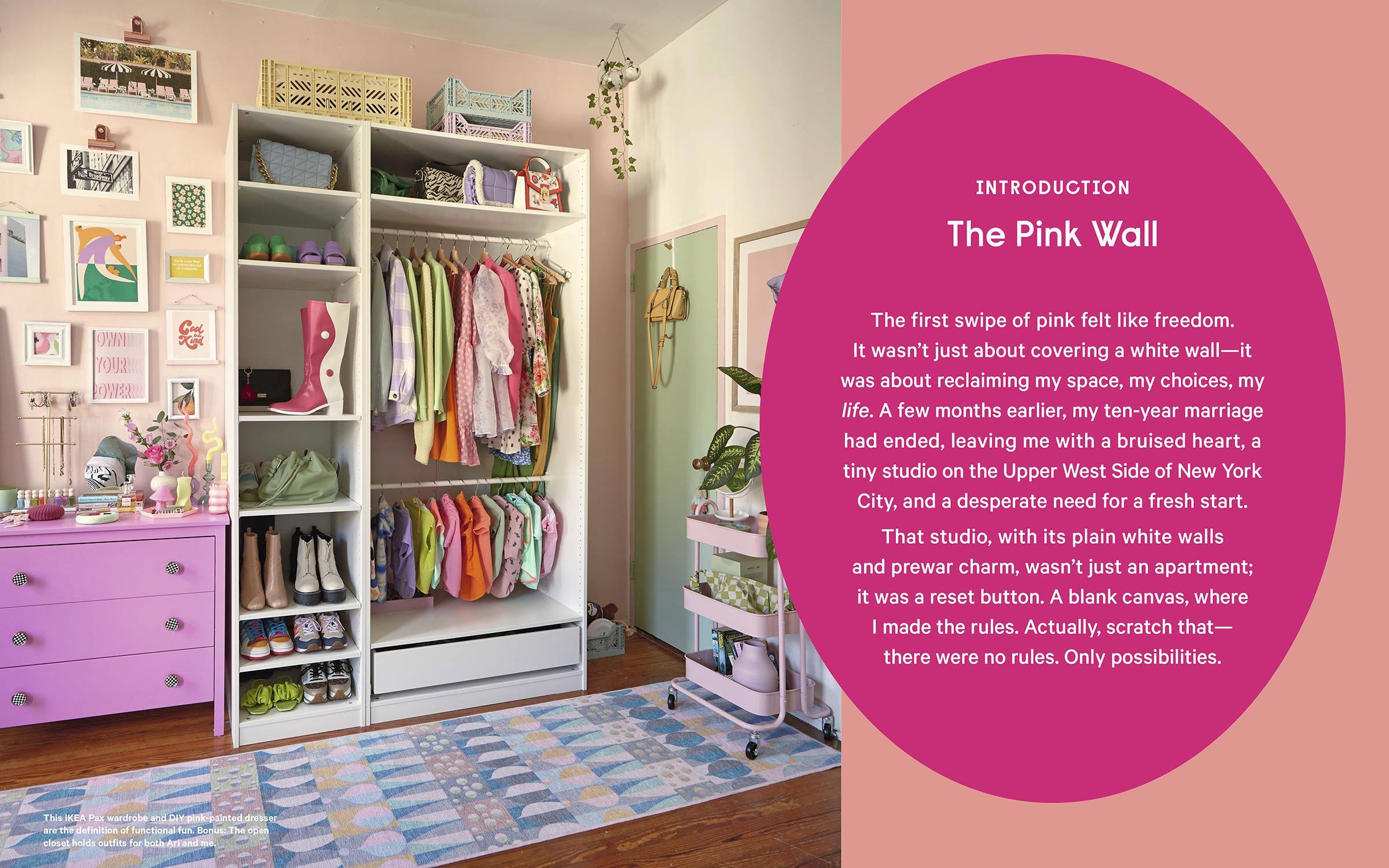
IntroductionThe Pink WallThe first swipe of pink felt like freedom. It wasn’t just about covering a white wall—it was about reclaiming my space, my choices, my
life. A few months earlier, my ten-year marriage had ended, leaving me with a bruised heart, a tiny studio on the Upper West Side of New York City, and a desperate need for a fresh start.
That studio, with its plain white walls and prewar charm, wasn’t just an apartment; it was a reset button. A blank canvas, where I made the rules. Actually, scratch that— there were no rules. Only possibilities.
Rolling pastel pink paint across the wall felt like dropping the mic on my old life. It was like my soul let out a happy little squeal. For the first time, I was making a space that felt like me. Not “Pinterest-perfect” me or “approved by committee” me—just
me. Until that moment, every home I’d lived in had been compromised, inherited, never truly mine. Growing up in Mumbai, I lived with my parents and younger brother in a two-room apartment. (And when I say two rooms, I mean two rooms. Not two bedrooms. Just two hardworking spaces pulling triple duty.) Our living room wore a lot of hats: homework station, dining room, guest lounge, and, by night, shared sleeping space. Everything in our home was practical—the furniture, the decor, all of it.
But creativity found its way in through other outlets: I sketched glamorous outfits, mixed bold colors and patterns in my clothes, and jumped at every art class my mom could find. I learned early on that creating something with your own hands brings a kind of magic that can’t be explained—only felt.
Years later, that ingenuity sparked in my childhood became my career. I studied fashion in Mumbai, styled for music videos and commercials, and worked on editorial shoots. My days were a kaleidoscope of colors, textures, and ideas, and I thrived on the fast pace and creativity of it all.
But when I got married and moved to the United States—Jersey City, New Jersey, to be exact—everything shifted. My dependent spouse visa meant I couldn’t work, and without the career I’d built to anchor me, I felt unmoored. So, I decided to go back to school, this time at the Fashion Institute of Technology in New York.
Those two years of school changed everything. I earned a bachelor’s degree in International Trade and Marketing for the Fashion Industries, graduated summa cum laude, and even received scholarships from Ralph Lauren and Cotton Incorporated. Walking across the stage at graduation was one of my proudest moments. It wasn’t just about the accolades—it was about proving to myself that I could start over and carve a new path, no matter what life threw at me.
But it wasn’t until my then-husband’s job took us to London that I really found my calling. London is like a design love letter in 3D—pastel townhouses in Chelsea and Notting Hill, mint-green Figaros casually parked on cobblestoned streets, and doors painted in colors so bold they practically dare you not to smile.
Believe it or not, I wasn’t always a pastel person—far from it. Before London, pink wasn’t even on my radar. Now? I’m 100 percent team blush. One walk through a candy-colored street in May, and I was done for. The way those dreamy pastels popped against the gray sky? Instant love affair.
Evening walks became my thing. I’d peek through those enormous windows (respectfully!) and catch glimpses of gorgeous, jewel-toned interiors so perfectly styled they felt like still-life paintings.
And don’t even get me started on the flowers. Rose arches. Wisteriacovered townhouses. Cherry blossoms fluffier than cotton candy. I used to not be able to tell the difference between a peony and a petunia. Now I’m a flower girlie for life. I learned to pause and take in the beauty of small moments. Flowers became my daily reminder that even the simplest details can transform how a space feels.
It was during those London years that I launched an Instagram account with my beloved pug, Ari, called athoneyidressedthepug. It started as a fun side project—dressing us in matching outfits, experimenting with pattern and color, and fully embracing the playful side of fashion. Ari was the star, and I was his loyal stylist. But what began as a creative outlet soon turned into something bigger, planting the seeds of what would eventually become a career in content creation.
Fast-forward a few years to another big move, this time back to New York. After a long stretch of trying to make it work, I ended my marriage, and I found myself starting over in that small studio apartment on the Upper West Side. Standing there with an open can of pink paint and a roller in hand, I let it sink in.
There was no one else’s opinion to consider. It was just me (and Ari, of course). I asked myself:
What do I want this space to feel like? The answer was crystal clear: joy. Bold, bright, fierce, unstoppable joy. The kind that dances on tables and wears sequins to breakfast.
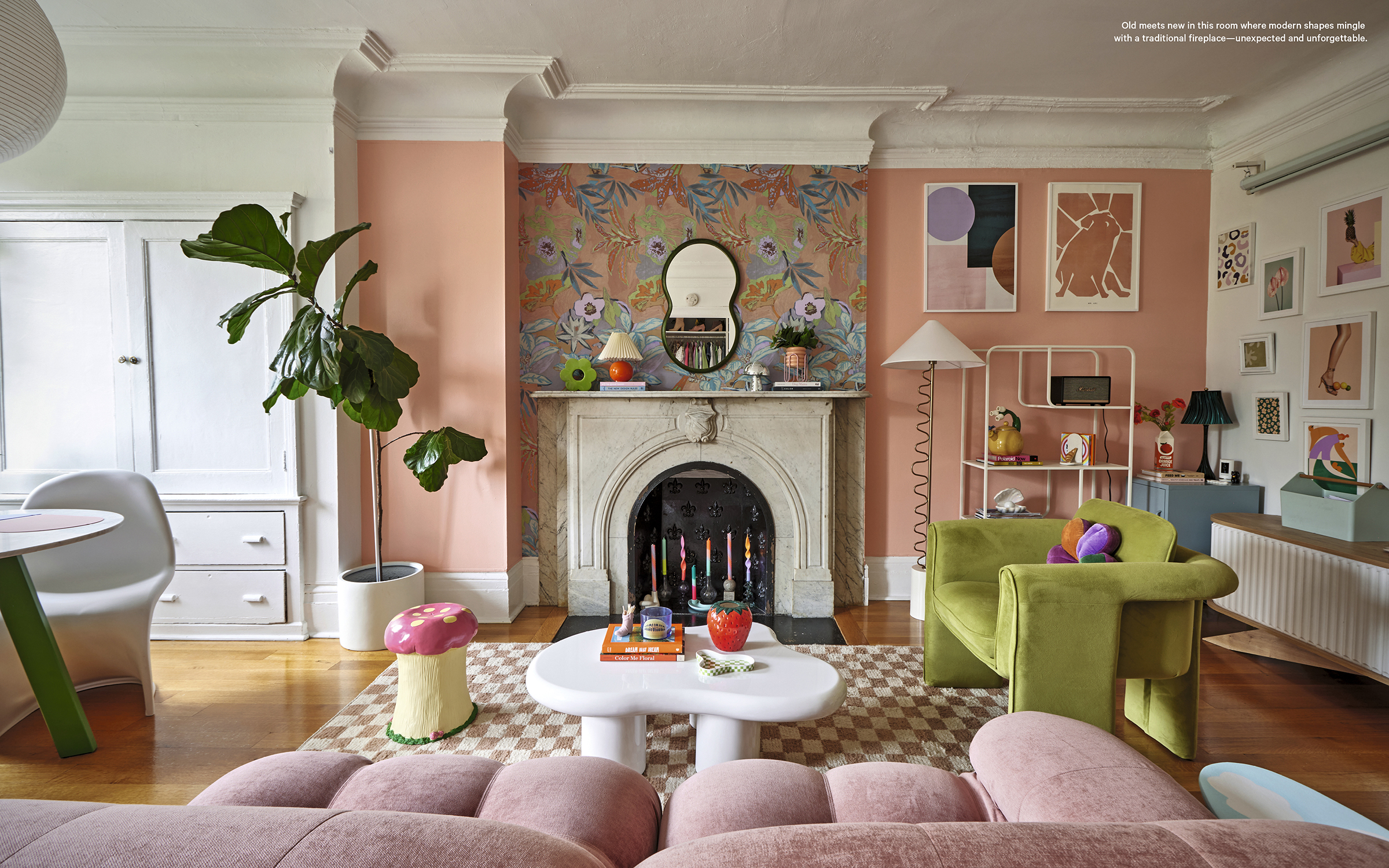
The pink wall was just the start. It was my rebellion against the muted, minimalist design trends that felt more like showroom inspo than real life. Next came flowers, fairy lights, and a purple-checkered wall—because why should your home whisper when it can sing? Layer by layer, I added touches that made the studio feel uniquely mine—pops of color, whimsical patterns, and exuberant flourishes. Piece by piece, I turned it into a home that wasn’t just a place to live but also an extension of
me. And here’s the best part: It didn’t just look good—it made me feel good. Coming home wasn’t just a routine; it was a reset. No matter how messy or exhausting the world outside felt, my apartment was my sanctuary. It was a reminder that home is where your happiness begins. Somewhere between the pink wall and the fairy lights, I discovered a kind of magic I now call dopamine decor.
Copyright © 2026 by Maitri Mody. All rights reserved. No part of this excerpt may be reproduced or reprinted without permission in writing from the publisher.