Close Modal

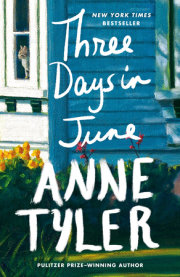
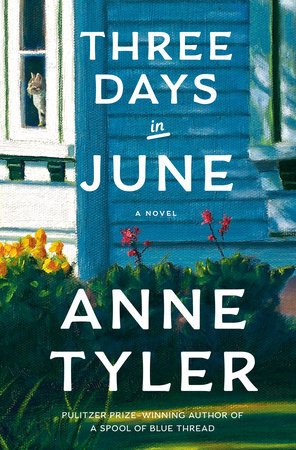
Three Days in June

A Novel

Author Anne Tyler
Look inside
Hardcover
$27.00 US
5.76"W x 8.55"H x 0.77"D   | 11 oz | 12 per carton
On sale Feb 11, 2025 | 176 Pages | 9780593803486

See Additional Formats
NEW YORK TIMES BESTSELLER • A new Anne Tyler novel destined to be an instant classic: a socially awkward mother of the bride navigates the days before and after her daughter's wedding.

“What a treat.” —Washington Post

“Simply exquisite.” —Liane Moriarty

“Nobody understands human nature better than Tyler. And nobody understands the complexities of love the way she does.” —Boston Globe

Three Days in June is like reading a hug.” —Minneapolis Star Tribune


Gail Baines is having a bad day. To start, she loses her job—or quits, depending on whom you ask. Tomorrow her daughter, Debbie, is getting married, and she hasn’t even been invited to the spa day organized by the mother of the groom. Then, Gail’s ex-husband, Max, arrives unannounced on her doorstep, carrying a cat, without a place to stay, and without even a suit.

But the true crisis lands when Debbie shares with her parents a secret she has just learned about her husband to be. It will not only throw the wedding into question but also stir up Gail and Max’s past.

Told with deep sensitivity and a tart sense of humor, full of the joys and heartbreaks of love and marriage and family life, Three Days in June is a triumph, and gives us the perennially bestselling, Pulitzer Prize–winning writer at the height of her powers.
“Anne Tyler remains my favourite author in the world. I’ve adored everything she’s ever written. Three Days in June is, of course, simply exquisite.” —Liane Moriarty

“Tyler lights up the space between people, and shows how it feels to be on the outside looking in. This is her superpower.” New York Times

“Another delightfully assured exploration of the way sorrow and joy meld together in the crucible of family life. . . . [It] seems to defy the conventions of romantic comedy until it finally, gloriously gives in. . . . What a treat to listen in on this banter. . . . Few writers can weave the threads of dialogue with such casual brilliance as Tyler. . . . She and her shelf of celebrated novels sit confidently at the end of a circuitous line that winds back through Jane Austen’s novels to Shakespeare’s comedies.” Washington Post

“Spot on and often very funny. . . . Nobody understands human nature—the yearning, the envy, the sadness, the regret—better than Tyler. And nobody understands the complexities of love the way she does.” Boston Globe

“Deeply compassionate and very witty. . . . The bad news: Anne Tyler can’t possibly write forever. The good news: Her latest novel proves that she’s still inimitable and still providing fresh perspectives on ordinary people.” Los Angeles Times

“This is storytelling at its very best.” Rachel Joyce, author of Miss Benson’s Beetle

Three Days in June is like reading a hug. [Tyler] embraces us from the very first sentence. . . . You’ll want to stay in the warmth of her storytelling. Let it hug you, too, and don’t be afraid to give it a snuggle back. . . . Tyler’s pacing is incomparable.” Minneapolis Star Tribune

“A wise, wonderful book. . . . Three Days in June takes two days to read, but it envelops you just the same, her characters so alive they could be sitting next to you telling you what happened to them last Tuesday—and the ending is a beauty.” The Observer (London)

“Winningly deft. . . . For more than 60 years her clear-eyed but kindly approach to people moving through recognizable daily life has enabled her to serve up a convincing combination of sharpness, tenderness, mild satire and rueful comedy, not just in a single book, but sometimes in a single sentence.” The Times (London)

“As word gets out, all fiction lovers seeking a smart, sunny novel will ask for this one. . . . [A] delectable, tightly focused, and piquant comedy. . . . Tyler is exceptionally adept at exhilarating dialogue and the nuances of relationships. . . . With every character, cat included, incisively and vividly realized, and myriad preoccupations and emotions limned with nimble wit and empathy, this is a keen delight.” Booklist

“Sweet, sharp, and satisfying. . . . Tyler’s touch is as delicate, her empathy for human beings and all their quirks as evident in her 25th work of fiction as it was in her first, published an astonishing 60 years ago.” Kirkus Reviews

“As always, it’s sublimely written and beautifully observed.” Good Housekeeping

“Anne Tyler’s novels plumb the everyday to make magic. . . . Beneath the tidy crust of her plainsong sentences, as ever, seethes the lava of familial and marital relations. . . . Tyler is too deep and nimble a writer, of course, to skate dramedy grooves, though much of her droll banter would shine in a screenplay; she ballasts Three Days in June with the hard weight of life. (Not for nothing did she major in Russian literature.) . . . Family life [is] the source of the unexpectedly heart-busting poignancy at the novel’s close. Are families absolutely, intrinsically interesting? Updike asked. Anne Tyler’s are. Just ask the people at the coffee shop who saw me wiping my eyes as I closed this novel shut.” Garden & Gun

“Three Days in June is a valentine to readers. It’s funny and touching. . . . There isn’t a wrong move in it. It’s the literary equivalent of a box of chocolates with no duds. . . . If you’re looking for a deeply humane writer abounding in wit and wisdom, read Anne Tyler.” —Christian Science Monitor

“With flairs for ingenuity and dexterity, she creates a tapestry of family issues. . . . In the words of singer Celine Dion, perhaps for Gail ‘it’s all coming back for me now.’ As it will for Tyler’s devoted admirers.” Richmond Times-Dispatch

“Tyler’s trademark witticisms and creation of vulnerable characters shows us just how precious life can be.” —Minnesota Monthly

“Written in Anne Tyler’s warm and wonderful style, this is a heart-warming story you’ll fall in love with. . . . Witty, thoughtful and brilliantly character-driven.” —Woman and Home
© Diana Walker
ANNE TYLER was born in Minneapolis, Minnesota, in 1941 and grew up in Raleigh, North Carolina. She is the author of more than twenty novels. Her twentieth novel, A Spool of Blue Thread, was short-listed for the Man Booker Prize in 2015. Her eleventh novel, Breathing Lessons, was awarded the Pulitzer Prize in 1989. She is a member of the American Academy of Arts and Letters. She lives in Baltimore, Maryland.

annetyler.com View titles by Anne Tyler
one

Day of Beauty

People don’t tap their watches anymore; have you noticed?

Standard wristwatches, I’m talking about. Remember how people used to tap them?

My father, for instance. His watch was a Timex with a face as big as a fifty-cent piece, and whenever my mother kept him waiting he would frown down at it and give it a tap. Implying, I suppose now, “Can this possibly be correct? Could it really be this late?” But when I was a little girl, I imagined he was trying to make time move faster—to bring my mother before us instantly, already wearing her coat, like someone in a speeded-up movie.

What reminded me of this recently was that Marilee Burton, the headmistress at the school where I worked, called me into her office one Friday morning as I was walking past. “Come chat for a moment, why don’t you?” she said. This was not a regular occurrence. (We were on more or less formal terms.) She waved toward the Windsor chair facing her desk, but I stayed in the doorway and cocked my head at her.

“I thought I should let you know,” she said, “I won’t be coming in on Monday. I have to have a cardioversion.”

“A what?” I asked.

“A procedure for my heart. It’s been beating wrong.”

“Oh,” I said. I couldn’t pretend to be surprised. She was one of those ladylike women who wear heels on all occasions, the perfect candidate for heart issues. “Well, I’m sorry to hear that,” I told her.

“They’re giving it an electrical jolt that will stop it and then start it again.”

“Huh,” I said. “Like tapping a watch.”

“Pardon?”

“Is it dangerous?” I asked.

“No, no,” she said. “I’ve had it done once before, in fact. But that was over spring break, so I didn’t see the need to announce it.”

“Okay,” I said. “And how long will you be out of the office?”

“I’ll be back on Tuesday, good as new. No need to alter your routine in the slightest. However,” she said, and then she sat straighter behind her desk; she cleared her throat; she briskly aligned a stack of papers that didn’t need aligning. “However, it brings me to a subject I’ve been meaning to discuss with you.”

I stood a bit straighter myself. I am very alert to people’s tones of voice.

“I’ll be sixty-six years old on my next birthday,” she said, “and Ralph just turned sixty-eight. He’s starting to talk about traveling a bit, and seeing more of the grandchildren.”

“Really.”

“So I’m thinking of handing in my resignation before the new school year begins.”

The new school year would begin in September. We were already in late June.

I said, “So . . . does this mean I’ll take over as headmistress?”

It was a perfectly logical question, right? Somebody had to do it. And I was next in line, for sure. I’d been Marilee’s assistant for the past eleven years. But Marilee let a small silence develop, as if I’d presumed in some way. Then she said, “Well, that’s what I wanted to chat about.”

She selected the top sheet on her stack of papers, and she turned it around to face me and slid it across her desk. I stepped forward, grudgingly. I squinted at it. A typewritten page with a newspaper clipping stapled to one corner—a black-and-white photo of a serious young woman with energetically curly dark hair. “Nashville Educator’s Study on Learning Differences Wins McLellan Prize,” the headline read.

I said, “Nashville?” (We lived in Baltimore.) And I had no idea what the McLellan Prize was.

“I brought her name to the board’s attention when I first began to think of retiring,” Marilee said. “Dorothy Edge; maybe you’ve heard of her. I’d read her book, you see, and I’d found it very impressive.”

“You brought her to the board’s attention,” I repeated.

“After all, Gail,” she said. “You’re sixty-one years old, am I right? You won’t be working much longer yourself.”

“I’m sixty-one years old!” I said. “Nowhere near retirement age!”

“It’s not only a matter of age,” she told me. She was looking at me with her chin raised, the way people do when they know they’re in the wrong. “Face it: this job is a matter of people skills. You know that! And surely you’ll be the first to admit that social interactions have never been your strong point.”

“What are you talking about?” I asked her. “What possible interactions could you be referring to?”

“I mean, of course you have many other skills,” Marilee said. “You’re much more organized than I am. You’re a much better public speaker. But look at just now, for instance. I tell you I have a heart condition and you just say, ‘Oh,’ and pass right on to the question of taking over my job.”

“I said, ‘Oh,’ ” I reminded her. “I said, ‘I’m sorry to hear that.’ ” (Another of my strengths is that I have a very good audial memory, including for my own words.) “What more did you require of me?”

“I ‘required’ nothing at all,” she said, and now her chin was practically pointed at the ceiling. “All I’m saying is, to head a private girls’ school you need tact. You need diplomacy. You need to avoid saying things like ‘Good God, Mrs. Morris, surely you realize your daughter doesn’t have the slightest chance of getting into Princeton.’ ”

“Katy Morris couldn’t get into a decent trade school,” I said.

“That’s not the point,” Marilee said.

“So?” I said. “Just because I refuse to sweet-talk all your rich-guy parents I’m doomed to stay on forever as assistant headmistress?”

“Or,” Marilee said, and now she lowered her chin and gazed at me directly across the expanse of her desk. “Perhaps not stay on.”

“Excuse me?”

“Think of some new occupation, perhaps,” she suggested. “Strike out in a whole new direction. Do something you’ve always dreamed of doing; what do you say?”

I wondered what on earth she imagined that might be. I am not the kind of woman who dreams of doing things.

“Dottie, I mean Dr. Edge, has expressed a wish that we bring in the assistant she’s been working with in Nashville,” Marilee said. “Apparently the two of them have formed quite an effective team together.”

Dottie.

All this time, I’d been clasping my purse with both hands in front of me. (Marilee had caught me on my way to my office, at the very start of the day.) Now I felt like some sort of beggar, like someone lacing her fingers together and pleading for a favor, and I dropped my purse to my left side. “Well,” I said, “I hope they’ll both be very happy here. Good-bye, Marilee.”

“Gail?”

I spun on my heel and walked out.

“Gail, please don’t be like this!”

I walked back down the hall to the foyer, past the trophy case, and out the front door to the street.

Didn’t even stop to collect the pen-and-pencil set on my desk, or the photo of my daughter in her cap and gown, or the cardigan I kept hanging in the closet. Someone could send it all to me later, I thought. Or throw it out; what did I care?

In the parking lot there were only three cars—Marilee’s and mine and the custodian’s. The sky overhead was gray and looming—rain had been forecast for later—and the two workmen setting traffic cones on the nearby sidewalk wore bright orange slickers. I got into my Corolla and started the engine and took off immediately, not even pausing to roll down my window, although the interior felt like an oven already. I couldn’t bear to be observed, was why. I felt embarrassed; I felt conspicuous.

Although it wasn’t as if this were my fault!

I lived in a neighborhood so close to the school that sometimes I walked to work, but I had driven that morning because I’d been planning to stop by the cleaner’s afterward and pick up the dress I’d be wearing that evening. It was the evening of my daughter’s wedding rehearsal, with dinner to follow. But now I couldn’t imagine attending, even. I pictured sitting in the half-empty church while the rest of the wedding party pointed at me and whispered. “Poor, poor Gail,” they would whisper. “Have you heard?”

She was let go, at age sixty-one.

Lacks people skills.

Wasn’t even consulted about her daughter’s Day of Beauty today at Darleen’s Spa and Massage. The groom’s mother set that up entirely on her own. (What could Gail have contributed? she must have thought. Such a . . . right-angled person, such a pale-faced, straight-haired person who doesn’t care in the least about looks!)

But they could at least have discussed it with me. I was the mother of the bride.

Never mind that I hadn’t known there was even such a thing as a Day of Beauty.



I didn’t stop by the cleaner’s. I drove directly home. I parked at the curb and climbed the steps to the porch, unlocked the door, and walked into the living room and sank into the first chair I came to, facing the front window. A gauzy white curtain misted the view, so no one could look in and see me. Grandpa Simmons’s mantel clock ticked on the bookcase. I didn’t possess an actual mantel. This was a very small, very unassuming house, two-bedroom, built sometime in the sixties. TV set so old that it stuck out in back a good foot and a half. Crocheted afghan draped over one couch arm to hide where the upholstery had worn down to bare threads. I did own the house outright, though. I bought it with the money my father left me. I could have taken over my parents’ house, since my mother moved to a high-rise immediately after his death, but by that time my marriage was already on rocky ground and I knew that what I needed was a place I could maintain on my own without needing to count on Max. I don’t mean that Max was a deadbeat, or anything like that; it was just that he had a tendency to choose low-paying jobs. To this day, he lived hand to mouth—taught at a school for at-risk teenagers over on the Eastern Shore. Rented a one-room apartment above somebody’s garage.

No one had ever told me before that I lacked people skills. Not in so many words, at least. It was true that my one-time mother-in-law had given me a copy of Manners for the Mystified, but that was just . . . pro forma, right? All brides could use an etiquette book! She didn’t mean anything by it.

I wrote her a thank-you note for that book just to prove that my manners were fine, and then Max suggested that maybe we could invite his parents to dinner and I could go to extremes on the etiquette—offer finger bowls after the soup or something. He was joking, of course. I don’t think we ever did have his parents to dinner.

Did Marilee imagine that I was independently wealthy? I couldn’t afford to quit work!

The clock gathered itself together with a whirring of gears and struck a series of blurry notes. Nine o’clock, I was thinking; but no, it turned out to be ten. I’d been sitting there in a sort of stupor, evidently. I stood up and hung my purse in the closet, but then outside the window I saw some movement on the other side of the curtain, some dark and ponderous shape laboring up my front walk. I tweaked the curtain aside a half inch. Max, for God’s sake. Max with a duffel bag slung over one shoulder, and a bulky square suitcase dangling from his left hand.

I went to the front door and opened it and looked out at him through the screen. “What on earth?” I asked him.

“You’re home!” he said.

“Yes . . .”

“Debbie is at something called a Day of Beauty.”

“Right,” I said.

“But she knew ahead I was coming. I told her I was coming. I get there and no one’s home. I call her cell phone and she says she didn’t expect me so early.”

“Why did you come so early?” I asked him.

“I wanted to beat the rush. You know what Fridays are like on the Bay Bridge.”

All the more reason not to live on the other side of it, I could have pointed out. I opened the screen door for him and reached for his suitcase, but it wasn’t a suitcase; it was some kind of animal carrier. Square patch of wire grid on the end and something watchful and alert staring out from behind it gleaming-eyed. Max moved the carrier away from me a bit and said, “I’ve got it.”

“What is it?”

“It’s a cat.”

“A cat!”

“Could I come in, do you think?”

I retreated and he lumbered in, out of breath, shaking the floorboards. Max was nowhere near fat, but he was weighty, broad shouldered; he always gave the impression of taking up more than his share of room, although he was not much taller than I was. In the years since we’d divorced he had grown the kind of beard that you’re not quite sure is deliberate; maybe he’d merely forgotten to shave for a while. A short gray frizzle with a frizzle of gray hair to match, and he seemed to have given up on his clothes; generally he wore stretched-out knit tops and baggy khakis. I hoped he’d brought a suit for the wedding. You never could be sure.

“Couldn’t you have just left your cat at home with food and water?” I asked, following him through the living room. “I mean, it’s already bad enough that you’re staying with Debbie yourself. In the middle of her wedding preparations, for God’s sake!”

“She said it would be fine if I stayed,” Max told me. “She said it wasn’t a problem.”

“Okay, but then to add a cat to the mix . . . Cats do very well on their own. They almost prefer it, in fact.”

“Not this one,” he said. He set the carrier on my kitchen counter. “This one is too new.”

“It’s a kitten?”

“No, no, it’s old.”

“You just said—”

“It’s an elderly female cat who belonged to a very old woman, and now the woman has up and died and the cat is in mourning,” he told me.

There was a lot I could have asked about this, but it didn’t seem worth the effort. I leaned closer to peer at the cat. “Does Debbie know you’re bringing it?” I asked him.

“Now she does.”

I waited.

“It’s complicated,” he said. He blotted his face on his shoulder. “I phoned her; I said, ‘Where are you?’ She says she’s at a Day of Beauty. ‘Did you leave a key out someplace?’ I asked her, and she says no, but she’ll be home in a few hours. ‘A few hours!’ I say. ‘I can’t wait a few hours! I’ve got a cat here!’ She says, ‘A what?’ Then she hits the roof. Tells me I can in no way bring a cat to her house, because Kenneth is allergic.”

Discussion Guide for Three Days in June

Provides questions, discussion topics, suggested reading lists, introductions and/or author Q&As, which are intended to enhance reading groups’ experiences.

(Please note: the guide displayed here is the most recently uploaded version; while unlikely, any page citation discrepancies between the guide and book is likely due to pagination differences between a book’s different formats.)

About

NEW YORK TIMES BESTSELLER • A new Anne Tyler novel destined to be an instant classic: a socially awkward mother of the bride navigates the days before and after her daughter's wedding.

“What a treat.” —Washington Post

“Simply exquisite.” —Liane Moriarty

“Nobody understands human nature better than Tyler. And nobody understands the complexities of love the way she does.” —Boston Globe

Three Days in June is like reading a hug.” —Minneapolis Star Tribune


Gail Baines is having a bad day. To start, she loses her job—or quits, depending on whom you ask. Tomorrow her daughter, Debbie, is getting married, and she hasn’t even been invited to the spa day organized by the mother of the groom. Then, Gail’s ex-husband, Max, arrives unannounced on her doorstep, carrying a cat, without a place to stay, and without even a suit.

But the true crisis lands when Debbie shares with her parents a secret she has just learned about her husband to be. It will not only throw the wedding into question but also stir up Gail and Max’s past.

Told with deep sensitivity and a tart sense of humor, full of the joys and heartbreaks of love and marriage and family life, Three Days in June is a triumph, and gives us the perennially bestselling, Pulitzer Prize–winning writer at the height of her powers.

Praise

“Anne Tyler remains my favourite author in the world. I’ve adored everything she’s ever written. Three Days in June is, of course, simply exquisite.” —Liane Moriarty

“Tyler lights up the space between people, and shows how it feels to be on the outside looking in. This is her superpower.” New York Times

“Another delightfully assured exploration of the way sorrow and joy meld together in the crucible of family life. . . . [It] seems to defy the conventions of romantic comedy until it finally, gloriously gives in. . . . What a treat to listen in on this banter. . . . Few writers can weave the threads of dialogue with such casual brilliance as Tyler. . . . She and her shelf of celebrated novels sit confidently at the end of a circuitous line that winds back through Jane Austen’s novels to Shakespeare’s comedies.” Washington Post

“Spot on and often very funny. . . . Nobody understands human nature—the yearning, the envy, the sadness, the regret—better than Tyler. And nobody understands the complexities of love the way she does.” Boston Globe

“Deeply compassionate and very witty. . . . The bad news: Anne Tyler can’t possibly write forever. The good news: Her latest novel proves that she’s still inimitable and still providing fresh perspectives on ordinary people.” Los Angeles Times

“This is storytelling at its very best.” Rachel Joyce, author of Miss Benson’s Beetle

Three Days in June is like reading a hug. [Tyler] embraces us from the very first sentence. . . . You’ll want to stay in the warmth of her storytelling. Let it hug you, too, and don’t be afraid to give it a snuggle back. . . . Tyler’s pacing is incomparable.” Minneapolis Star Tribune

“A wise, wonderful book. . . . Three Days in June takes two days to read, but it envelops you just the same, her characters so alive they could be sitting next to you telling you what happened to them last Tuesday—and the ending is a beauty.” The Observer (London)

“Winningly deft. . . . For more than 60 years her clear-eyed but kindly approach to people moving through recognizable daily life has enabled her to serve up a convincing combination of sharpness, tenderness, mild satire and rueful comedy, not just in a single book, but sometimes in a single sentence.” The Times (London)

“As word gets out, all fiction lovers seeking a smart, sunny novel will ask for this one. . . . [A] delectable, tightly focused, and piquant comedy. . . . Tyler is exceptionally adept at exhilarating dialogue and the nuances of relationships. . . . With every character, cat included, incisively and vividly realized, and myriad preoccupations and emotions limned with nimble wit and empathy, this is a keen delight.” Booklist

“Sweet, sharp, and satisfying. . . . Tyler’s touch is as delicate, her empathy for human beings and all their quirks as evident in her 25th work of fiction as it was in her first, published an astonishing 60 years ago.” Kirkus Reviews

“As always, it’s sublimely written and beautifully observed.” Good Housekeeping

“Anne Tyler’s novels plumb the everyday to make magic. . . . Beneath the tidy crust of her plainsong sentences, as ever, seethes the lava of familial and marital relations. . . . Tyler is too deep and nimble a writer, of course, to skate dramedy grooves, though much of her droll banter would shine in a screenplay; she ballasts Three Days in June with the hard weight of life. (Not for nothing did she major in Russian literature.) . . . Family life [is] the source of the unexpectedly heart-busting poignancy at the novel’s close. Are families absolutely, intrinsically interesting? Updike asked. Anne Tyler’s are. Just ask the people at the coffee shop who saw me wiping my eyes as I closed this novel shut.” Garden & Gun

“Three Days in June is a valentine to readers. It’s funny and touching. . . . There isn’t a wrong move in it. It’s the literary equivalent of a box of chocolates with no duds. . . . If you’re looking for a deeply humane writer abounding in wit and wisdom, read Anne Tyler.” —Christian Science Monitor

“With flairs for ingenuity and dexterity, she creates a tapestry of family issues. . . . In the words of singer Celine Dion, perhaps for Gail ‘it’s all coming back for me now.’ As it will for Tyler’s devoted admirers.” Richmond Times-Dispatch

“Tyler’s trademark witticisms and creation of vulnerable characters shows us just how precious life can be.” —Minnesota Monthly

“Written in Anne Tyler’s warm and wonderful style, this is a heart-warming story you’ll fall in love with. . . . Witty, thoughtful and brilliantly character-driven.” —Woman and Home

Author

© Diana Walker
ANNE TYLER was born in Minneapolis, Minnesota, in 1941 and grew up in Raleigh, North Carolina. She is the author of more than twenty novels. Her twentieth novel, A Spool of Blue Thread, was short-listed for the Man Booker Prize in 2015. Her eleventh novel, Breathing Lessons, was awarded the Pulitzer Prize in 1989. She is a member of the American Academy of Arts and Letters. She lives in Baltimore, Maryland.

annetyler.com View titles by Anne Tyler

Excerpt

one

Day of Beauty

People don’t tap their watches anymore; have you noticed?

Standard wristwatches, I’m talking about. Remember how people used to tap them?

My father, for instance. His watch was a Timex with a face as big as a fifty-cent piece, and whenever my mother kept him waiting he would frown down at it and give it a tap. Implying, I suppose now, “Can this possibly be correct? Could it really be this late?” But when I was a little girl, I imagined he was trying to make time move faster—to bring my mother before us instantly, already wearing her coat, like someone in a speeded-up movie.

What reminded me of this recently was that Marilee Burton, the headmistress at the school where I worked, called me into her office one Friday morning as I was walking past. “Come chat for a moment, why don’t you?” she said. This was not a regular occurrence. (We were on more or less formal terms.) She waved toward the Windsor chair facing her desk, but I stayed in the doorway and cocked my head at her.

“I thought I should let you know,” she said, “I won’t be coming in on Monday. I have to have a cardioversion.”

“A what?” I asked.

“A procedure for my heart. It’s been beating wrong.”

“Oh,” I said. I couldn’t pretend to be surprised. She was one of those ladylike women who wear heels on all occasions, the perfect candidate for heart issues. “Well, I’m sorry to hear that,” I told her.

“They’re giving it an electrical jolt that will stop it and then start it again.”

“Huh,” I said. “Like tapping a watch.”

“Pardon?”

“Is it dangerous?” I asked.

“No, no,” she said. “I’ve had it done once before, in fact. But that was over spring break, so I didn’t see the need to announce it.”

“Okay,” I said. “And how long will you be out of the office?”

“I’ll be back on Tuesday, good as new. No need to alter your routine in the slightest. However,” she said, and then she sat straighter behind her desk; she cleared her throat; she briskly aligned a stack of papers that didn’t need aligning. “However, it brings me to a subject I’ve been meaning to discuss with you.”

I stood a bit straighter myself. I am very alert to people’s tones of voice.

“I’ll be sixty-six years old on my next birthday,” she said, “and Ralph just turned sixty-eight. He’s starting to talk about traveling a bit, and seeing more of the grandchildren.”

“Really.”

“So I’m thinking of handing in my resignation before the new school year begins.”

The new school year would begin in September. We were already in late June.

I said, “So . . . does this mean I’ll take over as headmistress?”

It was a perfectly logical question, right? Somebody had to do it. And I was next in line, for sure. I’d been Marilee’s assistant for the past eleven years. But Marilee let a small silence develop, as if I’d presumed in some way. Then she said, “Well, that’s what I wanted to chat about.”

She selected the top sheet on her stack of papers, and she turned it around to face me and slid it across her desk. I stepped forward, grudgingly. I squinted at it. A typewritten page with a newspaper clipping stapled to one corner—a black-and-white photo of a serious young woman with energetically curly dark hair. “Nashville Educator’s Study on Learning Differences Wins McLellan Prize,” the headline read.

I said, “Nashville?” (We lived in Baltimore.) And I had no idea what the McLellan Prize was.

“I brought her name to the board’s attention when I first began to think of retiring,” Marilee said. “Dorothy Edge; maybe you’ve heard of her. I’d read her book, you see, and I’d found it very impressive.”

“You brought her to the board’s attention,” I repeated.

“After all, Gail,” she said. “You’re sixty-one years old, am I right? You won’t be working much longer yourself.”

“I’m sixty-one years old!” I said. “Nowhere near retirement age!”

“It’s not only a matter of age,” she told me. She was looking at me with her chin raised, the way people do when they know they’re in the wrong. “Face it: this job is a matter of people skills. You know that! And surely you’ll be the first to admit that social interactions have never been your strong point.”

“What are you talking about?” I asked her. “What possible interactions could you be referring to?”

“I mean, of course you have many other skills,” Marilee said. “You’re much more organized than I am. You’re a much better public speaker. But look at just now, for instance. I tell you I have a heart condition and you just say, ‘Oh,’ and pass right on to the question of taking over my job.”

“I said, ‘Oh,’ ” I reminded her. “I said, ‘I’m sorry to hear that.’ ” (Another of my strengths is that I have a very good audial memory, including for my own words.) “What more did you require of me?”

“I ‘required’ nothing at all,” she said, and now her chin was practically pointed at the ceiling. “All I’m saying is, to head a private girls’ school you need tact. You need diplomacy. You need to avoid saying things like ‘Good God, Mrs. Morris, surely you realize your daughter doesn’t have the slightest chance of getting into Princeton.’ ”

“Katy Morris couldn’t get into a decent trade school,” I said.

“That’s not the point,” Marilee said.

“So?” I said. “Just because I refuse to sweet-talk all your rich-guy parents I’m doomed to stay on forever as assistant headmistress?”

“Or,” Marilee said, and now she lowered her chin and gazed at me directly across the expanse of her desk. “Perhaps not stay on.”

“Excuse me?”

“Think of some new occupation, perhaps,” she suggested. “Strike out in a whole new direction. Do something you’ve always dreamed of doing; what do you say?”

I wondered what on earth she imagined that might be. I am not the kind of woman who dreams of doing things.

“Dottie, I mean Dr. Edge, has expressed a wish that we bring in the assistant she’s been working with in Nashville,” Marilee said. “Apparently the two of them have formed quite an effective team together.”

Dottie.

All this time, I’d been clasping my purse with both hands in front of me. (Marilee had caught me on my way to my office, at the very start of the day.) Now I felt like some sort of beggar, like someone lacing her fingers together and pleading for a favor, and I dropped my purse to my left side. “Well,” I said, “I hope they’ll both be very happy here. Good-bye, Marilee.”

“Gail?”

I spun on my heel and walked out.

“Gail, please don’t be like this!”

I walked back down the hall to the foyer, past the trophy case, and out the front door to the street.

Didn’t even stop to collect the pen-and-pencil set on my desk, or the photo of my daughter in her cap and gown, or the cardigan I kept hanging in the closet. Someone could send it all to me later, I thought. Or throw it out; what did I care?

In the parking lot there were only three cars—Marilee’s and mine and the custodian’s. The sky overhead was gray and looming—rain had been forecast for later—and the two workmen setting traffic cones on the nearby sidewalk wore bright orange slickers. I got into my Corolla and started the engine and took off immediately, not even pausing to roll down my window, although the interior felt like an oven already. I couldn’t bear to be observed, was why. I felt embarrassed; I felt conspicuous.

Although it wasn’t as if this were my fault!

I lived in a neighborhood so close to the school that sometimes I walked to work, but I had driven that morning because I’d been planning to stop by the cleaner’s afterward and pick up the dress I’d be wearing that evening. It was the evening of my daughter’s wedding rehearsal, with dinner to follow. But now I couldn’t imagine attending, even. I pictured sitting in the half-empty church while the rest of the wedding party pointed at me and whispered. “Poor, poor Gail,” they would whisper. “Have you heard?”

She was let go, at age sixty-one.

Lacks people skills.

Wasn’t even consulted about her daughter’s Day of Beauty today at Darleen’s Spa and Massage. The groom’s mother set that up entirely on her own. (What could Gail have contributed? she must have thought. Such a . . . right-angled person, such a pale-faced, straight-haired person who doesn’t care in the least about looks!)

But they could at least have discussed it with me. I was the mother of the bride.

Never mind that I hadn’t known there was even such a thing as a Day of Beauty.



I didn’t stop by the cleaner’s. I drove directly home. I parked at the curb and climbed the steps to the porch, unlocked the door, and walked into the living room and sank into the first chair I came to, facing the front window. A gauzy white curtain misted the view, so no one could look in and see me. Grandpa Simmons’s mantel clock ticked on the bookcase. I didn’t possess an actual mantel. This was a very small, very unassuming house, two-bedroom, built sometime in the sixties. TV set so old that it stuck out in back a good foot and a half. Crocheted afghan draped over one couch arm to hide where the upholstery had worn down to bare threads. I did own the house outright, though. I bought it with the money my father left me. I could have taken over my parents’ house, since my mother moved to a high-rise immediately after his death, but by that time my marriage was already on rocky ground and I knew that what I needed was a place I could maintain on my own without needing to count on Max. I don’t mean that Max was a deadbeat, or anything like that; it was just that he had a tendency to choose low-paying jobs. To this day, he lived hand to mouth—taught at a school for at-risk teenagers over on the Eastern Shore. Rented a one-room apartment above somebody’s garage.

No one had ever told me before that I lacked people skills. Not in so many words, at least. It was true that my one-time mother-in-law had given me a copy of Manners for the Mystified, but that was just . . . pro forma, right? All brides could use an etiquette book! She didn’t mean anything by it.

I wrote her a thank-you note for that book just to prove that my manners were fine, and then Max suggested that maybe we could invite his parents to dinner and I could go to extremes on the etiquette—offer finger bowls after the soup or something. He was joking, of course. I don’t think we ever did have his parents to dinner.

Did Marilee imagine that I was independently wealthy? I couldn’t afford to quit work!

The clock gathered itself together with a whirring of gears and struck a series of blurry notes. Nine o’clock, I was thinking; but no, it turned out to be ten. I’d been sitting there in a sort of stupor, evidently. I stood up and hung my purse in the closet, but then outside the window I saw some movement on the other side of the curtain, some dark and ponderous shape laboring up my front walk. I tweaked the curtain aside a half inch. Max, for God’s sake. Max with a duffel bag slung over one shoulder, and a bulky square suitcase dangling from his left hand.

I went to the front door and opened it and looked out at him through the screen. “What on earth?” I asked him.

“You’re home!” he said.

“Yes . . .”

“Debbie is at something called a Day of Beauty.”

“Right,” I said.

“But she knew ahead I was coming. I told her I was coming. I get there and no one’s home. I call her cell phone and she says she didn’t expect me so early.”

“Why did you come so early?” I asked him.

“I wanted to beat the rush. You know what Fridays are like on the Bay Bridge.”

All the more reason not to live on the other side of it, I could have pointed out. I opened the screen door for him and reached for his suitcase, but it wasn’t a suitcase; it was some kind of animal carrier. Square patch of wire grid on the end and something watchful and alert staring out from behind it gleaming-eyed. Max moved the carrier away from me a bit and said, “I’ve got it.”

“What is it?”

“It’s a cat.”

“A cat!”

“Could I come in, do you think?”

I retreated and he lumbered in, out of breath, shaking the floorboards. Max was nowhere near fat, but he was weighty, broad shouldered; he always gave the impression of taking up more than his share of room, although he was not much taller than I was. In the years since we’d divorced he had grown the kind of beard that you’re not quite sure is deliberate; maybe he’d merely forgotten to shave for a while. A short gray frizzle with a frizzle of gray hair to match, and he seemed to have given up on his clothes; generally he wore stretched-out knit tops and baggy khakis. I hoped he’d brought a suit for the wedding. You never could be sure.

“Couldn’t you have just left your cat at home with food and water?” I asked, following him through the living room. “I mean, it’s already bad enough that you’re staying with Debbie yourself. In the middle of her wedding preparations, for God’s sake!”

“She said it would be fine if I stayed,” Max told me. “She said it wasn’t a problem.”

“Okay, but then to add a cat to the mix . . . Cats do very well on their own. They almost prefer it, in fact.”

“Not this one,” he said. He set the carrier on my kitchen counter. “This one is too new.”

“It’s a kitten?”

“No, no, it’s old.”

“You just said—”

“It’s an elderly female cat who belonged to a very old woman, and now the woman has up and died and the cat is in mourning,” he told me.

There was a lot I could have asked about this, but it didn’t seem worth the effort. I leaned closer to peer at the cat. “Does Debbie know you’re bringing it?” I asked him.

“Now she does.”

I waited.

“It’s complicated,” he said. He blotted his face on his shoulder. “I phoned her; I said, ‘Where are you?’ She says she’s at a Day of Beauty. ‘Did you leave a key out someplace?’ I asked her, and she says no, but she’ll be home in a few hours. ‘A few hours!’ I say. ‘I can’t wait a few hours! I’ve got a cat here!’ She says, ‘A what?’ Then she hits the roof. Tells me I can in no way bring a cat to her house, because Kenneth is allergic.”

Additional Materials

Discussion Guide for Three Days in June

Provides questions, discussion topics, suggested reading lists, introductions and/or author Q&As, which are intended to enhance reading groups’ experiences.

(Please note: the guide displayed here is the most recently uploaded version; while unlikely, any page citation discrepancies between the guide and book is likely due to pagination differences between a book’s different formats.)