Close Modal

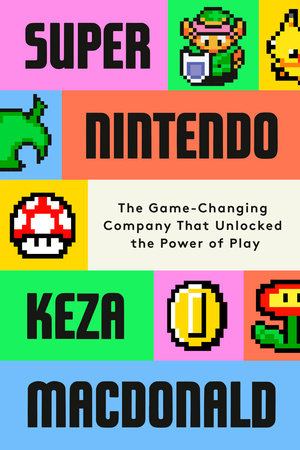
Super Nintendo

The Game-Changing Company That Unlocked the Power of Play

Look inside
Hardcover
$32.00 US
6.35"W x 9.6"H x 1.2"D   | 19 oz | 12 per carton
On sale Feb 03, 2026 | 304 Pages | 9780593802687

An exuberant, behind-the-scenes look at the designers and the company that brought us Mario, Zelda, Pokémon, and so much more

“Keza MacDonald pulls back the curtain on the Nintendo dream factory.” —Walt Williams, author of Significant Zero


What magical mushroom could have turned an unassuming playing card company into one of the dominant cultural forces of the twenty-first century?

In Super Nintendo, lifelong gamer and a renowned video games journalist Keza MacDonald traces Nintendo back to its quirky beginnings in 1889, illuminating its singular ethos, its endlessly innovative leaders and developers, its massive cultural impact, and, most of all, the video games themselves, which have inspired joy and creativity in millions.

Leaping from game to game, Super Nintendo tells the remarkable story of the people who brought us Super Mario Bros., Zelda, Pokémon, Animal Crossing, Splatoon, and more—not to mention the SNES, N64, Game Boy, Wii, Switch, and a host of other wacky gizmos—and charts the delights they’ve offered over the decades. MacDonald draws on private interviews with icons like Shigeru Miyamoto, the creator of Mario, who continues to leave his stamp on the company, and takes readers on a trip to the secretive Nintendo HQ—making her one of the few Western journalists to have set foot inside the building. Along the way, she uncovers the driving force behind these creative triumphs: a willingness to take risks and place long-term success over short-term profits.

A carousel of wonders, Super Nintendo whisks you back to the couch in the den, a controller in your hands for the very first time, staring up at a screen of infinite possibilities.
“MacDonald has done something no English-speaking reporter has before her: told the story of Nintendo, in detail, from beginning to end. She has gotten inside the mind of Miyamoto, the doors of Nintendo’s headquarters, and the intangible miasma that has made Nintendo and video games what they are today.” —Chris Plante, Vulture

"A joyful celebration of the gaming giant. . . . Winsomely enthusiastic. . . . MacDonald’s conversations with all the gifted (and often eccentric) creative people who actually make the games are full of such wholesome insights, as are her own superb analyses of favourite games." —Steven Poole, The Guardian

"[A] spirited new history [that] offers acute and entertaining analysis of the company’s many game franchises . . . Nostalgia abounds." —Nathan Smith, Washington Post

Super Nintendo inspired me to break out my old Switch and dig into a few hours of ‘Mario Kart.’ Now that I’m a dad, no one can tell me when I have to stop.” —Will Leith, The Wall Street Journal

"A breezy, colorful trip through the history of Mario, Zelda, Metroid and much more. Keza MacDonald adroitly weaves personal observations with original reporting to tell a fascinating story that's packed full of delightful anecdotes (did you know that Splatoon's stylish squids started off as blocks of tofu?). This book paints a vivid picture of the most important company in video games." —Jason Schreier, New York Times bestselling author of Play Nice, Press Reset, and Blood, Sweat, and Pixels

“MacDonald writes brilliantly about videogames, and this is a great book.” —Charlie Brooker, creator and writer of Black Mirror

“Fluently written, deeply informed. . . . You won’t find anyone with a better insight into the nuts and bolts of these games. . . . Here is a book bursting with love. Bop your head against it and see if a shower of gold coins comes out.” —Sam Leith, The Times (London)

“What better guide through Nintendo history than MacDonald? . . . I can’t help but wonder if she peeked into my head when writing her retrospective Super Nintendo book. After all, these are all the very memories I associate with my Nintendo-obsessed childhood: little, trivial activities that define my nostalgia even more than grand adventures, unforgettable characters, or towering beasts. . . . Being one of the few journalists who’s stepped foot into Nintendo headquarters, it’s not just [MacDonald’s] fountain of knowledge and years of experience that makes Super Nintendo a riveting read—her remarkable profession ensures us we’re in the right hands.” —Anthony Pelone, Gaming Trend

“Comprehensive but never too dense, informative but approachable, and packed with an unwavering passion for Nintendo that I'd wager even the company's biggest detractors would find infectious. In short, if you want to learn about Nintendo, this is the book to do it.” —Jim Norman, Nintendo Life

"I thought I knew everything there was to know about Nintendo before I read Keza's book—and I literally used to work there. It's fun, it's fascinating, and it only makes me love Mario even more." —Mike Drucker, author of Good Game, No Rematch

“I’ve read and admired Keza MacDonald’s work for years, so it’s no surprise that this book ranks high among the best things ever written about Nintendo. She’s incisive about its corporate history and revelatory about what it actually took—culturally and technically—to create its incomparable games. Anyone who cares about interactive entertainment will be surprised and delighted by this book.” —Tom Bissell, author of Extra Lives: Why Video Games Matter

"Keza MacDonald pulls back the curtain on the Nintendo dream factory, providing a fascinating look into the minds and culture that defined my childhood and so many others." —Walt Williams, author of Significant Zero

“Nobody knows Nintendo like Keza MacDonald. This engrossing book is both a personal history of playing the greatest games in the world and a fascinating, insightful look at what makes this company tick. An absolute must for all gamers.” —Keith Stuart, author of A Boy Made of Blocks

“This is cultural history at its most generous: Nintendo not as corporate monolith, but as dream factory, mythmaker, and companion to childhood. Keza MacDonald presents an electrifying blend of criticism, reportage, and affectionate storytelling about the company that shaped not only how we play, but also how we imagine.” —Simon Parkin, author of The Forbidden Garden of Leningrad

“I can think of few writers better equipped to tackle a book like this. [MacDonald’s] bona fides are beyond reproach. So, happily, is the book itself. . . . Elegant, coherent, and relentlessly engaging. . . . It has genuinely changed the way I think about certain games . . . and it has deepened my understanding of how Nintendo works and thinks, why it does the things it does. . . . [An] esteemed tome.” —Nathan Brown, Hit Points

"Gaming history written with a fan’s verve." Kirkus Reviews
© Aglaé Zebrowski
KEZA MACDONALD is video games editor at The Guardian, where she writes the "Pushing Buttons" newsletter. Having previously held editorial roles at IGN and Kotaku, two of the biggest specialist games websites in the world, she is also the coauthor of You Died: The Dark Souls Companion with Jason Killingsworth and regularly appears on TV and radio as a video games expert. View titles by Keza MacDonald
1

Ultra Hand

Nintendo’s prehistory, from playing cards to Love Testers

It was a time of great fun . . . I saw myself as a cartoonist who understood movements in the world and created abstractions of them.

Gunpei Yokoi on Nintendo’s early days, from David Sheff’s Game Over

In a garden in Alsace, France, rather out of place among the modern housing that surrounds it, sits an exact replica of a Japanese building from 1889. Outside, a small bamboo fountain trickles quietly, and the red leaves of a miniature Japanese maple frame the door. Above the threshold are three kanji: 任天堂–Nin-ten-do.

Inside is a low table on a bamboo floor, a desk in the corner, and—an incredible sight—shelves and shelves of irreplaceable Nintendo history; not consoles and carts, figures and toys and curios, though there are a few of those, too, but instead hundreds of packs of playing cards, catalogs, signage, and advertisements torn from the pages of old magazines. This building, reconstructed from photos of Nintendo’s very first shop front in Kyoto, Japan, is the passion project of Nintendo collector Fabrice Heilig, and it houses an extraordinary collection of Nintendo history, some of it more than a hundred years old. Before it became the house of Mario, Nintendo began life in the late 1890s manufacturing and selling flower-adorned hanafuda playing cards out of a small workshop just like this.

There are precious few photographs of this original Nintendo headquarters, which was located between the Shosei-en Garden and the western bank of the Kamo River, across the water from the city’s tourist-mobbed temples. Fabrice calculated the height of the building from the relative height of the local landmarks that can be seen in the background of those photos, and asked someone in Kyoto to physically go and measure the place where the shop once stood. After finding a perfect source for the style of the era, he imported the tiles and woodwork from Japan and found a carpenter who shared his excitement about the project. Construction took ten months.

“Like many collectors, I’m very familiar with the space restrictions that crop up sooner or later,” Fabrice tells me. “When my own collection started to pile up, I was looking for a solution to highlight it better. So I came up with the idea of building a little annex specially dedicated to my collection. When I was perusing some photos of one of Nintendo’s first wooden buildings in Kyoto, which was sadly destroyed in 2004 because it was too old, I was inspired. Why not perfectly reconstruct the facade of this famous wooden building, which didn’t exist anymore? This reconstruction could also give more meaning to the cards that would be exhibited there . . . During construction, there was always that small fear that it wouldn’t look like I hoped, that it wouldn’t have that old traditional Japanese spirit reminiscent of the era of Nintendo’s card games. But it all turned out well in the end.”

Fabrice says that his neighbors and friends were a little taken aback at first, even though they were all well acquainted with his fondness for Japan. “Looking at it, all they saw was a small Japanese-style house,” he says. “But after I explained exactly what this building was and its history, people were pleasantly surprised. Plenty of them had no idea about Nintendo’s long history outside of the Zelda and Mario games.”

Two unofficial items in his collection are a source of particular pride: the heavy green-and-gold plaques that sit on one of Fabrice’s shelves. They are replicas of the iconic plaques that you can find outside the door of Nintendo’s second headquarters in Kyoto’s Kagiyacho district, now a luxury hotel called Marufukuro that contains its own small library of early Nintendo history. He had them re-created precisely from 15-pound blocks of aluminum using a specialist machine, then had them painted. Underneath the words toranpu and karuta—two Japanese words for Western playing cards—appears 任天堂山内, Nintendo Yamauchi. The origins of this name are lost to time—even Nintendo’s own historians don’t know its precise meaning, and the kanji characters carry varied connotations—but one plausible theory is that the word derives from the phrase un o ten ni makaseru, meaning “leave luck to heaven.”

Nintendo’s founder was entrepreneur Fusajiro Yamauchi, a keen cardplayer who started the company to make handcrafted hanafuda—small, rectangular, hard tiles made from wood, cardboard, and paper and illustrated with animals, flowers, and objects, used in several different games. Hanafuda were, at the time, closely associated with gambling and, therefore, with organized crime; the very word yakuza, the Japanese for “gangster,” derives from a losing hanafuda hand. Playing cards had been more or less banned throughout the Edo period from 1603 to 1868, but authorities in the following Meiji period had softened toward them, which allowed Yamauchi’s business to take off.

Watada, another small Kyoto company, once printed playing cards for Nintendo, and to this day it still prints its catalogs and game boxes. Nintendo also still makes hanafuda, though these days you might see Mario, Yoshi, or Kirby depicted on their little tiles, wreathed in flowers. Perhaps the bright, organic iconography of Mario’s early adventures, the Fire Flowers and Piranha Plants, the stars and coins and mushrooms, owe something to these relics of Nintendo’s 1800s history.


In 1902, Nintendo became the first Japanese company to make Western-style playing cards, known as trump decks (though they had nothing to do with Top Trumps). Over the next few decades it branched out into iroha karuta, decks of images and letters that helped kids learn the Japanese phonetic alphabets, katakana and hiragana, through syllable-matching games. Nintendo made hyakunin isshu decks, too, a Japanese card game where players must race to match the beginnings of short poems with the endings, on cards decorated with images of the poets themselves. During the 1940s, as part of the Japanese government’s national propaganda program, Nintendo produced a patriotic version of this card game that replaced some of the poems with more nationalist material—these are some of the most historically interesting decks in Fabrice’s collection.

Housed in glass cases in the interior of Fabrice’s building, there are particularly old and rare sets of cards, including one decorated with pinup models. Cuttings from old newspapers and documents that mention Nintendo are tucked away in black binders. The oldest Nintendo advertisement in Fabrice’s collection is from 1904, and he has a few highly sought-after sample catalogs of cards, thick and brightly decorated books that would have been brought out in front of potential customers by Nintendo’s traveling salesmen when they were selling to retailers across Japan. The hardest thing about collecting these pieces of Nintendo history, he says, is the need for patience: Without it, the oldest and rarest cards are not easy to get hold of.

Fabrice has plenty of Nintendo games and toys, too, of course—those still live in his cellar. But it’s the playing cards that are his specialty, and he has, he thinks, the largest collection of them in the world. “At the start I collected everything to do with video games,” he says. “But a few years in, I decided to focus in on one brand, the one that had the biggest impact on me in my youth, and so I landed on Nintendo. I wanted to know what Nintendo had done before video games. At the time there wasn’t much information about that online—so when I made the discovery that Nintendo had made playing cards and games, I was fascinated. I’ve always wanted to know more about the origins of the company. I concentrate on the playing cards in particular because, for me, those represent Nintendo’s foundations.”

Nintendo’s beginnings as a card game company locate it on a continuum of play that stretches right back through human history. For as long as humans have lived together, on every continent and in every culture, we have had games. Archaeologists have found dice made from bone and board games with painted figures dating back five thousand years, and game boards scratched into the sides of ancient buildings. The earliest examples of card games that we’ve found come from ninth-century China, when woodblock printing became a widespread technology. From there they spread to Egypt, where the oldest surviving decks of cards—dating from the fifteenth century—were discovered in 1939, and then on to Europe. The Portuguese would introduce playing cards to Japan in the 1500s.

As part of human civilization, games have connected us socially, told us stories about our past and our culture, and given us an opportunity to exercise our extraordinary brains. They have been bridges between cultures and vehicles for imagination and invention, and a vector for the evolution of language. Video games still do all of this. Nintendo’s hanafuda history might not seem especially relevant to where it is today, but traditional games form the backdrop to the history of video games. That history didn’t begin in the 1950s, when the first computer scientists at universities started coding to entertain themselves and their colleagues on hulking mainframes; it stretches all the way back through card games, chess, and senet to the most primitive technologies of sticks and stones. What makes a game a game isn’t just its form and its rules; it’s the players. Without human imagination and competition, any game, from hanafuda to Halo, is inert.


Fusajiro Yamauchi’s son-in-law, who was adopted into the family and took the name Sekiryo Yamauchi, inherited the business in 1929. Fusajiro’s great-grandson, Hiroshi Yamauchi, would become the third president of Nintendo in 1949, when he was just twenty-two. Hiroshi had been raised by his maternal grandparents after his father abandoned him and his mother; when his grandfather Sekiryo suffered a stroke, Hiroshi dropped out of a law degree at Waseda University in Tokyo to return to Kyoto. It was Hiroshi who would eventually transform Nintendo into the company we know today: He remained its president until 2002, and died in 2013.

Most accounts that we have of Hiroshi Yamauchi paint him as a hard, authoritarian leader. He was too young to be conscripted in the Second World War, instead working in a weapons factory before beginning his law degree, but he nonetheless led Nintendo with a militaristic attitude. He insisted that his older cousin be fired from Nintendo when he took up the reins, making him the only Yamauchi family member at the company and cementing his authority in the process. Such a young CEO wasn’t taken seriously by many of his workers, who went on strike shortly after he took over; he dealt with this by firing them, a shocking move in a country whose business culture prizes the institutional knowledge of long-standing employees. When his absent father Shikanojō attempted to get in contact with him, he refused his overtures. Shikanojō died of a stroke shortly before Hiroshi turned thirty, and at his funeral Hiroshi met a stepmother and four half-sisters whom he’d never known about.

But Hiroshi Yamauchi also had exceptional business instincts, and unwavering conviction in those instincts. His youth, and the lack of respect afforded him by his business contemporaries in postwar Kyoto, freed him up to look toward the new. “He was a Kyotoite. It’s a city with a lot of long-running businesses, some maybe five or even six hundred years old,” remembered the Nintendo Entertainment System’s late designer Masayuki Uemura in a 2019 interview with Matt Alt, author of Pure Invention: How Japanese Pop Culture Changed the World. “In the hierarchy of the city, traditional craftspeople rank at the top. Nintendo, as a purveyor of playthings like hanafuda or Western playing cards, originally ranked down at the very bottom. Doing business in that environment made him very open to new ventures. He wasn’t interested in specializing. He was keenly interested in new trends.”

The first thing that Hiroshi Yamauchi did was introduce plastic playing cards to Japan in 1953, when plastic itself was still a new and novel material. In the 1950s, all playing cards were still closely associated with gambling and the yakuza; Nintendo was one of the first companies to change this, marketing them instead as family-oriented entertainment, packaging cards with instruction leaflets showing how to play several different games. Nintendo produced hundreds and hundreds of different decks, the likes of which now line the shelves of Fabrice Heilig’s collection. There are cheerful, surprisingly modern-looking designs and elegant geometric decks, as well as cards themed after movies and manga. One line came in a plastic casing that resembled an old-school television, letting kids slide cards in behind the “screen” to tell themselves stories.

This strategy was massively successful. In the late 1950s, Yamauchi struck a deal with Disney, producing Bambi–, Mickey Mouse–, and Snow White–themed cards that were targeted even more precisely at families. By the following decade, Nintendo was the number-one producer of playing cards in all of Japan, and Yamauchi was looking to branch out. Nintendo was briefly involved with all kinds of businesses: instant rice, taxis, and—notoriously but fleetingly—pay-by-the-hour love hotels. Hiroshi was a keen player of go, the highly respected game that is Japan’s and China’s native equivalent of chess, and so Nintendo started manufacturing board games, too: Disney-licensed versions, Ultraman-licensed ones that capitalized upon the growing popularity of Japanese action TV shows in the 1960s, and roulette and marble runs as well. There were also sports games such as 1965’s Nintendo no Yakuban, a baseball board game with little plastic figures and a ball bearing for them to thwack into indented pits around the field.

That year, 1965, would turn out to be pivotal for Nintendo. It was then that the engineer Gunpei Yokoi joined the company, originally hired to maintain and fix the machines that made hanafuda cards. He is better known as the person who later invented the Game Boy.

The eccentric toymakers

Players of 2023’s Tears of the Kingdom will know the Ultrahand as the mysterious ancient power that allows the Legend of Zelda protagonist Link to pick up, spin around, and glue together whatever he finds around him, leading to the creation of rickety, madcap contraptions that have a habit of falling apart with perfect comic timing. Its name is a callback to one of Yokoi and Nintendo’s first successful toys, a comically large lattice of concertinaed blue plastic with soft yellow plastic cups on the end, an extendable gripper of questionable utility. Yokoi made its first prototype to entertain himself in between fixing the machines on the hanafuda production line and, on a 1966 visit to Nintendo’s factory, Hiroshi Yamauchi noticed it and instructed Yokoi to turn it into a salable product. He did so in time for that year’s Christmas gifting season, and Nintendo ended up selling over a million of them.

After the success of the Ultra Hand, Yokoi was made head of Nintendo’s research and development department, where he presided over three decades of playful experimentation. He died tragically in a car accident in 1997, just one year after his retirement, but his ideas became part of Nintendo’s DNA. A born tinkerer, he had a degree in electronics, and with his toys and, later, his consoles, he was committed to finding the fun in any given piece of technology. He invented the Game & Watch, the tiny, simple, rectangular handheld LCD games that were some of Nintendo’s first hits, with their two simple buttons and cross-shaped directional pad—the D-pad, as it became known. You can still find them on most game controllers today.

Yokoi’s personal design philosophy, articulated in a now extremely rare 1997 book called Yokoi Gunpei Gēmukan (Yokoi Gunpei’s Game House), was “lateral thinking with withered technology”—in other words, finding new ways to work with what you already have and getting the most out of affordable components, rather than chasing the expensive technological cutting edge. This remains Nintendo’s approach today: Where other makers of game consoles have sold high-powered machines at a loss and tried to make up the profits on software, Nintendo’s consoles usually employ hardware that’s already widely available (and can be sold at a profit). And where most companies in gaming have chased graphical advancement, Nintendo has instead looked for different ways to innovate.

For Erik Voskuil, a Dutch Nintendo collector, the Ultra Hand was the beginning of a fascination with the company’s pre-video-game history. After discovering that the man who had invented the Game Boy had been making toys for twenty years prior, he set about trying to acquire some of them. “While nowadays most information can be found with just a few clicks on Wikipedia or other online sources, when I started my collection this period in Nintendo’s history was still very much shrouded in mystery. This was the case even in Japan, and definitely outside of it,” he tells me. Erik spent many patient years watching Japanese auction sites, where unopened Nintendo toys that had been hanging around in some storage facility or toy store basement for years would sometimes appear like glittering nuggets of gold in muddy silt.

“Digging into this history really felt like treasure hunting and discovering forgotten artifacts,” he says. “And the relics that surfaced were very intriguing. It seemed as if the designers at Nintendo at the time almost got carte blanche. They tried many ideas to see what would sell, including some truly wacky ones. The company culture formed at that time largely endures to this day. Two key ingredients: daring to be innovative (which also includes accepting the occasional failure) and getting the maximum amount of fun out of clever use of modest technical means.”

Erik’s huge collection of Nintendo ephemera is chronicled on a blog called Before Mario, and in a book of the same name. Three of his favorites are the Yokoi-designed Chiritori, a teeny-tiny (about 6 inches across), red remote-controlled vacuum cleaner that would later make an appearance in one of WarioWare’s mini-games; the Lefty RX, an adorable little racing car that, as the name suggests, can only turn left; and the Kōsen Denwa (Light Telephone), a completely mad contraption that looked like an 8mm film camera and could transmit sound via light rather than radio waves.

About

An exuberant, behind-the-scenes look at the designers and the company that brought us Mario, Zelda, Pokémon, and so much more

“Keza MacDonald pulls back the curtain on the Nintendo dream factory.” —Walt Williams, author of Significant Zero


What magical mushroom could have turned an unassuming playing card company into one of the dominant cultural forces of the twenty-first century?

In Super Nintendo, lifelong gamer and a renowned video games journalist Keza MacDonald traces Nintendo back to its quirky beginnings in 1889, illuminating its singular ethos, its endlessly innovative leaders and developers, its massive cultural impact, and, most of all, the video games themselves, which have inspired joy and creativity in millions.

Leaping from game to game, Super Nintendo tells the remarkable story of the people who brought us Super Mario Bros., Zelda, Pokémon, Animal Crossing, Splatoon, and more—not to mention the SNES, N64, Game Boy, Wii, Switch, and a host of other wacky gizmos—and charts the delights they’ve offered over the decades. MacDonald draws on private interviews with icons like Shigeru Miyamoto, the creator of Mario, who continues to leave his stamp on the company, and takes readers on a trip to the secretive Nintendo HQ—making her one of the few Western journalists to have set foot inside the building. Along the way, she uncovers the driving force behind these creative triumphs: a willingness to take risks and place long-term success over short-term profits.

A carousel of wonders, Super Nintendo whisks you back to the couch in the den, a controller in your hands for the very first time, staring up at a screen of infinite possibilities.

Praise

“MacDonald has done something no English-speaking reporter has before her: told the story of Nintendo, in detail, from beginning to end. She has gotten inside the mind of Miyamoto, the doors of Nintendo’s headquarters, and the intangible miasma that has made Nintendo and video games what they are today.” —Chris Plante, Vulture

"A joyful celebration of the gaming giant. . . . Winsomely enthusiastic. . . . MacDonald’s conversations with all the gifted (and often eccentric) creative people who actually make the games are full of such wholesome insights, as are her own superb analyses of favourite games." —Steven Poole, The Guardian

"[A] spirited new history [that] offers acute and entertaining analysis of the company’s many game franchises . . . Nostalgia abounds." —Nathan Smith, Washington Post

Super Nintendo inspired me to break out my old Switch and dig into a few hours of ‘Mario Kart.’ Now that I’m a dad, no one can tell me when I have to stop.” —Will Leith, The Wall Street Journal

"A breezy, colorful trip through the history of Mario, Zelda, Metroid and much more. Keza MacDonald adroitly weaves personal observations with original reporting to tell a fascinating story that's packed full of delightful anecdotes (did you know that Splatoon's stylish squids started off as blocks of tofu?). This book paints a vivid picture of the most important company in video games." —Jason Schreier, New York Times bestselling author of Play Nice, Press Reset, and Blood, Sweat, and Pixels

“MacDonald writes brilliantly about videogames, and this is a great book.” —Charlie Brooker, creator and writer of Black Mirror

“Fluently written, deeply informed. . . . You won’t find anyone with a better insight into the nuts and bolts of these games. . . . Here is a book bursting with love. Bop your head against it and see if a shower of gold coins comes out.” —Sam Leith, The Times (London)

“What better guide through Nintendo history than MacDonald? . . . I can’t help but wonder if she peeked into my head when writing her retrospective Super Nintendo book. After all, these are all the very memories I associate with my Nintendo-obsessed childhood: little, trivial activities that define my nostalgia even more than grand adventures, unforgettable characters, or towering beasts. . . . Being one of the few journalists who’s stepped foot into Nintendo headquarters, it’s not just [MacDonald’s] fountain of knowledge and years of experience that makes Super Nintendo a riveting read—her remarkable profession ensures us we’re in the right hands.” —Anthony Pelone, Gaming Trend

“Comprehensive but never too dense, informative but approachable, and packed with an unwavering passion for Nintendo that I'd wager even the company's biggest detractors would find infectious. In short, if you want to learn about Nintendo, this is the book to do it.” —Jim Norman, Nintendo Life

"I thought I knew everything there was to know about Nintendo before I read Keza's book—and I literally used to work there. It's fun, it's fascinating, and it only makes me love Mario even more." —Mike Drucker, author of Good Game, No Rematch

“I’ve read and admired Keza MacDonald’s work for years, so it’s no surprise that this book ranks high among the best things ever written about Nintendo. She’s incisive about its corporate history and revelatory about what it actually took—culturally and technically—to create its incomparable games. Anyone who cares about interactive entertainment will be surprised and delighted by this book.” —Tom Bissell, author of Extra Lives: Why Video Games Matter

"Keza MacDonald pulls back the curtain on the Nintendo dream factory, providing a fascinating look into the minds and culture that defined my childhood and so many others." —Walt Williams, author of Significant Zero

“Nobody knows Nintendo like Keza MacDonald. This engrossing book is both a personal history of playing the greatest games in the world and a fascinating, insightful look at what makes this company tick. An absolute must for all gamers.” —Keith Stuart, author of A Boy Made of Blocks

“This is cultural history at its most generous: Nintendo not as corporate monolith, but as dream factory, mythmaker, and companion to childhood. Keza MacDonald presents an electrifying blend of criticism, reportage, and affectionate storytelling about the company that shaped not only how we play, but also how we imagine.” —Simon Parkin, author of The Forbidden Garden of Leningrad

“I can think of few writers better equipped to tackle a book like this. [MacDonald’s] bona fides are beyond reproach. So, happily, is the book itself. . . . Elegant, coherent, and relentlessly engaging. . . . It has genuinely changed the way I think about certain games . . . and it has deepened my understanding of how Nintendo works and thinks, why it does the things it does. . . . [An] esteemed tome.” —Nathan Brown, Hit Points

"Gaming history written with a fan’s verve." Kirkus Reviews

Author

© Aglaé Zebrowski
KEZA MACDONALD is video games editor at The Guardian, where she writes the "Pushing Buttons" newsletter. Having previously held editorial roles at IGN and Kotaku, two of the biggest specialist games websites in the world, she is also the coauthor of You Died: The Dark Souls Companion with Jason Killingsworth and regularly appears on TV and radio as a video games expert. View titles by Keza MacDonald

Excerpt

1

Ultra Hand

Nintendo’s prehistory, from playing cards to Love Testers

It was a time of great fun . . . I saw myself as a cartoonist who understood movements in the world and created abstractions of them.

Gunpei Yokoi on Nintendo’s early days, from David Sheff’s Game Over

In a garden in Alsace, France, rather out of place among the modern housing that surrounds it, sits an exact replica of a Japanese building from 1889. Outside, a small bamboo fountain trickles quietly, and the red leaves of a miniature Japanese maple frame the door. Above the threshold are three kanji: 任天堂–Nin-ten-do.

Inside is a low table on a bamboo floor, a desk in the corner, and—an incredible sight—shelves and shelves of irreplaceable Nintendo history; not consoles and carts, figures and toys and curios, though there are a few of those, too, but instead hundreds of packs of playing cards, catalogs, signage, and advertisements torn from the pages of old magazines. This building, reconstructed from photos of Nintendo’s very first shop front in Kyoto, Japan, is the passion project of Nintendo collector Fabrice Heilig, and it houses an extraordinary collection of Nintendo history, some of it more than a hundred years old. Before it became the house of Mario, Nintendo began life in the late 1890s manufacturing and selling flower-adorned hanafuda playing cards out of a small workshop just like this.

There are precious few photographs of this original Nintendo headquarters, which was located between the Shosei-en Garden and the western bank of the Kamo River, across the water from the city’s tourist-mobbed temples. Fabrice calculated the height of the building from the relative height of the local landmarks that can be seen in the background of those photos, and asked someone in Kyoto to physically go and measure the place where the shop once stood. After finding a perfect source for the style of the era, he imported the tiles and woodwork from Japan and found a carpenter who shared his excitement about the project. Construction took ten months.

“Like many collectors, I’m very familiar with the space restrictions that crop up sooner or later,” Fabrice tells me. “When my own collection started to pile up, I was looking for a solution to highlight it better. So I came up with the idea of building a little annex specially dedicated to my collection. When I was perusing some photos of one of Nintendo’s first wooden buildings in Kyoto, which was sadly destroyed in 2004 because it was too old, I was inspired. Why not perfectly reconstruct the facade of this famous wooden building, which didn’t exist anymore? This reconstruction could also give more meaning to the cards that would be exhibited there . . . During construction, there was always that small fear that it wouldn’t look like I hoped, that it wouldn’t have that old traditional Japanese spirit reminiscent of the era of Nintendo’s card games. But it all turned out well in the end.”

Fabrice says that his neighbors and friends were a little taken aback at first, even though they were all well acquainted with his fondness for Japan. “Looking at it, all they saw was a small Japanese-style house,” he says. “But after I explained exactly what this building was and its history, people were pleasantly surprised. Plenty of them had no idea about Nintendo’s long history outside of the Zelda and Mario games.”

Two unofficial items in his collection are a source of particular pride: the heavy green-and-gold plaques that sit on one of Fabrice’s shelves. They are replicas of the iconic plaques that you can find outside the door of Nintendo’s second headquarters in Kyoto’s Kagiyacho district, now a luxury hotel called Marufukuro that contains its own small library of early Nintendo history. He had them re-created precisely from 15-pound blocks of aluminum using a specialist machine, then had them painted. Underneath the words toranpu and karuta—two Japanese words for Western playing cards—appears 任天堂山内, Nintendo Yamauchi. The origins of this name are lost to time—even Nintendo’s own historians don’t know its precise meaning, and the kanji characters carry varied connotations—but one plausible theory is that the word derives from the phrase un o ten ni makaseru, meaning “leave luck to heaven.”

Nintendo’s founder was entrepreneur Fusajiro Yamauchi, a keen cardplayer who started the company to make handcrafted hanafuda—small, rectangular, hard tiles made from wood, cardboard, and paper and illustrated with animals, flowers, and objects, used in several different games. Hanafuda were, at the time, closely associated with gambling and, therefore, with organized crime; the very word yakuza, the Japanese for “gangster,” derives from a losing hanafuda hand. Playing cards had been more or less banned throughout the Edo period from 1603 to 1868, but authorities in the following Meiji period had softened toward them, which allowed Yamauchi’s business to take off.

Watada, another small Kyoto company, once printed playing cards for Nintendo, and to this day it still prints its catalogs and game boxes. Nintendo also still makes hanafuda, though these days you might see Mario, Yoshi, or Kirby depicted on their little tiles, wreathed in flowers. Perhaps the bright, organic iconography of Mario’s early adventures, the Fire Flowers and Piranha Plants, the stars and coins and mushrooms, owe something to these relics of Nintendo’s 1800s history.


In 1902, Nintendo became the first Japanese company to make Western-style playing cards, known as trump decks (though they had nothing to do with Top Trumps). Over the next few decades it branched out into iroha karuta, decks of images and letters that helped kids learn the Japanese phonetic alphabets, katakana and hiragana, through syllable-matching games. Nintendo made hyakunin isshu decks, too, a Japanese card game where players must race to match the beginnings of short poems with the endings, on cards decorated with images of the poets themselves. During the 1940s, as part of the Japanese government’s national propaganda program, Nintendo produced a patriotic version of this card game that replaced some of the poems with more nationalist material—these are some of the most historically interesting decks in Fabrice’s collection.

Housed in glass cases in the interior of Fabrice’s building, there are particularly old and rare sets of cards, including one decorated with pinup models. Cuttings from old newspapers and documents that mention Nintendo are tucked away in black binders. The oldest Nintendo advertisement in Fabrice’s collection is from 1904, and he has a few highly sought-after sample catalogs of cards, thick and brightly decorated books that would have been brought out in front of potential customers by Nintendo’s traveling salesmen when they were selling to retailers across Japan. The hardest thing about collecting these pieces of Nintendo history, he says, is the need for patience: Without it, the oldest and rarest cards are not easy to get hold of.

Fabrice has plenty of Nintendo games and toys, too, of course—those still live in his cellar. But it’s the playing cards that are his specialty, and he has, he thinks, the largest collection of them in the world. “At the start I collected everything to do with video games,” he says. “But a few years in, I decided to focus in on one brand, the one that had the biggest impact on me in my youth, and so I landed on Nintendo. I wanted to know what Nintendo had done before video games. At the time there wasn’t much information about that online—so when I made the discovery that Nintendo had made playing cards and games, I was fascinated. I’ve always wanted to know more about the origins of the company. I concentrate on the playing cards in particular because, for me, those represent Nintendo’s foundations.”

Nintendo’s beginnings as a card game company locate it on a continuum of play that stretches right back through human history. For as long as humans have lived together, on every continent and in every culture, we have had games. Archaeologists have found dice made from bone and board games with painted figures dating back five thousand years, and game boards scratched into the sides of ancient buildings. The earliest examples of card games that we’ve found come from ninth-century China, when woodblock printing became a widespread technology. From there they spread to Egypt, where the oldest surviving decks of cards—dating from the fifteenth century—were discovered in 1939, and then on to Europe. The Portuguese would introduce playing cards to Japan in the 1500s.

As part of human civilization, games have connected us socially, told us stories about our past and our culture, and given us an opportunity to exercise our extraordinary brains. They have been bridges between cultures and vehicles for imagination and invention, and a vector for the evolution of language. Video games still do all of this. Nintendo’s hanafuda history might not seem especially relevant to where it is today, but traditional games form the backdrop to the history of video games. That history didn’t begin in the 1950s, when the first computer scientists at universities started coding to entertain themselves and their colleagues on hulking mainframes; it stretches all the way back through card games, chess, and senet to the most primitive technologies of sticks and stones. What makes a game a game isn’t just its form and its rules; it’s the players. Without human imagination and competition, any game, from hanafuda to Halo, is inert.


Fusajiro Yamauchi’s son-in-law, who was adopted into the family and took the name Sekiryo Yamauchi, inherited the business in 1929. Fusajiro’s great-grandson, Hiroshi Yamauchi, would become the third president of Nintendo in 1949, when he was just twenty-two. Hiroshi had been raised by his maternal grandparents after his father abandoned him and his mother; when his grandfather Sekiryo suffered a stroke, Hiroshi dropped out of a law degree at Waseda University in Tokyo to return to Kyoto. It was Hiroshi who would eventually transform Nintendo into the company we know today: He remained its president until 2002, and died in 2013.

Most accounts that we have of Hiroshi Yamauchi paint him as a hard, authoritarian leader. He was too young to be conscripted in the Second World War, instead working in a weapons factory before beginning his law degree, but he nonetheless led Nintendo with a militaristic attitude. He insisted that his older cousin be fired from Nintendo when he took up the reins, making him the only Yamauchi family member at the company and cementing his authority in the process. Such a young CEO wasn’t taken seriously by many of his workers, who went on strike shortly after he took over; he dealt with this by firing them, a shocking move in a country whose business culture prizes the institutional knowledge of long-standing employees. When his absent father Shikanojō attempted to get in contact with him, he refused his overtures. Shikanojō died of a stroke shortly before Hiroshi turned thirty, and at his funeral Hiroshi met a stepmother and four half-sisters whom he’d never known about.

But Hiroshi Yamauchi also had exceptional business instincts, and unwavering conviction in those instincts. His youth, and the lack of respect afforded him by his business contemporaries in postwar Kyoto, freed him up to look toward the new. “He was a Kyotoite. It’s a city with a lot of long-running businesses, some maybe five or even six hundred years old,” remembered the Nintendo Entertainment System’s late designer Masayuki Uemura in a 2019 interview with Matt Alt, author of Pure Invention: How Japanese Pop Culture Changed the World. “In the hierarchy of the city, traditional craftspeople rank at the top. Nintendo, as a purveyor of playthings like hanafuda or Western playing cards, originally ranked down at the very bottom. Doing business in that environment made him very open to new ventures. He wasn’t interested in specializing. He was keenly interested in new trends.”

The first thing that Hiroshi Yamauchi did was introduce plastic playing cards to Japan in 1953, when plastic itself was still a new and novel material. In the 1950s, all playing cards were still closely associated with gambling and the yakuza; Nintendo was one of the first companies to change this, marketing them instead as family-oriented entertainment, packaging cards with instruction leaflets showing how to play several different games. Nintendo produced hundreds and hundreds of different decks, the likes of which now line the shelves of Fabrice Heilig’s collection. There are cheerful, surprisingly modern-looking designs and elegant geometric decks, as well as cards themed after movies and manga. One line came in a plastic casing that resembled an old-school television, letting kids slide cards in behind the “screen” to tell themselves stories.

This strategy was massively successful. In the late 1950s, Yamauchi struck a deal with Disney, producing Bambi–, Mickey Mouse–, and Snow White–themed cards that were targeted even more precisely at families. By the following decade, Nintendo was the number-one producer of playing cards in all of Japan, and Yamauchi was looking to branch out. Nintendo was briefly involved with all kinds of businesses: instant rice, taxis, and—notoriously but fleetingly—pay-by-the-hour love hotels. Hiroshi was a keen player of go, the highly respected game that is Japan’s and China’s native equivalent of chess, and so Nintendo started manufacturing board games, too: Disney-licensed versions, Ultraman-licensed ones that capitalized upon the growing popularity of Japanese action TV shows in the 1960s, and roulette and marble runs as well. There were also sports games such as 1965’s Nintendo no Yakuban, a baseball board game with little plastic figures and a ball bearing for them to thwack into indented pits around the field.

That year, 1965, would turn out to be pivotal for Nintendo. It was then that the engineer Gunpei Yokoi joined the company, originally hired to maintain and fix the machines that made hanafuda cards. He is better known as the person who later invented the Game Boy.

The eccentric toymakers

Players of 2023’s Tears of the Kingdom will know the Ultrahand as the mysterious ancient power that allows the Legend of Zelda protagonist Link to pick up, spin around, and glue together whatever he finds around him, leading to the creation of rickety, madcap contraptions that have a habit of falling apart with perfect comic timing. Its name is a callback to one of Yokoi and Nintendo’s first successful toys, a comically large lattice of concertinaed blue plastic with soft yellow plastic cups on the end, an extendable gripper of questionable utility. Yokoi made its first prototype to entertain himself in between fixing the machines on the hanafuda production line and, on a 1966 visit to Nintendo’s factory, Hiroshi Yamauchi noticed it and instructed Yokoi to turn it into a salable product. He did so in time for that year’s Christmas gifting season, and Nintendo ended up selling over a million of them.

After the success of the Ultra Hand, Yokoi was made head of Nintendo’s research and development department, where he presided over three decades of playful experimentation. He died tragically in a car accident in 1997, just one year after his retirement, but his ideas became part of Nintendo’s DNA. A born tinkerer, he had a degree in electronics, and with his toys and, later, his consoles, he was committed to finding the fun in any given piece of technology. He invented the Game & Watch, the tiny, simple, rectangular handheld LCD games that were some of Nintendo’s first hits, with their two simple buttons and cross-shaped directional pad—the D-pad, as it became known. You can still find them on most game controllers today.

Yokoi’s personal design philosophy, articulated in a now extremely rare 1997 book called Yokoi Gunpei Gēmukan (Yokoi Gunpei’s Game House), was “lateral thinking with withered technology”—in other words, finding new ways to work with what you already have and getting the most out of affordable components, rather than chasing the expensive technological cutting edge. This remains Nintendo’s approach today: Where other makers of game consoles have sold high-powered machines at a loss and tried to make up the profits on software, Nintendo’s consoles usually employ hardware that’s already widely available (and can be sold at a profit). And where most companies in gaming have chased graphical advancement, Nintendo has instead looked for different ways to innovate.

For Erik Voskuil, a Dutch Nintendo collector, the Ultra Hand was the beginning of a fascination with the company’s pre-video-game history. After discovering that the man who had invented the Game Boy had been making toys for twenty years prior, he set about trying to acquire some of them. “While nowadays most information can be found with just a few clicks on Wikipedia or other online sources, when I started my collection this period in Nintendo’s history was still very much shrouded in mystery. This was the case even in Japan, and definitely outside of it,” he tells me. Erik spent many patient years watching Japanese auction sites, where unopened Nintendo toys that had been hanging around in some storage facility or toy store basement for years would sometimes appear like glittering nuggets of gold in muddy silt.

“Digging into this history really felt like treasure hunting and discovering forgotten artifacts,” he says. “And the relics that surfaced were very intriguing. It seemed as if the designers at Nintendo at the time almost got carte blanche. They tried many ideas to see what would sell, including some truly wacky ones. The company culture formed at that time largely endures to this day. Two key ingredients: daring to be innovative (which also includes accepting the occasional failure) and getting the maximum amount of fun out of clever use of modest technical means.”

Erik’s huge collection of Nintendo ephemera is chronicled on a blog called Before Mario, and in a book of the same name. Three of his favorites are the Yokoi-designed Chiritori, a teeny-tiny (about 6 inches across), red remote-controlled vacuum cleaner that would later make an appearance in one of WarioWare’s mini-games; the Lefty RX, an adorable little racing car that, as the name suggests, can only turn left; and the Kōsen Denwa (Light Telephone), a completely mad contraption that looked like an 8mm film camera and could transmit sound via light rather than radio waves.