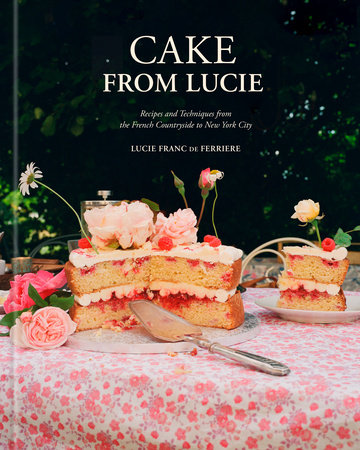
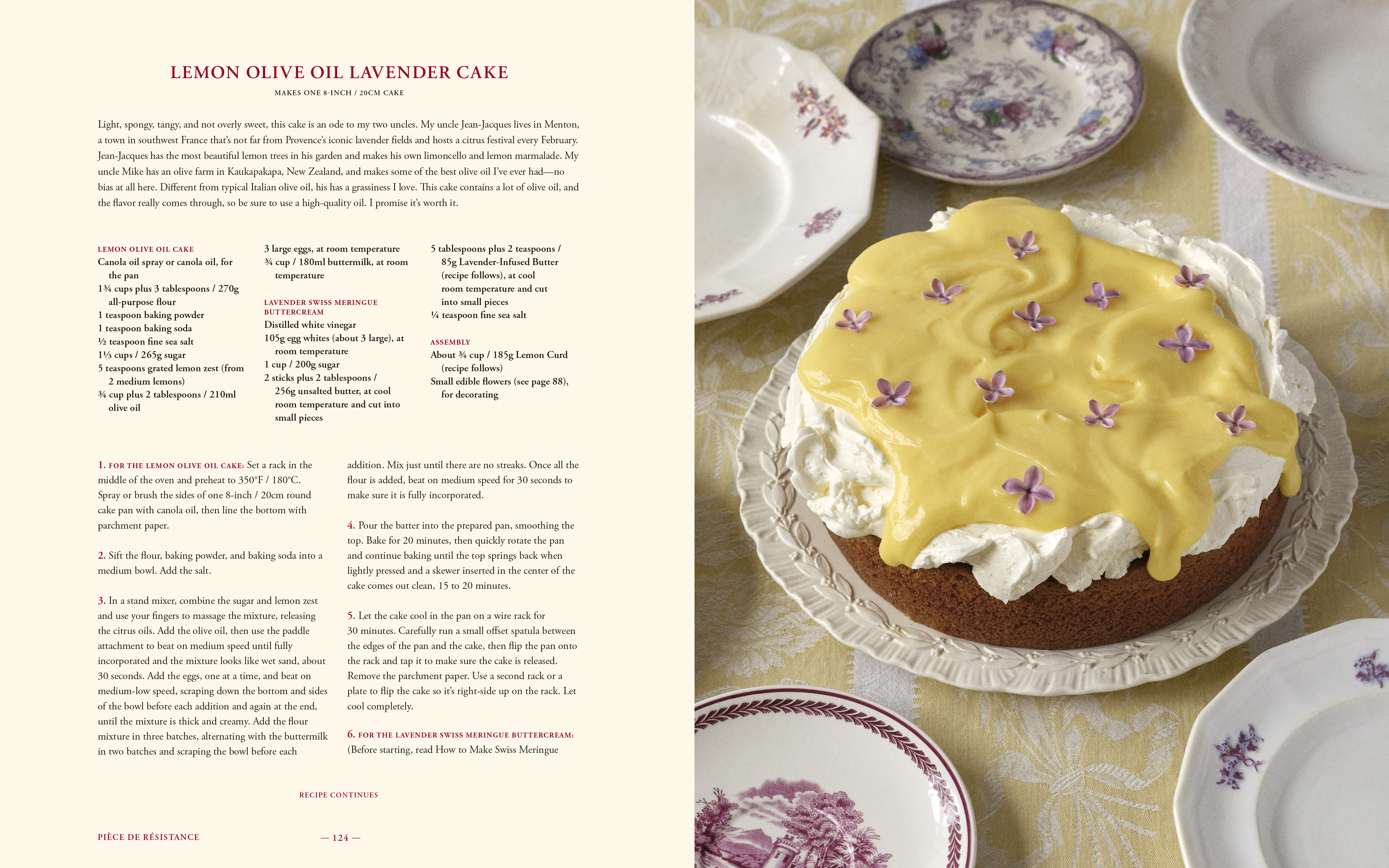
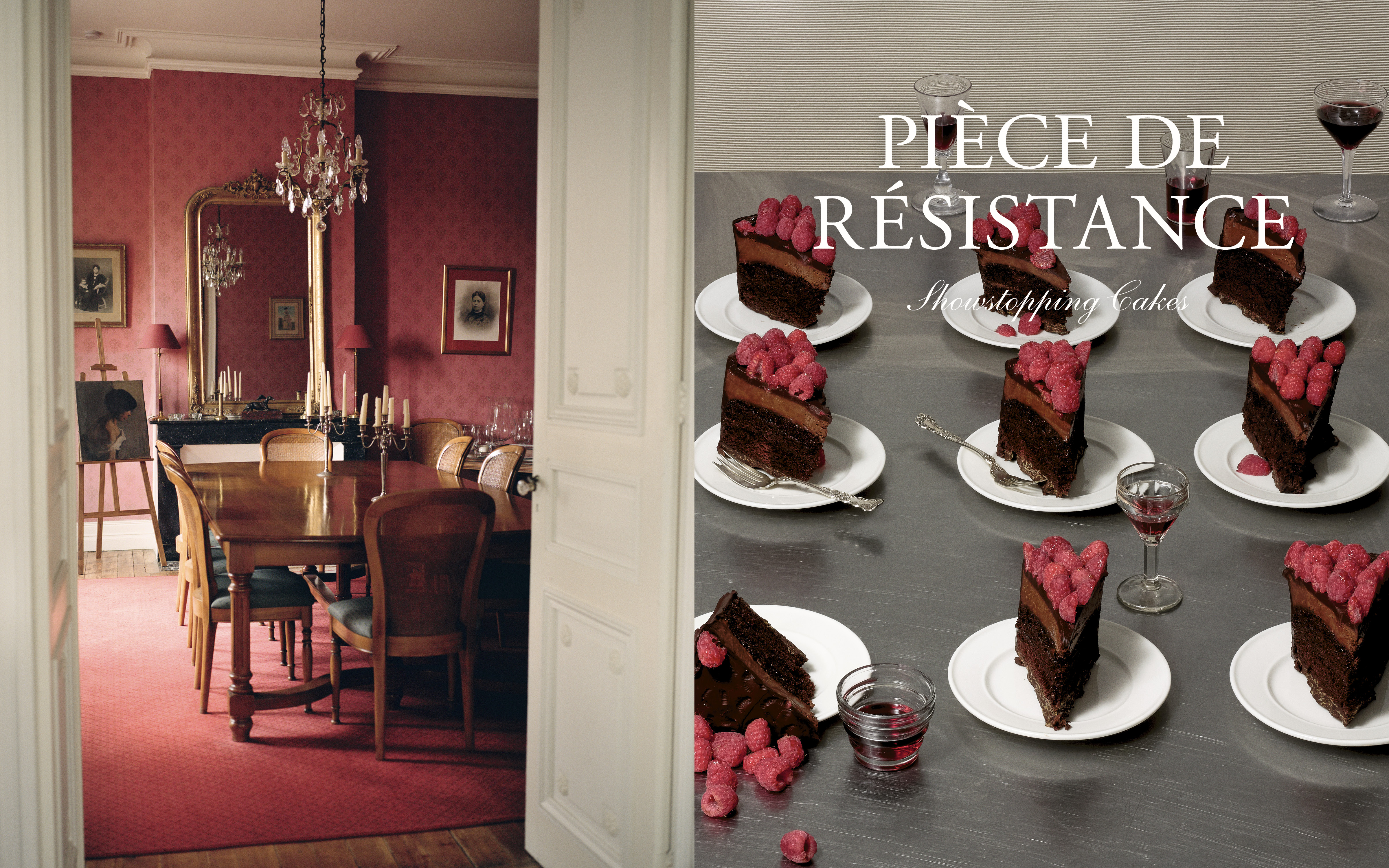
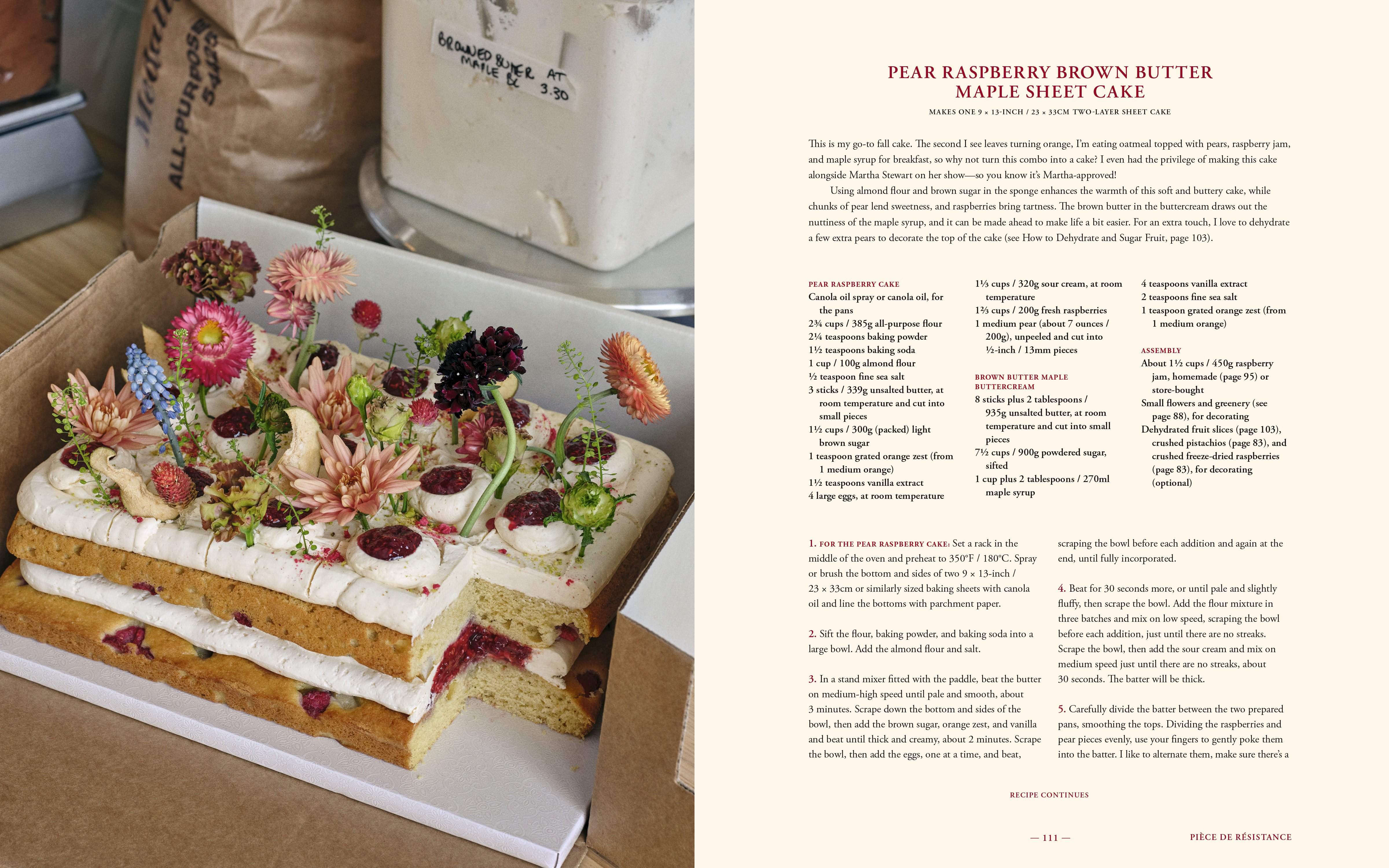
IntroductionAs I sit down to write this, my kettle is boiling, a generous slice of cake rests on my plate—a portion some might say could serve two—and my dog, Dalida, is fast asleep. It sounds like the perfect, cozy afternoon, but it’s 11 p.m. on a Tuesday, after a long day at the bakery. My approach to baking mirrors my approach to life. People have called my baking whimsical, and I love that. Whimsy implies something imperfect, messy, and full of personality—just like me. I embrace it because, truth be told, I’m not an organized person, but I am a generous one. I love the look of overflowing cream and jam on a cake, preferring to see it oozing from a slice rather than tucked away neatly. For me, flavor always comes first, and design follows naturally.
I grew up in the countryside of southwest France, in a small village called Pessacsur-Dordogne, with our family vineyard, Château Carbonneau, as my playground. My mother ran a bed and breakfast with a tearoom. My father made wine and raised cows, dogs, cats, and chickens, whose eggs made the most wonderful cakes! In a town of just four hundred people, teenage curiosity pushed me to explore beyond our quiet hills. I studied art history in Toulouse, then in Rome, and ultimately completed my master’s degree in Leeds in northern England. After graduating, I landed an internship at an art gallery in Manhattan, packed my bags, and within two weeks, arrived wide-eyed with no clue how the subway worked. I was jet-lagged and five minutes late on my first day, but I kept repeating to myself: “Fake it until you make it.”
My bakery, From Lucie, was born out of both necessity and love. In April of 2020, after three years in New York, I lost my gallery job at the height of the pandemic. Flights home felt impossible, and I was madly in love with my then boyfriend (now husband), Gurpreet, so I decided to stay in New York. Gurpreet had just opened Sunday to Sunday, a cafe on the Lower East Side, and when their pastry suppliers closed, I started baking for them in my free time. At first, it was just simple things like cookies and banana bread, but cakes have always been my true love and what I really wanted to devote my time to. There wasn’t a market for layer cakes at the cafe, so when pop-ups gained traction around the city, I started working with different brands to sell my cakes. That led me to embrace social media. I didn’t have a storefront, and it was a way for people to discover and buy my cakes. It was also a great way to share my baking journey and stay connected with friends and family back home during a troubling time.
Over the next three years, my cake business grew dramatically, and I realized I needed my own space. We opened the tiniest bakery in a charming spot in the East Village that I found almost by accident. Despite its moldy floors and clutter, I saw its potential as a welcoming place where people could pick up a cake or stop in for a slice and a coffee. We crowdfunded the renovation (thank you to our 475 backers), bringing touches of my home country to the bakery, from the mustard yellow exterior inspired by houses found in the South of France to the ceramic tiles we used for our address that came from my uncle in Menton. On our opening day, January 14, 2023, I watched in awe as a line started wrapping around the block. We were completely unprepared, but with the help of some friends and family, we served nearly everyone. That day, I felt overwhelming gratitude for the community we had built.
This book is for anyone who doesn’t know where to start with baking. As much as I’d love to say I was born baking, that’s not the case. I was born eating my mother’s incredible desserts, but did I bake a lot? No. I simply watched her. It wasn’t until I moved to New York that I truly learned to bake—spending hours on the phone with my mum, scouring the internet, flipping through cookbooks, and mostly trying and failing, and trying and failing again, until something finally clicked. I once handed out samples of a chocolate chip cookie I was working on at Gurpreet’s cafe, and a customer said, “Oh, I didn’t know you sold rocks here.” Instead of giving up, I took the feedback and perfected the recipe, which the
New York Times declared “the classic” on their list of five stellar cookies in New York City.
I must credit my parents for my persistence. My mother, an English teacher, left everything behind in New Zealand to follow my father back to his home in France. Her teaching degree didn’t transfer internationally, so with little money and an inherited, timeworn home, my parents set out to build a life together from scratch. My dad, with no formal training, planted vines with a dream of making wine, while my mum saw the potential in our house. She took on countless jobs—teaching piano, sewing children’s clothes for the local market, among others—just to buy wallpaper and paint, and transformed the house room by room. She made curtains and cushions from fabric she could barely afford, eventually turning our home into a bed and breakfast. She dug and planted her own garden, and in the kitchen, she worked her magic with meals and desserts she learned from friends, family, or simply on the fly.
My parents taught me that if you pour your heart into something, people will naturally gravitate toward it. It won’t be perfect—perfection isn’t the goal—but it will be honest, fulfilling, and true to oneself. I’m grateful my family instilled in me the courage to take risks, embrace failure, and live without the weight of “what if.” I’m equally grateful for what New York has given me. The city celebrates differences and innovation like nowhere else. When I started making cakes adorned with flowers, people said, “That’s different—let me try it.” The city fosters dreamers, pushing them to go beyond their limits. I’ll never take that for granted.
My kind of baking is inspired by my childhood on the farm. Working with seasonal and fresh ingredients is at the core of my baking philosophy. I also focus on creating desserts that aren’t overly sweet. It’s not a critique, but American desserts (especially ones with buttercream) tend to be a bit too sweet for me. My approach to baking is to balance flavors, so if a cake is on the sweeter side, the buttercream will offer a tangy, refreshing contrast.
Flowers and herbs are the heart of my baking. When I was growing up, the bed and breakfast entertained guests from around the world. There was always something baking in the oven, and the house was filled with the scent of fresh cakes and flowers from the garden. That combination of smells is where my inspiration for using florals and herbs in my baking began.
When it comes to decorating, I never plan too much in advance, as I enjoy letting my creativity flow naturally, and I suggest you try the same. In this book, I hope to guide you in discovering your own style by sharing the flowers I love and use on my cakes, as well as the ways I decorate. I encourage you to experiment and find a style that works for you.
Throughout the book, you’ll find “How to” sections that are meant to be moments where we can connect. They’re a place where I can share insights I’ve learned through many rounds of trial and error—from the countless hours spent on the phone with my mum, asking why my cakes didn’t turn out right, to combing through secondhand cookbooks to working with the talented bakers at my bakery, without whom I would be nowhere today. I’ll show you how to make Swiss meringue buttercream exactly how I like it, how I choose flowers for decoration, and much more, while sharing the common mistakes to avoid.
This book isn’t about perfection; it’s about the joy of baking. I want to guide you through the same journey I took—from hesitation to confidence. Some recipes are effortless, made from ingredients you likely already have at home, while others are more intricate showstoppers. Either way, you’ll find that there’s always room for creativity.
I hope this book encourages you to embrace baking in a way that feels accessible and enjoyable. Let’s start somewhere together.
Copyright © 2026 by Lucie Franc de Ferriere. All rights reserved. No part of this excerpt may be reproduced or reprinted without permission in writing from the publisher.