Close Modal

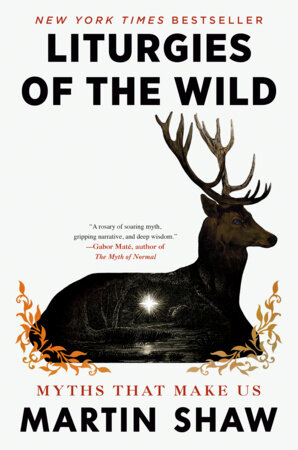
Liturgies of the Wild

Myths That Make Us

Look inside
AN INSTANT NEW YORK TIMES BESTSELLER

“Here is a rosary of soaring myth, gripping narrative, and deep wisdom, all told with breathtaking verve that enchants and sweeps us along, from first word to last. A superb, inspiring read.” —GABOR MATÉ, author of The Myth of Normal


From "one of the greatest storytellers we have" (Robert Bly), an urgent invitation to allow the oldest stories—and the Greatest Story—to reshape our own.


There’s an old Irish belief that if you aren’t wrapped in a cloak of story you will be unprepared for what the world will hurl at you. You remain adolescent at just the moment a culture worth its salt requires you to become a real, grown, human being.

In Liturgies of the Wild, acclaimed mythographer, storyteller and Christian thinker Martin Shaw argues that we live in a myth-impoverished age and that such poverty has left us vulnerable to stories that may not wish us well. Drawing on the “ancient technologies” of myths and initiatory rites, Shaw provides a road to wholeness, maturity and connection. He teaches us to read a myth the way it wants to be read; provides vivid retellings of tales powerful enough to carry you through life’s travails; and shows you how to gather and reshape your own thrown-away stories. Most vividly, he shares how these ancient technologies led him—unexpectedly—to Christ, “the True Myth,” by way of a thirty-year journey and a 101-night vigil in a Dartmoor forest.

Combining scholarly erudition with nimble storytelling in the tradition of C.S. Lewis and J.R.R. Tolkien, Liturgies of the Wild is a thrilling counsel of resistance and delight in the face of many modern monsters.
“A journey of heart-expanding magic and redemption.”
GLEN HANSARD, singer-songwriter and Academy Award winner for Once

“From our greatest living storyteller, a validation of all that is awe-inspiring and implicit in a world where we are confined by the explicit and banal.”
IAIN MCGILCHRIST, author of The Master and His Emissary

“A book that will help seekers, doubters, and believers alike appreciate faith anew, not by reinventing Christianity, but by retelling its story through the experience of a thousand other stories. Read it . . . then read it again. It will do your soul so much good.”
JUSTIN BRIERLEY, author of The Surprising Rebirth of Belief in God

“Here is a rosary of soaring myth, gripping narrative, and deep wisdom, all told with breathtaking verve that enchants and sweeps us along, from first word to last. A superb, inspiring read.”
GABOR MATÉ, author of The Myth of Normal

“Shaw is a harbinger, a sign of the shift in consciousness that all of us, trapped in our techno-bubbles, so desperately need.”
MALCOLM GUITE, author of Mariner: A Theological Voyage with Samuel Taylor Coleridge

“Decades of learning, practice, and refinement shine in every line.”
MARK VERNON, author of Awake! William Blake and the Power of the Imagination

“I loved this tender, honest book for the way it defamiliarizes the well-worn pathways of religion, bringing to life the power within and compelling the reader to take note: Here be dragons, but also grace in almost indecently extravagant abundance.”
CATHERINE COLDSTREAM, author of Cloistered: My Years as a Nun
© Ruth Medjber
Dr. Martin Shaw is a writer, mythographer, and Christian thinker who has authored seventeen books. He holds a visiting position at the Faculty of Divinity at Cambridge University and is a fellow of the Temenos Academy. He founded the Oral Tradition and Mythic Life courses at Stanford University and is director of the Westcountry School of Myth in the UK. For thirty years Shaw has been a wilderness rites-of-passage guide, working with men and women seeking a deeper life. View titles by Martin Shaw
1
On Thrown Away Stories

I ask him for a dream and the veteran's distressed. High colour, heavyset, hands tapping knees, a light sheen of sweat, he'd rather be anywhere but here. But he has no distance left to run. The diets don't work, the therapy doesn't work, even the Bible isn't working. Nothing will work because Jeff has a secret. A story. Unsaid words that have been eating him up from the inside for almost fifty years. There was a war in the East that Jeff never came back from. But today, finally, the story's going to get told. The whole sprawling extraordinary mess of it. In a hut in the backwoods of Minnesota a taboo will get broken. Jeff will say the thing he cannot say. I tell the small group of veterans that we won't be stopping for supper until the story's over. Late summer light slants through the window and lands in the circle between us, dust suddenly visible.

Ruth is sitting with her back against a rowan tree in a Dartmoor forest. She's talking about the rape she endured at fourteen as if it happened to someone else. The horror's been told so often it's taken on a literary polish. I listen and prod the fire. I then ask her to tell the story in a way she's never done before. Not for the podcast listeners or TED Talk. Not as a motivational speech about overcoming adversity. No, tell it like a fairy tale. Tell it in the third person. Something unexpected happens when you do that. Something beyond your own imaginative choreography. She tells the story in this way: Once upon a time, at the end of her childhood, a young woman found herself lost in the forest. Suddenly tears fall like rain. She stays with it, gasping and occasionally silenced but valiantly holding the thread. And, at the end, I ask her the old story-time question: And what happened next? Suddenly the earth is ancient and listening closely to her.

I'm driving Gary back to his house on a Plymouth council estate. He's off drugs, off servicing men behind the bus station, out of the gang his brother runs. But only just, these things being a magnet he keeps floating towards. Sometimes he wants to talk to me about his life, sometimes not, and the change can be in a fraction of a second. Last time we did he threatened to hurl himself into the fast-moving current of a river we were passing. But today's different, today he wants a story. I tell him a tale about a girl leaving a village for good, and not one pair of eyes is on her wishing her well. At this he moans for a bit, rocks a bit, then makes a grab for the gear stick, tries to uproot it from the stem and bring the car off the road. I pull over and he starts pummelling his own head. Get it out of my head, he says. Get the story away from me, it's in me, I don't like it, what have you done? This from a young man who watches horror, porn, and plays war games on an almost hourly rotation. A tiny folk tale has unearthed something in its terrible simplicity that's gone straight to his heart. That's me, the girl is me, no one, no one, is looking out for me. I hug him for a moment and tell him, I am. To get to you, they have to come through me. Whoever they may be. He cries then opens the car door.

It's January, and it's dark. A great blast of freezing air gallops into the car. For a moment he's lit up under a streetlamp before darting into the shadows. I will never see him again.

There's no one in this whole wide world that isn't carrying a story. You could be president, a yoga teacher, a junkie, and you have this one completely unique thing in your pocket. Your story. It may be crumpled like a bus ticket or writ large on tablets of stone, but it's yours. And God almighty you need to tell it, to rest in it, to find some peace with it. You may realise this at twenty or ninety, but one day you'll realise it.

As we age life moves fast. It seems to speed up, and sometimes any kind of coherent narrative seems lost in the crosswinds. But every now and then, there will be a moment of coincidence or even providence that makes us stop and scratch our head. We catch a glimpse of meaning. And then we are distracted, look away, and focus on something shiny and exotic. But in that distraction can be a discarding of something that is absolutely ours, distinct and site-specific. That's the real gold, the little crumbs of plum cake leading us home when we are lost in the wires and lights of a world growing at a mechanized not human pace. The treasure is when you locate something that feels properly, authentically yours. Its treasure is its specificity not its universality.

The question is: Why do we throw our stories away? Why do we undervalue them? I think it's to do with attention. We are perennially distracted. In the past it would have been the sheer heft of raising a family, earning a living, the struggle and gain of our years. That alone was absorbing enough, and all are noble attentions. And we had myths that made them so, that mirrored such attentions back to us, but with dignified, spiritual dimensions. These days social media pulls us in a variety of directions, but the general emphasis being achievement and visibility. In comparison to Hollywood or even TikTok ideals, our own strange walk may seem unexceptional. It's easier to just focus on something more glamourous. It seems that there's quite the divide between the happy face we post online and the disinterest we actually have in the narrative of our own years.

The first step is to take a breath and dare to entertain the thought that in the debris of your life would be stories worth examining. That they are, as I just wrote, a kind of treasure.

The less we do this, the more unanchored we become, and susceptible to a virtual reality that will fill our entire waking hours given a ghost of a chance. To give your lost stories some attention is a surprisingly radical act.

As a teenager I had a friend, Johnny, who lived nearby. There wasn't much money in his house or mine. But mine did have heating. His mum had split, dad was day drinking. Johnny would come up to our place in midwinter just to lean against the radiator before trudging home. His bedroom had a spare mattress where his father's drinking pals would collapse at the end of a night's boozing. It could be a shadowy world at times, the kind of place you may not want to think about again if you got out.

But he did something unusual. Johnny took the conditions of his upbringing seriously. He took them mythically. They were not random. He combed through fairy tales, stories of Cronos devouring his children. He made a home for the testing conditions of early years. He storied it. He afforded his life the dignity of serious attention. He started to write poems. He learnt a musical instrument, started to dance. His introduction to dark experience he turned to his advantage. He had empathy and a certain sobriety in understanding people's inner motivations. He had Underworld knowledge. Many of the kids in his science class were innocents in comparison. He didn't go looking for disorder, but he'd found a primeval device to grow corn from ashes. He'd found myth.

It wasn't glamourous, Johnny's growing. He could have easily crushed it under his heel and created another persona. He didn't do that. He gathered his tales in, gave them form, and in doing so they did not unconsciously run the show. When he spoke of his story, it had the protein of a fairy tale, and when he told a fairy tale it had the grit of lived experience. He threaded them together. Thirty years on, with children and a PhD, he lives a very different story. But even so, Johnny ennobles those early experiences a place at the table.

As we think about stories, I'd suggest two things are happening these days. On the one hand we have more public confessions than ever-chat show, podcast variety-and at the very same moment we are drowning in a deficit of deeper meaning, deeper communication. Our addiction to the cult of I and the social mediums to communicate that I is no replacement for profound, dare I say it, soulful disclosure. According to ancient sources the soul is not impressed by much we hurl at it. It discriminates, usefully.

I knew a woman who'd always been rich. Lived on a big pot of family money; it was never, ever going to run out. Julia's story was one of the best education, holidays that took months not weeks, and courting various movers and shakers, even a Scandinavian prince. But when she spoke of it her voice took on a flat, even embarrassed, tone. Julia's story didn't have the drama of a story like Johnny's, and she was keen to throw it away. She had become expert at concealment. But the only job in town that's truly ours is to be conscious of our own story. When you can speak of it honestly, it can become useful to others. If it remains co-opted by shame, others sense it and we become hard to trust.

One day we took a walk through a wood. As we strolled I told her the story of Parzival riding through the wasteland of ancient Britain. On the outside he was resplendent and privileged, on the inside he was filled with doubt and confusion. "The slum must be inside us," as the poets say. Julia slowly grew to resituate her experience. It too had something to say. Endless privilege can be a monster all its own. Damaging to soul, wonder, and a sense of vocation. Gradually she started to locate the adversarial encounters and sudden marvels of her own years hidden up in the castle's tower. Like Rapunzel, the stories became threads she could lower to the ground, and all sorts of rich and earned experiences could climb up to meet her. There is no one-size-fits-all to a mythic life. Her mythologies were different to Johnny's, seemingly subtler, but no less tricky.

People say I must be thrilled by modern life because it's called the Hermian Age. You may remember Hermes is the Greek god of the storytellers and instant communication between people. Surely this is what's happening now? Ah, friends, draw closer. We're not addressing the fine print in Hermes's contract. His connection is only successful soul to soul. If the soul is not roused, Hermes is simply not present. We are living in a facsimile of that rapidity; our ears are filled with story but maybe not myth. I will come to the difference soon.

Tristan and Isolde is still playing itself out in fraught love affairs all across America, Beowulf is called forth in the sheer guts of trying to piece yourself together after a rough divorce. It's my job, my civic duty, my privilege to track the myth hanging onto the wingtip of the personal anecdote, or the tale you are trying to brush aside. The myth is moved from confessional to majestic, from persona to presence. It's always a mistake to tell a myth exactly what it is: They contract from sight, stop delivering protein when we do that. We are left with an allegory, not a mystery, and that's no kind of trade. We are suddenly standing with a pelt, not a wild animal.

Myths are wily enough to remember they have a connection to the oral tradition. Something preliterate. In a promiscuous way they have moved from mouth to mouth, settlement to settlement over the centuries. Their particular power is that they refer to what I call both the timebound and the timeless. The gritty complexity of life but also the miraculous that surrounds us if we dare but behold it. Mythic awareness is always moving us from seeing to beholding life, in its multidimensional, irrational, providential, tragic, and glorious dimensions. It is the royal road to the deepest depths of the psyche.

What is your own creation story? What characters and events helped form you? There will be fairy tales brushing up to all sorts of experiences we disregard. Myths assist in the growing of consciousness and the slow tempering of maturity. They are not just patterns or codes, they are allies.

When we reach for a myth to help recover our own stories, we make connections with the little I and the big We, and in doing so, shrug off a little unnecessary loneliness. In place of isolation we now have the camaraderie of being worked within a bigger story.

This is no small thing we're doing, anchoring ourselves to the most extraordinary source of wisdom. Myths are north stars to a culture deserving of the name, culture coming from the Latin, colere, which means to till the ground. To make a culture you dig down into a story. That story needs to be robust enough to explain a few things whilst also accommodating mystery. Myths hold together heaven and earth, they are a crossroads between the timeless and the timebound. Myths are connecting tissue between us and the universe.

Myths can be the words that underpin a ritual, or actually are a ritual themselves. They often explicate our origins, the gods, the visible and invisible worlds. They have images so emphatic and nourishing that humans can organise their philosophies around them. They afford dignity and purpose to the highly reactive experience of living. They intrigue us, they excite us, they deepen our understanding of the ordinary. They make luminous. At their best, they contain what I call the timeless and the timebound.

Myths are the original ecstasies: tales ground down by the gleaming teeth of wolves, containing the whispers of a Ghanaian grandmother, fulsome with the blue longings of the moon. Such stories shouldn't behave or play nice. They slip the trap of allegory and pad off over the snow, leaving us baffled and delighted.

When they fulfill this mystical mandate, you get what could be called a Sacred Story. It's a tale that's not transactional but transformative, takes rupture and gives it rapture. It's what we've always done. From the very beginning of things we've tended to imagine in story. Thousands and thousands of years before cuneiform tablets, we stuffed wild, useful ideas into stories so they could be passed from generation to generation.

Of course, everything has its darker aspect. The word often associated with myth is fiction, a fib, a lie. For me this is a thin and inaccurate read. The nearest it could get to truth is the sense of modern advertising aggressively selling a story so hard its essential game plan is possession of your imagination. That's not where I'm going. That's a toxic mimic. That comes from a long tradition that assumes all stories are nutted out by human beings trying to orientate their way in the travails of life. It's effectively a secular position and is not mine, nor ever was. For more on that kind of thing, seek out Roland Barthes, sipping his coffee and scowling at trees.

About

AN INSTANT NEW YORK TIMES BESTSELLER

“Here is a rosary of soaring myth, gripping narrative, and deep wisdom, all told with breathtaking verve that enchants and sweeps us along, from first word to last. A superb, inspiring read.” —GABOR MATÉ, author of The Myth of Normal


From "one of the greatest storytellers we have" (Robert Bly), an urgent invitation to allow the oldest stories—and the Greatest Story—to reshape our own.


There’s an old Irish belief that if you aren’t wrapped in a cloak of story you will be unprepared for what the world will hurl at you. You remain adolescent at just the moment a culture worth its salt requires you to become a real, grown, human being.

In Liturgies of the Wild, acclaimed mythographer, storyteller and Christian thinker Martin Shaw argues that we live in a myth-impoverished age and that such poverty has left us vulnerable to stories that may not wish us well. Drawing on the “ancient technologies” of myths and initiatory rites, Shaw provides a road to wholeness, maturity and connection. He teaches us to read a myth the way it wants to be read; provides vivid retellings of tales powerful enough to carry you through life’s travails; and shows you how to gather and reshape your own thrown-away stories. Most vividly, he shares how these ancient technologies led him—unexpectedly—to Christ, “the True Myth,” by way of a thirty-year journey and a 101-night vigil in a Dartmoor forest.

Combining scholarly erudition with nimble storytelling in the tradition of C.S. Lewis and J.R.R. Tolkien, Liturgies of the Wild is a thrilling counsel of resistance and delight in the face of many modern monsters.

Praise

“A journey of heart-expanding magic and redemption.”
GLEN HANSARD, singer-songwriter and Academy Award winner for Once

“From our greatest living storyteller, a validation of all that is awe-inspiring and implicit in a world where we are confined by the explicit and banal.”
IAIN MCGILCHRIST, author of The Master and His Emissary

“A book that will help seekers, doubters, and believers alike appreciate faith anew, not by reinventing Christianity, but by retelling its story through the experience of a thousand other stories. Read it . . . then read it again. It will do your soul so much good.”
JUSTIN BRIERLEY, author of The Surprising Rebirth of Belief in God

“Here is a rosary of soaring myth, gripping narrative, and deep wisdom, all told with breathtaking verve that enchants and sweeps us along, from first word to last. A superb, inspiring read.”
GABOR MATÉ, author of The Myth of Normal

“Shaw is a harbinger, a sign of the shift in consciousness that all of us, trapped in our techno-bubbles, so desperately need.”
MALCOLM GUITE, author of Mariner: A Theological Voyage with Samuel Taylor Coleridge

“Decades of learning, practice, and refinement shine in every line.”
MARK VERNON, author of Awake! William Blake and the Power of the Imagination

“I loved this tender, honest book for the way it defamiliarizes the well-worn pathways of religion, bringing to life the power within and compelling the reader to take note: Here be dragons, but also grace in almost indecently extravagant abundance.”
CATHERINE COLDSTREAM, author of Cloistered: My Years as a Nun

Author

© Ruth Medjber
Dr. Martin Shaw is a writer, mythographer, and Christian thinker who has authored seventeen books. He holds a visiting position at the Faculty of Divinity at Cambridge University and is a fellow of the Temenos Academy. He founded the Oral Tradition and Mythic Life courses at Stanford University and is director of the Westcountry School of Myth in the UK. For thirty years Shaw has been a wilderness rites-of-passage guide, working with men and women seeking a deeper life. View titles by Martin Shaw

Excerpt

1
On Thrown Away Stories

I ask him for a dream and the veteran's distressed. High colour, heavyset, hands tapping knees, a light sheen of sweat, he'd rather be anywhere but here. But he has no distance left to run. The diets don't work, the therapy doesn't work, even the Bible isn't working. Nothing will work because Jeff has a secret. A story. Unsaid words that have been eating him up from the inside for almost fifty years. There was a war in the East that Jeff never came back from. But today, finally, the story's going to get told. The whole sprawling extraordinary mess of it. In a hut in the backwoods of Minnesota a taboo will get broken. Jeff will say the thing he cannot say. I tell the small group of veterans that we won't be stopping for supper until the story's over. Late summer light slants through the window and lands in the circle between us, dust suddenly visible.

Ruth is sitting with her back against a rowan tree in a Dartmoor forest. She's talking about the rape she endured at fourteen as if it happened to someone else. The horror's been told so often it's taken on a literary polish. I listen and prod the fire. I then ask her to tell the story in a way she's never done before. Not for the podcast listeners or TED Talk. Not as a motivational speech about overcoming adversity. No, tell it like a fairy tale. Tell it in the third person. Something unexpected happens when you do that. Something beyond your own imaginative choreography. She tells the story in this way: Once upon a time, at the end of her childhood, a young woman found herself lost in the forest. Suddenly tears fall like rain. She stays with it, gasping and occasionally silenced but valiantly holding the thread. And, at the end, I ask her the old story-time question: And what happened next? Suddenly the earth is ancient and listening closely to her.

I'm driving Gary back to his house on a Plymouth council estate. He's off drugs, off servicing men behind the bus station, out of the gang his brother runs. But only just, these things being a magnet he keeps floating towards. Sometimes he wants to talk to me about his life, sometimes not, and the change can be in a fraction of a second. Last time we did he threatened to hurl himself into the fast-moving current of a river we were passing. But today's different, today he wants a story. I tell him a tale about a girl leaving a village for good, and not one pair of eyes is on her wishing her well. At this he moans for a bit, rocks a bit, then makes a grab for the gear stick, tries to uproot it from the stem and bring the car off the road. I pull over and he starts pummelling his own head. Get it out of my head, he says. Get the story away from me, it's in me, I don't like it, what have you done? This from a young man who watches horror, porn, and plays war games on an almost hourly rotation. A tiny folk tale has unearthed something in its terrible simplicity that's gone straight to his heart. That's me, the girl is me, no one, no one, is looking out for me. I hug him for a moment and tell him, I am. To get to you, they have to come through me. Whoever they may be. He cries then opens the car door.

It's January, and it's dark. A great blast of freezing air gallops into the car. For a moment he's lit up under a streetlamp before darting into the shadows. I will never see him again.

There's no one in this whole wide world that isn't carrying a story. You could be president, a yoga teacher, a junkie, and you have this one completely unique thing in your pocket. Your story. It may be crumpled like a bus ticket or writ large on tablets of stone, but it's yours. And God almighty you need to tell it, to rest in it, to find some peace with it. You may realise this at twenty or ninety, but one day you'll realise it.

As we age life moves fast. It seems to speed up, and sometimes any kind of coherent narrative seems lost in the crosswinds. But every now and then, there will be a moment of coincidence or even providence that makes us stop and scratch our head. We catch a glimpse of meaning. And then we are distracted, look away, and focus on something shiny and exotic. But in that distraction can be a discarding of something that is absolutely ours, distinct and site-specific. That's the real gold, the little crumbs of plum cake leading us home when we are lost in the wires and lights of a world growing at a mechanized not human pace. The treasure is when you locate something that feels properly, authentically yours. Its treasure is its specificity not its universality.

The question is: Why do we throw our stories away? Why do we undervalue them? I think it's to do with attention. We are perennially distracted. In the past it would have been the sheer heft of raising a family, earning a living, the struggle and gain of our years. That alone was absorbing enough, and all are noble attentions. And we had myths that made them so, that mirrored such attentions back to us, but with dignified, spiritual dimensions. These days social media pulls us in a variety of directions, but the general emphasis being achievement and visibility. In comparison to Hollywood or even TikTok ideals, our own strange walk may seem unexceptional. It's easier to just focus on something more glamourous. It seems that there's quite the divide between the happy face we post online and the disinterest we actually have in the narrative of our own years.

The first step is to take a breath and dare to entertain the thought that in the debris of your life would be stories worth examining. That they are, as I just wrote, a kind of treasure.

The less we do this, the more unanchored we become, and susceptible to a virtual reality that will fill our entire waking hours given a ghost of a chance. To give your lost stories some attention is a surprisingly radical act.

As a teenager I had a friend, Johnny, who lived nearby. There wasn't much money in his house or mine. But mine did have heating. His mum had split, dad was day drinking. Johnny would come up to our place in midwinter just to lean against the radiator before trudging home. His bedroom had a spare mattress where his father's drinking pals would collapse at the end of a night's boozing. It could be a shadowy world at times, the kind of place you may not want to think about again if you got out.

But he did something unusual. Johnny took the conditions of his upbringing seriously. He took them mythically. They were not random. He combed through fairy tales, stories of Cronos devouring his children. He made a home for the testing conditions of early years. He storied it. He afforded his life the dignity of serious attention. He started to write poems. He learnt a musical instrument, started to dance. His introduction to dark experience he turned to his advantage. He had empathy and a certain sobriety in understanding people's inner motivations. He had Underworld knowledge. Many of the kids in his science class were innocents in comparison. He didn't go looking for disorder, but he'd found a primeval device to grow corn from ashes. He'd found myth.

It wasn't glamourous, Johnny's growing. He could have easily crushed it under his heel and created another persona. He didn't do that. He gathered his tales in, gave them form, and in doing so they did not unconsciously run the show. When he spoke of his story, it had the protein of a fairy tale, and when he told a fairy tale it had the grit of lived experience. He threaded them together. Thirty years on, with children and a PhD, he lives a very different story. But even so, Johnny ennobles those early experiences a place at the table.

As we think about stories, I'd suggest two things are happening these days. On the one hand we have more public confessions than ever-chat show, podcast variety-and at the very same moment we are drowning in a deficit of deeper meaning, deeper communication. Our addiction to the cult of I and the social mediums to communicate that I is no replacement for profound, dare I say it, soulful disclosure. According to ancient sources the soul is not impressed by much we hurl at it. It discriminates, usefully.

I knew a woman who'd always been rich. Lived on a big pot of family money; it was never, ever going to run out. Julia's story was one of the best education, holidays that took months not weeks, and courting various movers and shakers, even a Scandinavian prince. But when she spoke of it her voice took on a flat, even embarrassed, tone. Julia's story didn't have the drama of a story like Johnny's, and she was keen to throw it away. She had become expert at concealment. But the only job in town that's truly ours is to be conscious of our own story. When you can speak of it honestly, it can become useful to others. If it remains co-opted by shame, others sense it and we become hard to trust.

One day we took a walk through a wood. As we strolled I told her the story of Parzival riding through the wasteland of ancient Britain. On the outside he was resplendent and privileged, on the inside he was filled with doubt and confusion. "The slum must be inside us," as the poets say. Julia slowly grew to resituate her experience. It too had something to say. Endless privilege can be a monster all its own. Damaging to soul, wonder, and a sense of vocation. Gradually she started to locate the adversarial encounters and sudden marvels of her own years hidden up in the castle's tower. Like Rapunzel, the stories became threads she could lower to the ground, and all sorts of rich and earned experiences could climb up to meet her. There is no one-size-fits-all to a mythic life. Her mythologies were different to Johnny's, seemingly subtler, but no less tricky.

People say I must be thrilled by modern life because it's called the Hermian Age. You may remember Hermes is the Greek god of the storytellers and instant communication between people. Surely this is what's happening now? Ah, friends, draw closer. We're not addressing the fine print in Hermes's contract. His connection is only successful soul to soul. If the soul is not roused, Hermes is simply not present. We are living in a facsimile of that rapidity; our ears are filled with story but maybe not myth. I will come to the difference soon.

Tristan and Isolde is still playing itself out in fraught love affairs all across America, Beowulf is called forth in the sheer guts of trying to piece yourself together after a rough divorce. It's my job, my civic duty, my privilege to track the myth hanging onto the wingtip of the personal anecdote, or the tale you are trying to brush aside. The myth is moved from confessional to majestic, from persona to presence. It's always a mistake to tell a myth exactly what it is: They contract from sight, stop delivering protein when we do that. We are left with an allegory, not a mystery, and that's no kind of trade. We are suddenly standing with a pelt, not a wild animal.

Myths are wily enough to remember they have a connection to the oral tradition. Something preliterate. In a promiscuous way they have moved from mouth to mouth, settlement to settlement over the centuries. Their particular power is that they refer to what I call both the timebound and the timeless. The gritty complexity of life but also the miraculous that surrounds us if we dare but behold it. Mythic awareness is always moving us from seeing to beholding life, in its multidimensional, irrational, providential, tragic, and glorious dimensions. It is the royal road to the deepest depths of the psyche.

What is your own creation story? What characters and events helped form you? There will be fairy tales brushing up to all sorts of experiences we disregard. Myths assist in the growing of consciousness and the slow tempering of maturity. They are not just patterns or codes, they are allies.

When we reach for a myth to help recover our own stories, we make connections with the little I and the big We, and in doing so, shrug off a little unnecessary loneliness. In place of isolation we now have the camaraderie of being worked within a bigger story.

This is no small thing we're doing, anchoring ourselves to the most extraordinary source of wisdom. Myths are north stars to a culture deserving of the name, culture coming from the Latin, colere, which means to till the ground. To make a culture you dig down into a story. That story needs to be robust enough to explain a few things whilst also accommodating mystery. Myths hold together heaven and earth, they are a crossroads between the timeless and the timebound. Myths are connecting tissue between us and the universe.

Myths can be the words that underpin a ritual, or actually are a ritual themselves. They often explicate our origins, the gods, the visible and invisible worlds. They have images so emphatic and nourishing that humans can organise their philosophies around them. They afford dignity and purpose to the highly reactive experience of living. They intrigue us, they excite us, they deepen our understanding of the ordinary. They make luminous. At their best, they contain what I call the timeless and the timebound.

Myths are the original ecstasies: tales ground down by the gleaming teeth of wolves, containing the whispers of a Ghanaian grandmother, fulsome with the blue longings of the moon. Such stories shouldn't behave or play nice. They slip the trap of allegory and pad off over the snow, leaving us baffled and delighted.

When they fulfill this mystical mandate, you get what could be called a Sacred Story. It's a tale that's not transactional but transformative, takes rupture and gives it rapture. It's what we've always done. From the very beginning of things we've tended to imagine in story. Thousands and thousands of years before cuneiform tablets, we stuffed wild, useful ideas into stories so they could be passed from generation to generation.

Of course, everything has its darker aspect. The word often associated with myth is fiction, a fib, a lie. For me this is a thin and inaccurate read. The nearest it could get to truth is the sense of modern advertising aggressively selling a story so hard its essential game plan is possession of your imagination. That's not where I'm going. That's a toxic mimic. That comes from a long tradition that assumes all stories are nutted out by human beings trying to orientate their way in the travails of life. It's effectively a secular position and is not mine, nor ever was. For more on that kind of thing, seek out Roland Barthes, sipping his coffee and scowling at trees.