Close Modal

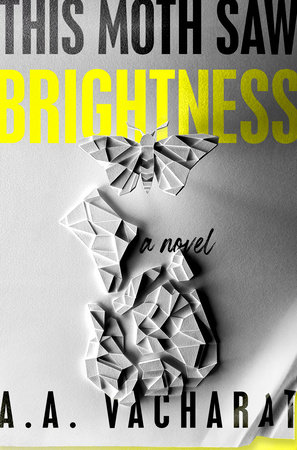
This Moth Saw Brightness

Look inside
Paperback
$13.99 US
5.56"W x 8.3"H x 0.97"D   | 13 oz | 24 per carton
On sale May 26, 2026 | 448 Pages | 9780593698617
Age 14 and up | Grade 9 & Up
Reading Level: Lexile 650L

See Additional Formats
A weird and revelatory debut that vividly captures the dislocation of growing up BIPOC and neurodivergent in a country awash in both conspiracy theories and genuine conspiracies.

"The invisible D in my name is my mother’s second most lasting contribution to my life."

‘Wayne Le—known as "Invisible-D 'Wayne" at school—has been invited to participate in a seemingly ordinary, innocuous adolescent health study by a prestigious university. The study has a few nice perks, but most important to ‘Wayne, is the opportunity to give his immigrant father an accomplishment to be proud of—something that's been in short supply since 'Wayne's mother left.

But the study quickly proves to be anything but ordinary and innocuous, and ‘Wayne, his best friend Kermit, and a fellow study participant named Jane (a girl who shall not be manic-pixied) find themselves sucked into an M. C. Escheresque maze of conspiracies that might be entirely in their heads or might truly be a sinister government plot.

A New York Public Library Best Book of the Year
A YALSA Best Fiction for Young Adults Selection


★ "This funny, insightful debut about mental illness, identity, and a person’s capacity to change packs a surprising emotional punch. Bold stylistic choices—wry footnotes, the inclusion of documents referenced in the story, a brief interjection by the author—add an interactive element to D's humorous and self-deprecating first-person narration. Superb."—Kirkus, starred review

★ "The true conspiracy theories are the friends we made along the way—or are they?... This debut is an engaging read while also having great potential to spark conversations about information literacy with the implications of its deeply unsettling ending."—Booklist, starred review

★ "A remarkable debut novel which delves into both adolescent struggles and mental health."—SLJ, starred review

"Vacharat’s debut is a standout work of speculative fiction and a foreboding social satire about unethical governing and the corrosive values of Big Tech."—The Horn Book

"Vacharat's debut YA novel is a compelling dissection of humanity's 'impulse to treat people...like they are the property of whoever's in power.'... An enigmatic, entertaining experience."—Shelf Awareness

"A.A. Vacharat is a bold and strange new YA voice, with shades of A.S. King. This Moth Saw Brightness defies description; at once sweeping and specific, full of huge ideas and beautifully honest relationships, this is a debut from a fascinating new writer. I can’t wait to see what she does next."—Joy McCullough, New York Times bestselling author of Blood Water Paint and Everything Is Poison

"Utilizing cheeky footnotes and fourth-wall-breaking asides, and deploying shocking twists and turns, Vacharat delivers a propulsive and unnerving debut."—PW
A. A. Vacharat is an author, illustrator, and web developer. She is a graduate of the Vermont College of Fine Art MFA program. Her books include elements of science, technology, and usually at least a little whimsy or absurdity. She includes characters that her child-self yearned to see—such as children with one Asian parent and autistic protagonists—and portrays worlds beyond those most often seen. This Moth Saw Brightness is her debut. View titles by A. A. Vacharat
The mail fwumps through the brass door flap. It falls directly into my lap.

The mail that I absolutely am not stealing consists of the following:

On top: Two promotional postcards. The first is the weekly “20% off any drink!” coupon from the Tiki Bar (actually a café), inside the recently de-and-re-malled Marley Station Shopping & Experience Center (1).

The second has a coupon code for the selfie “theme park and experience simulator” that recently opened outside downtown Baltimore. I pocket the code. You never know when you’re going to need Salvation of Your Future Self Through the Now™.

Below that: A “certified” letter with a holographic seal of Johns Hopkins University in the return address corner.

It’s addressed to me. Sort of.

“ATTN: Mr. Dwayne Le,” it says. The invisible D in ’Wayne is not only visible on the envelope but also slightly out of line, as though someone intentionally added it after the fact.

“URGENT” is stamped diagonally down the right side. “OPEN IMMEDIATELY” is stamped down the left.

Spam, clearly. Or part of one of Kermit’s elaborate pranks.

A cardboard box meant for recycling lives by the front door. My father is of the convenience-equals-art mindset, as far as interior design goes.

I use the box.

On the bottom: What I’ve been sitting by the door waiting for. The reason I’ve been tiptoeing around the house in my spy socks (2) for the last hour.

The envelope is from Glenville High School. It is addressed to my father.

I open it immediately.


NUMERICAL PRECISION

My father works from home. His schedule is precise and—mostly—unwavering.

As of the last day of summer vacation, which was the last day I was home to witness his entire weekday structure, his schedule was the following:

At 8:58 a.m., he slips off his home shoes and slips on his work shoes, which he ordered custom-made from England for their “quality leather exterior” and comfortable-yet-functional, sweat-wicking “Harris Tweed” interiors.

Then, he “goes to work” (i.e., goes into his office, which is next to the living room) at exactly nine. He turns on his solar-powered mirror that keeps sunlight optimally directed at his walls, stashes his bento box (prepared the night before) in the “office kitchen” (mini fridge with microwave on top), and then works until twelve, doing something involving numbers, a spreadsheet, and “quantifying risk.” He microwaves and eats lunch before going for his speed walk until exactly one, when his electric kettle (on a timer) prepares him a cup of genmaicha. Then he puts on a fresh shirt and resumes working at his desk, or, maybe once a week, goes somewhere to meet with clients.

Finally, he “comes home,” slipping on his home shoes, at exactly, precisely, five. (3)

I bring the envelope into the kitchen, which also serves as our dining room (efficiency, again).

The clock on the kitchen wall says 4:42, meaning I have eighteen minutes before Dad “comes home.”

Dad leaves his tablet on the counter while he’s “at the office,” to minimize the time between “getting home” and starting to make dinner.

I swipe past Olive’s artwork that serves as the lock screen, open a new tab behind today’s recipe. Then I dump out the contents of the Glenville High School envelope onto the table: a short note and a cardstock square.

It’s the cardstock square I care about. It’s printed with the six-digit two-factor auth code that ensures that my father is the only one who can log in and confirm my mid-trimester grades.

“Ensures.”

On the Glenville High homepage, the familiar image of a former student dunking a basketball welcomes me. I log in using Dad’s password, generously provided to me by Kermit for a mere one hundred dollars (his “best friend discount”), and type in the code.

I check the box to confirm that “I, Peter Le, parent/guardian of ’Wayne Le, have seen and acknowledged my student’s mid-trimester interim progress.”

I log out. I return the recipe tab to the front.

4:48. Master Spy Am I.


DNS FACE


Yes, I know, Dad is going to see my grades eventually.

The thing is, though, Dad makes faces.

An introductory glossary:

ODC: Olive Did Cute. Dad ODCs whenever Olive is around. Can’t blame him. Everything she does is unnervingly likable. Everything. Like doing math homework. When she figures out an answer, she pops up her index finger an inch like she’s raising her hand for herself before writing the answer down.

IKB: I Know Better. Inevitably followed by a lengthy explanation of exactly what he knows better, how, and why.

DNS: Disappointed, Not Surprised. The worst of all faces.

Dad DNSes every time he looks at anything related to my school records. Also in regard to many other things I do. And all the things I don’t do.

Every school report Dad doesn’t have to look at is another day he can thrive in his carefully crafted paradise of maximized, risk-averse numbers.


THE SLIPPERY SLOPE OF DIRTY PANTS

A door clicks shut somewhere in the house. The clock reads 4:49.

Tiny arms drape around me and squeeze.

Olive, home early from Art Club, gently rests her bag on the floor before taking the chair across from me. It squeaks and rolls backward slightly. We’ve had office chairs in the kitchen since Dad closed his non-quotation-marks office downtown.

Olive scoots herself back toward the table. “Whatcha doing on Dad’s tablet?”

“Homework.”

She eyes the envelope on the table. “You opened Dad’s mail again.” The envelope is crumpled, but Peter Le is clearly visible in the address field. “You need to stop doing that.”

“I didn’t do anything.”

“Yes, you did.”

“I didn’t!”

She puts her head below the table edge. “You’re wearing your spy socks.”

“I need to do laundry.”

“You do this every time.”

“There’s no evidence.” I crumple the envelope further and toss it into the kitchen recycling box. (4)

“See? Absolutely zero evidence.”

Her eyes narrow.

“No one has caught me so far.”

“Um. Except me. Your eleven-year-old sister, emphasis on eleven. No PhD, no FBI training, merely a modest eye for detail.” She adjusts invisible glasses on her nose and glares at me.

I glare back.

Finally, she sighs. She squeezes down onto the floor, picks up the envelope from where I tossed it. “You would make an absolutely terrible secret agent.” She buries the envelope under other papers. “Good thing you have me as your sister.”

Olive isn’t technically my sister, and Olive isn’t really her name. She’s a removed cousin, or something like that. Her parents, my first cousin and her husband, are Vietnamese. They sent Olive to live with us so she could go to American schools.

She’s been here since she was four, minus a month each summer when she has to go back to renew her visa. Dad tried to officially adopt her, but he couldn’t get it approved. Still, she thinks of me as her brother. I think of her as my sister.

I get the better end of the deal.

I roll my chair to the fridge and pull out the bagels. “Your usual?”

“Mm.” She stacks more envelopes on top of my guilty one in the recycling box. “You know, hiding your grades is a waste of time.”

“Untrue. I’m reducing the number of bad days by half.” The toaster hums as it heats up. I pull Olive’s special blue plate out of the dirty dishwasher and run it under hot water.

“Huh.” She joins me at the counter, leans over the sink as if she’s very interested in what’s happening to her plate. “Well, I’m about to do my homework.” She watches my hands pick a dried rice grain free. “You could join me.”

“Oh, I could, could I?”

“If you’re ready to admit your career as a secret agent is a total failure and that you need to take the same drudging path as the rest of us civilians.”

I don’t know where she gets this stuff. “Oh, yeah?” I turn off the water and face her.

“Yeah.” She puffs out her lower cheeks. She’s wearing a bright green T-shirt with a large white chicken printed in the middle. The chicken is labeled “Dinosaur.” “Well?” she says.

“Well.”

I take the dish towel from the oven handle and wipe her plate dry, lay it on the counter. Next to it, Dad’s tablet lights up with a news notification.

Here is something that is hard to describe: how knowing you’ve already screwed up makes it infinitely harder to keep trying. It’s like forgetting to put your dirty pants in a hamper one time. There’s no hope for any future pants, because why bother? Your room is already a mess. From that day on, all your pants will end up on the floor.

The toaster dings. “I’m planning to do my homework. Later.”

Olive puffs her cheeks again, then blows the air out. “Okay.”

I plop the bagel onto the plate, then cut a cube of cream cheese next to it, far enough away that they aren’t touching. She told me a couple months ago that she’s fine with them touching now, but I’m pretty sure she still prefers it this way.

“Homework or not, you’re my favorite.” She takes the plate, and her bag, and heads into the living room to work.

The warm bagel smell fades quickly. The sink drips. The clock on the kitchen wall ticks loudly.


Footnotes:
(1) Kermit says the coupons are part of a marketing push targeted at high school students to persuade us to spend our free time inside “their rectangular corporate utopia.”
(2) . . . which are the same as my regular socks but pink. Sent due to company error. I kept them because Olive begged me to, and now I like them. They remind me of the soft pads on a big cat’s toes, what Olive calls “squinkleberries.” Pink socks—> panther squinkleberries—> maximum stealth.
(3) His schedule changes only when he has new ideas to shave off time between tasks. For example, the day he realized that slicing his chicken thinner would reduce three whole seconds from reheating time. A landmark day.
(4) This box lives in the doorway of a glass tile wall that separates our kitchen-slash-dining room from the actual intended dining room, which is now a guest room that we never use.

About

A weird and revelatory debut that vividly captures the dislocation of growing up BIPOC and neurodivergent in a country awash in both conspiracy theories and genuine conspiracies.

"The invisible D in my name is my mother’s second most lasting contribution to my life."

‘Wayne Le—known as "Invisible-D 'Wayne" at school—has been invited to participate in a seemingly ordinary, innocuous adolescent health study by a prestigious university. The study has a few nice perks, but most important to ‘Wayne, is the opportunity to give his immigrant father an accomplishment to be proud of—something that's been in short supply since 'Wayne's mother left.

But the study quickly proves to be anything but ordinary and innocuous, and ‘Wayne, his best friend Kermit, and a fellow study participant named Jane (a girl who shall not be manic-pixied) find themselves sucked into an M. C. Escheresque maze of conspiracies that might be entirely in their heads or might truly be a sinister government plot.

A New York Public Library Best Book of the Year

Praise

A New York Public Library Best Book of the Year
A YALSA Best Fiction for Young Adults Selection


★ "This funny, insightful debut about mental illness, identity, and a person’s capacity to change packs a surprising emotional punch. Bold stylistic choices—wry footnotes, the inclusion of documents referenced in the story, a brief interjection by the author—add an interactive element to D's humorous and self-deprecating first-person narration. Superb."—Kirkus, starred review

★ "The true conspiracy theories are the friends we made along the way—or are they?... This debut is an engaging read while also having great potential to spark conversations about information literacy with the implications of its deeply unsettling ending."—Booklist, starred review

★ "A remarkable debut novel which delves into both adolescent struggles and mental health."—SLJ, starred review

"Vacharat’s debut is a standout work of speculative fiction and a foreboding social satire about unethical governing and the corrosive values of Big Tech."—The Horn Book

"Vacharat's debut YA novel is a compelling dissection of humanity's 'impulse to treat people...like they are the property of whoever's in power.'... An enigmatic, entertaining experience."—Shelf Awareness

"A.A. Vacharat is a bold and strange new YA voice, with shades of A.S. King. This Moth Saw Brightness defies description; at once sweeping and specific, full of huge ideas and beautifully honest relationships, this is a debut from a fascinating new writer. I can’t wait to see what she does next."—Joy McCullough, New York Times bestselling author of Blood Water Paint and Everything Is Poison

"Utilizing cheeky footnotes and fourth-wall-breaking asides, and deploying shocking twists and turns, Vacharat delivers a propulsive and unnerving debut."—PW

Author

A. A. Vacharat is an author, illustrator, and web developer. She is a graduate of the Vermont College of Fine Art MFA program. Her books include elements of science, technology, and usually at least a little whimsy or absurdity. She includes characters that her child-self yearned to see—such as children with one Asian parent and autistic protagonists—and portrays worlds beyond those most often seen. This Moth Saw Brightness is her debut. View titles by A. A. Vacharat

Excerpt

The mail fwumps through the brass door flap. It falls directly into my lap.

The mail that I absolutely am not stealing consists of the following:

On top: Two promotional postcards. The first is the weekly “20% off any drink!” coupon from the Tiki Bar (actually a café), inside the recently de-and-re-malled Marley Station Shopping & Experience Center (1).

The second has a coupon code for the selfie “theme park and experience simulator” that recently opened outside downtown Baltimore. I pocket the code. You never know when you’re going to need Salvation of Your Future Self Through the Now™.

Below that: A “certified” letter with a holographic seal of Johns Hopkins University in the return address corner.

It’s addressed to me. Sort of.

“ATTN: Mr. Dwayne Le,” it says. The invisible D in ’Wayne is not only visible on the envelope but also slightly out of line, as though someone intentionally added it after the fact.

“URGENT” is stamped diagonally down the right side. “OPEN IMMEDIATELY” is stamped down the left.

Spam, clearly. Or part of one of Kermit’s elaborate pranks.

A cardboard box meant for recycling lives by the front door. My father is of the convenience-equals-art mindset, as far as interior design goes.

I use the box.

On the bottom: What I’ve been sitting by the door waiting for. The reason I’ve been tiptoeing around the house in my spy socks (2) for the last hour.

The envelope is from Glenville High School. It is addressed to my father.

I open it immediately.


NUMERICAL PRECISION

My father works from home. His schedule is precise and—mostly—unwavering.

As of the last day of summer vacation, which was the last day I was home to witness his entire weekday structure, his schedule was the following:

At 8:58 a.m., he slips off his home shoes and slips on his work shoes, which he ordered custom-made from England for their “quality leather exterior” and comfortable-yet-functional, sweat-wicking “Harris Tweed” interiors.

Then, he “goes to work” (i.e., goes into his office, which is next to the living room) at exactly nine. He turns on his solar-powered mirror that keeps sunlight optimally directed at his walls, stashes his bento box (prepared the night before) in the “office kitchen” (mini fridge with microwave on top), and then works until twelve, doing something involving numbers, a spreadsheet, and “quantifying risk.” He microwaves and eats lunch before going for his speed walk until exactly one, when his electric kettle (on a timer) prepares him a cup of genmaicha. Then he puts on a fresh shirt and resumes working at his desk, or, maybe once a week, goes somewhere to meet with clients.

Finally, he “comes home,” slipping on his home shoes, at exactly, precisely, five. (3)

I bring the envelope into the kitchen, which also serves as our dining room (efficiency, again).

The clock on the kitchen wall says 4:42, meaning I have eighteen minutes before Dad “comes home.”

Dad leaves his tablet on the counter while he’s “at the office,” to minimize the time between “getting home” and starting to make dinner.

I swipe past Olive’s artwork that serves as the lock screen, open a new tab behind today’s recipe. Then I dump out the contents of the Glenville High School envelope onto the table: a short note and a cardstock square.

It’s the cardstock square I care about. It’s printed with the six-digit two-factor auth code that ensures that my father is the only one who can log in and confirm my mid-trimester grades.

“Ensures.”

On the Glenville High homepage, the familiar image of a former student dunking a basketball welcomes me. I log in using Dad’s password, generously provided to me by Kermit for a mere one hundred dollars (his “best friend discount”), and type in the code.

I check the box to confirm that “I, Peter Le, parent/guardian of ’Wayne Le, have seen and acknowledged my student’s mid-trimester interim progress.”

I log out. I return the recipe tab to the front.

4:48. Master Spy Am I.


DNS FACE


Yes, I know, Dad is going to see my grades eventually.

The thing is, though, Dad makes faces.

An introductory glossary:

ODC: Olive Did Cute. Dad ODCs whenever Olive is around. Can’t blame him. Everything she does is unnervingly likable. Everything. Like doing math homework. When she figures out an answer, she pops up her index finger an inch like she’s raising her hand for herself before writing the answer down.

IKB: I Know Better. Inevitably followed by a lengthy explanation of exactly what he knows better, how, and why.

DNS: Disappointed, Not Surprised. The worst of all faces.

Dad DNSes every time he looks at anything related to my school records. Also in regard to many other things I do. And all the things I don’t do.

Every school report Dad doesn’t have to look at is another day he can thrive in his carefully crafted paradise of maximized, risk-averse numbers.


THE SLIPPERY SLOPE OF DIRTY PANTS

A door clicks shut somewhere in the house. The clock reads 4:49.

Tiny arms drape around me and squeeze.

Olive, home early from Art Club, gently rests her bag on the floor before taking the chair across from me. It squeaks and rolls backward slightly. We’ve had office chairs in the kitchen since Dad closed his non-quotation-marks office downtown.

Olive scoots herself back toward the table. “Whatcha doing on Dad’s tablet?”

“Homework.”

She eyes the envelope on the table. “You opened Dad’s mail again.” The envelope is crumpled, but Peter Le is clearly visible in the address field. “You need to stop doing that.”

“I didn’t do anything.”

“Yes, you did.”

“I didn’t!”

She puts her head below the table edge. “You’re wearing your spy socks.”

“I need to do laundry.”

“You do this every time.”

“There’s no evidence.” I crumple the envelope further and toss it into the kitchen recycling box. (4)

“See? Absolutely zero evidence.”

Her eyes narrow.

“No one has caught me so far.”

“Um. Except me. Your eleven-year-old sister, emphasis on eleven. No PhD, no FBI training, merely a modest eye for detail.” She adjusts invisible glasses on her nose and glares at me.

I glare back.

Finally, she sighs. She squeezes down onto the floor, picks up the envelope from where I tossed it. “You would make an absolutely terrible secret agent.” She buries the envelope under other papers. “Good thing you have me as your sister.”

Olive isn’t technically my sister, and Olive isn’t really her name. She’s a removed cousin, or something like that. Her parents, my first cousin and her husband, are Vietnamese. They sent Olive to live with us so she could go to American schools.

She’s been here since she was four, minus a month each summer when she has to go back to renew her visa. Dad tried to officially adopt her, but he couldn’t get it approved. Still, she thinks of me as her brother. I think of her as my sister.

I get the better end of the deal.

I roll my chair to the fridge and pull out the bagels. “Your usual?”

“Mm.” She stacks more envelopes on top of my guilty one in the recycling box. “You know, hiding your grades is a waste of time.”

“Untrue. I’m reducing the number of bad days by half.” The toaster hums as it heats up. I pull Olive’s special blue plate out of the dirty dishwasher and run it under hot water.

“Huh.” She joins me at the counter, leans over the sink as if she’s very interested in what’s happening to her plate. “Well, I’m about to do my homework.” She watches my hands pick a dried rice grain free. “You could join me.”

“Oh, I could, could I?”

“If you’re ready to admit your career as a secret agent is a total failure and that you need to take the same drudging path as the rest of us civilians.”

I don’t know where she gets this stuff. “Oh, yeah?” I turn off the water and face her.

“Yeah.” She puffs out her lower cheeks. She’s wearing a bright green T-shirt with a large white chicken printed in the middle. The chicken is labeled “Dinosaur.” “Well?” she says.

“Well.”

I take the dish towel from the oven handle and wipe her plate dry, lay it on the counter. Next to it, Dad’s tablet lights up with a news notification.

Here is something that is hard to describe: how knowing you’ve already screwed up makes it infinitely harder to keep trying. It’s like forgetting to put your dirty pants in a hamper one time. There’s no hope for any future pants, because why bother? Your room is already a mess. From that day on, all your pants will end up on the floor.

The toaster dings. “I’m planning to do my homework. Later.”

Olive puffs her cheeks again, then blows the air out. “Okay.”

I plop the bagel onto the plate, then cut a cube of cream cheese next to it, far enough away that they aren’t touching. She told me a couple months ago that she’s fine with them touching now, but I’m pretty sure she still prefers it this way.

“Homework or not, you’re my favorite.” She takes the plate, and her bag, and heads into the living room to work.

The warm bagel smell fades quickly. The sink drips. The clock on the kitchen wall ticks loudly.


Footnotes:
(1) Kermit says the coupons are part of a marketing push targeted at high school students to persuade us to spend our free time inside “their rectangular corporate utopia.”
(2) . . . which are the same as my regular socks but pink. Sent due to company error. I kept them because Olive begged me to, and now I like them. They remind me of the soft pads on a big cat’s toes, what Olive calls “squinkleberries.” Pink socks—> panther squinkleberries—> maximum stealth.
(3) His schedule changes only when he has new ideas to shave off time between tasks. For example, the day he realized that slicing his chicken thinner would reduce three whole seconds from reheating time. A landmark day.
(4) This box lives in the doorway of a glass tile wall that separates our kitchen-slash-dining room from the actual intended dining room, which is now a guest room that we never use.