Close Modal

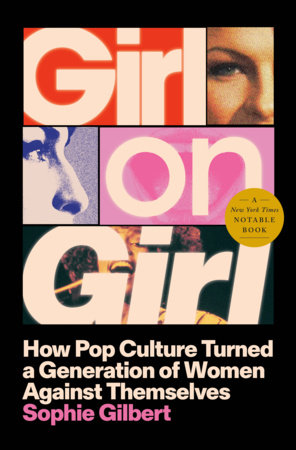
Girl on Girl

How Pop Culture Turned a Generation of Women Against Themselves

Look inside
Hardcover
$30.00 US
6.24"W x 9.29"H x 1.23"D   | 17 oz | 12 per carton
On sale Apr 29, 2025 | 352 Pages | 9780593656297

A New York Times and Washington Post Notable Book • Named one of the Best Books of the Year by TIME and NPR

“Searing… rigorously researched but never stuffy… Gilbert has compiled perhaps the first comprehensive examination of turn-of-the-millennium mainstream, cool-kid trends and ephemera, and how they were largely molded by those in power to sell a generation of girls and young women reality-warping lies.” —The New York Times

“So clear-eyed that it’s startling." —The Washington Post

“Entertaining and even energizing, transforming a dismal history into something like a rallying cry.” —The Boston Globe

From Atlantic critic and Pulitzer Prize finalist Sophie Gilbert, a blazing critique of early aughts pop culture


What happened to feminism in the twenty-first century? This question feels increasingly urgent in a moment of cultural and legislative backlash, when widespread uncertainty about the movement’s power, focus, and currency threatens decades of progress.

Sophie Gilbert identifies an inflection point in the late 1990s and early 2000s, when the energy of third-wave and “riot grrrl” feminism collapsed into a regressive period of hyper-objectification, sexualization, and infantilization. Mining the darker side of nostalgia, Gilbert trains her keen analytic eye on the most revealing cultural objects of the era, across music, film, television, fashion, tabloid journalism, and more. What she recounts is harrowing, from the leering gaze of the paparazzi to the gleeful cruelty of early reality TV and a burgeoning internet culture vicious toward women in the spotlight and damaging for those who weren’t. Gilbert tracks many of the period’s dominant themes back to the rise of internet porn, which gained widespread influence as it began to pervade our collective consciousness.

The result is a devastating portrait of a time when a distinctly American blend of excess, materialism, and power worship collided with the culture’s reactionary, puritanical, and chauvinistic currents. Amid a collective reconsideration of the way women are treated in public, Girl on Girl is a blistering indictment of the matrix of misogyny that undergirded the cultural production of the early twenty-first century, and continues to shape our world today.
“Searing . . . There were several passages in Gilbert’s blistering, sobering book Girl on Girl that challenged my selective nostalgia, making me wince. If you too came of age around the late 1990s and early aughts, prepare to have the balloon string of sentimentality pried from your grip. The party’s over. It’s been over . . . Her book is a course correction of sorts, taking a holistic tack to explain our current sociopolitical reality: one in which women’s hard-fought gains are quickly eroding, and men and boys are in crisis . . . Across 10 rigorously researched but never stuffy chapters, Gilbert has compiled perhaps the first comprehensive examination of turn-of-the-millennium mainstream, cool-kid trends and ephemera, and how they were largely molded by those in power to sell a generation of girls and young women reality-warping lies . . . Gilbert isn’t concerned with softening the blow. Instead, she’s intent on snapping millennials out of any instinct to idealize the decades that shaped us—even if that awareness stings.” New York Times

“So clear-eyed that it’s startling . . . Girl on Girl covers how American culture writ large treated women from the 1990s to the 2010s. It’s to Gilbert’s credit that she makes a cohesive history emerge from this morass of references . . . Her organization is as confident and nimble as her arguments . . . The informed and persuasive essays in Girl on Girl stand alone, even as they build on one another. A chapter on the early years of reality television is exceptional . . . This ground is well-trod, but rarely trod so well . . . Gilbert is a critic skilled in the art of seeing close-up and faraway all at once, a Vertigo effect of cultural observation. Girl on Girl doesn’t settle into outrage or pity, but instead offers a clear-eyed, unblinking stare that conveys one thing: I see what you’re doing.” The Washington Post

“Gilbert, a staff writer at the Atlantic, meticulously documents the explosion of highly sexualized content in mainstream American culture . . . A reminder of where we come from as a culture, and a reinvigorating exhortation not to return there.” Los Angeles Times

“Gilbert has earned a National Magazine Award and a spot on the Pulitzer Prize shortlist for her work as a critic with The Atlantic. In Girl on Girl, her first book-length work, Gilbert trains her gimlet eye on popular culture in the past 30 years and the ways that its pervasive images "calibrated to male desire" have reduced, distorted and ultimately undermined the promises of feminism.” —NPR.org

“Fans of pop culture analysis need to add this non-fiction book on their TBR ASAP!... It's an ultra fascinating read!” –E! News

“Gilbert’s is the first book I’ve read that takes on porn and porn culture with the same feminist skepticism that we’ve long applied to all other forms of mass media . . . Or, I should say, it’s the first book on the matter that seems to be widely resonating with the women who lived through it . . . It’s a conversation that is well overdue . . . Gilbert’s book has pried open a feminist door that felt long slammed shut . . . Thank goodness. Here’s hoping other feminists will join in.” —Slate

“Gilbert paints a clear and narrative odyssey of 21st-century feminism and how society has regressed toward the hyper-objectification, sexualization and infantilization of women.” USA Today

“Incisive and witty . . . Thoroughly researched and superbly written . . . This sharp and entertaining delve into the grim side of 2000s nostalgia will appeal to many Millennial readers and is an important work that contextualizes the systemic misogyny that remains pervasive to this day… An excellent addition to any nonfiction collection, this book offers a fresh perspective on what happened to feminism in the aughts.” —Library Journal, starred review

“Mining the darker side of nostalgia, Gilbert trains her keen analytic eye on the most revealing cultural objects of the era, across music, film, television, fashion, tabloid journalism, and more . . . The result is a devastating portrait of a time when a distinctly American blend of excess, materialism, and power worship collided with the culture’s reactionary, puritanical, and chauvinistic currents.” Daily Kos

“Chapter by chapter, Gilbert methodically shows how the backlash against second- and third-wave and riot grrrl feminism fueled the rise of incel culture, trad wives, the stay-at-home girlfriends on TikTok, and much more. There is a lot to unpack here, but it is well worth the effort.” AP

“In exploring the years that saw millennial feminism curdle into a wan tool of capitalism (lean in, girlboss!), the book is somehow very entertaining and even energizing, transforming a dismal history into something like a rallying cry.” Boston Globe

“Gilbert is one of my favorite writers and thinkers, particularly on the subjects of gender and womanhood—and her debut book, which dissects three decades of pop culture through a feminist lens, is sure to be one of the standouts of the year.” The Millions

“Amid pervasive rollbacks to women’s rights in America, Gilbert . . . mounts a powerful argument that millennial pop culture ‘turned a generation of women against themselves.’” —The New York Times

“The book takes a hard look at the pop culture of the late ‘90s and early 2000s—the explosion of tabloid photography, increasingly cruel and ceaseless commentary on celebrity blogs, sexualization of young women by the media, etc.—and the lasting damage it has done to modern women and, possibly, the feminist movement itself. It's a book that will make you think, and want to discuss.” Glamour

“Add this book to the list of titles that urgently provide context and answers to the hell storm that is [vaguely waves around] everything going on right now . . .Gilbert unmasks the collective regression that continues to influence our views on misogyny, feminism, and womanhood today.” Harper’s Bazaar

“Intelligent and enlightening.” OurCulture

“In this triumphant debut, Pulitzer finalist Gilbert dissects three decades of pop culture, from the Riot Grrrl 1990s to the #Girlboss 2010s . . . a tour de force of cultural criticism.” Publishers Weekly (starred review)

“Gilbert deserves a medal—not only for her observations and conclusions, but for navigating the sludge she had to wade through to get there. Essential cultural criticism.” Kirkus (starred review)

Girl on Girl is a work of overwhelming meticulousness and clarity. If you’re confused about the current uncertainty about feminism’s power, Sophie Gilbert has done the work of painstakingly and granularly tracing every cultural thread to reveal how we got here. Gilbert unmasks an insidious cultural coup that seemingly overnight dethroned the transgressive women of the 90s; 'Just like that they were gone–replaced by girls,' she writes. Over and over, Gilbert reminds us: it wasn’t always this bad–in fact, it was getting better, then it got taken away. Girl on Girl is a necessary corrective of cultural memory, but more importantly, it is a definitive archive of that disempowerment and its ensuing cruelties.” —Elamin Abdelmahmoud, host of CBC’s Commotion and author of Son of Elsewhere

“With panache, wit, and brilliance, Sophie Gilbert's Girl on Girl offers compelling analyses of how mass culture has diluted and tainted feminism. A captivating must-read for anyone who wants to understand how and why misogyny is as powerful a force as ever.” —Kate Manne, author of Down Girl and Unshrinking

“A riveting, incisive, rousing exploration of millennial culture that reveals the cyclical pattern of political movements, the insidious nature of backlash, and the importance of understanding how we got here, so that we can move forward. Sophie Gilbert is one of our most important cultural critics and I'll read everything she ever writes.” —Melissa Febos, author of The Dry Season and Girlhood, winner of the National Book Critics Circle Award in Criticism

“A deep dive into pop culture's pernicious obsession with female youth. An incisive spotlight that lays bare the trap of postfeminism. A fascinating, compelling, and maddening look at the guise of female sexuality in the new millennium—how it became a dominant yet misperceived source of power for women and, of course, how it was and continues to be used against us.” —Anna Marie Tendler, New York Times bestselling author of Men Have Called Her Crazy

“Reading Girl on Girl feels like revisiting your memories with your brilliant protective older sister making sense of them for you. Her cultural criticism is as coolly sophisticated as it is deeply personal, making you feel like she’s reading your mind. It’s alarming to see so clearly how cruel the aughts were to young women. But the great payoff is, finally, self awareness.” —Hanna Rosin, author of The End of Men

“Girl on Girl’s greatest gift is its insistence on treating some of culture’s longest-standing punchlines—porn girls, reality stars, gossipmongers, self-mythologizers—with the seriousness they deserve, interrogating them both as the products of their circumstances and as a material basis for the new world in which we live. The result is dizzying, engrossing, sometimes nauseating; an ambitious modern history of public-facing womanhood that manages to make the senselessness and horror of our current moment feel eminently comprehensible.” —Rayne Fisher-Quann, writer of the blog and newsletter Internet Princess
© Urszula Soltys
Sophie Gilbert is a staff writer at The Atlantic, where she writes about television, books, and popular culture. She won the 2024 National Magazine Award for Reviews and Criticism and was a finalist for the 2022 Pulitzer Prize in Criticism. She lives in London. View titles by Sophie Gilbert
Chapter 1

Girl Power, Boy Rage

Music and Feminism in the 1990s

I heard someone from the music business saying they are no longer looking for talent, they want people with a certain look and a willingness to cooperate.
Joni Mitchell (2004)

When will this caveboy shit end?
dream hampton (1991)

In 2003, the music critic Jessica Hopper published an essay in Punk Planet titled "Emo: Where the Girls Aren't," detailing the alienation she felt from one of the most influential artistic genres of the era. "Girls in emo songs today do not have names," she wrote. "Our actions are portrayed solely through the detailing of neurotic self-entanglement of the boy singer-our region of personal power, simply, is our impact on his romantic life. We're vessels redeemed in the light of boy-love. On a pedestal, on our backs."

Many of us could sense this dynamic at the time, even if we couldn't quite rationalize it. What Hopper was articulating about emo was true of much music in the aughts: The most popular anthems of the decade were sticky, leaden strip-club soundtracks, full of rote clichés about male sexual prowess and devious, grasping women. In my late teens and twenties, I danced in clubs to Sisqó's "Thong Song," Christina Aguilera's "Dirrty," and 50 Cent's "P.I.M.P." without realizing that something had shifted. It's impossible to analyze millennial culture without first going back to the 1990s, where flash points in music would uncannily anticipate and inform what was coming. During that decade, music was the site of some of our most crucial battles over sex, power, and feminism. It was where provocateurs and rebels came to play and to protest. Women in music in the 1990s were angry and abrasive and thrillingly powerful. And then, just like that, they were gone-replaced by girls. The backlash that banished them would reverberate across all forms of media, so relentlessly and persuasively that people of my generation would hardly think to notice what we'd lost.

At the tail end of 1990, Madonna released a video to accompany her new single, "Justify My Love," that set the tone for the coming decade: audacious, wildly sexual, a little bit trollish. The song was a hypnotic, trip-hoppy declaration of lust; the video was a conceptual, wildly sexual exploration of fantasy and desire that detonated pre-internet popular discourse. Madonna, shot in black-and-white, is seen walking down a hotel hallway toward an assignation, limping slightly in heels and a black raincoat, clutching her head as if in pain. As she passes different doorways, we see fleeting glimpses of the people occupying various rooms, watching us watch them. The star is joined by her lover (played by her real-life boyfriend at the time, the amiable lunk Tony Ward); a man laces a woman into a rubber corset; a dancer in a unitard contorts into shifting positions; Ward watches Madonna with another partner, his expression a picture. More people arrive; Ward gets trussed up in fetish netting; everyone tests the amorphous boundaries of sexuality, gender, and dominance. Finally, Madonna puts on her coat and leaves, laughing, renewed and jubilant, no longer tired.

The brazen, unnerving sexuality of the video was the whole point. By the end of that year, the AIDS epidemic had claimed more than 120,000 lives in the United States, one-fifth of which were in New York, the epicenter of fashion, art, music, media, and advertising. Cultural anxiety regarding the idea that sex could literally kill you had led to two wildly divergent schools of thought in media. One, nicknamed the New Traditionalism, preached a revival of old-fashioned family values, where women went home and stayed there. (The 1987 movie Fatal Attraction made this fear of a corrupted American culture literal, in the form of Glenn Close's sexually adventurous, bunny-boiling career woman, the fling who won't be flung.) The other, the New Voyeurism, embraced sex, but as a spectator sport. "At a time when doing it has become excessively dangerous, looking at it, reading about it, thinking about it have become a necessity," a Newsweek feature on Madonna declared in 1992. "AIDS has pushed voyeurism from the sexual second tier . . . into the front row."

For the rest of the 1990s, culture would be shaped by the push-pull of these two opposing forces. The New Traditionalism and the New Voyeurism seemed at odds, but both were essentially promising women the same thing: that fulfillment and prosperity lie in catering to men's desires. Music, though, was where women were pushing back. The "Justify My Love" video reads now as a brazen affirmation of sexual freedom in a turbulent era. But there was a twist. The subject of the video was Madonna-the fantasies, the imagery, the pleasure all hers. If it was alienating to men, or to mainstream audiences, she didn't care. The video ended with words on a screen: "Poor is the man / Whose pleasures depend / On the permission of another."

Madonna must have anticipated mass outrage, and she got it. But she also helped ignite a sex-positive wave of music that put women's desires front and center. In 1993, Janet Jackson released Janet, a silky, carnal record all about lust. The video for her track "Any Time, Any Place" teases the same voyeuristic impulses at play in "Justify My Love"; people spy on each other through peepholes and letterboxes and an elderly neighbor looks on, disapprovingly, as Jackson pushes her lover's head down while he's on top of her-a revolutionary assertion of sexual power and equality that would later be echoed in videos and lyrics by TLC, Mary J. Blige, and Lil' Kim.

At the time, music videos were still a novel art form. The 1990s predilection for voyeurism wasn't just a response to AIDS: Images became more ubiquitous and more freighted because consumers now had the ability to watch music as well as listen to it. When MTV launched in 1981, it turned the nature of pop and rock stardom inside out. What you looked like as an artist became, overnight, as crucial as the sound you made. Artists such as Madonna, Cyndi Lauper, and Tina Turner, whose unique aesthetics made them immediately recognizable on-screen, flourished in the new medium. But Madonna and Jackson both also seemed to recognize all the ways in which video made women targets. Twelve days after the launch of MTV, Duran Duran began production on the video for "Girls on Film," a six-minute short in which topless models had pillow fights, mud wrestled, kissed, poured champagne over each other's breasts, and straddled an oversized pole covered in shaving cream-adapting hokey sexist imagery for a new technological era.

Madonna's and Jackson's videos openly challenged the idea of women's performing for men's pleasure. In the 1986 video for "Open Your Heart," which incorporates a vast nude painting by the Polish artist Tamara de Lempicka, Madonna played a peep-show dancer in front of an audience of leering, dead-eyed onlookers. The following year, a study found that while rock videos were "cable's first real contribution to entertainment programming on television," the majority of videos shown on MTV depicted women as sex objects or two-dimensional stereotypes. Madonna was more pro-sex than possibly anyone else alive, but for her, sexuality was synonymous with power. Her 1992 coffee-table erotica book Sex was another manifestation of her fantasies: surreal in parts, kinky in others, sometimes outright comical. The author Mary Gabriel argues that it "may have been the first major book of female sexual imagery ever published that was not created to titillate a heterosexual man." And yet the message the entertainment industry would end up taking away from the book was that it was sexual-and that it sold, and sold, and sold.


In some ways, the story of what happened to the feminist movement during the 1990s can be told by tracing the evolution of a single slogan. In 1991, Kathleen Hanna was in Olympia, Washington, in her final semester of college, preoccupied with the fanzine she was making for her punk band, Bikini Kill. Hanna had been reading some of the feminist psychologist Carol Gilligan’s work on adolescent girlhood, confidence, and resistance and was brainstorming titles for her next zine with Bikini Kill’s drummer, Tobi Vail. “Let’s put a word with ‘girl’ that doesn’t usually go with ‘girl,’” Hanna recalls suggesting in her 2024 autobiography, Rebel Girl.

"Power," Vail replied. "Girl Power."

By the end of the 1990s, Girl Power would be a universally familiar slogan, and yet the more it was recited, the less it seemed to stand for. Girl Power as an early-1990s ideology was intensely, intentionally political. It filtered punk's rage through lived experience, demanding more space and respect for women at live shows and throughout the industry as well as creating radical texts that often resembled-with their use of collage, drawings, and block letters-a girl's diary. One flier Hanna wrote for a Bikini Kill show featured a list of imperatives titled "The Revolution Starts Here + Now Within Each One of Us" and included exhortations such as "Resist the internalization of capitalism, the reducing of people + oneself to commodities meant to be consumed." Other contemporary zines associated with the nascent movement that would be named "riot grrrl" explored subjects such as postmodernism, bisexuality, inclusivity in feminism, and the work of the surrealist French playwright Antonin Artaud.

There was no political Teen Vogue during the 1990s. The magazine I read as a tween in the United Kingdom was Just Seventeen, a heavily consumerist, boy-obsessed glossy named after the Beatles' lyric about dating a teenager. It offered leg workouts, twenty reasons to call your crush, even explicit sex tips, but nothing about Artaud or self-commodification. The writer Olivia Laing, also growing up in Britain that decade, was luckier: They discovered riot grrrl via a blistering performance by the punk band Huggy Bear on Channel 4's The Word and immediately sent off a stamped-addressed envelope to claim their own zine. "It's easy to be dismissive about teenage girls-frivolous, vapid, superficial-but looking again at these secret texts, what I'm struck by is their intensity of thought," they wrote in The Guardian in 2018. "Early zines discuss ways to empower girls, to stay safe, to reclaim streets and mosh pits. . . . But the potential self-righteousness is undercut by an avant-garde irreverence of style. Mainstream culture is literally chopped up and rearranged, embroidered for good measure with a doodling of guns and stars."

I've always wondered why people diminish girlhood as somehow cosseted or twee, when the reality of coming-of-age as a young woman is so raw, filled with emotional violence and literal blood. Do girls not suffer enough to be taken seriously? In Rebel Girl, Hanna recounts the experiences that led her to punk activism: her abusive father, whom she and her sister once had to talk out of shooting both them and himself; an unplanned pregnancy and abortion that, because she was underage, she had to write an essay to be granted; the time her ex-boyfriend papered her college library with pictures of her naked; her experience volunteering at a women's shelter after her roommate was violently assaulted by a stranger; her time as a dancer at a gentleman's club; and her rape at the hands of an intimate friend whom she trusted. She remembers thinking that the kind of feminism she was looking for might not exist. The name "Bikini Kill" was a reference to Bikini Atoll, the coral reef in the Marshall Islands where the US government tested nuclear weapons after forcibly repatriating inhabitants. The military, Hanna writes, "taped a picture of Rita Hayworth to the side of one of the bombs, an act against Hayworth's will that left her known as a 'bombshell.'"

What charged the riot-grrrl movement from the beginning was anger at this kind of diminishment and abuse. In the late 1980s, punk music was thriving in Washington, DC, and in the Pacific Northwest, but it made little space for women and girls who felt marginalized within the music scene and unsafe in their day-to-day lives. By the early 1990s, bands such as Babes in Toyland, Bikini Kill, Heavens to Betsy, Excuse 17, 7 Year Bitch, and Bratmobile were coalescing as a ferocious but nebulous movement. In 1991, Hanna and Vail published the "Riot Grrrl Manifesto," arguing that visibility, encouragement, and safety were necessary for women artists to thrive, and that an "angry grrrl rock revolution" was coming that would seek "to save the psychic and cultural lives of girls and women everywhere." As bands toured, they disseminated this message all over the country, leading to riot-grrrl chapters nationwide.

In 1992, the Chicago Reader examined the riot-grrrl scene, noting that one of its earliest political acts wasn't a song but a list of men who date-raped women, scrawled on the wall of a restroom at Evergreen State College. The idea of secrecy-that the movement was empowered both by public expression and private discourse among its followers-was pivotal to riot grrrl's early popularity, while also contributing to its downfall. Without a formalized structure, the coalition was splintered and vulnerable to charges that it was juvenile, precious, and not sufficiently inclusive. Many punk fans felt left out: The musician Ramdasha Bikceem founded her own zine, GUNK, at the age of fifteen, where she wrote about feeling doubly excluded from both the music she loved and the riot-grrrl scene that she characterized as "white middle class punk grrrls."

By 1993, frustrated with the condescension with which riot grrrl had been portrayed in the media, Bikini Kill had stopped doing interviews, which limited riot grrrl's influence. But Hanna's "Girls to the Front" ethos also forcibly carved out space for both female punk fans and baby feminists outside the music scene, and the spirit of creativity and confession contained in zine culture would be reborn online in the years to come. By 1996, independent riot-grrrl conventions had taken place in a dozen cities across the United States, as well as in Europe and Asia, when the movement's "Girl Power" slogan was appropriated by an all-new girl band several thousand miles away.

The riot-grrrl movement and the Spice Girls were sharply at odds. Riot grrrl evolved organically out of art women were making on their own to signal their presence as an engaged, political fandom. The Spice Girls were created by a father-and-son producer team who put an ad in a trade paper announcing auditions. Riot grrrl was a creative manifestation of third-wave feminism. The Spice Girls pioneered and embodied postfeminism and its messaging: Feminism was over, having achieved all it needed to; women were free to dress and adorn themselves however they wanted; any individual choice could be empowering if someone declared it to be so; consumerism was the path to self-fulfillment. If the emerging model for pop stars was "sexy teenager," the Spice Girls were sexy women who behaved like toddlers at a wedding: grabbing things at random, spinning round and round and round, throwing food on the floor. They embodied "freedom" if you understood that concept as "total absence of impulse control." They made you want to immediately go shopping. And they talked, often, about Girl Power.
Contents

Introduction
ix

CHAPTER 1
Girl Power, Boy Rage
Music and Feminism in the 1990s
1

CHAPTER 2
Show Girl
Overexposure in the New Millennium
27

CHAPTER 3
Girls on Film
Sex Comedies from the Multiplex to the Manosphere
53

CHAPTER 4
Girl Fight
Regression and Representation in the Early Years of Reality Television
83

CHAPTER 5
Beautiful Girl
The Goldmine of Impossible Expectations
113

CHAPTER 6
Final Girl
Extreme Sex, Art, and Violence in Post-9/11 America
147

CHAPTER 7
Gossip Girls
The Degradation of Women and Fame in Twenty-First-Century Media
175

CHAPTER 8
Girl on Girls
The Confessional Auteur and Her Detractors
203

CHAPTER 9
Girl Boss

The Making Over of Female Ambition
231

CHAPTER 10
Girls on Top

Rewriting a Path Toward Power

Acknowledgments
285

Notes
287

Index
315

About

A New York Times and Washington Post Notable Book • Named one of the Best Books of the Year by TIME and NPR

“Searing… rigorously researched but never stuffy… Gilbert has compiled perhaps the first comprehensive examination of turn-of-the-millennium mainstream, cool-kid trends and ephemera, and how they were largely molded by those in power to sell a generation of girls and young women reality-warping lies.” —The New York Times

“So clear-eyed that it’s startling." —The Washington Post

“Entertaining and even energizing, transforming a dismal history into something like a rallying cry.” —The Boston Globe

From Atlantic critic and Pulitzer Prize finalist Sophie Gilbert, a blazing critique of early aughts pop culture


What happened to feminism in the twenty-first century? This question feels increasingly urgent in a moment of cultural and legislative backlash, when widespread uncertainty about the movement’s power, focus, and currency threatens decades of progress.

Sophie Gilbert identifies an inflection point in the late 1990s and early 2000s, when the energy of third-wave and “riot grrrl” feminism collapsed into a regressive period of hyper-objectification, sexualization, and infantilization. Mining the darker side of nostalgia, Gilbert trains her keen analytic eye on the most revealing cultural objects of the era, across music, film, television, fashion, tabloid journalism, and more. What she recounts is harrowing, from the leering gaze of the paparazzi to the gleeful cruelty of early reality TV and a burgeoning internet culture vicious toward women in the spotlight and damaging for those who weren’t. Gilbert tracks many of the period’s dominant themes back to the rise of internet porn, which gained widespread influence as it began to pervade our collective consciousness.

The result is a devastating portrait of a time when a distinctly American blend of excess, materialism, and power worship collided with the culture’s reactionary, puritanical, and chauvinistic currents. Amid a collective reconsideration of the way women are treated in public, Girl on Girl is a blistering indictment of the matrix of misogyny that undergirded the cultural production of the early twenty-first century, and continues to shape our world today.

Praise

“Searing . . . There were several passages in Gilbert’s blistering, sobering book Girl on Girl that challenged my selective nostalgia, making me wince. If you too came of age around the late 1990s and early aughts, prepare to have the balloon string of sentimentality pried from your grip. The party’s over. It’s been over . . . Her book is a course correction of sorts, taking a holistic tack to explain our current sociopolitical reality: one in which women’s hard-fought gains are quickly eroding, and men and boys are in crisis . . . Across 10 rigorously researched but never stuffy chapters, Gilbert has compiled perhaps the first comprehensive examination of turn-of-the-millennium mainstream, cool-kid trends and ephemera, and how they were largely molded by those in power to sell a generation of girls and young women reality-warping lies . . . Gilbert isn’t concerned with softening the blow. Instead, she’s intent on snapping millennials out of any instinct to idealize the decades that shaped us—even if that awareness stings.” New York Times

“So clear-eyed that it’s startling . . . Girl on Girl covers how American culture writ large treated women from the 1990s to the 2010s. It’s to Gilbert’s credit that she makes a cohesive history emerge from this morass of references . . . Her organization is as confident and nimble as her arguments . . . The informed and persuasive essays in Girl on Girl stand alone, even as they build on one another. A chapter on the early years of reality television is exceptional . . . This ground is well-trod, but rarely trod so well . . . Gilbert is a critic skilled in the art of seeing close-up and faraway all at once, a Vertigo effect of cultural observation. Girl on Girl doesn’t settle into outrage or pity, but instead offers a clear-eyed, unblinking stare that conveys one thing: I see what you’re doing.” The Washington Post

“Gilbert, a staff writer at the Atlantic, meticulously documents the explosion of highly sexualized content in mainstream American culture . . . A reminder of where we come from as a culture, and a reinvigorating exhortation not to return there.” Los Angeles Times

“Gilbert has earned a National Magazine Award and a spot on the Pulitzer Prize shortlist for her work as a critic with The Atlantic. In Girl on Girl, her first book-length work, Gilbert trains her gimlet eye on popular culture in the past 30 years and the ways that its pervasive images "calibrated to male desire" have reduced, distorted and ultimately undermined the promises of feminism.” —NPR.org

“Fans of pop culture analysis need to add this non-fiction book on their TBR ASAP!... It's an ultra fascinating read!” –E! News

“Gilbert’s is the first book I’ve read that takes on porn and porn culture with the same feminist skepticism that we’ve long applied to all other forms of mass media . . . Or, I should say, it’s the first book on the matter that seems to be widely resonating with the women who lived through it . . . It’s a conversation that is well overdue . . . Gilbert’s book has pried open a feminist door that felt long slammed shut . . . Thank goodness. Here’s hoping other feminists will join in.” —Slate

“Gilbert paints a clear and narrative odyssey of 21st-century feminism and how society has regressed toward the hyper-objectification, sexualization and infantilization of women.” USA Today

“Incisive and witty . . . Thoroughly researched and superbly written . . . This sharp and entertaining delve into the grim side of 2000s nostalgia will appeal to many Millennial readers and is an important work that contextualizes the systemic misogyny that remains pervasive to this day… An excellent addition to any nonfiction collection, this book offers a fresh perspective on what happened to feminism in the aughts.” —Library Journal, starred review

“Mining the darker side of nostalgia, Gilbert trains her keen analytic eye on the most revealing cultural objects of the era, across music, film, television, fashion, tabloid journalism, and more . . . The result is a devastating portrait of a time when a distinctly American blend of excess, materialism, and power worship collided with the culture’s reactionary, puritanical, and chauvinistic currents.” Daily Kos

“Chapter by chapter, Gilbert methodically shows how the backlash against second- and third-wave and riot grrrl feminism fueled the rise of incel culture, trad wives, the stay-at-home girlfriends on TikTok, and much more. There is a lot to unpack here, but it is well worth the effort.” AP

“In exploring the years that saw millennial feminism curdle into a wan tool of capitalism (lean in, girlboss!), the book is somehow very entertaining and even energizing, transforming a dismal history into something like a rallying cry.” Boston Globe

“Gilbert is one of my favorite writers and thinkers, particularly on the subjects of gender and womanhood—and her debut book, which dissects three decades of pop culture through a feminist lens, is sure to be one of the standouts of the year.” The Millions

“Amid pervasive rollbacks to women’s rights in America, Gilbert . . . mounts a powerful argument that millennial pop culture ‘turned a generation of women against themselves.’” —The New York Times

“The book takes a hard look at the pop culture of the late ‘90s and early 2000s—the explosion of tabloid photography, increasingly cruel and ceaseless commentary on celebrity blogs, sexualization of young women by the media, etc.—and the lasting damage it has done to modern women and, possibly, the feminist movement itself. It's a book that will make you think, and want to discuss.” Glamour

“Add this book to the list of titles that urgently provide context and answers to the hell storm that is [vaguely waves around] everything going on right now . . .Gilbert unmasks the collective regression that continues to influence our views on misogyny, feminism, and womanhood today.” Harper’s Bazaar

“Intelligent and enlightening.” OurCulture

“In this triumphant debut, Pulitzer finalist Gilbert dissects three decades of pop culture, from the Riot Grrrl 1990s to the #Girlboss 2010s . . . a tour de force of cultural criticism.” Publishers Weekly (starred review)

“Gilbert deserves a medal—not only for her observations and conclusions, but for navigating the sludge she had to wade through to get there. Essential cultural criticism.” Kirkus (starred review)

Girl on Girl is a work of overwhelming meticulousness and clarity. If you’re confused about the current uncertainty about feminism’s power, Sophie Gilbert has done the work of painstakingly and granularly tracing every cultural thread to reveal how we got here. Gilbert unmasks an insidious cultural coup that seemingly overnight dethroned the transgressive women of the 90s; 'Just like that they were gone–replaced by girls,' she writes. Over and over, Gilbert reminds us: it wasn’t always this bad–in fact, it was getting better, then it got taken away. Girl on Girl is a necessary corrective of cultural memory, but more importantly, it is a definitive archive of that disempowerment and its ensuing cruelties.” —Elamin Abdelmahmoud, host of CBC’s Commotion and author of Son of Elsewhere

“With panache, wit, and brilliance, Sophie Gilbert's Girl on Girl offers compelling analyses of how mass culture has diluted and tainted feminism. A captivating must-read for anyone who wants to understand how and why misogyny is as powerful a force as ever.” —Kate Manne, author of Down Girl and Unshrinking

“A riveting, incisive, rousing exploration of millennial culture that reveals the cyclical pattern of political movements, the insidious nature of backlash, and the importance of understanding how we got here, so that we can move forward. Sophie Gilbert is one of our most important cultural critics and I'll read everything she ever writes.” —Melissa Febos, author of The Dry Season and Girlhood, winner of the National Book Critics Circle Award in Criticism

“A deep dive into pop culture's pernicious obsession with female youth. An incisive spotlight that lays bare the trap of postfeminism. A fascinating, compelling, and maddening look at the guise of female sexuality in the new millennium—how it became a dominant yet misperceived source of power for women and, of course, how it was and continues to be used against us.” —Anna Marie Tendler, New York Times bestselling author of Men Have Called Her Crazy

“Reading Girl on Girl feels like revisiting your memories with your brilliant protective older sister making sense of them for you. Her cultural criticism is as coolly sophisticated as it is deeply personal, making you feel like she’s reading your mind. It’s alarming to see so clearly how cruel the aughts were to young women. But the great payoff is, finally, self awareness.” —Hanna Rosin, author of The End of Men

“Girl on Girl’s greatest gift is its insistence on treating some of culture’s longest-standing punchlines—porn girls, reality stars, gossipmongers, self-mythologizers—with the seriousness they deserve, interrogating them both as the products of their circumstances and as a material basis for the new world in which we live. The result is dizzying, engrossing, sometimes nauseating; an ambitious modern history of public-facing womanhood that manages to make the senselessness and horror of our current moment feel eminently comprehensible.” —Rayne Fisher-Quann, writer of the blog and newsletter Internet Princess

Author

© Urszula Soltys
Sophie Gilbert is a staff writer at The Atlantic, where she writes about television, books, and popular culture. She won the 2024 National Magazine Award for Reviews and Criticism and was a finalist for the 2022 Pulitzer Prize in Criticism. She lives in London. View titles by Sophie Gilbert

Excerpt

Chapter 1

Girl Power, Boy Rage

Music and Feminism in the 1990s

I heard someone from the music business saying they are no longer looking for talent, they want people with a certain look and a willingness to cooperate.
Joni Mitchell (2004)

When will this caveboy shit end?
dream hampton (1991)

In 2003, the music critic Jessica Hopper published an essay in Punk Planet titled "Emo: Where the Girls Aren't," detailing the alienation she felt from one of the most influential artistic genres of the era. "Girls in emo songs today do not have names," she wrote. "Our actions are portrayed solely through the detailing of neurotic self-entanglement of the boy singer-our region of personal power, simply, is our impact on his romantic life. We're vessels redeemed in the light of boy-love. On a pedestal, on our backs."

Many of us could sense this dynamic at the time, even if we couldn't quite rationalize it. What Hopper was articulating about emo was true of much music in the aughts: The most popular anthems of the decade were sticky, leaden strip-club soundtracks, full of rote clichés about male sexual prowess and devious, grasping women. In my late teens and twenties, I danced in clubs to Sisqó's "Thong Song," Christina Aguilera's "Dirrty," and 50 Cent's "P.I.M.P." without realizing that something had shifted. It's impossible to analyze millennial culture without first going back to the 1990s, where flash points in music would uncannily anticipate and inform what was coming. During that decade, music was the site of some of our most crucial battles over sex, power, and feminism. It was where provocateurs and rebels came to play and to protest. Women in music in the 1990s were angry and abrasive and thrillingly powerful. And then, just like that, they were gone-replaced by girls. The backlash that banished them would reverberate across all forms of media, so relentlessly and persuasively that people of my generation would hardly think to notice what we'd lost.

At the tail end of 1990, Madonna released a video to accompany her new single, "Justify My Love," that set the tone for the coming decade: audacious, wildly sexual, a little bit trollish. The song was a hypnotic, trip-hoppy declaration of lust; the video was a conceptual, wildly sexual exploration of fantasy and desire that detonated pre-internet popular discourse. Madonna, shot in black-and-white, is seen walking down a hotel hallway toward an assignation, limping slightly in heels and a black raincoat, clutching her head as if in pain. As she passes different doorways, we see fleeting glimpses of the people occupying various rooms, watching us watch them. The star is joined by her lover (played by her real-life boyfriend at the time, the amiable lunk Tony Ward); a man laces a woman into a rubber corset; a dancer in a unitard contorts into shifting positions; Ward watches Madonna with another partner, his expression a picture. More people arrive; Ward gets trussed up in fetish netting; everyone tests the amorphous boundaries of sexuality, gender, and dominance. Finally, Madonna puts on her coat and leaves, laughing, renewed and jubilant, no longer tired.

The brazen, unnerving sexuality of the video was the whole point. By the end of that year, the AIDS epidemic had claimed more than 120,000 lives in the United States, one-fifth of which were in New York, the epicenter of fashion, art, music, media, and advertising. Cultural anxiety regarding the idea that sex could literally kill you had led to two wildly divergent schools of thought in media. One, nicknamed the New Traditionalism, preached a revival of old-fashioned family values, where women went home and stayed there. (The 1987 movie Fatal Attraction made this fear of a corrupted American culture literal, in the form of Glenn Close's sexually adventurous, bunny-boiling career woman, the fling who won't be flung.) The other, the New Voyeurism, embraced sex, but as a spectator sport. "At a time when doing it has become excessively dangerous, looking at it, reading about it, thinking about it have become a necessity," a Newsweek feature on Madonna declared in 1992. "AIDS has pushed voyeurism from the sexual second tier . . . into the front row."

For the rest of the 1990s, culture would be shaped by the push-pull of these two opposing forces. The New Traditionalism and the New Voyeurism seemed at odds, but both were essentially promising women the same thing: that fulfillment and prosperity lie in catering to men's desires. Music, though, was where women were pushing back. The "Justify My Love" video reads now as a brazen affirmation of sexual freedom in a turbulent era. But there was a twist. The subject of the video was Madonna-the fantasies, the imagery, the pleasure all hers. If it was alienating to men, or to mainstream audiences, she didn't care. The video ended with words on a screen: "Poor is the man / Whose pleasures depend / On the permission of another."

Madonna must have anticipated mass outrage, and she got it. But she also helped ignite a sex-positive wave of music that put women's desires front and center. In 1993, Janet Jackson released Janet, a silky, carnal record all about lust. The video for her track "Any Time, Any Place" teases the same voyeuristic impulses at play in "Justify My Love"; people spy on each other through peepholes and letterboxes and an elderly neighbor looks on, disapprovingly, as Jackson pushes her lover's head down while he's on top of her-a revolutionary assertion of sexual power and equality that would later be echoed in videos and lyrics by TLC, Mary J. Blige, and Lil' Kim.

At the time, music videos were still a novel art form. The 1990s predilection for voyeurism wasn't just a response to AIDS: Images became more ubiquitous and more freighted because consumers now had the ability to watch music as well as listen to it. When MTV launched in 1981, it turned the nature of pop and rock stardom inside out. What you looked like as an artist became, overnight, as crucial as the sound you made. Artists such as Madonna, Cyndi Lauper, and Tina Turner, whose unique aesthetics made them immediately recognizable on-screen, flourished in the new medium. But Madonna and Jackson both also seemed to recognize all the ways in which video made women targets. Twelve days after the launch of MTV, Duran Duran began production on the video for "Girls on Film," a six-minute short in which topless models had pillow fights, mud wrestled, kissed, poured champagne over each other's breasts, and straddled an oversized pole covered in shaving cream-adapting hokey sexist imagery for a new technological era.

Madonna's and Jackson's videos openly challenged the idea of women's performing for men's pleasure. In the 1986 video for "Open Your Heart," which incorporates a vast nude painting by the Polish artist Tamara de Lempicka, Madonna played a peep-show dancer in front of an audience of leering, dead-eyed onlookers. The following year, a study found that while rock videos were "cable's first real contribution to entertainment programming on television," the majority of videos shown on MTV depicted women as sex objects or two-dimensional stereotypes. Madonna was more pro-sex than possibly anyone else alive, but for her, sexuality was synonymous with power. Her 1992 coffee-table erotica book Sex was another manifestation of her fantasies: surreal in parts, kinky in others, sometimes outright comical. The author Mary Gabriel argues that it "may have been the first major book of female sexual imagery ever published that was not created to titillate a heterosexual man." And yet the message the entertainment industry would end up taking away from the book was that it was sexual-and that it sold, and sold, and sold.


In some ways, the story of what happened to the feminist movement during the 1990s can be told by tracing the evolution of a single slogan. In 1991, Kathleen Hanna was in Olympia, Washington, in her final semester of college, preoccupied with the fanzine she was making for her punk band, Bikini Kill. Hanna had been reading some of the feminist psychologist Carol Gilligan’s work on adolescent girlhood, confidence, and resistance and was brainstorming titles for her next zine with Bikini Kill’s drummer, Tobi Vail. “Let’s put a word with ‘girl’ that doesn’t usually go with ‘girl,’” Hanna recalls suggesting in her 2024 autobiography, Rebel Girl.

"Power," Vail replied. "Girl Power."

By the end of the 1990s, Girl Power would be a universally familiar slogan, and yet the more it was recited, the less it seemed to stand for. Girl Power as an early-1990s ideology was intensely, intentionally political. It filtered punk's rage through lived experience, demanding more space and respect for women at live shows and throughout the industry as well as creating radical texts that often resembled-with their use of collage, drawings, and block letters-a girl's diary. One flier Hanna wrote for a Bikini Kill show featured a list of imperatives titled "The Revolution Starts Here + Now Within Each One of Us" and included exhortations such as "Resist the internalization of capitalism, the reducing of people + oneself to commodities meant to be consumed." Other contemporary zines associated with the nascent movement that would be named "riot grrrl" explored subjects such as postmodernism, bisexuality, inclusivity in feminism, and the work of the surrealist French playwright Antonin Artaud.

There was no political Teen Vogue during the 1990s. The magazine I read as a tween in the United Kingdom was Just Seventeen, a heavily consumerist, boy-obsessed glossy named after the Beatles' lyric about dating a teenager. It offered leg workouts, twenty reasons to call your crush, even explicit sex tips, but nothing about Artaud or self-commodification. The writer Olivia Laing, also growing up in Britain that decade, was luckier: They discovered riot grrrl via a blistering performance by the punk band Huggy Bear on Channel 4's The Word and immediately sent off a stamped-addressed envelope to claim their own zine. "It's easy to be dismissive about teenage girls-frivolous, vapid, superficial-but looking again at these secret texts, what I'm struck by is their intensity of thought," they wrote in The Guardian in 2018. "Early zines discuss ways to empower girls, to stay safe, to reclaim streets and mosh pits. . . . But the potential self-righteousness is undercut by an avant-garde irreverence of style. Mainstream culture is literally chopped up and rearranged, embroidered for good measure with a doodling of guns and stars."

I've always wondered why people diminish girlhood as somehow cosseted or twee, when the reality of coming-of-age as a young woman is so raw, filled with emotional violence and literal blood. Do girls not suffer enough to be taken seriously? In Rebel Girl, Hanna recounts the experiences that led her to punk activism: her abusive father, whom she and her sister once had to talk out of shooting both them and himself; an unplanned pregnancy and abortion that, because she was underage, she had to write an essay to be granted; the time her ex-boyfriend papered her college library with pictures of her naked; her experience volunteering at a women's shelter after her roommate was violently assaulted by a stranger; her time as a dancer at a gentleman's club; and her rape at the hands of an intimate friend whom she trusted. She remembers thinking that the kind of feminism she was looking for might not exist. The name "Bikini Kill" was a reference to Bikini Atoll, the coral reef in the Marshall Islands where the US government tested nuclear weapons after forcibly repatriating inhabitants. The military, Hanna writes, "taped a picture of Rita Hayworth to the side of one of the bombs, an act against Hayworth's will that left her known as a 'bombshell.'"

What charged the riot-grrrl movement from the beginning was anger at this kind of diminishment and abuse. In the late 1980s, punk music was thriving in Washington, DC, and in the Pacific Northwest, but it made little space for women and girls who felt marginalized within the music scene and unsafe in their day-to-day lives. By the early 1990s, bands such as Babes in Toyland, Bikini Kill, Heavens to Betsy, Excuse 17, 7 Year Bitch, and Bratmobile were coalescing as a ferocious but nebulous movement. In 1991, Hanna and Vail published the "Riot Grrrl Manifesto," arguing that visibility, encouragement, and safety were necessary for women artists to thrive, and that an "angry grrrl rock revolution" was coming that would seek "to save the psychic and cultural lives of girls and women everywhere." As bands toured, they disseminated this message all over the country, leading to riot-grrrl chapters nationwide.

In 1992, the Chicago Reader examined the riot-grrrl scene, noting that one of its earliest political acts wasn't a song but a list of men who date-raped women, scrawled on the wall of a restroom at Evergreen State College. The idea of secrecy-that the movement was empowered both by public expression and private discourse among its followers-was pivotal to riot grrrl's early popularity, while also contributing to its downfall. Without a formalized structure, the coalition was splintered and vulnerable to charges that it was juvenile, precious, and not sufficiently inclusive. Many punk fans felt left out: The musician Ramdasha Bikceem founded her own zine, GUNK, at the age of fifteen, where she wrote about feeling doubly excluded from both the music she loved and the riot-grrrl scene that she characterized as "white middle class punk grrrls."

By 1993, frustrated with the condescension with which riot grrrl had been portrayed in the media, Bikini Kill had stopped doing interviews, which limited riot grrrl's influence. But Hanna's "Girls to the Front" ethos also forcibly carved out space for both female punk fans and baby feminists outside the music scene, and the spirit of creativity and confession contained in zine culture would be reborn online in the years to come. By 1996, independent riot-grrrl conventions had taken place in a dozen cities across the United States, as well as in Europe and Asia, when the movement's "Girl Power" slogan was appropriated by an all-new girl band several thousand miles away.

The riot-grrrl movement and the Spice Girls were sharply at odds. Riot grrrl evolved organically out of art women were making on their own to signal their presence as an engaged, political fandom. The Spice Girls were created by a father-and-son producer team who put an ad in a trade paper announcing auditions. Riot grrrl was a creative manifestation of third-wave feminism. The Spice Girls pioneered and embodied postfeminism and its messaging: Feminism was over, having achieved all it needed to; women were free to dress and adorn themselves however they wanted; any individual choice could be empowering if someone declared it to be so; consumerism was the path to self-fulfillment. If the emerging model for pop stars was "sexy teenager," the Spice Girls were sexy women who behaved like toddlers at a wedding: grabbing things at random, spinning round and round and round, throwing food on the floor. They embodied "freedom" if you understood that concept as "total absence of impulse control." They made you want to immediately go shopping. And they talked, often, about Girl Power.

Table of Contents

Contents

Introduction
ix

CHAPTER 1
Girl Power, Boy Rage
Music and Feminism in the 1990s
1

CHAPTER 2
Show Girl
Overexposure in the New Millennium
27

CHAPTER 3
Girls on Film
Sex Comedies from the Multiplex to the Manosphere
53

CHAPTER 4
Girl Fight
Regression and Representation in the Early Years of Reality Television
83

CHAPTER 5
Beautiful Girl
The Goldmine of Impossible Expectations
113

CHAPTER 6
Final Girl
Extreme Sex, Art, and Violence in Post-9/11 America
147

CHAPTER 7
Gossip Girls
The Degradation of Women and Fame in Twenty-First-Century Media
175

CHAPTER 8
Girl on Girls
The Confessional Auteur and Her Detractors
203

CHAPTER 9
Girl Boss

The Making Over of Female Ambition
231

CHAPTER 10
Girls on Top

Rewriting a Path Toward Power

Acknowledgments
285

Notes
287

Index
315