Close Modal

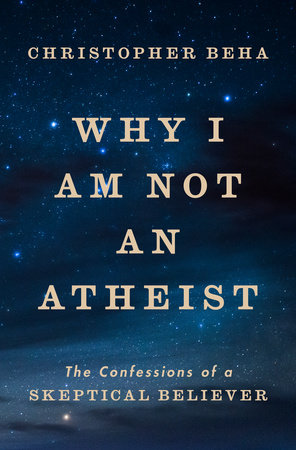
Why I Am Not an Atheist

The Confessions of a Skeptical Believer

Look inside
Hardcover
$30.00 US
6.31"W x 9.52"H x 1.37"D   | 21 oz | 12 per carton
On sale Feb 17, 2026 | 432 Pages | 9780593490471

Named One of The New Yorker’s Best Books of 2026
One of The New York Times’s anticipated books of February!

What can I know? What must I do? What may I hope?


National Book Award–longlisted author Christopher Beha recounts his struggle with these questions while making an earnest appeal for readers to seek out answers of their own


Twenty-five years ago, celebrated author (and cradle Catholic) Christopher Beha gave up on God. Helped along by a reading of Bertrand Russell’s classic text Why I Am Not a Christian, he became a committed atheist, certain that his days of belief were behind him. A youthful brush with mortality soon set Beha on a decades-long quest for meaning in a godless world.

Why I Am Not an Atheist tells the story of this search for secular answers to what Immanuel Kant called the most urgent human questions: What can I know? What must I do? What may I hope? Along the way, Beha traces the development of what he understands to be the two major atheist worldviews: scientific materialism and romantic idealism.

Beha’s passage through these rival forms of atheism leads him to the surprising conclusion that faith—particularly faith in a created order in which each human life has a meaningful part—preserves the best of both traditions while offering a complete and coherent picture of reality.

This magisterial investigation of the heights of human intellectual achievement is at once deeply personal and universal—grounded in decades of reading and thinking about the problems of suffering, mortality, and ultimate meaning. Why I Am Not an Atheist is not a polemic on behalf of belief but a record of Beha’s long engagement with the enduring human questions, and a call for readers to take up these questions for themselves.
“Beha is sincere, honest and likable on the page. Unlike a traditional pilgrimage, this book is an odyssey of the mind . . . [a] deep-dive meditation on faith and philosophy [that] shows his ambidextrous literary talents.” —Timothy Egan, The New York Times Book Review

“The greatest strength of Why I Am Not an Atheist is this humility. Beha never tries to win. He doesn’t preach or posture. Instead, he offers the rarest thing in modern writing on belief: openness without hostility, emotion without excess, and a measured voice without a hint of self-importance. The highs are the moments of insight that feel earned. The lows are the dark corridors he walks without self-pity. Beha leans on the idea that meaning grows when we face the world in its fullness, with all its doubt, difficulty, and wonder.” —John Mac Ghlionn, World

“Former Harper’s editor Beha recounts his decades-long struggle to find answers in atheism before embracing faith, and along the way tackles questions about suffering, pain, mortality and purpose.” —Publishers Weekly, Top 10 Religion and Spirituality titles for Spring 2026

“A nuanced philosophical investigation of belief and nonbelief . . . [Beha] is a smart and fluent interpreter. A lucid, thought-provoking treatise.” —Kirkus

“This powerful and poignant book lays bare Christoper Beha’s heartfelt and erudite journey from Bertrand Russell’s Why I Am Not a Christian to John Henry Newman’s legendary conversion to Catholicism, American-style! Like Dante’s Beatrice, his transformative experience of earthly love opens the windows to genuine divine presence! His literary artistry sparkles as his heart yearns for and burns with transcendence!” —Cornel West, author of Black Prophetic Fire

“What a thrilling and fascinating mind Beha has, and what a brilliant and beautiful (and sometimes very funny) book he has written with Why I Am Not an Atheist! It’s a joy to read him probing the philosophical traditions underlying our contemporary worldviews, and when the book moves into his own attempts to live out various faiths, from atheism to Roman Catholicism, the book doesn’t just offer us a brilliant portrait of sophisticated faith in the modern age but also gives us a genuinely moving narrative of spiritual longing and love.” —Phil Klay, author of Uncertain Ground

“Sometimes a matter of personal, existential urgency will impel a man to start questioning the certainties of his time. Christopher Beha found himself at such a juncture, and the fruit of it is Why I Am Not an Atheist. Beha recovers and reconstructs the steps by which Western man got himself into a jam—that is, how we ended up with a world-picture that renders important swaths of experience unintelligible. We bracket off moments of wonder and grace as unexplainable, and therefore as unreal. The result is a flattened world. But it is not the only world available. In tracing the intellectual genealogy of our superficial metaphysics, Beha clears the way for us to hear the quiet, clear call of . . . well, of something very large that addresses us.” —Matthew B. Crawford, New York Times bestselling author of Shop Class as Soulcraft

“Christopher Beha’s brilliant memoir takes to heart Saint Augustine’s injunction to ‘read your life.’ In doing so, Beha offers his own, deeply personal confrontations with religious faith, even as he examines the philosophical traditions that both underpin and undermine his attempt—anyone’s attempt, really—to respond to that simple and persistent question: How should we live? A profound and honest book that proves intelligent belief is not an oxymoron, that both faith and doubt can nurture the soul.” —Alice McDermott, author of Absolution
Christopher Beha is the former editor of Harper’s Magazine and the author of four previous books, including The Index of Self-Destructive Acts, which was nominated for the 2020 National Book Award. View titles by Christopher Beha
One

Strange Prisoners

Before offering a picture of these atheist worldviews, I need to say a bit more about what I mean by this word. There is no perfectly settled philosophical definition of the term, and the very idea that we all must inevitably occupy some worldview or another is itself controversial. In that sense, I am begging the question a bit by starting from this assumption. But I hope before I'm done to have gone some way in justifying that approach.

As I came to understand it, a proper worldview consists of three related elements: (1) a theory of the underlying nature of reality, (2) a theory of how we ought to act, and (3) a theory of knowledge. I suspect that nearly everyone alive has given some thought to the first two, the subjects of metaphysics and ethics, respectively. Fewer people spend time on the nature of knowledge. Even those familiar with the intellectual subdiscipline that deals with the subject-epistemology-may consider it one of those areas where philosophy drifts from real human concerns into academic navel-gazing.

One of the first things I learned when I started seriously reading modern philosophy, however, was the central position epistemology holds within it. This makes sense when you think about it. Before we can tackle even the most urgent subjects, we need a sound method for separating the true from the false from the senseless. We need to know what form genuine knowledge takes. This becomes clearer if we define metaphysics as knowledge about the nature of reality and ethics as knowledge about proper human action.

When we put things this way, however, a problem emerges. Surely the underlying nature of reality ought to determine what form our knowledge about reality takes? There's an inevitable circularity here: The soundness of an epistemological approach depends on the object under study, but our understanding of the object depends on our approach.

The matter gets only more complex when we turn to ethics. There's great disagreement on the epistemological issue of whether questions of value can be treated in the same terms as questions of fact. Is knowledge in this area even possible? Is there such a thing as ethical "truth"? Your answers will depend quite a bit on the metaphysical status you accord to ethical values (and to truth itself). The question of value would seem to depend on metaphysics and epistemology both.

But there's also a very real sense in which ethics must take precedence. The decision to pursue certain kinds of knowledge is a decision to act in a particular way, which is to say that it is an ethical decision. Modern sensibilities find something atavistic in the idea that some truths are just too dangerous or destructive to be pursued, but we all take for granted that knowledge of how to make a nuclear bomb, for example, should be kept out of certain hands, and many of us would have no hesitation in stating that humanity as a whole should never have acquired this knowledge in the first place. (It's insufficient to separate possession of the knowledge from use of that knowledge; the knowledge was sought out-one might say, the knowledge was created-for the purpose of using it.)

Ethics can also claim a different sort of precedence. On a very basic level, it's the one component of a worldview that we can't do without. Even the least reflective among us make countless choices every day. We may be entirely unsystematic about them, but our choices inevitably reflect a set of values. As William James notes, our sense of these values might be rather vague, but the choices themselves are necessarily concrete.

Certain worldviews make ethical demands of us that are not just impossible to achieve in practice but impossible for us to aspire to achieve. If we can't recognize a worldview's "good," we are going to reject that worldview, no matter how theoretically convincing it might be. Conversely, people will believe all sorts of things they can't otherwise justify, so long as those beliefs make life livable.

So it's difficult to identify one of these elements as the obvious foundation on which the others must rest. In a compelling worldview, the elements instead reinforce each other. When this happens, we generally don't think of ourselves as occupying a worldview at all; we are simply living in the world. From inside a coherent and livable worldview, other worldviews seem not just wrong but absurd, while criticisms of a worldview that seem devastating from the outside are viewed from within as utterly missing the point.

Yet people do sometimes consciously abandon worldviews, even compelling ones. This is precisely what I did when I gave up on God. I did not feel called from my theistic worldview to some other, better option. The walls of the house where I'd spent all my life had suddenly collapsed, and I needed a new place to live. But it's incredibly difficult to build a worldview from scratch. Whenever one attempts to lay foundations, the circularity I've been discussing shows itself. At the same time, already existing worldviews can be sometimes unwelcoming. Accepting any one of their elements seems to depend on having already accepted the others.

How does one overcome these barriers?


This process is the subject of perhaps the most famous metaphor in the history of Western philosophy. In Plato’s Republic, Socrates asks one of his interlocutors (Plato’s older brother, Glaucon) to imagine a group of people trapped all their lives in an underground cave. Far above and behind them, the cave opens out into sunlight, but the light does not reach to where they’re sitting, and they can’t turn to see it, because they are shackled in place, facing the cave’s back wall. Yet they are not in utter darkness. Between them and the opening a fire burns, and between them and the fire is a low wall, “like the screen in front of puppeteers above which they show their puppets.” People walk back and forth along the wall, carrying statues of humans, animals, and various other objects that project their shadows on the back of the cave.

"It's a strange image you're describing," Glaucon quite reasonably notes, "and strange prisoners."

To which Socrates responds: "They're like us."

In the Platonic view, those of us mired in the ever-flickering, ever-changing world of sense perception are the prisoners in the cave. What we take as reality is only a shadow show. Because our heads are locked in place, we can't even see our own true selves-enduring souls temporarily passing through these physical bodies-let alone see the real objects whose shadows appear on the wall. Philosophy exists to free people from their bonds so that they might turn away from the shadows, recognize the reality of their situation in the cave, and ultimately leave the cave entirely to stand in the sun of the eternal and unchanging Good.

You don't have to share Plato's metaphysical rejection of sense perception to recognize the power of his metaphor. The trope of the cave has had such enormous influence because it can be applied to any movement from the darkness of a mistaken view to the sunlight of the truth. A few points about its picture of conversion have resonated throughout the ages. The first and most basic is that a change in worldview is a conversion-a turning. So long as the prisoners face in this particular way, someone who describes their situation accurately will sound insane. As Socrates has it, language fitted to the shadow world can't even describe the sunlit aboveground reality. A person who wants to share the experience can only get you facing in the right direction. What's needed is not the acceptance of some expository theory but the dramatic reorientation of one's entire life.

This turning is not an especially pleasant experience. Socrates asks Glaucon to imagine someone suddenly freed of these lifelong bonds, able to stand up and face the light. Such a person, Socrates says, would be "pained and dazzled and unable to see the things whose shadows he'd seen before." He might think that he'd been torn away from reality, rather than delivered over to it.

Once his eyes adjusted, he would see the fire within the cave and the statues being carried along the wall, and he would recognize that he'd been mistaken about reality. To be truly free, however, he would still need to get out of the cave entirely, to stand in the light of the sun. Leading people to that point is a kind of violence: "If someone dragged him away from there by force, up the rough, steep path, and didn't let him go until he had dragged him into the sunlight, wouldn't he be pained and irritated at being treated that way?"

Initially, the person dragged into the glare of the sun would be unable to make out anything. He would not see the truth he'd been told to expect, and he might want to return to his old life. But this wouldn't be possible: His eyes would have adjusted enough to make them useless in the dark cave, even if they couldn't yet see in the light. For a time, at least, such a person would be dissociated from any reality at all.

Someone who returned to the cave and stumbled around in the darkness would naturally "invite ridicule" among the prisoners. It would be said that he had "returned from his upward journey with his eyesight ruined," and this would be proof that such a journey had not been worthwhile. If this person tried to lead others up where he'd been, the prisoners would "somehow get their hands on him," and they would kill him.

The Republic was written about twenty-five years after the death of Socrates, and Plato is clearly putting some retrospective prophecy into his teacher's mouth. For it did appear to most Athenians that the young men who fell under Socrates's sway came to believe strange and improbable things that ruined them for productive society, and they naturally blamed Socrates for this. He was eventually tried for corrupting the Athenian youth, found guilty, and put to death.

One of the reasons that Socrates has come to be emblematic for so many people, including many who disagree with each other about almost everything else, is that most of us feel that our lives ought to be oriented toward the truth, even if we can't agree on what that truth is. Socrates teaches us that the first step in living the truth is being freed from the falsehoods we too easily accept. So long as we are imprisoned by the false, we can't possibly turn ourselves toward the true.

When I began seriously reading philosophy, I didn't imagine that I needed help breaking my chains, turning from the shadow show. As I saw it, certain events in my life-my brother's accident, my own cancer diagnosis-had shaken me free. I'd already made the turn, and I recognized the reality of my situation. Now I wanted to escape the cave, to see things as they really were, to stand in the sun.


The next few chapters will offer an account of the rise of the primary modern-atheist answer to the question of how things really are once you’ve broken free from theism’s chains. But first I want to fill out the description of what I call “scientific materialism” with the three-part structure I’ve just introduced.

The "materialism" part entails the claim that physical matter is all that exists. I want to call this the worldview's metaphysics. As we'll see, most materialists describe their view instead as a rejection of metaphysics. In place of metaphysics, they would say, they simply have physics. But the claim that reality is entirely composed of physical matter is not itself a claim that physics can address. It's not a claim about any entity within the physical world, or even a claim about the physical world in its entirety. It is, inevitably, a metaphysical claim.

The "scientific" part describes the worldview's epistemology. Scientific materialism is empirical; it claims that knowledge about reality comes to us exclusively through sense experience. But it claims more than this. Because reality is composed of physical objects, scientific materialism tells us, our subjective sense experiences must be objectified in order to serve as a proper basis for real knowledge. This objectification occurs on the model of the physical sciences, which convert sense experiences into quantifiable data points and subject them to prediction and experimentation.

And what about the worldview's ethics? To the extent that we can have real ethical knowledge, scientific materialists insist, it must concern material reality, and it must be subject to the same process of objectification, quantification, and experimentation. The dominant scientific materialist ethic is utilitarianism, which judges acts on their objective consequences in the physical world rather than their subjective motivation, attempts to quantify these consequences, and subjects the problem of maximizing positive consequences to experiment.

The rise of scientific materialism is part of the much larger shift from the medieval Christian worldview to what we now understand as modernity. That shift-the secularization of the West, the disenchantment of the world-is among the most significant developments in human history, and entire libraries are filled with accounts of it. I'm not really equipped to tell that story, even in a radically abridged form. Instead, I am going to pull out certain threads that relate directly to the assumptions of contemporary atheism.

Even given these parameters, what follows will be radically incomplete. I want to tell the story of how I came to understand scientific materialism, what books and thinkers led me to this understanding. My primary aim is to arrive at a working picture of this worldview that one of its adherents would accept as an accurate self-description. I also hope to show that scientific materialism is, indeed, a historically conditioned worldview, rather than simply a neutral picture of "the world" to which we moderns are lucky enough to have privileged access. Having done that, I want to invite readers convinced by scientific materialism's account of reality to consider the possibility that they are the strange prisoners, turned away from the real action.

For reasons I've already explained, it doesn't seem to me productive to attack scientific materialism from the standpoint of some other worldview; instead I want to challenge it from within. I'm going to argue that scientific materialism is internally contradictory and even incoherent, that despite taking experience as the bedrock of knowledge, it fails to account for fundamental and unmistakable features of human experience. Finally, I'm going to argue that it is-not just for some but for most of us-simply unlivable.
Contents

PRELUDE:

Looking the World Frankly in the Face 1

PART I:
A Universal Science 35

1. Strange Prisoners 37

2. From Generalities to Particulars 45

3. The Bounds of Human Empire 56

4. The Restless Desire of Power 67

5. The Empty Cabinet 78

6. Passion’s Slave 91

7. Experiments of Living 103

8. Embryo Englands 121

9. Robbing the Gods 131

10. Some Hard Problems 143

11. A Satisfied Pig 163

12. How Little Has Been Done 180

INTERLUDE:
The Refuge of Art 193

PART II:

Absolute Reality 203

13. The Intellectual Love of God 205

14. Consult the Inner Light 223

15. Denying Knowledge to Make Room for Faith 238

16. The Artist Forming the Work 253

17. Man Is Something That Should Be Overcome 274

18. In the Face of Nothing 297

19. A Total Absence of Hope 314

20. Among the Ironists 327

21. The Way Out of the Bottle 345

POSTLUDE:
The Man Who Needs Infinite Help 355

About

Named One of The New Yorker’s Best Books of 2026
One of The New York Times’s anticipated books of February!

What can I know? What must I do? What may I hope?


National Book Award–longlisted author Christopher Beha recounts his struggle with these questions while making an earnest appeal for readers to seek out answers of their own


Twenty-five years ago, celebrated author (and cradle Catholic) Christopher Beha gave up on God. Helped along by a reading of Bertrand Russell’s classic text Why I Am Not a Christian, he became a committed atheist, certain that his days of belief were behind him. A youthful brush with mortality soon set Beha on a decades-long quest for meaning in a godless world.

Why I Am Not an Atheist tells the story of this search for secular answers to what Immanuel Kant called the most urgent human questions: What can I know? What must I do? What may I hope? Along the way, Beha traces the development of what he understands to be the two major atheist worldviews: scientific materialism and romantic idealism.

Beha’s passage through these rival forms of atheism leads him to the surprising conclusion that faith—particularly faith in a created order in which each human life has a meaningful part—preserves the best of both traditions while offering a complete and coherent picture of reality.

This magisterial investigation of the heights of human intellectual achievement is at once deeply personal and universal—grounded in decades of reading and thinking about the problems of suffering, mortality, and ultimate meaning. Why I Am Not an Atheist is not a polemic on behalf of belief but a record of Beha’s long engagement with the enduring human questions, and a call for readers to take up these questions for themselves.

Praise

“Beha is sincere, honest and likable on the page. Unlike a traditional pilgrimage, this book is an odyssey of the mind . . . [a] deep-dive meditation on faith and philosophy [that] shows his ambidextrous literary talents.” —Timothy Egan, The New York Times Book Review

“The greatest strength of Why I Am Not an Atheist is this humility. Beha never tries to win. He doesn’t preach or posture. Instead, he offers the rarest thing in modern writing on belief: openness without hostility, emotion without excess, and a measured voice without a hint of self-importance. The highs are the moments of insight that feel earned. The lows are the dark corridors he walks without self-pity. Beha leans on the idea that meaning grows when we face the world in its fullness, with all its doubt, difficulty, and wonder.” —John Mac Ghlionn, World

“Former Harper’s editor Beha recounts his decades-long struggle to find answers in atheism before embracing faith, and along the way tackles questions about suffering, pain, mortality and purpose.” —Publishers Weekly, Top 10 Religion and Spirituality titles for Spring 2026

“A nuanced philosophical investigation of belief and nonbelief . . . [Beha] is a smart and fluent interpreter. A lucid, thought-provoking treatise.” —Kirkus

“This powerful and poignant book lays bare Christoper Beha’s heartfelt and erudite journey from Bertrand Russell’s Why I Am Not a Christian to John Henry Newman’s legendary conversion to Catholicism, American-style! Like Dante’s Beatrice, his transformative experience of earthly love opens the windows to genuine divine presence! His literary artistry sparkles as his heart yearns for and burns with transcendence!” —Cornel West, author of Black Prophetic Fire

“What a thrilling and fascinating mind Beha has, and what a brilliant and beautiful (and sometimes very funny) book he has written with Why I Am Not an Atheist! It’s a joy to read him probing the philosophical traditions underlying our contemporary worldviews, and when the book moves into his own attempts to live out various faiths, from atheism to Roman Catholicism, the book doesn’t just offer us a brilliant portrait of sophisticated faith in the modern age but also gives us a genuinely moving narrative of spiritual longing and love.” —Phil Klay, author of Uncertain Ground

“Sometimes a matter of personal, existential urgency will impel a man to start questioning the certainties of his time. Christopher Beha found himself at such a juncture, and the fruit of it is Why I Am Not an Atheist. Beha recovers and reconstructs the steps by which Western man got himself into a jam—that is, how we ended up with a world-picture that renders important swaths of experience unintelligible. We bracket off moments of wonder and grace as unexplainable, and therefore as unreal. The result is a flattened world. But it is not the only world available. In tracing the intellectual genealogy of our superficial metaphysics, Beha clears the way for us to hear the quiet, clear call of . . . well, of something very large that addresses us.” —Matthew B. Crawford, New York Times bestselling author of Shop Class as Soulcraft

“Christopher Beha’s brilliant memoir takes to heart Saint Augustine’s injunction to ‘read your life.’ In doing so, Beha offers his own, deeply personal confrontations with religious faith, even as he examines the philosophical traditions that both underpin and undermine his attempt—anyone’s attempt, really—to respond to that simple and persistent question: How should we live? A profound and honest book that proves intelligent belief is not an oxymoron, that both faith and doubt can nurture the soul.” —Alice McDermott, author of Absolution

Author

Christopher Beha is the former editor of Harper’s Magazine and the author of four previous books, including The Index of Self-Destructive Acts, which was nominated for the 2020 National Book Award. View titles by Christopher Beha

Excerpt

One

Strange Prisoners

Before offering a picture of these atheist worldviews, I need to say a bit more about what I mean by this word. There is no perfectly settled philosophical definition of the term, and the very idea that we all must inevitably occupy some worldview or another is itself controversial. In that sense, I am begging the question a bit by starting from this assumption. But I hope before I'm done to have gone some way in justifying that approach.

As I came to understand it, a proper worldview consists of three related elements: (1) a theory of the underlying nature of reality, (2) a theory of how we ought to act, and (3) a theory of knowledge. I suspect that nearly everyone alive has given some thought to the first two, the subjects of metaphysics and ethics, respectively. Fewer people spend time on the nature of knowledge. Even those familiar with the intellectual subdiscipline that deals with the subject-epistemology-may consider it one of those areas where philosophy drifts from real human concerns into academic navel-gazing.

One of the first things I learned when I started seriously reading modern philosophy, however, was the central position epistemology holds within it. This makes sense when you think about it. Before we can tackle even the most urgent subjects, we need a sound method for separating the true from the false from the senseless. We need to know what form genuine knowledge takes. This becomes clearer if we define metaphysics as knowledge about the nature of reality and ethics as knowledge about proper human action.

When we put things this way, however, a problem emerges. Surely the underlying nature of reality ought to determine what form our knowledge about reality takes? There's an inevitable circularity here: The soundness of an epistemological approach depends on the object under study, but our understanding of the object depends on our approach.

The matter gets only more complex when we turn to ethics. There's great disagreement on the epistemological issue of whether questions of value can be treated in the same terms as questions of fact. Is knowledge in this area even possible? Is there such a thing as ethical "truth"? Your answers will depend quite a bit on the metaphysical status you accord to ethical values (and to truth itself). The question of value would seem to depend on metaphysics and epistemology both.

But there's also a very real sense in which ethics must take precedence. The decision to pursue certain kinds of knowledge is a decision to act in a particular way, which is to say that it is an ethical decision. Modern sensibilities find something atavistic in the idea that some truths are just too dangerous or destructive to be pursued, but we all take for granted that knowledge of how to make a nuclear bomb, for example, should be kept out of certain hands, and many of us would have no hesitation in stating that humanity as a whole should never have acquired this knowledge in the first place. (It's insufficient to separate possession of the knowledge from use of that knowledge; the knowledge was sought out-one might say, the knowledge was created-for the purpose of using it.)

Ethics can also claim a different sort of precedence. On a very basic level, it's the one component of a worldview that we can't do without. Even the least reflective among us make countless choices every day. We may be entirely unsystematic about them, but our choices inevitably reflect a set of values. As William James notes, our sense of these values might be rather vague, but the choices themselves are necessarily concrete.

Certain worldviews make ethical demands of us that are not just impossible to achieve in practice but impossible for us to aspire to achieve. If we can't recognize a worldview's "good," we are going to reject that worldview, no matter how theoretically convincing it might be. Conversely, people will believe all sorts of things they can't otherwise justify, so long as those beliefs make life livable.

So it's difficult to identify one of these elements as the obvious foundation on which the others must rest. In a compelling worldview, the elements instead reinforce each other. When this happens, we generally don't think of ourselves as occupying a worldview at all; we are simply living in the world. From inside a coherent and livable worldview, other worldviews seem not just wrong but absurd, while criticisms of a worldview that seem devastating from the outside are viewed from within as utterly missing the point.

Yet people do sometimes consciously abandon worldviews, even compelling ones. This is precisely what I did when I gave up on God. I did not feel called from my theistic worldview to some other, better option. The walls of the house where I'd spent all my life had suddenly collapsed, and I needed a new place to live. But it's incredibly difficult to build a worldview from scratch. Whenever one attempts to lay foundations, the circularity I've been discussing shows itself. At the same time, already existing worldviews can be sometimes unwelcoming. Accepting any one of their elements seems to depend on having already accepted the others.

How does one overcome these barriers?


This process is the subject of perhaps the most famous metaphor in the history of Western philosophy. In Plato’s Republic, Socrates asks one of his interlocutors (Plato’s older brother, Glaucon) to imagine a group of people trapped all their lives in an underground cave. Far above and behind them, the cave opens out into sunlight, but the light does not reach to where they’re sitting, and they can’t turn to see it, because they are shackled in place, facing the cave’s back wall. Yet they are not in utter darkness. Between them and the opening a fire burns, and between them and the fire is a low wall, “like the screen in front of puppeteers above which they show their puppets.” People walk back and forth along the wall, carrying statues of humans, animals, and various other objects that project their shadows on the back of the cave.

"It's a strange image you're describing," Glaucon quite reasonably notes, "and strange prisoners."

To which Socrates responds: "They're like us."

In the Platonic view, those of us mired in the ever-flickering, ever-changing world of sense perception are the prisoners in the cave. What we take as reality is only a shadow show. Because our heads are locked in place, we can't even see our own true selves-enduring souls temporarily passing through these physical bodies-let alone see the real objects whose shadows appear on the wall. Philosophy exists to free people from their bonds so that they might turn away from the shadows, recognize the reality of their situation in the cave, and ultimately leave the cave entirely to stand in the sun of the eternal and unchanging Good.

You don't have to share Plato's metaphysical rejection of sense perception to recognize the power of his metaphor. The trope of the cave has had such enormous influence because it can be applied to any movement from the darkness of a mistaken view to the sunlight of the truth. A few points about its picture of conversion have resonated throughout the ages. The first and most basic is that a change in worldview is a conversion-a turning. So long as the prisoners face in this particular way, someone who describes their situation accurately will sound insane. As Socrates has it, language fitted to the shadow world can't even describe the sunlit aboveground reality. A person who wants to share the experience can only get you facing in the right direction. What's needed is not the acceptance of some expository theory but the dramatic reorientation of one's entire life.

This turning is not an especially pleasant experience. Socrates asks Glaucon to imagine someone suddenly freed of these lifelong bonds, able to stand up and face the light. Such a person, Socrates says, would be "pained and dazzled and unable to see the things whose shadows he'd seen before." He might think that he'd been torn away from reality, rather than delivered over to it.

Once his eyes adjusted, he would see the fire within the cave and the statues being carried along the wall, and he would recognize that he'd been mistaken about reality. To be truly free, however, he would still need to get out of the cave entirely, to stand in the light of the sun. Leading people to that point is a kind of violence: "If someone dragged him away from there by force, up the rough, steep path, and didn't let him go until he had dragged him into the sunlight, wouldn't he be pained and irritated at being treated that way?"

Initially, the person dragged into the glare of the sun would be unable to make out anything. He would not see the truth he'd been told to expect, and he might want to return to his old life. But this wouldn't be possible: His eyes would have adjusted enough to make them useless in the dark cave, even if they couldn't yet see in the light. For a time, at least, such a person would be dissociated from any reality at all.

Someone who returned to the cave and stumbled around in the darkness would naturally "invite ridicule" among the prisoners. It would be said that he had "returned from his upward journey with his eyesight ruined," and this would be proof that such a journey had not been worthwhile. If this person tried to lead others up where he'd been, the prisoners would "somehow get their hands on him," and they would kill him.

The Republic was written about twenty-five years after the death of Socrates, and Plato is clearly putting some retrospective prophecy into his teacher's mouth. For it did appear to most Athenians that the young men who fell under Socrates's sway came to believe strange and improbable things that ruined them for productive society, and they naturally blamed Socrates for this. He was eventually tried for corrupting the Athenian youth, found guilty, and put to death.

One of the reasons that Socrates has come to be emblematic for so many people, including many who disagree with each other about almost everything else, is that most of us feel that our lives ought to be oriented toward the truth, even if we can't agree on what that truth is. Socrates teaches us that the first step in living the truth is being freed from the falsehoods we too easily accept. So long as we are imprisoned by the false, we can't possibly turn ourselves toward the true.

When I began seriously reading philosophy, I didn't imagine that I needed help breaking my chains, turning from the shadow show. As I saw it, certain events in my life-my brother's accident, my own cancer diagnosis-had shaken me free. I'd already made the turn, and I recognized the reality of my situation. Now I wanted to escape the cave, to see things as they really were, to stand in the sun.


The next few chapters will offer an account of the rise of the primary modern-atheist answer to the question of how things really are once you’ve broken free from theism’s chains. But first I want to fill out the description of what I call “scientific materialism” with the three-part structure I’ve just introduced.

The "materialism" part entails the claim that physical matter is all that exists. I want to call this the worldview's metaphysics. As we'll see, most materialists describe their view instead as a rejection of metaphysics. In place of metaphysics, they would say, they simply have physics. But the claim that reality is entirely composed of physical matter is not itself a claim that physics can address. It's not a claim about any entity within the physical world, or even a claim about the physical world in its entirety. It is, inevitably, a metaphysical claim.

The "scientific" part describes the worldview's epistemology. Scientific materialism is empirical; it claims that knowledge about reality comes to us exclusively through sense experience. But it claims more than this. Because reality is composed of physical objects, scientific materialism tells us, our subjective sense experiences must be objectified in order to serve as a proper basis for real knowledge. This objectification occurs on the model of the physical sciences, which convert sense experiences into quantifiable data points and subject them to prediction and experimentation.

And what about the worldview's ethics? To the extent that we can have real ethical knowledge, scientific materialists insist, it must concern material reality, and it must be subject to the same process of objectification, quantification, and experimentation. The dominant scientific materialist ethic is utilitarianism, which judges acts on their objective consequences in the physical world rather than their subjective motivation, attempts to quantify these consequences, and subjects the problem of maximizing positive consequences to experiment.

The rise of scientific materialism is part of the much larger shift from the medieval Christian worldview to what we now understand as modernity. That shift-the secularization of the West, the disenchantment of the world-is among the most significant developments in human history, and entire libraries are filled with accounts of it. I'm not really equipped to tell that story, even in a radically abridged form. Instead, I am going to pull out certain threads that relate directly to the assumptions of contemporary atheism.

Even given these parameters, what follows will be radically incomplete. I want to tell the story of how I came to understand scientific materialism, what books and thinkers led me to this understanding. My primary aim is to arrive at a working picture of this worldview that one of its adherents would accept as an accurate self-description. I also hope to show that scientific materialism is, indeed, a historically conditioned worldview, rather than simply a neutral picture of "the world" to which we moderns are lucky enough to have privileged access. Having done that, I want to invite readers convinced by scientific materialism's account of reality to consider the possibility that they are the strange prisoners, turned away from the real action.

For reasons I've already explained, it doesn't seem to me productive to attack scientific materialism from the standpoint of some other worldview; instead I want to challenge it from within. I'm going to argue that scientific materialism is internally contradictory and even incoherent, that despite taking experience as the bedrock of knowledge, it fails to account for fundamental and unmistakable features of human experience. Finally, I'm going to argue that it is-not just for some but for most of us-simply unlivable.

Table of Contents

Contents

PRELUDE:

Looking the World Frankly in the Face 1

PART I:
A Universal Science 35

1. Strange Prisoners 37

2. From Generalities to Particulars 45

3. The Bounds of Human Empire 56

4. The Restless Desire of Power 67

5. The Empty Cabinet 78

6. Passion’s Slave 91

7. Experiments of Living 103

8. Embryo Englands 121

9. Robbing the Gods 131

10. Some Hard Problems 143

11. A Satisfied Pig 163

12. How Little Has Been Done 180

INTERLUDE:
The Refuge of Art 193

PART II:

Absolute Reality 203

13. The Intellectual Love of God 205

14. Consult the Inner Light 223

15. Denying Knowledge to Make Room for Faith 238

16. The Artist Forming the Work 253

17. Man Is Something That Should Be Overcome 274

18. In the Face of Nothing 297

19. A Total Absence of Hope 314

20. Among the Ironists 327

21. The Way Out of the Bottle 345

POSTLUDE:
The Man Who Needs Infinite Help 355