Close Modal

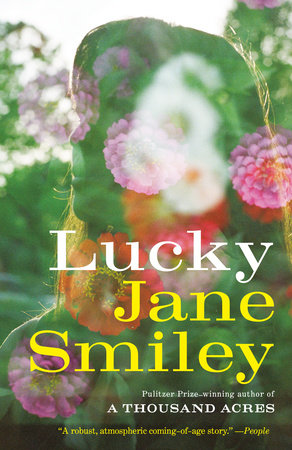
Lucky

A Novel

Look inside
Paperback
$18.00 US
5.18"W x 7.97"H x 0.79"D   | 9 oz | 24 per carton
On sale Mar 18, 2025 | 384 Pages | 9780593468302

See Additional Formats
From the best-selling, Pulitzer Prize–winning writer, a soaring, soulful novel about a folk musician who rises to fame across our changing times

Before Jodie Rattler became a star, she was a girl growing up in St. Louis. One day in 1955, when she was just six years old, her uncle Drew took her to the racetrack, where she got lucky—and that roll of two-dollar bills she won has never since left her side. Jodie thrived in the warmth of her extended family, and then—through a combination of hardwork and serendipity—she started a singing career, which catapulted her from St. Louis to New York City, from the English countryside to the tropical beaches of St. Thomas, from Cleveland to Los Angeles, and back again. Jodie comes of age in recording studios, backstage, and on tour, and she tries to hold her own in the wake of Janis Joplin, Joan Baez, Judy Collins, and Joni Mitchell. Yet it feels like something is missing. Could it be true love? Or is that not actually what Jodie is looking for?

Full of atmosphere, shot through with longing and exuberance, romance and rock 'n' roll, Lucky is a story of chance and grit and the glitter of real talent, a colorful portrait of one woman's journey in search of herself.
Lucky is framed as a rock’n’roll novel, but it’s a tricky and surprising one. Smiley seems determined to upend the conventions of the genre . . . What emerges instead in Lucky is a simple yet provocative idea—what if a woman protagonist were allowed to live independently on her own terms, not tied down by typically novelistic men or the bad blood that infects family life? . . . The novel’s title, upbeat on the surface, is darkened by the notion of how rare such a character is . . . Life and death flow in and out, and Smiley observes it clearly but empathetically. (Not for nothing is Dickens among her favorite writers.) . . . There’s no signal that Lucky is Smiley’s final book, but if it were, it would make for an admirable summing up—the story of a well-traveled, keen-eyed writer who’s spent decades making sense of the world in words, and taking pleasure in it for its own sake. A lucky way to make a living.” —Mark Athitakis, Los Angeles Times
 
“A robust, atmospheric coming-of-age story.” People

“I suspect Lucky will be polarizing, which may well make it the book club pick of the year.” —Maren Longbella, Minneapolis Star Tribune
 
“A delightful trip through the 20th century’s greatest hits . . . This is life as a lesson in how to live, for which you must write your own instructions as you go along . . . Luckily, this is Jane Smiley, so the details, the insights, the songs—those she writes, and the dizzying assortment she mentions—are entertaining.” —Ellen Akins, Washington Post

“Spellbinding . . . Smiley neatly reverses the usual story of a 1970s singer [and then] orchestrates a seismic twist of staggering magnitude . . . Every novel by Smiley is a surprise.” —Donna Seaman, Booklist (starred)
© Derek Shapton
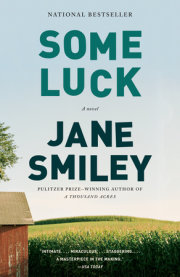
JANE SMILEY is the author of numerous novels, including A Thousand Acres, which was awarded the Pulitzer Prize, and the Last Hundred Years Trilogy: Some LuckEarly Warning, and Golden Age. She is the author as well of several works of nonfiction and books for young adults. A member of the American Academy of Arts and Letters, she has also received the PEN Center USA Lifetime Achievement Award for Literature. She lives in Northern California. View titles by Jane Smiley
1

When I was six and my uncle was twenty-four, he did something that you can’t do anymore—he took me to a racetrack across the river called Cahokia Downs. That was where I saw horses for the first time—it was 1955, we didn’t have a television yet, so I never watched Roy Rogers or My Friend Flicka. I had no idea why we were there or what we were supposed to do, but Uncle Drew held my hand, bought me an ice cream cone, walked around when the horses were being mounted, and shouted when they were running. After we had been there awhile, he handed me a piece of paper and a pencil and told me to circle some numbers. I circled 4, then 2, then 8. He then handed the paper to a man behind a window along with six dollars (he later told me it was his last six dollars, but I never believed that). He got another piece of paper back, and we went to our seats. We sat quietly, jumped up and down for the race, and then he grabbed my hand and took me back to the window. He handed in the piece of paper, and the man counted out his winnings—$5,986, all in twenties and two-dollar bills. My uncle was grinning from ear to ear. We walked around for a long time, then we went to the parking lot. Just before we got into his car, he squatted down and put his hands on my shoulders. He said, “Don’t tell anyone we’ve been here, or where you got this money. Hide it, save it, and buy something nice someday.” He put a folded green pile in my hand. I stuck it in my pocket, and when we got home just before dinner, I went to my room and shoved it under the mattress. A month later, I remembered it, pulled it out, and counted it. It was forty-three two-dollar bills, the $86 that I later realized would tell everyone where he had been and how he had gotten the money. The reason I waited so long was that the day after we went to the races, on Sunday afternoon, my uncle walked in the front door with a puppy, a cocker spaniel. He said it was a present for me, because he knew I wanted a dog, and I did.

Mom and I had no idea how to bring up a puppy. She was a blond cocker spaniel, and I named her Dizzy, maybe a misspelling of “Disney,” since Lady and the Tramp was the reason I’d wanted a cocker. Mom only took me to see it one time, but it was as though certain pictures were engraved into my brain: the moon shining over puddles in the road, the spaghetti scene, the shadows, trees looming in the background. Once we had my very own “Lady” in our house, Mom set up a gate that kept her in the kitchen most of the time, and spread paper all over the floor to “paper-train” her. It was my job to feed her—Hill’s Horse Meat, which we bought in cans, and which stank so much when I opened the can that I could barely stand it. Fortunately for me, since it was my job to make sure Dizzy went outside and did her business, our house on Skinker had a yard—the four houses between ours and Clayton Road had almost no yards. Dizzy would race out the door and tear around in the grass, often so happy that she would forget to do her business and then come back inside and do it in the kitchen. She wanted to get out of the house and explore the neighborhood. The scariest thing she did was run across Skinker into the park. She never once came back when I was looking for her, though a couple of times, I sat down on the hillside that abutted the park, across from an apartment building called the Wiltshire, and she wandered past and decided to come over to me. I handed her the Milk-Bone and snapped on the leash, but that didn’t convince her to like me.

Even when I was six, I knew we were lucky, because I heard my relatives talk about where they had lived before. My grandfather was from Akron and lived there much of his life. Grandmother was born and raised in Galesburg, Illinois. Uncle Hank, who was two years younger than Mom, moved to Houston after the war, but he was the only one, and everyone felt sorry for him. Aunt Louise, who married Uncle Drew about six months after he won the money, grew up in Joplin. Everyone in the family except Uncle Hank had come to live in St. Louis around the time I was born, and every one of them acted like they had been stranded and then rescued and brought to St. Louis to recover. For my grandfather and my uncle Drew, the medicine of choice was the Cardinals, and the miracle-working healer was Stan Musial. For Aunt Louise, it was the houses, the neighborhoods, the lawns, the gardens, the parks, the trees. She loved to have me walk along when she pushed my cousin Allison, who was born when I was eight, up and down the streets. I later found out that she knew about the money Uncle Drew had won, and what she was doing when she was taking walks was thinking about where to live and what to buy. They eventually picked a house, one much more beautiful than the one my grandparents lived in.

My mother, maybe like Uncle Hank, wanted to get out. Before we lived in St. Louis, we lived with my father in New York, in an apartment on East Tenth Street across from Tompkins Square Park. She told me about local markets, about pushing me around the park, about how I learned to walk one day and the next day ran across Tenth Street because I saw a cat on the other side. One car was coming; it screeched to a halt, and the driver yelled at my mother, but I did approach the cat, the cat did lie down, roll over, and allow me to scratch its belly.

The problem was that my father was married to someone else, and his family prevailed upon him to go back to his wife. He lived on the Upper East Side. My mother thought she was going to make it on Broadway; she got bit parts in musicals, with a few lines and a chance to sashay across the stage, but there was something about her voice—perhaps her St. Louis accent or our characteristic family squawking sound—that stood in her way. She once said, laughing, that she got a fairly large part in a successful musical—but when she stood downstage, saying her lines, she saw people in the front rows putting their fingers in their ears. That was her last big part, though for a couple more years, she did dance numbers, kicked up her heels, showed off her stride. Once back in St. Louis, she worked for the Muny Opera, first onstage, then in the office, and later for Kiel Auditorium. She got to the point where she didn’t envy the actresses and the musicians, but it took a long time. Even so, that place on East Tenth Street remained her dream house—the paneling, the flooring, the tall windows, the proximity to the Village, to Saks and Bergdorf’s, the subway, which she preferred to cars. After she came back to St. Louis, she dated a few men, but in the end they didn’t interest her, so we continued to live where I wanted to live, in a golden brick house on Skinker, across from the park, walking distance from the zoo and the museums, just down from the Hi-Pointe Theatre.

I knew what my father looked like, because my mother had a small photograph of him that I found in a drawer in her room. He looked like me. When I was in New York in 1969, I saw him on the street, followed him into Zabar’s, stood behind him at the counter, bumped elbows with him. He glanced at me, half-frightened, half-angry, and moved away. I ordered the same sandwich he did—pastrami on rye, with a touch of mustard. It was delicious. Perhaps I saw his wife, too. I also discovered (because he had an unusual name, my name—Rattler) where his three children went to school. When yearbooks went online, I managed to look at their yearbook photos. Of all of us, I am the only one who looked like him.

Our house was fairly large, so Aunt Lily and Cousin Brucie moved in when they “came back from Springfield as quick as she could,” and a few friends came and went as their circumstances rose and fell. Did Mom like or dislike having her sister or a friend in the spare bedroom, using the single bathroom, cooking what they liked in the kitchen? There was no way of knowing. She accepted. That’s what she did. My grandparents lived on a street in Webster Groves, five doors up from the railroad embankment. There was something interesting in every direction—Deer Creek, the candy cabinet at the grocery store, the school playground, a small park, the railroad tracks themselves, other kids running here, there, and everywhere.

Uncle Drew and Aunt Louise moved into a “plantation style” house with a wraparound front porch, lots of trees, and a sandbox in the backyard, on Argonne, in Kirkwood. It had a bigger lawn, more trees and flowers, and that neighborhood was a wonderful display of different types of houses. Aunt Louise would point at them, say “Colonial,” “Mission style,” “Craftsman.” On Argonne a huge, elegant house with a hedge might be across the street from a tiny one-floor dump. My friend Leslie lived in one of those. Leslie said that the house next door to theirs was haunted, and I believed her, since it was dark brown and surrounded by trees, and the old woman who lived there would shoo us off her lawn even if we weren’t actually on her lawn.

Leslie used every visit I made to Uncle Drew and Aunt Louise as an opportunity to come over and play, because she loved their house. She told me that someday she would own this very house, that she would do anything to have it. When I invited her to come to the house that I loved, she would sniff and say, “This is nice.” But the main thing I loved about all three houses was the chance to walk walk walk around the neighborhoods, smell the gardens, look at the trees, stare at the other houses.

I was also quite fond of my cousin Brucie. Brucie was older than I was, even though Aunt Lily was younger than Mom. Aunt Lily had a much harder time finding a job when she came to St. Louis than Mom did, because she couldn’t help talking back. Eventually, she did manage to hold down a job at a restaurant across from Bettendorf’s. She worked as a server, and she developed her habit of talking back into good-natured joking: “I’ll have the roast beef and the baked potato.” “Really? You might regret that.” Big grin. Or, “Pardon me, you forgot to order the Baked Alaska I told them to save for you.” Easygoing laugh. Aunt Lily and Brucie eventually moved into a house that was on St. John. Aunt Lily would say, “AT LEAST there are three bedrooms!” Or, “AT LEAST there are a lot of children around.” Compared to Uncle Drew’s house, or Mom’s, or even my grandparents’ house, the St. John house was a shack, but, as always in St. Louis, it was surrounded by new houses, old houses, nice houses, wrecks.

Did Mom have a right to Mr. Rattler’s name? I am sure not. But in order to move back to St. Louis and avoid scandalizing everyone, she could not share my grandparents’ name, Roberts. She made sure that people she didn’t know very well called her “Mrs. Rattler” or “May Rattler,” even though Grandmother and Grandfather still called her “Martha Roberts,” her given name. It was Brucie who told me what a rattler was—at one point when we were staying overnight with my grandparents, he took me down to Deer Creek and led me through the woods, telling me he was going to find one, just to show me. Luckily, he didn’t find one (though he said that the rattle would be so loud that we could hear it from ten feet away). “Rattlesnake” was the first thing I looked up in the fall of fourth grade, when the man who sold World Book encyclopedias stopped by and talked Mom into buying a set, just for me. He helped her install them on the lowest shelf of my bookcase, across from my bed. Each volume was so heavy that instead of reading it in bed, as I did the Hardy Boys and the Boxcar Children, I laid it on the rug, crossed my legs, and leaned over it, turning the pages one by one. After rattlesnakes, I looked up horses, cats, dogs, rabbits, parakeets, and each entry led me to others nearby, like hell, Congo, Dostoevsky, railroad, opera.

Every spring, Uncle Drew took me to the Father/Daughter Dinner at school. Mom dressed me up, and of course Uncle Drew was perfectly turned out. Because it was in the spring, the sunlight would be just beginning to fade as we walked to the school, always the long way there and the short way home—over to Clayton, then down Alamo Alley to De Mun, then along the sidewalk past the green grass and under the flowering trees to Northwood. Up Northwood to the school, Uncle Drew telling me about trees or bricks. We ate our dinner, listened to the principal give his talk, then walked home in the dark, past the apartment buildings on Skinker, a walk I was used to, since that’s how I went to school in the mornings. No one at the dinner looked at us askance, wondering where Mr. Rattler was. The ones who recognized Uncle Drew nodded to him, and the ones who didn’t admired his suit, and also his alligator slip-ons.

When I visited Aunt Lily and Brucie on St. John, Brucie and I always went across the street to a much newer house, where we played with the Johnson boys, Fred and Dan. They had the best trees to climb, and we climbed them over and over—Brucie always got almost to the top and I always stayed two or three limbs from the bottom. Brucie often threatened to launch himself out of the tree, but he never did. Fred, who was my age, maybe eight at the time, did fall out of the tree, breaking his arm. Once it healed, we were all over the tree again. What I learned from the St. John neighborhood was that some people were luckier than others. Some of the kids were Black, some were white, some had fathers, some didn’t, some ran faster than others, some read more books, some excelled at slapjack, some never won a penny.

About

From the best-selling, Pulitzer Prize–winning writer, a soaring, soulful novel about a folk musician who rises to fame across our changing times

Before Jodie Rattler became a star, she was a girl growing up in St. Louis. One day in 1955, when she was just six years old, her uncle Drew took her to the racetrack, where she got lucky—and that roll of two-dollar bills she won has never since left her side. Jodie thrived in the warmth of her extended family, and then—through a combination of hardwork and serendipity—she started a singing career, which catapulted her from St. Louis to New York City, from the English countryside to the tropical beaches of St. Thomas, from Cleveland to Los Angeles, and back again. Jodie comes of age in recording studios, backstage, and on tour, and she tries to hold her own in the wake of Janis Joplin, Joan Baez, Judy Collins, and Joni Mitchell. Yet it feels like something is missing. Could it be true love? Or is that not actually what Jodie is looking for?

Full of atmosphere, shot through with longing and exuberance, romance and rock 'n' roll, Lucky is a story of chance and grit and the glitter of real talent, a colorful portrait of one woman's journey in search of herself.

Praise

Lucky is framed as a rock’n’roll novel, but it’s a tricky and surprising one. Smiley seems determined to upend the conventions of the genre . . . What emerges instead in Lucky is a simple yet provocative idea—what if a woman protagonist were allowed to live independently on her own terms, not tied down by typically novelistic men or the bad blood that infects family life? . . . The novel’s title, upbeat on the surface, is darkened by the notion of how rare such a character is . . . Life and death flow in and out, and Smiley observes it clearly but empathetically. (Not for nothing is Dickens among her favorite writers.) . . . There’s no signal that Lucky is Smiley’s final book, but if it were, it would make for an admirable summing up—the story of a well-traveled, keen-eyed writer who’s spent decades making sense of the world in words, and taking pleasure in it for its own sake. A lucky way to make a living.” —Mark Athitakis, Los Angeles Times
 
“A robust, atmospheric coming-of-age story.” People

“I suspect Lucky will be polarizing, which may well make it the book club pick of the year.” —Maren Longbella, Minneapolis Star Tribune
 
“A delightful trip through the 20th century’s greatest hits . . . This is life as a lesson in how to live, for which you must write your own instructions as you go along . . . Luckily, this is Jane Smiley, so the details, the insights, the songs—those she writes, and the dizzying assortment she mentions—are entertaining.” —Ellen Akins, Washington Post

“Spellbinding . . . Smiley neatly reverses the usual story of a 1970s singer [and then] orchestrates a seismic twist of staggering magnitude . . . Every novel by Smiley is a surprise.” —Donna Seaman, Booklist (starred)

Author

© Derek Shapton
JANE SMILEY is the author of numerous novels, including A Thousand Acres, which was awarded the Pulitzer Prize, and the Last Hundred Years Trilogy: Some LuckEarly Warning, and Golden Age. She is the author as well of several works of nonfiction and books for young adults. A member of the American Academy of Arts and Letters, she has also received the PEN Center USA Lifetime Achievement Award for Literature. She lives in Northern California. View titles by Jane Smiley

Excerpt

1

When I was six and my uncle was twenty-four, he did something that you can’t do anymore—he took me to a racetrack across the river called Cahokia Downs. That was where I saw horses for the first time—it was 1955, we didn’t have a television yet, so I never watched Roy Rogers or My Friend Flicka. I had no idea why we were there or what we were supposed to do, but Uncle Drew held my hand, bought me an ice cream cone, walked around when the horses were being mounted, and shouted when they were running. After we had been there awhile, he handed me a piece of paper and a pencil and told me to circle some numbers. I circled 4, then 2, then 8. He then handed the paper to a man behind a window along with six dollars (he later told me it was his last six dollars, but I never believed that). He got another piece of paper back, and we went to our seats. We sat quietly, jumped up and down for the race, and then he grabbed my hand and took me back to the window. He handed in the piece of paper, and the man counted out his winnings—$5,986, all in twenties and two-dollar bills. My uncle was grinning from ear to ear. We walked around for a long time, then we went to the parking lot. Just before we got into his car, he squatted down and put his hands on my shoulders. He said, “Don’t tell anyone we’ve been here, or where you got this money. Hide it, save it, and buy something nice someday.” He put a folded green pile in my hand. I stuck it in my pocket, and when we got home just before dinner, I went to my room and shoved it under the mattress. A month later, I remembered it, pulled it out, and counted it. It was forty-three two-dollar bills, the $86 that I later realized would tell everyone where he had been and how he had gotten the money. The reason I waited so long was that the day after we went to the races, on Sunday afternoon, my uncle walked in the front door with a puppy, a cocker spaniel. He said it was a present for me, because he knew I wanted a dog, and I did.

Mom and I had no idea how to bring up a puppy. She was a blond cocker spaniel, and I named her Dizzy, maybe a misspelling of “Disney,” since Lady and the Tramp was the reason I’d wanted a cocker. Mom only took me to see it one time, but it was as though certain pictures were engraved into my brain: the moon shining over puddles in the road, the spaghetti scene, the shadows, trees looming in the background. Once we had my very own “Lady” in our house, Mom set up a gate that kept her in the kitchen most of the time, and spread paper all over the floor to “paper-train” her. It was my job to feed her—Hill’s Horse Meat, which we bought in cans, and which stank so much when I opened the can that I could barely stand it. Fortunately for me, since it was my job to make sure Dizzy went outside and did her business, our house on Skinker had a yard—the four houses between ours and Clayton Road had almost no yards. Dizzy would race out the door and tear around in the grass, often so happy that she would forget to do her business and then come back inside and do it in the kitchen. She wanted to get out of the house and explore the neighborhood. The scariest thing she did was run across Skinker into the park. She never once came back when I was looking for her, though a couple of times, I sat down on the hillside that abutted the park, across from an apartment building called the Wiltshire, and she wandered past and decided to come over to me. I handed her the Milk-Bone and snapped on the leash, but that didn’t convince her to like me.

Even when I was six, I knew we were lucky, because I heard my relatives talk about where they had lived before. My grandfather was from Akron and lived there much of his life. Grandmother was born and raised in Galesburg, Illinois. Uncle Hank, who was two years younger than Mom, moved to Houston after the war, but he was the only one, and everyone felt sorry for him. Aunt Louise, who married Uncle Drew about six months after he won the money, grew up in Joplin. Everyone in the family except Uncle Hank had come to live in St. Louis around the time I was born, and every one of them acted like they had been stranded and then rescued and brought to St. Louis to recover. For my grandfather and my uncle Drew, the medicine of choice was the Cardinals, and the miracle-working healer was Stan Musial. For Aunt Louise, it was the houses, the neighborhoods, the lawns, the gardens, the parks, the trees. She loved to have me walk along when she pushed my cousin Allison, who was born when I was eight, up and down the streets. I later found out that she knew about the money Uncle Drew had won, and what she was doing when she was taking walks was thinking about where to live and what to buy. They eventually picked a house, one much more beautiful than the one my grandparents lived in.

My mother, maybe like Uncle Hank, wanted to get out. Before we lived in St. Louis, we lived with my father in New York, in an apartment on East Tenth Street across from Tompkins Square Park. She told me about local markets, about pushing me around the park, about how I learned to walk one day and the next day ran across Tenth Street because I saw a cat on the other side. One car was coming; it screeched to a halt, and the driver yelled at my mother, but I did approach the cat, the cat did lie down, roll over, and allow me to scratch its belly.

The problem was that my father was married to someone else, and his family prevailed upon him to go back to his wife. He lived on the Upper East Side. My mother thought she was going to make it on Broadway; she got bit parts in musicals, with a few lines and a chance to sashay across the stage, but there was something about her voice—perhaps her St. Louis accent or our characteristic family squawking sound—that stood in her way. She once said, laughing, that she got a fairly large part in a successful musical—but when she stood downstage, saying her lines, she saw people in the front rows putting their fingers in their ears. That was her last big part, though for a couple more years, she did dance numbers, kicked up her heels, showed off her stride. Once back in St. Louis, she worked for the Muny Opera, first onstage, then in the office, and later for Kiel Auditorium. She got to the point where she didn’t envy the actresses and the musicians, but it took a long time. Even so, that place on East Tenth Street remained her dream house—the paneling, the flooring, the tall windows, the proximity to the Village, to Saks and Bergdorf’s, the subway, which she preferred to cars. After she came back to St. Louis, she dated a few men, but in the end they didn’t interest her, so we continued to live where I wanted to live, in a golden brick house on Skinker, across from the park, walking distance from the zoo and the museums, just down from the Hi-Pointe Theatre.

I knew what my father looked like, because my mother had a small photograph of him that I found in a drawer in her room. He looked like me. When I was in New York in 1969, I saw him on the street, followed him into Zabar’s, stood behind him at the counter, bumped elbows with him. He glanced at me, half-frightened, half-angry, and moved away. I ordered the same sandwich he did—pastrami on rye, with a touch of mustard. It was delicious. Perhaps I saw his wife, too. I also discovered (because he had an unusual name, my name—Rattler) where his three children went to school. When yearbooks went online, I managed to look at their yearbook photos. Of all of us, I am the only one who looked like him.

Our house was fairly large, so Aunt Lily and Cousin Brucie moved in when they “came back from Springfield as quick as she could,” and a few friends came and went as their circumstances rose and fell. Did Mom like or dislike having her sister or a friend in the spare bedroom, using the single bathroom, cooking what they liked in the kitchen? There was no way of knowing. She accepted. That’s what she did. My grandparents lived on a street in Webster Groves, five doors up from the railroad embankment. There was something interesting in every direction—Deer Creek, the candy cabinet at the grocery store, the school playground, a small park, the railroad tracks themselves, other kids running here, there, and everywhere.

Uncle Drew and Aunt Louise moved into a “plantation style” house with a wraparound front porch, lots of trees, and a sandbox in the backyard, on Argonne, in Kirkwood. It had a bigger lawn, more trees and flowers, and that neighborhood was a wonderful display of different types of houses. Aunt Louise would point at them, say “Colonial,” “Mission style,” “Craftsman.” On Argonne a huge, elegant house with a hedge might be across the street from a tiny one-floor dump. My friend Leslie lived in one of those. Leslie said that the house next door to theirs was haunted, and I believed her, since it was dark brown and surrounded by trees, and the old woman who lived there would shoo us off her lawn even if we weren’t actually on her lawn.

Leslie used every visit I made to Uncle Drew and Aunt Louise as an opportunity to come over and play, because she loved their house. She told me that someday she would own this very house, that she would do anything to have it. When I invited her to come to the house that I loved, she would sniff and say, “This is nice.” But the main thing I loved about all three houses was the chance to walk walk walk around the neighborhoods, smell the gardens, look at the trees, stare at the other houses.

I was also quite fond of my cousin Brucie. Brucie was older than I was, even though Aunt Lily was younger than Mom. Aunt Lily had a much harder time finding a job when she came to St. Louis than Mom did, because she couldn’t help talking back. Eventually, she did manage to hold down a job at a restaurant across from Bettendorf’s. She worked as a server, and she developed her habit of talking back into good-natured joking: “I’ll have the roast beef and the baked potato.” “Really? You might regret that.” Big grin. Or, “Pardon me, you forgot to order the Baked Alaska I told them to save for you.” Easygoing laugh. Aunt Lily and Brucie eventually moved into a house that was on St. John. Aunt Lily would say, “AT LEAST there are three bedrooms!” Or, “AT LEAST there are a lot of children around.” Compared to Uncle Drew’s house, or Mom’s, or even my grandparents’ house, the St. John house was a shack, but, as always in St. Louis, it was surrounded by new houses, old houses, nice houses, wrecks.

Did Mom have a right to Mr. Rattler’s name? I am sure not. But in order to move back to St. Louis and avoid scandalizing everyone, she could not share my grandparents’ name, Roberts. She made sure that people she didn’t know very well called her “Mrs. Rattler” or “May Rattler,” even though Grandmother and Grandfather still called her “Martha Roberts,” her given name. It was Brucie who told me what a rattler was—at one point when we were staying overnight with my grandparents, he took me down to Deer Creek and led me through the woods, telling me he was going to find one, just to show me. Luckily, he didn’t find one (though he said that the rattle would be so loud that we could hear it from ten feet away). “Rattlesnake” was the first thing I looked up in the fall of fourth grade, when the man who sold World Book encyclopedias stopped by and talked Mom into buying a set, just for me. He helped her install them on the lowest shelf of my bookcase, across from my bed. Each volume was so heavy that instead of reading it in bed, as I did the Hardy Boys and the Boxcar Children, I laid it on the rug, crossed my legs, and leaned over it, turning the pages one by one. After rattlesnakes, I looked up horses, cats, dogs, rabbits, parakeets, and each entry led me to others nearby, like hell, Congo, Dostoevsky, railroad, opera.

Every spring, Uncle Drew took me to the Father/Daughter Dinner at school. Mom dressed me up, and of course Uncle Drew was perfectly turned out. Because it was in the spring, the sunlight would be just beginning to fade as we walked to the school, always the long way there and the short way home—over to Clayton, then down Alamo Alley to De Mun, then along the sidewalk past the green grass and under the flowering trees to Northwood. Up Northwood to the school, Uncle Drew telling me about trees or bricks. We ate our dinner, listened to the principal give his talk, then walked home in the dark, past the apartment buildings on Skinker, a walk I was used to, since that’s how I went to school in the mornings. No one at the dinner looked at us askance, wondering where Mr. Rattler was. The ones who recognized Uncle Drew nodded to him, and the ones who didn’t admired his suit, and also his alligator slip-ons.

When I visited Aunt Lily and Brucie on St. John, Brucie and I always went across the street to a much newer house, where we played with the Johnson boys, Fred and Dan. They had the best trees to climb, and we climbed them over and over—Brucie always got almost to the top and I always stayed two or three limbs from the bottom. Brucie often threatened to launch himself out of the tree, but he never did. Fred, who was my age, maybe eight at the time, did fall out of the tree, breaking his arm. Once it healed, we were all over the tree again. What I learned from the St. John neighborhood was that some people were luckier than others. Some of the kids were Black, some were white, some had fathers, some didn’t, some ran faster than others, some read more books, some excelled at slapjack, some never won a penny.