Close Modal

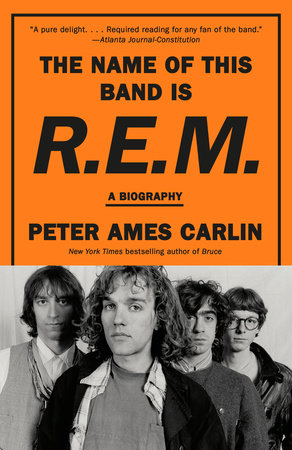
The Name of This Band Is R.E.M.

A Biography

Look inside
Paperback
$21.00 US
5.16"W x 7.97"H x 1.07"D   | 13 oz | 24 per carton
On sale Nov 04, 2025 | 480 Pages | 9780593312537

See Additional Formats
THE NEW YORK TIMES BOOK REVIEW EDITORS' CHOICE • An electrifying cultural biography of the greatest and last American rock band of the millennium, whose music ignited a generation—and reasserted the power of rock and roll

"[Carlin's] unique gift for capturing the sweep and tenor of a cultural moment...is here on brilliant display." —Michael Chabon


In the spring of 1980, an unexpected group of musical eccentrics came together to play their very first performance at a college party in Athens, Georgia. Within a few short years, they had taken over the world – with smash records like Out of Time, Automatic for the People, Monster and Green. Raw, outrageous, and expressive, R.E.M.’s distinctive musical flair was unmatched, and a string of mega-successes solidified them as generational spokesmen. In the tumultuous transition between the wide-open 80s and the anxiety of the early 90s, R.E.M. challenged the corporate and social order, chasing a vision and cultivating a magnetic, transgressive sound.

In this rich, intimate biography, critically acclaimed author Peter Ames Carlin looks beyond the sex, drugs, and rock’n’roll to open a window into the fascinating lives of four college friends – Michael Stipe, Peter Buck, Mike Mills and Bill Berry – who stuck together at any cost, until the end. Deeply descriptive and remarkably poetic, steeped in 80s and 90s nostalgia, The Name of This Band is R.E.M. paints a cultural history of the commercial peak and near-total collapse of a great music era, and the story of the generation that came of age at the apotheosis of rock.
“A book for fans with the voices of fans. The pleasure is much deeper than simply nostalgia. The story of R.E.M. is a reminder of who we were, and perhaps who we still hope to be.”
—Chicago Tribune

“Carlin writes vividly and in close detail about the group's formation and early days. . . [Carlin] is a pro at gathering and unspooling the facts. . . [He] clearly loves the songs and is smart about not just the most popular of them. . . [The Name of This Band Is R.E.M.] gets across all the fundamentals, with both affection and discernment.”
—Washington Post

“Vivid....Peter Ames Carlin's book isn’t just a cultural biography of the band going back to its formation in the-then sleepy college town of Athens, Georgia. It’s also a poetic meditation on what made so many of the band’s songs stand out, and continue to shine.... A fascinating history of a different era in music.”
Associated Press

“It takes a village to raise a rock band. That’s part of the premise of Peter Ames Carlin’s sensitive and well-made new biography.... That Carlin pays such close attention to how many people had a hand in the band’s early success gives his book a spirited communal vibe.”
—New York Times Book Review, Dwight Garner

“The definitive and highly engaging, soup-to-nuts telling of R.E.M.’s story.... A pure delight to read.... Carlin’s attention to detail and focus on the unique characteristics of the band members, the alchemy created by their collaboration and the wholly original, era-defining sound they produced makes The Name of This Band is R.E.M. required reading for any fan of the band.”
Atlanta Journal Constitution

The Name of This Band Is R.E.M. carefully tracks the band’s remarkable trajectory from kegger parties in the college town of Athens during the early ’80s to global ubiquity and its slow burn into dissolution in 2011.”
Los Angeles Times

“Carlin, known for his biographies of Paul Simon, Bruce Springsteen and Brian Wilson, widens his scope in this history of R.E.M., the 1980s college radio darling turned global rock phenomenon.... A kaleidoscopic tale.”
New York Times Book Review

“Carlin writes rock ‘n’ roll lives with a rare blend of documentary authority, narrative verve, and empathetic insight. His unique gift for capturing the sweep and tenor of a cultural moment—in this case, the long transitional moment between punk and the turn-of-the-century flowering of “indie” that was defined by the lifespan and the records of R.E.M.—is here on brilliant display.”
Michael Chabon, bestselling author of The Amazing Adventures of Kavalier & Clay

“R.E.M. is the quintessential indie band, a juggernaut of mumbled poetry and jangly guitar that revitalized the landscape of American music at a moment when we needed it the most. Peter Ames Carlin captures it all in this richly detailed and revelatory book—the fertile Athens scene, the alchemy of a great band bursting into life, their ambivalent rise to superstardom, and the tragedies and triumphs and surprises along the way. If you care about R.E.M. or indie rock or American popular culture, this is the book for you.”
—Tom Perrotta, bestselling author of The Leftovers

"Peter Ames Carlin's artful tour through R.E.M.'s remarkable lifespan portrays a band early on choosing to substitute distortion for clean jangle, an aesthetic decision entirely radical in a scene rife with punk rock noise. The fact that they remained true to the communitarian ideals of the underground, regardless of their mainstream success, will always be their most significant strength. And their songs were things of beauty."
—Thurston Moore, author of Sonic Life and founding member of Sonic Youth

“Carlin has compiled, culled, and documented R.E.M.’s life-long, yet ongoing, journey using their own distinctive maps and legends. The book takes an unparalleled deep dive into the individual lives of each band member, from reluctant college kids to unlikely international Rock and Roll superstars. A strangely familiar, yet fresh read. The story ends, but the music never will. Long live R.E.M.”
David Lowery, founding member of Cracker and Camper Van Beethoven

"Indie rock fans have long held up R.E.M. as a reflection and a goal: typical weird kids who found each other in art school or the aisles of a record store, old souls reborn as young punks, lovers of the American arts who tore them apart and built something fresh from the rubble. Peter Ames Carlin, one of our most thorough and insightful music biographers, recognizes the complexity of the R.E.M. story and honors it at every level: personal, musical, cultural. Longtime fans will love the deep dissections of the band's musical process and the way Carlin weaves their story through the bigger tale of indie culture and politics in the 1980s and beyond. Newcomers will appreciate his deft perceptions of four very different personalities and the creative dynamic that produced some of the late twentieth century's most indelible music."
—Ann Powers, NPR music critic and author of Traveling: On the Path of Joni Mitchell

“In the spring of 1983, I saw R.E.M., a band I had never heard of, open for the English Beat in Boston. It is no hyperbole to say it changed my life. It was an electrifying sense of discovery. Reading Peter Ames Carlin's book is like rediscovering R.E.M.. Peter masterfully spins the story and captures the magical chemistry of the most significant band of the 1980s.”
—Bill Janovitz, author of Leon Russell: The Master of Space and Time's Journey Through Rock & Roll History

“A definitive account of the iconic alt-rock band. . . Carlin still gives a detailed and nuanced portrait of the unique personalities and musical contributions that made them such an organic success.”
Rolling Stone

“Catnip for Gen Xers who came of age listening to these eccentric, groundbreaking musicians.”
—AARP

“An adoring, fact-obsessed, cradle-to-grave biography of the band.”
The Yale Review

“Plenty of books have been written about R.E.M., yet noted biographer Peter Ames Carlin manages to unearth new tidbits about the band members’ formative years through his extensive research and interviews. He tells the story of the band’s rise to fame in an artful fashion, while vividly describing the sound of their music and feel of their performances. This is an impressive feat. . . An essential read for fans old and new.”
Flood Magazine

“In this vivid and fast-paced story of one of rock’s most important bands, Carlin captures the energetic scene around Athens, Georgia, that produced R.E.M. and the ways that the band helped shape music history. Drawing deeply on archives and interviews, Carlin traces the rapid ascent and slow descent of the band on their over thirty-year run, from their debut at a friend’s birthday party in winter 1980 to their final album in March 2011. Carlin’s vibrant prose paints an intimate portrait of a band of friends whose music shaped a generation.”
No Depression: The Journal of Roots Music

“The R.E.M. book I’ve been wanting for, oh, three decades or so. . . [R.E.M.’s] was an extraordinary career and [The Name of This Band Is R.E.M.] is an extraordinary biography.”
—The Film Stage

“Here R.E.M. gets its due, which is considerable.”
—Parade

“Carlin brilliantly captures how a ‘spunky alternative band whose singer spoke in riddles’ became a powerhouse that brought alt rock into the mainstream. . . Vividly bringing to life the political and cultural ferment of the 1990s. . . Carlin examines how R.E.M. balanced their ‘countercultural’ ethos with the commercial appeal it brought them, touching on what it means for rock when the “rebels” become the ‘dominant culture.’ Kinetic prose elevates this perceptive portrait of one of America’s most vital bands.”
Publishers Weekly (starred)

“Astute. . . A pageant of riches for R.E.M. and Michael Stipe fans.”
—Booklist
© Terry Allen
PETER AMES CARLIN is the author of several books, including Sonic Boom: The Impossible Rise of Warner Bros. Records, published in 2021, and Bruce, the  biography of Bruce Springsteen published in 2012. Carlin has also been a freelance journalist, a senior writer at People in New York City, and a television columnist and feature writer at The Oregonian in Portland. A regular speaker on music, writing, and popular culture, Carlin lives in Seattle. View titles by Peter Ames Carlin
1

A few things that make perfect sense in retrospect, after everything he’s done and the way he did it:

Of course the teenage Michael Stipe was a Rocky Horror Picture Show guy.

Of course he was one of the cultists who attended the satiric horror-slash-musical movie’s weekly midnight showings at the Varsity Theater, right there among St. Louis’s other young outsiders, the arty and theatrical and socially dispossessed, the glams and nerds and punks. Anyone an adolescent jock of the late 1970s might refer to, with a derisive snort, as a fag.

And it goes without saying that the young Stipe dressed for the showings in the most outlandish fashion, dolled up as the film’s main hero/villain, the sweet transvestite from Transsexual, Transylvania, Dr. Frank-N-Furter, clad in a leather jacket, bustier, stockings, and one of his mom’s strands of pearls, with dark red lipstick and extremely heavy and artfully applied mascara.

And also a button featuring the male/female logo of the lightly transgressive ’70s rock band Blue Öyster Cult.

A TV news crew came to see the Rocky Horror gang that spring, to report a feature story about the bizarre goings-on taking place at the university district theater’s midnight screenings each week. Who knew there could be all these kids dressed up and dancing around, week after week, chorusing key lines of dialogue back at the screen in perfect synchrony, singing along to the songs, leaping to their feet to do the Time Warp again, and again?

Mike Stipe, a senior at Collinsville High School, was in the thick of it, and when the TV news showed up, lights, camera, and all, he beelined right over to see what was going on.

A bunch of kids were standing there, as people do when a portal to fame slides open, but the reporter was focused on one young woman who was excitedly explaining why she was about to see the movie for the sixty-first time. The reporter, expert at drollery, was making gentle but pointed sport of her. “Devotion has its limits,” he was saying. “Sixty is enough. But one more time?”

Mike Stipe was eighteen years old and already impatient. He wasn’t going to be a bystander to this. Not when The Rocky Horror Picture Show was being discussed. So he spoke up. Interrupted interviewer and interviewee in mid-discourse, and grasped the moment.

“This is an excellent movie. It really is,” Mike declared. “And we’re all quite normal, really.”

The reporter was incredulous. How, he wondered, gesturing to the be-dragged, bewigged gaggle of teens, could they even begin to seem normal?

Mike mused for a moment. What were the usual signifiers for standard-issue St. Louis teens? Well, nearly every lunkhead patrolling the hallway at school came wearing the same T-shirts for the same mainstream rock radio station, so . . . He spoke in quick bursts, thinking aloud about how a normal-seeming teen would behave:

“Show up . . . tomorrow afternoon . . . dressed up in our little KSHE pig shirts and our blue jeans.”

Around him, a burst of knowing laughter as the reporter continued. “That’d be normal?”

Mike, amid more laughs: “I guess . . . for the normal St. Louis KSHE fan, yes, it would.”

The laughter, gaining force, became something else: applause.

They applauded him. Or maybe they were applauding themselves.

Mike’s eyes shifted away from the TV reporter to focus on something else. Something that wasn’t visible yet but was out there, somewhere. Maybe closer than it seemed.


2

Many years later, nearing the end of yet another concert in front of yet another packed hall, Michael Stipe noticed a pair of school-aged boys standing in front of his stage. His band had just finished one song and he was about to set up the next, but first he pointed into the crowd. “Kiddo! Hey, kiddo, come on up. You too. Come on up.”

R.E.M. was taping a show for the Austin City Limits public television series. The stage was low, and the boys, one about eleven years old, the other maybe thirteen, came bouncing up the stairs to stand there and beam excitedly at the singer. After asking their names (Simon and Elliott), Michael shook their hands and asked if they were seeing their first R.E.M. concert. They both said yes, so he asked what they thought. The smaller boy, Simon, who was not the least bit shy in front of a thousand concertgoers, a bank of television cameras, and the millions of viewers watching from afar, didn’t hesitate. “I think you’re awesome,” he declared, and Elliott agreed. “That just about sums it up.” This was in 2008, nearly thirty years into a career that had elevated him far above an ordinary person’s experience of life and hero worship. But the singer seemed not just surprised but actually a little stunned by the boys’ compliments. His eyes sparkled, and he laughed. “I like you guys a lot!” he said, taking a moment to shake both their hands one more time. The boys hopped back down into the crowd and he stood at the microphone, still giggling with happiness. “I don’t know,” he said. “I feel awesome.”

Everyone carries their childhood with them throughout their adult lives, and though being part of a military family meant being perpetually on the move, Michael recalled his earliest years as extraordinarily warm and fulfilling. Asked in 2001 where he first felt like he really belonged, he didn’t hesitate: as a child. “My entire childhood,” he said, “I felt I really belonged to a strong family.”

Born on January 4, 1960, John Michael Stipe was the son of John Wesley Mobley Stipe Jr., a rising officer in the U.S. Army, and the former Marianne Hatch, both from small towns in Georgia.

John, a square-jawed young man, came from Augusta, Georgia, and attended North Georgia College, a military institution where he regularly made the dean’s list while earning degrees in physics and mathematics. Ambitious and energetic, he also played intramural sports and served in straight-arrow organizations including the Scabbard and Blade military honor society, the Forensic Senate, the Officer’s Club, the NCO Club, the Radio Club, and the Physics Club. John was still a student at North Georgia College when he met Marianne Hatch, a schoolmate who came from Hapeville, Georgia, a small town just south of Atlanta. The couple married in 1956 and settled in Decatur, Georgia, near Bainbridge Air Base, where John went to flight school. There John learned how to pilot helicopters and used his math skills to help compute the ebb and flow of goods and weaponry in the Army’s supply chain. Cyndy, the couple’s first child, arrived in 1958. Michael came two years later, and the baby of the family, Lynda, was born in 1962, just before John was assigned to a new post on a base in Texas.

From there the Stipe family rotated from one military base to the next as John’s career grew and his duties expanded. From Texas to Alabama to Germany and then back to Texas, where Marianne and the children lived while John served in Vietnam, flying reconnaissance missions in search of enemy positions. The helicopters flew low over the jungle, and when they located the Vietcong embattlements, the air outside the plastic bubble encasing Major Stipe and his crew would erupt with bullets, rocket-propelled grenades, and anti-aircraft weapons. Recon helicopter squads faced near-daily battle, were often hit, and regularly got shot down. The pilots who survived the six months of hazardous duty usually went home or switched to less dangerous duty as soon as possible. A few found something transcendent in battle: the heightened consciousness of living on the edge of death. When Major Stipe’s hitch in recon was over, he signed up for six more months at the front.

At home in Texas, Marianne and her young kids focused on their days. Breakfasts, school bells, classes, picture books, episodes of the animated Stone Age sitcom The Flintstones, the comic adventures of the pretend-gone-real pop band the Monkees, and whatever cartoons they could catch after school. Being close in age, and by necessity, Cyndy, Mike, and Lynda were one another’s best playmates. When Cyndy got a transistor radio around her tenth birthday, in 1967, they all tuned in to the Top 40 and country stations that crackled across the Texas airwaves. At seven years old, Mike fixed on the poppier songs: “Sugar, Sugar,” as performed by the Archies, a group of musicians masquerading as characters from the Archie comics, along with the hits of the Monkees and the songs performed on the Banana Splits Saturday morning show.

The country music they heard was nearly as cartoonish, the airwaves overflowing with the likes of Johnny Cash’s oddball “A Boy Named Sue,” Merle Haggard’s grumbling hippie takedown “Okie from Muskogee,” and Tammy Wynette’s pre-feminist anthem “Stand by Your Man.” A chorus of oddball voices, serious and silly, celebratory and mournful, all of them blowing around the heads of children whose family was defined by the absence of a father whose days they couldn’t imagine.

Major Stipe’s tour of duty ended in 1972 and he received a new assignment at an army base near St. Louis, Missouri. This time the family moved off-base, buying a home in the suburban town of Collinsville, Illinois, just fifteen miles from the center of St. Louis. The house, a split-level, four-bedroom home at 408 Camelot Drive, stood on a street of midcentury homes not far from Interstate 55. It had a long, sloping front lawn and a backyard separated by a short fence from the Town & Country pool, a neighborhood club that was a magnet for Collinsville youth in the warmer months. Mike was thirteen years old when they got there, an incoming eighth grader in a new town with a new school full of unfamiliar kids and a dad he had barely seen since he was a grade schooler.

To connect with his son and help him meet other boys in their new home, John Stipe signed them both up for the Boy Scouts, Mike as a Tenderfoot Scout and John as the troop’s scoutmaster. Bill Dorman, who befriended Mike when both of their troops were at scout camp in Missouri, was struck instantly by the Stipes, father and son. Dorman recalls the elder Stipe, by then a lieutenant colonel in the Army, as a near caricature of a military man. From the broad-brimmed cavalry hat that accentuated his six-foot-four frame to his prominent mustache, the pipe in his mouth, and the red flight suit he always wore, he looked as though he’d just stepped out of a helicopter. When Dorman saw Apocalypse Now a few years later, he wondered if Robert Duvall’s character, the bluff warrior Lieutenant Colonel Bill Kilgore, with his broad-brimmed cavalry hat and hyper-macho posture, had been based on Lieutenant Colonel Stipe, who was a ringer in every way except for the bluster. On the rare occasion when the elder Stipe did speak, he did it so quietly you’d miss it if you weren’t right next to him.

About

THE NEW YORK TIMES BOOK REVIEW EDITORS' CHOICE • An electrifying cultural biography of the greatest and last American rock band of the millennium, whose music ignited a generation—and reasserted the power of rock and roll

"[Carlin's] unique gift for capturing the sweep and tenor of a cultural moment...is here on brilliant display." —Michael Chabon


In the spring of 1980, an unexpected group of musical eccentrics came together to play their very first performance at a college party in Athens, Georgia. Within a few short years, they had taken over the world – with smash records like Out of Time, Automatic for the People, Monster and Green. Raw, outrageous, and expressive, R.E.M.’s distinctive musical flair was unmatched, and a string of mega-successes solidified them as generational spokesmen. In the tumultuous transition between the wide-open 80s and the anxiety of the early 90s, R.E.M. challenged the corporate and social order, chasing a vision and cultivating a magnetic, transgressive sound.

In this rich, intimate biography, critically acclaimed author Peter Ames Carlin looks beyond the sex, drugs, and rock’n’roll to open a window into the fascinating lives of four college friends – Michael Stipe, Peter Buck, Mike Mills and Bill Berry – who stuck together at any cost, until the end. Deeply descriptive and remarkably poetic, steeped in 80s and 90s nostalgia, The Name of This Band is R.E.M. paints a cultural history of the commercial peak and near-total collapse of a great music era, and the story of the generation that came of age at the apotheosis of rock.

Praise

“A book for fans with the voices of fans. The pleasure is much deeper than simply nostalgia. The story of R.E.M. is a reminder of who we were, and perhaps who we still hope to be.”
—Chicago Tribune

“Carlin writes vividly and in close detail about the group's formation and early days. . . [Carlin] is a pro at gathering and unspooling the facts. . . [He] clearly loves the songs and is smart about not just the most popular of them. . . [The Name of This Band Is R.E.M.] gets across all the fundamentals, with both affection and discernment.”
—Washington Post

“Vivid....Peter Ames Carlin's book isn’t just a cultural biography of the band going back to its formation in the-then sleepy college town of Athens, Georgia. It’s also a poetic meditation on what made so many of the band’s songs stand out, and continue to shine.... A fascinating history of a different era in music.”
Associated Press

“It takes a village to raise a rock band. That’s part of the premise of Peter Ames Carlin’s sensitive and well-made new biography.... That Carlin pays such close attention to how many people had a hand in the band’s early success gives his book a spirited communal vibe.”
—New York Times Book Review, Dwight Garner

“The definitive and highly engaging, soup-to-nuts telling of R.E.M.’s story.... A pure delight to read.... Carlin’s attention to detail and focus on the unique characteristics of the band members, the alchemy created by their collaboration and the wholly original, era-defining sound they produced makes The Name of This Band is R.E.M. required reading for any fan of the band.”
Atlanta Journal Constitution

The Name of This Band Is R.E.M. carefully tracks the band’s remarkable trajectory from kegger parties in the college town of Athens during the early ’80s to global ubiquity and its slow burn into dissolution in 2011.”
Los Angeles Times

“Carlin, known for his biographies of Paul Simon, Bruce Springsteen and Brian Wilson, widens his scope in this history of R.E.M., the 1980s college radio darling turned global rock phenomenon.... A kaleidoscopic tale.”
New York Times Book Review

“Carlin writes rock ‘n’ roll lives with a rare blend of documentary authority, narrative verve, and empathetic insight. His unique gift for capturing the sweep and tenor of a cultural moment—in this case, the long transitional moment between punk and the turn-of-the-century flowering of “indie” that was defined by the lifespan and the records of R.E.M.—is here on brilliant display.”
Michael Chabon, bestselling author of The Amazing Adventures of Kavalier & Clay

“R.E.M. is the quintessential indie band, a juggernaut of mumbled poetry and jangly guitar that revitalized the landscape of American music at a moment when we needed it the most. Peter Ames Carlin captures it all in this richly detailed and revelatory book—the fertile Athens scene, the alchemy of a great band bursting into life, their ambivalent rise to superstardom, and the tragedies and triumphs and surprises along the way. If you care about R.E.M. or indie rock or American popular culture, this is the book for you.”
—Tom Perrotta, bestselling author of The Leftovers

"Peter Ames Carlin's artful tour through R.E.M.'s remarkable lifespan portrays a band early on choosing to substitute distortion for clean jangle, an aesthetic decision entirely radical in a scene rife with punk rock noise. The fact that they remained true to the communitarian ideals of the underground, regardless of their mainstream success, will always be their most significant strength. And their songs were things of beauty."
—Thurston Moore, author of Sonic Life and founding member of Sonic Youth

“Carlin has compiled, culled, and documented R.E.M.’s life-long, yet ongoing, journey using their own distinctive maps and legends. The book takes an unparalleled deep dive into the individual lives of each band member, from reluctant college kids to unlikely international Rock and Roll superstars. A strangely familiar, yet fresh read. The story ends, but the music never will. Long live R.E.M.”
David Lowery, founding member of Cracker and Camper Van Beethoven

"Indie rock fans have long held up R.E.M. as a reflection and a goal: typical weird kids who found each other in art school or the aisles of a record store, old souls reborn as young punks, lovers of the American arts who tore them apart and built something fresh from the rubble. Peter Ames Carlin, one of our most thorough and insightful music biographers, recognizes the complexity of the R.E.M. story and honors it at every level: personal, musical, cultural. Longtime fans will love the deep dissections of the band's musical process and the way Carlin weaves their story through the bigger tale of indie culture and politics in the 1980s and beyond. Newcomers will appreciate his deft perceptions of four very different personalities and the creative dynamic that produced some of the late twentieth century's most indelible music."
—Ann Powers, NPR music critic and author of Traveling: On the Path of Joni Mitchell

“In the spring of 1983, I saw R.E.M., a band I had never heard of, open for the English Beat in Boston. It is no hyperbole to say it changed my life. It was an electrifying sense of discovery. Reading Peter Ames Carlin's book is like rediscovering R.E.M.. Peter masterfully spins the story and captures the magical chemistry of the most significant band of the 1980s.”
—Bill Janovitz, author of Leon Russell: The Master of Space and Time's Journey Through Rock & Roll History

“A definitive account of the iconic alt-rock band. . . Carlin still gives a detailed and nuanced portrait of the unique personalities and musical contributions that made them such an organic success.”
Rolling Stone

“Catnip for Gen Xers who came of age listening to these eccentric, groundbreaking musicians.”
—AARP

“An adoring, fact-obsessed, cradle-to-grave biography of the band.”
The Yale Review

“Plenty of books have been written about R.E.M., yet noted biographer Peter Ames Carlin manages to unearth new tidbits about the band members’ formative years through his extensive research and interviews. He tells the story of the band’s rise to fame in an artful fashion, while vividly describing the sound of their music and feel of their performances. This is an impressive feat. . . An essential read for fans old and new.”
Flood Magazine

“In this vivid and fast-paced story of one of rock’s most important bands, Carlin captures the energetic scene around Athens, Georgia, that produced R.E.M. and the ways that the band helped shape music history. Drawing deeply on archives and interviews, Carlin traces the rapid ascent and slow descent of the band on their over thirty-year run, from their debut at a friend’s birthday party in winter 1980 to their final album in March 2011. Carlin’s vibrant prose paints an intimate portrait of a band of friends whose music shaped a generation.”
No Depression: The Journal of Roots Music

“The R.E.M. book I’ve been wanting for, oh, three decades or so. . . [R.E.M.’s] was an extraordinary career and [The Name of This Band Is R.E.M.] is an extraordinary biography.”
—The Film Stage

“Here R.E.M. gets its due, which is considerable.”
—Parade

“Carlin brilliantly captures how a ‘spunky alternative band whose singer spoke in riddles’ became a powerhouse that brought alt rock into the mainstream. . . Vividly bringing to life the political and cultural ferment of the 1990s. . . Carlin examines how R.E.M. balanced their ‘countercultural’ ethos with the commercial appeal it brought them, touching on what it means for rock when the “rebels” become the ‘dominant culture.’ Kinetic prose elevates this perceptive portrait of one of America’s most vital bands.”
Publishers Weekly (starred)

“Astute. . . A pageant of riches for R.E.M. and Michael Stipe fans.”
—Booklist

Author

© Terry Allen
PETER AMES CARLIN is the author of several books, including Sonic Boom: The Impossible Rise of Warner Bros. Records, published in 2021, and Bruce, the  biography of Bruce Springsteen published in 2012. Carlin has also been a freelance journalist, a senior writer at People in New York City, and a television columnist and feature writer at The Oregonian in Portland. A regular speaker on music, writing, and popular culture, Carlin lives in Seattle. View titles by Peter Ames Carlin

Excerpt

1

A few things that make perfect sense in retrospect, after everything he’s done and the way he did it:

Of course the teenage Michael Stipe was a Rocky Horror Picture Show guy.

Of course he was one of the cultists who attended the satiric horror-slash-musical movie’s weekly midnight showings at the Varsity Theater, right there among St. Louis’s other young outsiders, the arty and theatrical and socially dispossessed, the glams and nerds and punks. Anyone an adolescent jock of the late 1970s might refer to, with a derisive snort, as a fag.

And it goes without saying that the young Stipe dressed for the showings in the most outlandish fashion, dolled up as the film’s main hero/villain, the sweet transvestite from Transsexual, Transylvania, Dr. Frank-N-Furter, clad in a leather jacket, bustier, stockings, and one of his mom’s strands of pearls, with dark red lipstick and extremely heavy and artfully applied mascara.

And also a button featuring the male/female logo of the lightly transgressive ’70s rock band Blue Öyster Cult.

A TV news crew came to see the Rocky Horror gang that spring, to report a feature story about the bizarre goings-on taking place at the university district theater’s midnight screenings each week. Who knew there could be all these kids dressed up and dancing around, week after week, chorusing key lines of dialogue back at the screen in perfect synchrony, singing along to the songs, leaping to their feet to do the Time Warp again, and again?

Mike Stipe, a senior at Collinsville High School, was in the thick of it, and when the TV news showed up, lights, camera, and all, he beelined right over to see what was going on.

A bunch of kids were standing there, as people do when a portal to fame slides open, but the reporter was focused on one young woman who was excitedly explaining why she was about to see the movie for the sixty-first time. The reporter, expert at drollery, was making gentle but pointed sport of her. “Devotion has its limits,” he was saying. “Sixty is enough. But one more time?”

Mike Stipe was eighteen years old and already impatient. He wasn’t going to be a bystander to this. Not when The Rocky Horror Picture Show was being discussed. So he spoke up. Interrupted interviewer and interviewee in mid-discourse, and grasped the moment.

“This is an excellent movie. It really is,” Mike declared. “And we’re all quite normal, really.”

The reporter was incredulous. How, he wondered, gesturing to the be-dragged, bewigged gaggle of teens, could they even begin to seem normal?

Mike mused for a moment. What were the usual signifiers for standard-issue St. Louis teens? Well, nearly every lunkhead patrolling the hallway at school came wearing the same T-shirts for the same mainstream rock radio station, so . . . He spoke in quick bursts, thinking aloud about how a normal-seeming teen would behave:

“Show up . . . tomorrow afternoon . . . dressed up in our little KSHE pig shirts and our blue jeans.”

Around him, a burst of knowing laughter as the reporter continued. “That’d be normal?”

Mike, amid more laughs: “I guess . . . for the normal St. Louis KSHE fan, yes, it would.”

The laughter, gaining force, became something else: applause.

They applauded him. Or maybe they were applauding themselves.

Mike’s eyes shifted away from the TV reporter to focus on something else. Something that wasn’t visible yet but was out there, somewhere. Maybe closer than it seemed.


2

Many years later, nearing the end of yet another concert in front of yet another packed hall, Michael Stipe noticed a pair of school-aged boys standing in front of his stage. His band had just finished one song and he was about to set up the next, but first he pointed into the crowd. “Kiddo! Hey, kiddo, come on up. You too. Come on up.”

R.E.M. was taping a show for the Austin City Limits public television series. The stage was low, and the boys, one about eleven years old, the other maybe thirteen, came bouncing up the stairs to stand there and beam excitedly at the singer. After asking their names (Simon and Elliott), Michael shook their hands and asked if they were seeing their first R.E.M. concert. They both said yes, so he asked what they thought. The smaller boy, Simon, who was not the least bit shy in front of a thousand concertgoers, a bank of television cameras, and the millions of viewers watching from afar, didn’t hesitate. “I think you’re awesome,” he declared, and Elliott agreed. “That just about sums it up.” This was in 2008, nearly thirty years into a career that had elevated him far above an ordinary person’s experience of life and hero worship. But the singer seemed not just surprised but actually a little stunned by the boys’ compliments. His eyes sparkled, and he laughed. “I like you guys a lot!” he said, taking a moment to shake both their hands one more time. The boys hopped back down into the crowd and he stood at the microphone, still giggling with happiness. “I don’t know,” he said. “I feel awesome.”

Everyone carries their childhood with them throughout their adult lives, and though being part of a military family meant being perpetually on the move, Michael recalled his earliest years as extraordinarily warm and fulfilling. Asked in 2001 where he first felt like he really belonged, he didn’t hesitate: as a child. “My entire childhood,” he said, “I felt I really belonged to a strong family.”

Born on January 4, 1960, John Michael Stipe was the son of John Wesley Mobley Stipe Jr., a rising officer in the U.S. Army, and the former Marianne Hatch, both from small towns in Georgia.

John, a square-jawed young man, came from Augusta, Georgia, and attended North Georgia College, a military institution where he regularly made the dean’s list while earning degrees in physics and mathematics. Ambitious and energetic, he also played intramural sports and served in straight-arrow organizations including the Scabbard and Blade military honor society, the Forensic Senate, the Officer’s Club, the NCO Club, the Radio Club, and the Physics Club. John was still a student at North Georgia College when he met Marianne Hatch, a schoolmate who came from Hapeville, Georgia, a small town just south of Atlanta. The couple married in 1956 and settled in Decatur, Georgia, near Bainbridge Air Base, where John went to flight school. There John learned how to pilot helicopters and used his math skills to help compute the ebb and flow of goods and weaponry in the Army’s supply chain. Cyndy, the couple’s first child, arrived in 1958. Michael came two years later, and the baby of the family, Lynda, was born in 1962, just before John was assigned to a new post on a base in Texas.

From there the Stipe family rotated from one military base to the next as John’s career grew and his duties expanded. From Texas to Alabama to Germany and then back to Texas, where Marianne and the children lived while John served in Vietnam, flying reconnaissance missions in search of enemy positions. The helicopters flew low over the jungle, and when they located the Vietcong embattlements, the air outside the plastic bubble encasing Major Stipe and his crew would erupt with bullets, rocket-propelled grenades, and anti-aircraft weapons. Recon helicopter squads faced near-daily battle, were often hit, and regularly got shot down. The pilots who survived the six months of hazardous duty usually went home or switched to less dangerous duty as soon as possible. A few found something transcendent in battle: the heightened consciousness of living on the edge of death. When Major Stipe’s hitch in recon was over, he signed up for six more months at the front.

At home in Texas, Marianne and her young kids focused on their days. Breakfasts, school bells, classes, picture books, episodes of the animated Stone Age sitcom The Flintstones, the comic adventures of the pretend-gone-real pop band the Monkees, and whatever cartoons they could catch after school. Being close in age, and by necessity, Cyndy, Mike, and Lynda were one another’s best playmates. When Cyndy got a transistor radio around her tenth birthday, in 1967, they all tuned in to the Top 40 and country stations that crackled across the Texas airwaves. At seven years old, Mike fixed on the poppier songs: “Sugar, Sugar,” as performed by the Archies, a group of musicians masquerading as characters from the Archie comics, along with the hits of the Monkees and the songs performed on the Banana Splits Saturday morning show.

The country music they heard was nearly as cartoonish, the airwaves overflowing with the likes of Johnny Cash’s oddball “A Boy Named Sue,” Merle Haggard’s grumbling hippie takedown “Okie from Muskogee,” and Tammy Wynette’s pre-feminist anthem “Stand by Your Man.” A chorus of oddball voices, serious and silly, celebratory and mournful, all of them blowing around the heads of children whose family was defined by the absence of a father whose days they couldn’t imagine.

Major Stipe’s tour of duty ended in 1972 and he received a new assignment at an army base near St. Louis, Missouri. This time the family moved off-base, buying a home in the suburban town of Collinsville, Illinois, just fifteen miles from the center of St. Louis. The house, a split-level, four-bedroom home at 408 Camelot Drive, stood on a street of midcentury homes not far from Interstate 55. It had a long, sloping front lawn and a backyard separated by a short fence from the Town & Country pool, a neighborhood club that was a magnet for Collinsville youth in the warmer months. Mike was thirteen years old when they got there, an incoming eighth grader in a new town with a new school full of unfamiliar kids and a dad he had barely seen since he was a grade schooler.

To connect with his son and help him meet other boys in their new home, John Stipe signed them both up for the Boy Scouts, Mike as a Tenderfoot Scout and John as the troop’s scoutmaster. Bill Dorman, who befriended Mike when both of their troops were at scout camp in Missouri, was struck instantly by the Stipes, father and son. Dorman recalls the elder Stipe, by then a lieutenant colonel in the Army, as a near caricature of a military man. From the broad-brimmed cavalry hat that accentuated his six-foot-four frame to his prominent mustache, the pipe in his mouth, and the red flight suit he always wore, he looked as though he’d just stepped out of a helicopter. When Dorman saw Apocalypse Now a few years later, he wondered if Robert Duvall’s character, the bluff warrior Lieutenant Colonel Bill Kilgore, with his broad-brimmed cavalry hat and hyper-macho posture, had been based on Lieutenant Colonel Stipe, who was a ringer in every way except for the bluster. On the rare occasion when the elder Stipe did speak, he did it so quietly you’d miss it if you weren’t right next to him.