Close Modal

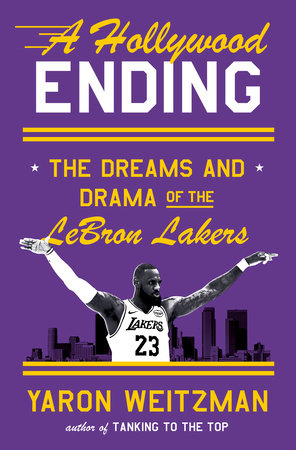
A Hollywood Ending

The Dreams and Drama of the LeBron Lakers

Look inside
Hardcover
$30.00 US
6.43"W x 9.54"H x 1.11"D   | 17 oz | 12 per carton
On sale Oct 21, 2025 | 320 Pages | 9780385550222

NBA journalist Yaron Weitzman lays out the high stakes drama happening inside the Lakers' organization as they try to juggle the warring priorities between LeBron James and the Buss family.

When LeBron James signed with the Los Angeles Lakers in 2018, it looked like a match made in heaven. Here was the preeminent athlete of his generation, fresh off ending Cleveland’s 50-year title drought and in need of a new challenge to help further burnish his legacy, joining forces with one of the most iconic teams in all of sports. And here were the Lakers, in the midst of their worst stretch in franchise history and reeling from the death of the legendary owner Dr. Jerry Buss, in need of a savior. The script wrote itself.

A little over two years later, LeBron and Dr. Buss' daughter, Jeanie, were standing shoulder to shoulder, hoisting the NBA finals trophy into the air. Having won their record-tying 17th NBA title, the Lakers had reclaimed their accustomed perch on top of the basketball world. It looked to be the birth of a new dynasty.  

But this was a new Lakers’ franchise, one beset by infighting and years removed from Kobe's prime. And this was LeBron James, the catalyst of the “player empowerment” era, an athlete chasing things greater than Michael Jordan’s ghost. The two parties were too big to peacefully coexist under one roof. The 2020 title would represent the pinnacle of their pairing, and the beginning of a precipitous decline.

Drawing from over 250 interviews, Yaron Weitzman takes readers on a riveting, behind the scenes journey of this fraught partnership. From the Succession-like power struggle between the Buss children, to the rise of LeBron’s landscape-altering talent agency and its attempts to assert its own power within the Lakers’ walls, to the evolution of LeBron’s priorities and political voice, “A Hollywood Ending” is the definitive story of an American icon’s final years on stage, one portraying him, a fabled NBA franchise, and the world of modern professional sports in a light never seen before.
A NEW YORKER BEST BOOK OF THE YEAR

"[E]xtensively reported ... Weitzman’s insights extend beyond the team’s road to victory to portray a group of players attempting to perform through an unprecedented pandemic while grappling with racial injustice."―The New Yorker

"[A] gossipy book with plenty to dish” ―The Wall Street Journal

“Weitzman cinematically portrays the high-stakes drama behind the pairing of a living legend and an iconic sports team. This is a must-read for pro hoops fans.”
Publishers Weekly, (starred review)

"Weitzman skillfully shows how [James'] hardwood acumen is complemented by a systematic approach to wielding his influence ... perceptive reporting on a transcendent athlete’s methodical power moves." ―Kirkus Reviews

“In this age of ass-kissing hagiography, along comes Yaron Weitzman with “A Hollywood Ending,” a raw, unflinching look at the LeBron Lakers that will render basketball fans riveted and team executives seething. This is how it should be done.” Jeff Pearlman, New York Times bestselling author of Showtime and Three-Ring Circus

“In this exhaustively reported and an authoritatively told account, Weitzman has found never-before-told stories about some of the biggest stars and most important figures in basketball history. Fans who think they know the recent history of LeBron’s Lakers will be shocked by how much more was constantly bubbling beneath the surface. This book is the perfect capstone to the Buss family’s five-decade ownership of the Lakers and a must-read for Lakers fans and anyone who basks in off-court drama.”Bill Oram, sports columnist at The Oregonian and former Lakers beat writer for The Orange County Register and The Athletic

"A Hollywood Ending is a deeply incisive read on the league's most prominent player" —Chris Herring, New York Times bestselling author of Blood in the Garden
© Eitan Nidam
YARON WEITZMAN is an award-winning NBA writer and the author of TANKING TO THE TOP. He's covered the NBA for FOX Sports and Bleacher Report, and his writing has appeared in The Ringer, GQ, ESPN, The New Yorker, and more. His work has work has been recognized in The Best American Sports Writing and by the Professional Basketball Writers Association. View titles by Yaron Weitzman
- 1 -

Too Many Buss Drivers

He was seventy-­seven years old, and still, Dr. Jerry Buss couldn’t help but think about his team’s future.

It was June 2010, and, once again, his Lakers were on top of the NBA world. Just about one week earlier, confetti had rained down from the ceiling of Staples Center as the team celebrated its latest championship, this one coming via a seven-­game battle with the Boston Celtics. That night, euphoria had swept across Los Angeles, a town that, thanks to the brilliance of Dr. Buss, bled Lakers purple and gold. Not only had the Lakers been crowned champions for a second straight year, but the victory had also boosted their number of titles to 16, pulling them within one of the Celtics’ NBA record.

Yet Buss wanted more. On this afternoon, he convened with his children—­five of whom had roles within the organization—­for lunch. The agenda was to lay out the team’s offseason plans, but it didn’t take long for talk to turn to the topic on the minds of the entire sporting world: the ongoing free agency of Le­Bron James, the two-­time reigning MVP, who, after spending his entire professional career playing for the Cavaliers, appeared to be searching for a new home.

“It’d be good to know that guy,” Joey Buss recalled his father saying. Dr. Buss added that he was thinking about setting up a call.

Le­Bron, meanwhile, was also thinking about LA. That spring, he and David Geffen, the billionaire and record executive, had discussed the idea of Geffen buying the Los Angeles Clippers from the franchise’s notoriously cheap, racist, and incompetent owner, Donald Sterling. Le­Bron would then sign as a free agent.

Sterling refused to sell, crossing the Clippers off the board for Le­Bron. As for the Lakers, they were coming off a title run and looking to spend the offseason bolstering the team, not revamping it. And Le­Bron, still just twenty-­five years old, was looking to create his own legacy, not glom onto someone else’s. Yet the seeds had been planted.

The night of the title, Earvin “Magic” Johnson, the former Lakers superstar, had accepted the championship trophy on behalf of the franchise. Upon addressing the raucous Lakers crowd, Magic congratulated “the greatest owner in the world in Dr. Buss,” called head coach Phil Jackson “the greatest coach in the world,” and boasted that “we do have the greatest player in the world in Kobe Bryant.” The next day, in a story for ESPN.com, the acclaimed NBA analyst John Hollinger ranked the Lakers as the top franchise in NBA history. “When it comes to superstars,” Hollinger wrote, “the Lakers are so far out in front of everybody else it’s not even funny.”

Which is why no one could see the cracks forming in the foundation or notice that the whole structure was on the verge of collapse.

•••

Jerry Buss’s story was an American story, with an arc straight out of Hollywood.

Born during the Great Depression, Buss was raised by his mom and stepdad in the small mining and sheep ranching city of Kemmerer, Wyoming. Even as a kid he was a worker, taking whatever jobs he could get. Setting bowling pins. Shining shoes. Carrying guests’ bags at a hotel, where he’d sometimes rig the lobby slot machines to get some extra cash. He was smart, too, especially in math and science, and earned a scholarship to the University of Wyoming, and then another one for graduate school to USC, where he received a master’s and a PhD in physical chemistry. After that, Buss got a regular nine-­to-­five desk job at a Boston management consulting firm before moving back to California for a gig at a space laboratory.

In the late ’50s, Buss and a friend started investing in Los Angeles real estate, specializing in flipping buildings repossessed by banks. They made millions, and Buss, an avid sports fan, began looking for entry points into that world. In 1974, he founded the Los Angeles Strings, an indoor team tennis franchise. He wanted more, though, and in 1979, Lakers owner Jack Kent Cooke, looking for an infusion of cash following a divorce, reached out to Buss to see if he was interested in purchasing his LA sports teams. By this point, Buss had become a local celebrity, the rich guy with the long brown hair and thin mustache who’d be spotted around town—­at clubs, at restaurants, at the Playboy Mansion—­almost always with not-­even-­half-­his-­age women on his arms. At one point, he was offered the chance to play the Marlboro Man in an ad. He was exactly the sort of person who’d want to buy the Lakers, and after receiving Cooke’s offer, Buss pounced.

It was a fraught time for the league. Drug use among players was rampant. Teams were hemorrhaging money. Finals games were being shown on tape delay. Yet, just like with all that real estate he’d flipped, Buss saw potential where others did not. He became one of the first sports owners to sell the naming rights to his arena. Recognizing that NBA games were about entertainment, he created the Laker Girls. He turned home games into a hot spot for Hollywood celebrities, most notably Jack Nicholson, because he knew they would be seen sitting courtside every time the Lakers were on TV.

“Dr. Buss was a legitimate genius,” said Andy Roeser, a Clippers executive from 1984 to 2014.

Buss won a title in his first year with the Lakers and four more in the nine years after that. It was under his watch that Showtime—­the team’s fast-­paced, freewheeling, fan-­friendly style—­was born. It was because of what he built that the Lakers transformed into not just the NBA’s crown jewel but an organization synonymous with glitz and glamour and, most importantly, greatness. Seeing what the Lakers had become filled Buss with pride. The team was like another child to him, and his plan was for his family to take care of that child when he no longer could.

“The Lakers belong to my children,” he told Fox Sports West in 2005, “and that’s the way it’s gonna be.”

Doing so, he thought, would keep his family together.

Instead, the Lakers would become the thing that would drive them apart.

•••

One day, when Jerry Buss was about twenty years old, his wife, JoAnn, approached him with some news: Jerry was going to be a father.

She was excited.

He was not.

A baby would derail his plans. He and JoAnn were about to move to LA. He was about to begin pursuing his PhD. There was no way he could do all that while caring for a child. He knew what it was like to be poor, and he knew that wasn’t how he wanted to spend his life. It wasn’t that he didn’t want a family, he told JoAnn, it was just that this wasn’t the right time.

In 1953, JoAnn gave birth to a baby girl.

She and Buss named her Marie.

They then gave her up for adoption.

“[I’m] too busy getting an advanced degree and [have] neither the time nor the finances to keep her,” was the reason Buss listed on the adoption paperwork. JoAnn said that she “wanted to be a mother and keep [Marie] but went along with her husband’s wishes.”

This was the first time Buss chose his career over his kids.

It wouldn’t be the last.

•••

Buss did keep his word to his wife. By the mid-­’60s, he and JoAnn had filled their home with four children. First came two boys, Johnny and Jimmy. Then two girls, Jeanie and Janie. Buss loved them deeply. They’d play Monopoly and go swimming and take family trips to watch USC football. But he never changed who he was, never stopped prioritizing his businesses, never stopped putting his own desires before theirs.

“I remember asking a lot, ‘Where’s Dad?’ ” Janie said.

Buss and JoAnn separated in 1972. The kids remained with JoAnn in her Pacific Palisades home. Buss became more distant, showing up only in spurts. “It left us confused about who our father was,” Johnny said. “We knew Dad only as the guy who came over on weekends and took us to McDonald’s. I could never understand why he’d want to go to Las Vegas with the Playmate of the Year rather than take us to Disneyland.”

Buss missed Little League games and Boy Scout events, dance recitals and graduations. On those rare occasions when he was around, “We’d vie for his attention,” Jeanie said. This never-­ceasing competition for paternal adoration left its mark, and, as the Buss kids grew older, their battles evolved. Attention was no longer the resource being fought over; their father’s approval was. And, given the NBA’s rules requiring each franchise to have one boss, they figured what better way to earn that approval than by proving capable of running their father’s most prized possession.

•••

Johnny was the oldest boy. He believed this alone qualified him to be his father’s successor.

His résumé said otherwise.

Johnny had quit the high school football team on the first day of tryouts. He’d gotten kicked off the gymnastics team for not cutting his hair, and then out of school for cutting class. He had dropped out of Santa Monica College to spend more time with his then-­girlfriend, the Strings’ Australian tennis star Dianne Fromholtz, only to be dumped two years later. He had enrolled in USC’s drama department only to give that up early, too.

And yet, despite all that, Buss was still willing to give him a shot.

In 1982, Johnny was named president of his father’s new Major Indoor Soccer League team, the Los Angeles Lazers.

“I think we were 8–40 that first season,” Johnny recalled. Even worse: “We lost probably at least a half million dollars that first year, if not more.”

Johnny quit after three years. After, he fell into a years-­long depression. “Being the son of a famous man and being unable to find myself on my own,” he’d tell Sports Illustrated years later, had been too much to bear. In the ensuing decades, he’d dip his toes back into sports here and there, most notably by running his father’s WNBA team, the Los Angeles Sparks, from 1997 to 2006, a stretch that included two titles. But he bowed out of the competition to succeed his dad.

“I didn’t like being in the limelight,” he said.

With Johnny out of the picture, the battle was now between Jimmy and Jeanie.

Jimmy was older, but also more of a wild child, a charming and hard-­partying former athlete with long blond hair and blue eyes who was popular with the girls but who, like Johnny, had never found himself after high school. Jeanie, on the other hand, was the golden child, the bubbly blonde who was named Miss Palisades in 1979 but knew how to hang with the guys, too. She read DC Comics. She played high school basketball. She served as the scorekeeper for the boys’ team. She was also the most ambitious of the bunch, the one her siblings resented for, in Janie’s words, “always trying to please my dad, entering beauty pageants, getting good grades.” Asked by an interviewer in the ’80s if she wanted to replace her father “at the top,” she replied, “Yes, I already told him. He knows that. I think he’s kind of surprised that his daughter would be saying that, wanting to fill his shoes, but I think I can do it.”

At fourteen, Jeanie started accompanying her father to World TeamTennis board meetings. At nineteen, despite being enrolled in USC—­from where she’d eventually graduate with honors and a degree in business—­Buss named her general manager of the Strings. “I want you to know what it feels like to do this job,” he had told her, and so he gave her carte blanche. Jeanie chose whom to draft, whom to sign, and Zwith whom to do business. Her acumen and enthusiasm impressed those around her. She took the job seriously, but not herself. She’d walk around with a smile and was affable and warm. On road trips, she’d sit with her team and laugh at the latest gossip from the tennis world. All the while—­and taking a page out of her father’s please-­the-­players playbook—­making sure to provide the talent with top-­notch travel accommodations, a far cry from some of their World TeamTennis peers.

“It was very much the minor leagues, especially compared to the Lakers, but she didn’t treat it that way,” John Lloyd, a player and coach for the Strings under Jeanie, said. “She took it very seriously.”

Jeanie was fulfilling her dreams and doing what she had set out to, but she was looking for something more. In 1990, she married a gold-­medal-­winning volleyball player named Steve Timmons, whom she’d met at the Forum. (Buss showed up to the wedding reception with two dates.) Jeanie and Timmons moved to Italy, where Timmons was playing professionally, only for Jeanie to discover that, at that point, marriage wasn’t for her. Or at least not a marriage that pulled her away from her father and the family business.

“I was homesick,” Jeanie said. She’d fly back and forth to LA as often as she could, angering Timmons, who felt like she was choosing her family over their relationship. In 1993, the two got divorced, and Jeanie was back in LA. “I felt such a sense of relief,” she said.

The Strings folded in 1993, but by then Jeanie had already both proven herself and outshined her siblings. She’d spent time steering her father’s roller hockey and volleyball teams, with no qualms about the long hours or small staff, and had enticed tennis stars like John McEnroe, Andre Agassi, and Jimmy Connors to come for exhibition matches with promises of limos and aggressive advertising campaigns. In 1995, Buss promoted Jeanie, just thirty-­four years old, to Forum president and general manager. The job meant she ran the building and the two-­hundred-­plus events it hosted every year. He also named her an “alternate governor” of the Lakers. She began attending the NBA’s ownership meetings, often alongside her father.

It was an exciting time, but also a difficult one. Many of Buss’s colleagues didn’t believe a woman belonged in those rooms. Some ignored her. Some just rolled their eyes. One went even further, grabbing her rear while waiting behind her at the buffet line.

“I didn’t take it as much as a sexual advance but more, like, putting me in my place,” Jeanie said years later. “You don’t get a seat at the table. You’re just a piece of ass.”

Jeanie never told her father or brothers, nor did she ever name the culprit, and over two decades would pass before she’d share the story with the public. Her response was to do what she always did—­put her head down and work. As the years went by, she grew more comfortable. She started speaking up more during meetings, and her approach—­in particular, the way she prioritized the needs of the collective over those of the Lakers—­endeared her to her peers.

About

NBA journalist Yaron Weitzman lays out the high stakes drama happening inside the Lakers' organization as they try to juggle the warring priorities between LeBron James and the Buss family.

When LeBron James signed with the Los Angeles Lakers in 2018, it looked like a match made in heaven. Here was the preeminent athlete of his generation, fresh off ending Cleveland’s 50-year title drought and in need of a new challenge to help further burnish his legacy, joining forces with one of the most iconic teams in all of sports. And here were the Lakers, in the midst of their worst stretch in franchise history and reeling from the death of the legendary owner Dr. Jerry Buss, in need of a savior. The script wrote itself.

A little over two years later, LeBron and Dr. Buss' daughter, Jeanie, were standing shoulder to shoulder, hoisting the NBA finals trophy into the air. Having won their record-tying 17th NBA title, the Lakers had reclaimed their accustomed perch on top of the basketball world. It looked to be the birth of a new dynasty.  

But this was a new Lakers’ franchise, one beset by infighting and years removed from Kobe's prime. And this was LeBron James, the catalyst of the “player empowerment” era, an athlete chasing things greater than Michael Jordan’s ghost. The two parties were too big to peacefully coexist under one roof. The 2020 title would represent the pinnacle of their pairing, and the beginning of a precipitous decline.

Drawing from over 250 interviews, Yaron Weitzman takes readers on a riveting, behind the scenes journey of this fraught partnership. From the Succession-like power struggle between the Buss children, to the rise of LeBron’s landscape-altering talent agency and its attempts to assert its own power within the Lakers’ walls, to the evolution of LeBron’s priorities and political voice, “A Hollywood Ending” is the definitive story of an American icon’s final years on stage, one portraying him, a fabled NBA franchise, and the world of modern professional sports in a light never seen before.

Praise

A NEW YORKER BEST BOOK OF THE YEAR

"[E]xtensively reported ... Weitzman’s insights extend beyond the team’s road to victory to portray a group of players attempting to perform through an unprecedented pandemic while grappling with racial injustice."―The New Yorker

"[A] gossipy book with plenty to dish” ―The Wall Street Journal

“Weitzman cinematically portrays the high-stakes drama behind the pairing of a living legend and an iconic sports team. This is a must-read for pro hoops fans.”
Publishers Weekly, (starred review)

"Weitzman skillfully shows how [James'] hardwood acumen is complemented by a systematic approach to wielding his influence ... perceptive reporting on a transcendent athlete’s methodical power moves." ―Kirkus Reviews

“In this age of ass-kissing hagiography, along comes Yaron Weitzman with “A Hollywood Ending,” a raw, unflinching look at the LeBron Lakers that will render basketball fans riveted and team executives seething. This is how it should be done.” Jeff Pearlman, New York Times bestselling author of Showtime and Three-Ring Circus

“In this exhaustively reported and an authoritatively told account, Weitzman has found never-before-told stories about some of the biggest stars and most important figures in basketball history. Fans who think they know the recent history of LeBron’s Lakers will be shocked by how much more was constantly bubbling beneath the surface. This book is the perfect capstone to the Buss family’s five-decade ownership of the Lakers and a must-read for Lakers fans and anyone who basks in off-court drama.”Bill Oram, sports columnist at The Oregonian and former Lakers beat writer for The Orange County Register and The Athletic

"A Hollywood Ending is a deeply incisive read on the league's most prominent player" —Chris Herring, New York Times bestselling author of Blood in the Garden

Author

© Eitan Nidam
YARON WEITZMAN is an award-winning NBA writer and the author of TANKING TO THE TOP. He's covered the NBA for FOX Sports and Bleacher Report, and his writing has appeared in The Ringer, GQ, ESPN, The New Yorker, and more. His work has work has been recognized in The Best American Sports Writing and by the Professional Basketball Writers Association. View titles by Yaron Weitzman

Excerpt

- 1 -

Too Many Buss Drivers

He was seventy-­seven years old, and still, Dr. Jerry Buss couldn’t help but think about his team’s future.

It was June 2010, and, once again, his Lakers were on top of the NBA world. Just about one week earlier, confetti had rained down from the ceiling of Staples Center as the team celebrated its latest championship, this one coming via a seven-­game battle with the Boston Celtics. That night, euphoria had swept across Los Angeles, a town that, thanks to the brilliance of Dr. Buss, bled Lakers purple and gold. Not only had the Lakers been crowned champions for a second straight year, but the victory had also boosted their number of titles to 16, pulling them within one of the Celtics’ NBA record.

Yet Buss wanted more. On this afternoon, he convened with his children—­five of whom had roles within the organization—­for lunch. The agenda was to lay out the team’s offseason plans, but it didn’t take long for talk to turn to the topic on the minds of the entire sporting world: the ongoing free agency of Le­Bron James, the two-­time reigning MVP, who, after spending his entire professional career playing for the Cavaliers, appeared to be searching for a new home.

“It’d be good to know that guy,” Joey Buss recalled his father saying. Dr. Buss added that he was thinking about setting up a call.

Le­Bron, meanwhile, was also thinking about LA. That spring, he and David Geffen, the billionaire and record executive, had discussed the idea of Geffen buying the Los Angeles Clippers from the franchise’s notoriously cheap, racist, and incompetent owner, Donald Sterling. Le­Bron would then sign as a free agent.

Sterling refused to sell, crossing the Clippers off the board for Le­Bron. As for the Lakers, they were coming off a title run and looking to spend the offseason bolstering the team, not revamping it. And Le­Bron, still just twenty-­five years old, was looking to create his own legacy, not glom onto someone else’s. Yet the seeds had been planted.

The night of the title, Earvin “Magic” Johnson, the former Lakers superstar, had accepted the championship trophy on behalf of the franchise. Upon addressing the raucous Lakers crowd, Magic congratulated “the greatest owner in the world in Dr. Buss,” called head coach Phil Jackson “the greatest coach in the world,” and boasted that “we do have the greatest player in the world in Kobe Bryant.” The next day, in a story for ESPN.com, the acclaimed NBA analyst John Hollinger ranked the Lakers as the top franchise in NBA history. “When it comes to superstars,” Hollinger wrote, “the Lakers are so far out in front of everybody else it’s not even funny.”

Which is why no one could see the cracks forming in the foundation or notice that the whole structure was on the verge of collapse.

•••

Jerry Buss’s story was an American story, with an arc straight out of Hollywood.

Born during the Great Depression, Buss was raised by his mom and stepdad in the small mining and sheep ranching city of Kemmerer, Wyoming. Even as a kid he was a worker, taking whatever jobs he could get. Setting bowling pins. Shining shoes. Carrying guests’ bags at a hotel, where he’d sometimes rig the lobby slot machines to get some extra cash. He was smart, too, especially in math and science, and earned a scholarship to the University of Wyoming, and then another one for graduate school to USC, where he received a master’s and a PhD in physical chemistry. After that, Buss got a regular nine-­to-­five desk job at a Boston management consulting firm before moving back to California for a gig at a space laboratory.

In the late ’50s, Buss and a friend started investing in Los Angeles real estate, specializing in flipping buildings repossessed by banks. They made millions, and Buss, an avid sports fan, began looking for entry points into that world. In 1974, he founded the Los Angeles Strings, an indoor team tennis franchise. He wanted more, though, and in 1979, Lakers owner Jack Kent Cooke, looking for an infusion of cash following a divorce, reached out to Buss to see if he was interested in purchasing his LA sports teams. By this point, Buss had become a local celebrity, the rich guy with the long brown hair and thin mustache who’d be spotted around town—­at clubs, at restaurants, at the Playboy Mansion—­almost always with not-­even-­half-­his-­age women on his arms. At one point, he was offered the chance to play the Marlboro Man in an ad. He was exactly the sort of person who’d want to buy the Lakers, and after receiving Cooke’s offer, Buss pounced.

It was a fraught time for the league. Drug use among players was rampant. Teams were hemorrhaging money. Finals games were being shown on tape delay. Yet, just like with all that real estate he’d flipped, Buss saw potential where others did not. He became one of the first sports owners to sell the naming rights to his arena. Recognizing that NBA games were about entertainment, he created the Laker Girls. He turned home games into a hot spot for Hollywood celebrities, most notably Jack Nicholson, because he knew they would be seen sitting courtside every time the Lakers were on TV.

“Dr. Buss was a legitimate genius,” said Andy Roeser, a Clippers executive from 1984 to 2014.

Buss won a title in his first year with the Lakers and four more in the nine years after that. It was under his watch that Showtime—­the team’s fast-­paced, freewheeling, fan-­friendly style—­was born. It was because of what he built that the Lakers transformed into not just the NBA’s crown jewel but an organization synonymous with glitz and glamour and, most importantly, greatness. Seeing what the Lakers had become filled Buss with pride. The team was like another child to him, and his plan was for his family to take care of that child when he no longer could.

“The Lakers belong to my children,” he told Fox Sports West in 2005, “and that’s the way it’s gonna be.”

Doing so, he thought, would keep his family together.

Instead, the Lakers would become the thing that would drive them apart.

•••

One day, when Jerry Buss was about twenty years old, his wife, JoAnn, approached him with some news: Jerry was going to be a father.

She was excited.

He was not.

A baby would derail his plans. He and JoAnn were about to move to LA. He was about to begin pursuing his PhD. There was no way he could do all that while caring for a child. He knew what it was like to be poor, and he knew that wasn’t how he wanted to spend his life. It wasn’t that he didn’t want a family, he told JoAnn, it was just that this wasn’t the right time.

In 1953, JoAnn gave birth to a baby girl.

She and Buss named her Marie.

They then gave her up for adoption.

“[I’m] too busy getting an advanced degree and [have] neither the time nor the finances to keep her,” was the reason Buss listed on the adoption paperwork. JoAnn said that she “wanted to be a mother and keep [Marie] but went along with her husband’s wishes.”

This was the first time Buss chose his career over his kids.

It wouldn’t be the last.

•••

Buss did keep his word to his wife. By the mid-­’60s, he and JoAnn had filled their home with four children. First came two boys, Johnny and Jimmy. Then two girls, Jeanie and Janie. Buss loved them deeply. They’d play Monopoly and go swimming and take family trips to watch USC football. But he never changed who he was, never stopped prioritizing his businesses, never stopped putting his own desires before theirs.

“I remember asking a lot, ‘Where’s Dad?’ ” Janie said.

Buss and JoAnn separated in 1972. The kids remained with JoAnn in her Pacific Palisades home. Buss became more distant, showing up only in spurts. “It left us confused about who our father was,” Johnny said. “We knew Dad only as the guy who came over on weekends and took us to McDonald’s. I could never understand why he’d want to go to Las Vegas with the Playmate of the Year rather than take us to Disneyland.”

Buss missed Little League games and Boy Scout events, dance recitals and graduations. On those rare occasions when he was around, “We’d vie for his attention,” Jeanie said. This never-­ceasing competition for paternal adoration left its mark, and, as the Buss kids grew older, their battles evolved. Attention was no longer the resource being fought over; their father’s approval was. And, given the NBA’s rules requiring each franchise to have one boss, they figured what better way to earn that approval than by proving capable of running their father’s most prized possession.

•••

Johnny was the oldest boy. He believed this alone qualified him to be his father’s successor.

His résumé said otherwise.

Johnny had quit the high school football team on the first day of tryouts. He’d gotten kicked off the gymnastics team for not cutting his hair, and then out of school for cutting class. He had dropped out of Santa Monica College to spend more time with his then-­girlfriend, the Strings’ Australian tennis star Dianne Fromholtz, only to be dumped two years later. He had enrolled in USC’s drama department only to give that up early, too.

And yet, despite all that, Buss was still willing to give him a shot.

In 1982, Johnny was named president of his father’s new Major Indoor Soccer League team, the Los Angeles Lazers.

“I think we were 8–40 that first season,” Johnny recalled. Even worse: “We lost probably at least a half million dollars that first year, if not more.”

Johnny quit after three years. After, he fell into a years-­long depression. “Being the son of a famous man and being unable to find myself on my own,” he’d tell Sports Illustrated years later, had been too much to bear. In the ensuing decades, he’d dip his toes back into sports here and there, most notably by running his father’s WNBA team, the Los Angeles Sparks, from 1997 to 2006, a stretch that included two titles. But he bowed out of the competition to succeed his dad.

“I didn’t like being in the limelight,” he said.

With Johnny out of the picture, the battle was now between Jimmy and Jeanie.

Jimmy was older, but also more of a wild child, a charming and hard-­partying former athlete with long blond hair and blue eyes who was popular with the girls but who, like Johnny, had never found himself after high school. Jeanie, on the other hand, was the golden child, the bubbly blonde who was named Miss Palisades in 1979 but knew how to hang with the guys, too. She read DC Comics. She played high school basketball. She served as the scorekeeper for the boys’ team. She was also the most ambitious of the bunch, the one her siblings resented for, in Janie’s words, “always trying to please my dad, entering beauty pageants, getting good grades.” Asked by an interviewer in the ’80s if she wanted to replace her father “at the top,” she replied, “Yes, I already told him. He knows that. I think he’s kind of surprised that his daughter would be saying that, wanting to fill his shoes, but I think I can do it.”

At fourteen, Jeanie started accompanying her father to World TeamTennis board meetings. At nineteen, despite being enrolled in USC—­from where she’d eventually graduate with honors and a degree in business—­Buss named her general manager of the Strings. “I want you to know what it feels like to do this job,” he had told her, and so he gave her carte blanche. Jeanie chose whom to draft, whom to sign, and Zwith whom to do business. Her acumen and enthusiasm impressed those around her. She took the job seriously, but not herself. She’d walk around with a smile and was affable and warm. On road trips, she’d sit with her team and laugh at the latest gossip from the tennis world. All the while—­and taking a page out of her father’s please-­the-­players playbook—­making sure to provide the talent with top-­notch travel accommodations, a far cry from some of their World TeamTennis peers.

“It was very much the minor leagues, especially compared to the Lakers, but she didn’t treat it that way,” John Lloyd, a player and coach for the Strings under Jeanie, said. “She took it very seriously.”

Jeanie was fulfilling her dreams and doing what she had set out to, but she was looking for something more. In 1990, she married a gold-­medal-­winning volleyball player named Steve Timmons, whom she’d met at the Forum. (Buss showed up to the wedding reception with two dates.) Jeanie and Timmons moved to Italy, where Timmons was playing professionally, only for Jeanie to discover that, at that point, marriage wasn’t for her. Or at least not a marriage that pulled her away from her father and the family business.

“I was homesick,” Jeanie said. She’d fly back and forth to LA as often as she could, angering Timmons, who felt like she was choosing her family over their relationship. In 1993, the two got divorced, and Jeanie was back in LA. “I felt such a sense of relief,” she said.

The Strings folded in 1993, but by then Jeanie had already both proven herself and outshined her siblings. She’d spent time steering her father’s roller hockey and volleyball teams, with no qualms about the long hours or small staff, and had enticed tennis stars like John McEnroe, Andre Agassi, and Jimmy Connors to come for exhibition matches with promises of limos and aggressive advertising campaigns. In 1995, Buss promoted Jeanie, just thirty-­four years old, to Forum president and general manager. The job meant she ran the building and the two-­hundred-­plus events it hosted every year. He also named her an “alternate governor” of the Lakers. She began attending the NBA’s ownership meetings, often alongside her father.

It was an exciting time, but also a difficult one. Many of Buss’s colleagues didn’t believe a woman belonged in those rooms. Some ignored her. Some just rolled their eyes. One went even further, grabbing her rear while waiting behind her at the buffet line.

“I didn’t take it as much as a sexual advance but more, like, putting me in my place,” Jeanie said years later. “You don’t get a seat at the table. You’re just a piece of ass.”

Jeanie never told her father or brothers, nor did she ever name the culprit, and over two decades would pass before she’d share the story with the public. Her response was to do what she always did—­put her head down and work. As the years went by, she grew more comfortable. She started speaking up more during meetings, and her approach—­in particular, the way she prioritized the needs of the collective over those of the Lakers—­endeared her to her peers.