Close Modal

Empty Mansions

The Mysterious Life of Huguette Clark and the Spending of a Great American Fortune

Look inside
Hardcover
$38.00 US
6.65"W x 9.52"H x 1.21"D   | 29 oz | 12 per carton
On sale Sep 10, 2013 | 496 Pages | 9780345534521

See Additional Formats
#1 NEW YORK TIMES BESTSELLER

NAMED ONE OF THE BEST BOOKS OF THE YEAR BY
Janet Maslin, The New York Times • St. Louis Post-Dispatch

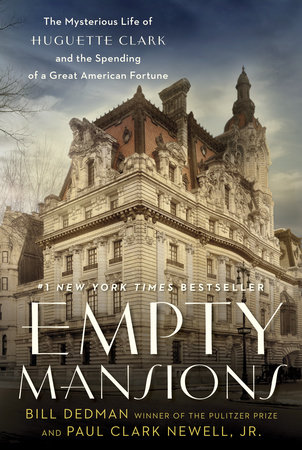
When Pulitzer Prizewinning journalist Bill Dedman noticed in 2009 a grand home for sale, unoccupied for nearly sixty years, he stumbled through a surprising portal into American history. Empty Mansions is a rich mystery of wealth and loss, connecting the Gilded Age opulence of the nineteenth century with a twenty-first-century battle over a $300 million inheritance. At its heart is a reclusive heiress named Huguette Clark, a woman so secretive that, at the time of her death at age 104, no new photograph of her had been seen in decades. Though she owned palatial homes in California, New York, and Connecticut, why had she lived for twenty years in a simple hospital room, despite being in excellent health? Why were her valuables being sold off? Was she in control of her fortune, or controlled by those managing her money?
 
Dedman has collaborated with Huguette Clark’s cousin, Paul Clark Newell, Jr., one of the few relatives to have frequent conversations with her. Dedman and Newell tell a fairy tale in reverse: the bright, talented daughter, born into a family of extreme wealth and privilege, who secrets herself away from the outside world.
 
Huguette was the daughter of self-made copper industrialist W. A. Clark, nearly as rich as Rockefeller in his day, a controversial senator, railroad builder, and founder of Las Vegas. She grew up in the largest house in New York City, a remarkable dwelling with 121 rooms for a family of four. She owned paintings by Degas and Renoir, a world-renowned Stradivarius violin, a vast collection of antique dolls. But wanting more than treasures, she devoted her wealth to buying gifts for friends and strangers alike, to quietly pursuing her own work as an artist, and to guarding the privacy she valued above all else.
 
The Clark family story spans nearly all of American history in three generations, from a log cabin in Pennsylvania to mining camps in the Montana gold rush, from backdoor politics in Washington to a distress call from an elegant Fifth Avenue apartment. The same Huguette who was touched by the terror attacks of 9/11 held a ticket nine decades earlier for a first-class stateroom on the second voyage of the Titanic.

Empty Mansions reveals a complex portrait of the mysterious Huguette and her intimate circle. We meet her extravagant father, her publicity-shy mother, her star-crossed sister, her French boyfriend, her nurse who received more than $30 million in gifts, and the relatives fighting to inherit Huguette’s copper fortune. Richly illustrated with more than seventy photographs, Empty Mansions is an enthralling story of an eccentric of the highest order, a last jewel of the Gilded Age who lived life on her own terms.

Praise for Empty Mansions
 
“An amazing story of profligate wealth . . . an outsized tale of rags-to-riches prosperity.”The New York Times
 
“An evocative and rollicking read, part social history, part hothouse mystery, part grand guignol.”—The Daily Beast

“Fascinating . . . [a] haunting true-life tale.”People

“One of those incredible stories that you didn’t even know existed. It filled a void.”—Jon Stewart, The Daily Show
 
“Thrilling . . . deliciously scandalous.”Publishers Weekly (starred review)
“An amazing story of profligate wealth . . . an outsized tale of rags-to-riches prosperity.”The New York Times
 
“A fascinating investigation into the haunting true-life tale of reclusive heiress Huguette Clark.”People

“An exhaustively researched, well-written account . . . a blood-boiling expose [that] will make you angry and will make you sad.”The Seattle Times
 
“An evocative and rollicking read, part social history, part hothouse mystery, part grand guignol.”The Daily Beast
 
“A childlike, self-exiled eccentric, [Huguette Clark] is the sort of of subject susceptible to a biography of broad strokes, which makes Empty Mansions, the first full-length account of her life, impressive for its delicacy and depth.”Town & Country
 
“One of those incredible stories that you didn’t even know existed. It filled a void.”—Jon Stewart, The Daily Show

“So well written . . . such a gripping, gripping story.”—Bill Goldstein, NBC 4 New York
 
“A compelling account of what happened to the Clark family and its fortune . . . a tremendous feat.”St. Louis Post-Dispatch
 
“A fascinating story.”Today
 
“Meticulous and absorbing.”Bloomberg Businessweek
 
“Brilliantly researched, tough-minded, and fair . . . a fascinating read.”Santa Barbara Independent

“Riveting . . . deliciously scandalous . . . a thrilling study of the responsibilities and privileges that come with great wealth.”Publishers Weekly (starred review)
 
“A spellbinding mystery.”Booklist
 
“Enlightening.”Library Journal

Empty Mansions is a dazzlement and a wonder. Bill Dedman and Paul Newell unravel a great character, Huguette Clark, a shy soul akin to Boo Radley in To Kill a Mockingbird—if Boo’s father had been as rich as Rockefeller. This is an enchanting journey into the mysteries of the mind, a true-to-life exploration of strangeness and delight.”—Pat Conroy, author of The Death of Santini: The Story of a Father and His Son
 
Empty Mansions is at once an engrossing portrait of a forgotten American heiress and a fascinating meditation on the crosswinds of extreme wealth. Hugely entertaining and well researched, Empty Mansions is a fabulous read.”—Amanda Foreman, author of A World on Fire
 
“In Empty Mansions, a unique American character emerges from the shadows. Through deep research and evocative writing, Bill Dedman and Paul Clark Newell, Jr., have expertly captured the arc of history covered by the remarkable Clark family, while solving a deeply personal mystery of wealth and eccentricity.”—Jon Meacham, author of Thomas Jefferson: The Art of Power
 
“Who knew? Though virtually unknown today, W. A. Clark was one of the fifty richest Americans ever—copper baron, railroad builder, art collector, U.S. senator, and world-class scoundrel. Yet his daughter and heiress Huguette became a bizarre recluse. Empty Mansions reveals this mysterious family in sumptuous detail.”—John Berendt, author of Midnight in the Garden of Good and Evil
 
Empty Mansions is a mesmerizing tale that delivers all the ingredients of a top-notch mystery novel. But there is nothing fictional about this true, fully researched story of a fascinating and reclusive woman from an era of fabulous American wealth. Empty Mansions is a delicious read—once you start it, you will find it hard to put down.”—Kate Alcott, bestselling author of The Dressmaker
 
“More than a biography, more than a mystery, Empty Mansions is a real-life American Bleak House, an arresting tale about misplaced souls sketched on a canvas that stretches from coast to coast, from riotous mining camps to the gilded dwellings of the very, very rich.”—John A. Farrell, author of Clarence Darrow: Attorney for the Damned
© David Beyda Studio
Bill Dedman introduced the public to heiress Huguette Clark and her empty mansions through his compelling series of narratives for NBC, which became the most popular feature in the history of the news website, topping 110 million page views. He received the 1989 Pulitzer Prize in investigative reporting while writing for The Atlanta Journal-Constitution and has written for The New York Times, The Washington Post, and The Boston Globe. View titles by Bill Dedman
Paul Clark Newell, Jr. View titles by Paul Clark Newell, Jr.
From day one at Doctors Hospital, Huguette had private nurses twenty-four hours a day. The nurse on the day shift, assigned randomly to Huguette in the spring of 1991, was Hadassah Peri. She would work for her “Madame” for twenty years, becoming, it seems probable, the wealthiest registered nurse in the world.

Doctors Hospital was not the place that a New Yorker with a lifethreatening illness normally would select. It was better known as a fashionable treatment center for the well-to-do, a society hospital, a great place for a face-lift or for drying out. Michael Jackson had been a patient, as had Marilyn Monroe, James Thurber, Clare Boothe Luce, and Eugene O’Neill. The fourteen-story brick structure on the Upper East Side of Manhattan, between Eighty-Seventh and Eighty-Eighth streets by a bend in the East River, gave the impression of being an apartment building or hotel, with a hair salon offering private appointments in patient rooms and a comfortable dining room where patients could order from the wine list if the doctor allowed. When it opened in 1929, it had no wards and no interns, allowed no charity care, and included hotel accommodations for family members of patients. In its early days, it was often used as a long-term residential hotel or spa, and finally in the 1970s it added modern coronary units and intensive care.

Huguette checked in to a room on the eleventh floor with a lovely view down to a city park and Gracie Mansion, the Federal-style home that is the official residence of the mayor of New York.

After living mostly alone at home for so many years, now Huguette was in a hospital with its constant noises and staff coming and going. At first she was a difficult patient, swathed in sheets and refusing to let anyone see her. A nurse wrote in the chart that she was “like a homeless person—no clothes, not in touch with the world, had not seen a doctor for 20 years, and threw everyone out of the room.”

A week into her stay, Huguette was evaluated by a social worker, who filled out the standard initial assessment. The patient, just short of age eighty-five, was scheduled for surgery to remove basal cell tumors and to reconstruct her lip, right cheek, and right eyelid. She had been “managing poorly at home—reclusive—not eating recently” and was dehydrated. Her only support system was her friend Suzanne Pierre, “helping with her affairs,” and a maid—no family. Her mental status was always awake and alert, but she was skittish: “Patient refused to speak with social worker. Patient has not been to doctor in many years—had refused medications in past. Patient anxious and uncooperative at times.”

Her plans after treatment? “Spoke with friend, Mrs. Pierre—feels patient will need convalescent care in facility but does not want to go to nursing home which she feels would be depressing. . . . Patient may need to go to a hotel with a nurse to recuperate.”
As for financial problems, “none noted.”

Huguette did not move on to a hotel. Within just over two months, she was an indefinite patient, a tenant, with Doctors Hospital charging her $829 a day. Eventually the rent rose to $1,200, or more than $400,000 a year.

Huguette had a series of surgeries in 1991 and 1992, with Dr. Jack Rudick removing malignant tumors and making initial repairs to her face. She was healthy, though she still needed a bit of plastic surgery, especially on her right eyelid. “It is not necessary,” she told her doctors. “I am not having any surgery. I don’t like needles.” She was not badly disfigured by the cancer. And there might have been another reason, Dr. Singman speculated. “This she has steadfastly put off,” he wrote in her chart in 1996, “I presume to avoid the final treatment and then possible discharge home.”

A board-certified specialist in internal medicine, cardiology, and geriatrics, Dr. Singman assured her that she could have round-the-clock nurses at home, and he would visit daily. “I had strongly urged that she go home,” he said. She was, however, “perfectly happy, content, to remain in the situation she was in.” When one of the first night nurses kept urging her to move back home, Huguette fired her. In the end, Dr. Singman accepted her decision, writing in her chart in 1996, “I fervently believe that this woman would not have survived if she had been discharged from the hospital.”

Dr. Singman’s backup, internist Dr. John Wolff, said he agreed. Huguette “was so content and so secure in the environment. There’s no question in my mind that’s really where she chose to be.” He brought her flowers on her birthday and liked to stop in. “She was a lovely woman, and we would talk. Her mind was clear. There was no confusion about her. Very warm, gracious, sweet, gentle, interested in other people, independent, guarded.”

Huguette was hardly ever sick. She refused to take a flu shot—she didn’t believe in medicine, she told her nurses, and felt that “nature should take its course.” Her only persistent medical issues were mild: osteopenia, a decrease of calcium in the bones not advanced enough to be called osteoporosis; a slightly elevated systolic blood pressure (150/80); and two nutrition issues, a mild electrolyte disorder and a mild salt depletion. Her illnesses passed quickly, usually with her refusing antibiotics. She had a bout of pneumonia, the seasonal flu, and a surgery to check out a suspicious lump that was benign.

In other words, from age eighty-five to well past one hundred, a stage when most people need elaborate pillboxes marked with the days of the week, Huguette was remarkably healthy, requiring no daily medications other than vitamins. Yet she was living in a hospital.

···

Dr. Singman said Huguette at first was “extremely frightened” of new people. She refused most medical treatments unless her day nurse, Hadassah, was there to hold her hand and talk calmingly. Hadassah and Huguette had a bond from the beginning, with Hadassah able to read Huguette’s feelings and help her overcome her distress. When they couldn’t reach Hadassah, the other nurses would sometimes pretend that they were talking with her on the phone, telling Huguette that Hadassah said that she had to eat now or she should allow them to check her blood pressure.

“You have to convince her,” explained Hadassah later. A small, compact woman with warm, dark eyes and black hair flecked with gray, Hadassah described patience as the key to her chemistry with Huguette. “You have to explain it to her, you have to educate her who is coming, what is that for—at times we have some difficulty.”

Hadassah Peri was born Gicela Tejada Oloroso in May 1950 to a politically prominent and eccentric family in the Philippine fishing town of Sapian. Gicela received a nursing degree before immigrating to the United States in 1972. She worked first at a hospital in Arkansas, then moved to New York in 1980. She passed her New York exams as a licensed practical nurse, then a registered nurse, and started working as a private-duty nurse. Born a Roman Catholic, she had married an Israeli immigrant and New York taxi driver, Daniel Peri, in 1982, converting to his Orthodox Judaism and using the name Hadassah Peri, although she didn’t change her name legally until 2011. Even today, she is a bit embarrassed about her English, though it’s quite good, despite some confusion over pronouns: “Madame love his favorite shoes.”

When she was assigned to Huguette, the Peris owned a small apartment in Brooklyn. They had three children born in the 1980s, two boys and a girl.

Private-duty nurses are temp workers, always hoping for a long-term assignment. Taking a day off means having a replacement nurse, one who might step into the regular role. So despite the Orthodox prohibition against working on Saturday, and despite having three school-age children, for many years Hadassah worked for Huguette from eight a.m. to eight p.m., twelve hours a day, seven days a week, fifty-two weeks a year. She was up and out of the house before her children left for school and home close to bedtime. It would be several years before she took a day off. Hadassah was paid $30 an hour, $2,520 a week, $131,040 a year, but she described her self-sacrifice for Huguette as extreme. “I give my life to Madame,” Hadassah said.

About

#1 NEW YORK TIMES BESTSELLER

NAMED ONE OF THE BEST BOOKS OF THE YEAR BY
Janet Maslin, The New York Times • St. Louis Post-Dispatch

When Pulitzer Prizewinning journalist Bill Dedman noticed in 2009 a grand home for sale, unoccupied for nearly sixty years, he stumbled through a surprising portal into American history. Empty Mansions is a rich mystery of wealth and loss, connecting the Gilded Age opulence of the nineteenth century with a twenty-first-century battle over a $300 million inheritance. At its heart is a reclusive heiress named Huguette Clark, a woman so secretive that, at the time of her death at age 104, no new photograph of her had been seen in decades. Though she owned palatial homes in California, New York, and Connecticut, why had she lived for twenty years in a simple hospital room, despite being in excellent health? Why were her valuables being sold off? Was she in control of her fortune, or controlled by those managing her money?
 
Dedman has collaborated with Huguette Clark’s cousin, Paul Clark Newell, Jr., one of the few relatives to have frequent conversations with her. Dedman and Newell tell a fairy tale in reverse: the bright, talented daughter, born into a family of extreme wealth and privilege, who secrets herself away from the outside world.
 
Huguette was the daughter of self-made copper industrialist W. A. Clark, nearly as rich as Rockefeller in his day, a controversial senator, railroad builder, and founder of Las Vegas. She grew up in the largest house in New York City, a remarkable dwelling with 121 rooms for a family of four. She owned paintings by Degas and Renoir, a world-renowned Stradivarius violin, a vast collection of antique dolls. But wanting more than treasures, she devoted her wealth to buying gifts for friends and strangers alike, to quietly pursuing her own work as an artist, and to guarding the privacy she valued above all else.
 
The Clark family story spans nearly all of American history in three generations, from a log cabin in Pennsylvania to mining camps in the Montana gold rush, from backdoor politics in Washington to a distress call from an elegant Fifth Avenue apartment. The same Huguette who was touched by the terror attacks of 9/11 held a ticket nine decades earlier for a first-class stateroom on the second voyage of the Titanic.

Empty Mansions reveals a complex portrait of the mysterious Huguette and her intimate circle. We meet her extravagant father, her publicity-shy mother, her star-crossed sister, her French boyfriend, her nurse who received more than $30 million in gifts, and the relatives fighting to inherit Huguette’s copper fortune. Richly illustrated with more than seventy photographs, Empty Mansions is an enthralling story of an eccentric of the highest order, a last jewel of the Gilded Age who lived life on her own terms.

Praise for Empty Mansions
 
“An amazing story of profligate wealth . . . an outsized tale of rags-to-riches prosperity.”The New York Times
 
“An evocative and rollicking read, part social history, part hothouse mystery, part grand guignol.”—The Daily Beast

“Fascinating . . . [a] haunting true-life tale.”People

“One of those incredible stories that you didn’t even know existed. It filled a void.”—Jon Stewart, The Daily Show
 
“Thrilling . . . deliciously scandalous.”Publishers Weekly (starred review)

Praise

“An amazing story of profligate wealth . . . an outsized tale of rags-to-riches prosperity.”The New York Times
 
“A fascinating investigation into the haunting true-life tale of reclusive heiress Huguette Clark.”People

“An exhaustively researched, well-written account . . . a blood-boiling expose [that] will make you angry and will make you sad.”The Seattle Times
 
“An evocative and rollicking read, part social history, part hothouse mystery, part grand guignol.”The Daily Beast
 
“A childlike, self-exiled eccentric, [Huguette Clark] is the sort of of subject susceptible to a biography of broad strokes, which makes Empty Mansions, the first full-length account of her life, impressive for its delicacy and depth.”Town & Country
 
“One of those incredible stories that you didn’t even know existed. It filled a void.”—Jon Stewart, The Daily Show

“So well written . . . such a gripping, gripping story.”—Bill Goldstein, NBC 4 New York
 
“A compelling account of what happened to the Clark family and its fortune . . . a tremendous feat.”St. Louis Post-Dispatch
 
“A fascinating story.”Today
 
“Meticulous and absorbing.”Bloomberg Businessweek
 
“Brilliantly researched, tough-minded, and fair . . . a fascinating read.”Santa Barbara Independent

“Riveting . . . deliciously scandalous . . . a thrilling study of the responsibilities and privileges that come with great wealth.”Publishers Weekly (starred review)
 
“A spellbinding mystery.”Booklist
 
“Enlightening.”Library Journal

Empty Mansions is a dazzlement and a wonder. Bill Dedman and Paul Newell unravel a great character, Huguette Clark, a shy soul akin to Boo Radley in To Kill a Mockingbird—if Boo’s father had been as rich as Rockefeller. This is an enchanting journey into the mysteries of the mind, a true-to-life exploration of strangeness and delight.”—Pat Conroy, author of The Death of Santini: The Story of a Father and His Son
 
Empty Mansions is at once an engrossing portrait of a forgotten American heiress and a fascinating meditation on the crosswinds of extreme wealth. Hugely entertaining and well researched, Empty Mansions is a fabulous read.”—Amanda Foreman, author of A World on Fire
 
“In Empty Mansions, a unique American character emerges from the shadows. Through deep research and evocative writing, Bill Dedman and Paul Clark Newell, Jr., have expertly captured the arc of history covered by the remarkable Clark family, while solving a deeply personal mystery of wealth and eccentricity.”—Jon Meacham, author of Thomas Jefferson: The Art of Power
 
“Who knew? Though virtually unknown today, W. A. Clark was one of the fifty richest Americans ever—copper baron, railroad builder, art collector, U.S. senator, and world-class scoundrel. Yet his daughter and heiress Huguette became a bizarre recluse. Empty Mansions reveals this mysterious family in sumptuous detail.”—John Berendt, author of Midnight in the Garden of Good and Evil
 
Empty Mansions is a mesmerizing tale that delivers all the ingredients of a top-notch mystery novel. But there is nothing fictional about this true, fully researched story of a fascinating and reclusive woman from an era of fabulous American wealth. Empty Mansions is a delicious read—once you start it, you will find it hard to put down.”—Kate Alcott, bestselling author of The Dressmaker
 
“More than a biography, more than a mystery, Empty Mansions is a real-life American Bleak House, an arresting tale about misplaced souls sketched on a canvas that stretches from coast to coast, from riotous mining camps to the gilded dwellings of the very, very rich.”—John A. Farrell, author of Clarence Darrow: Attorney for the Damned

Author

© David Beyda Studio
Bill Dedman introduced the public to heiress Huguette Clark and her empty mansions through his compelling series of narratives for NBC, which became the most popular feature in the history of the news website, topping 110 million page views. He received the 1989 Pulitzer Prize in investigative reporting while writing for The Atlanta Journal-Constitution and has written for The New York Times, The Washington Post, and The Boston Globe. View titles by Bill Dedman
Paul Clark Newell, Jr. View titles by Paul Clark Newell, Jr.

Excerpt

From day one at Doctors Hospital, Huguette had private nurses twenty-four hours a day. The nurse on the day shift, assigned randomly to Huguette in the spring of 1991, was Hadassah Peri. She would work for her “Madame” for twenty years, becoming, it seems probable, the wealthiest registered nurse in the world.

Doctors Hospital was not the place that a New Yorker with a lifethreatening illness normally would select. It was better known as a fashionable treatment center for the well-to-do, a society hospital, a great place for a face-lift or for drying out. Michael Jackson had been a patient, as had Marilyn Monroe, James Thurber, Clare Boothe Luce, and Eugene O’Neill. The fourteen-story brick structure on the Upper East Side of Manhattan, between Eighty-Seventh and Eighty-Eighth streets by a bend in the East River, gave the impression of being an apartment building or hotel, with a hair salon offering private appointments in patient rooms and a comfortable dining room where patients could order from the wine list if the doctor allowed. When it opened in 1929, it had no wards and no interns, allowed no charity care, and included hotel accommodations for family members of patients. In its early days, it was often used as a long-term residential hotel or spa, and finally in the 1970s it added modern coronary units and intensive care.

Huguette checked in to a room on the eleventh floor with a lovely view down to a city park and Gracie Mansion, the Federal-style home that is the official residence of the mayor of New York.

After living mostly alone at home for so many years, now Huguette was in a hospital with its constant noises and staff coming and going. At first she was a difficult patient, swathed in sheets and refusing to let anyone see her. A nurse wrote in the chart that she was “like a homeless person—no clothes, not in touch with the world, had not seen a doctor for 20 years, and threw everyone out of the room.”

A week into her stay, Huguette was evaluated by a social worker, who filled out the standard initial assessment. The patient, just short of age eighty-five, was scheduled for surgery to remove basal cell tumors and to reconstruct her lip, right cheek, and right eyelid. She had been “managing poorly at home—reclusive—not eating recently” and was dehydrated. Her only support system was her friend Suzanne Pierre, “helping with her affairs,” and a maid—no family. Her mental status was always awake and alert, but she was skittish: “Patient refused to speak with social worker. Patient has not been to doctor in many years—had refused medications in past. Patient anxious and uncooperative at times.”

Her plans after treatment? “Spoke with friend, Mrs. Pierre—feels patient will need convalescent care in facility but does not want to go to nursing home which she feels would be depressing. . . . Patient may need to go to a hotel with a nurse to recuperate.”
As for financial problems, “none noted.”

Huguette did not move on to a hotel. Within just over two months, she was an indefinite patient, a tenant, with Doctors Hospital charging her $829 a day. Eventually the rent rose to $1,200, or more than $400,000 a year.

Huguette had a series of surgeries in 1991 and 1992, with Dr. Jack Rudick removing malignant tumors and making initial repairs to her face. She was healthy, though she still needed a bit of plastic surgery, especially on her right eyelid. “It is not necessary,” she told her doctors. “I am not having any surgery. I don’t like needles.” She was not badly disfigured by the cancer. And there might have been another reason, Dr. Singman speculated. “This she has steadfastly put off,” he wrote in her chart in 1996, “I presume to avoid the final treatment and then possible discharge home.”

A board-certified specialist in internal medicine, cardiology, and geriatrics, Dr. Singman assured her that she could have round-the-clock nurses at home, and he would visit daily. “I had strongly urged that she go home,” he said. She was, however, “perfectly happy, content, to remain in the situation she was in.” When one of the first night nurses kept urging her to move back home, Huguette fired her. In the end, Dr. Singman accepted her decision, writing in her chart in 1996, “I fervently believe that this woman would not have survived if she had been discharged from the hospital.”

Dr. Singman’s backup, internist Dr. John Wolff, said he agreed. Huguette “was so content and so secure in the environment. There’s no question in my mind that’s really where she chose to be.” He brought her flowers on her birthday and liked to stop in. “She was a lovely woman, and we would talk. Her mind was clear. There was no confusion about her. Very warm, gracious, sweet, gentle, interested in other people, independent, guarded.”

Huguette was hardly ever sick. She refused to take a flu shot—she didn’t believe in medicine, she told her nurses, and felt that “nature should take its course.” Her only persistent medical issues were mild: osteopenia, a decrease of calcium in the bones not advanced enough to be called osteoporosis; a slightly elevated systolic blood pressure (150/80); and two nutrition issues, a mild electrolyte disorder and a mild salt depletion. Her illnesses passed quickly, usually with her refusing antibiotics. She had a bout of pneumonia, the seasonal flu, and a surgery to check out a suspicious lump that was benign.

In other words, from age eighty-five to well past one hundred, a stage when most people need elaborate pillboxes marked with the days of the week, Huguette was remarkably healthy, requiring no daily medications other than vitamins. Yet she was living in a hospital.

···

Dr. Singman said Huguette at first was “extremely frightened” of new people. She refused most medical treatments unless her day nurse, Hadassah, was there to hold her hand and talk calmingly. Hadassah and Huguette had a bond from the beginning, with Hadassah able to read Huguette’s feelings and help her overcome her distress. When they couldn’t reach Hadassah, the other nurses would sometimes pretend that they were talking with her on the phone, telling Huguette that Hadassah said that she had to eat now or she should allow them to check her blood pressure.

“You have to convince her,” explained Hadassah later. A small, compact woman with warm, dark eyes and black hair flecked with gray, Hadassah described patience as the key to her chemistry with Huguette. “You have to explain it to her, you have to educate her who is coming, what is that for—at times we have some difficulty.”

Hadassah Peri was born Gicela Tejada Oloroso in May 1950 to a politically prominent and eccentric family in the Philippine fishing town of Sapian. Gicela received a nursing degree before immigrating to the United States in 1972. She worked first at a hospital in Arkansas, then moved to New York in 1980. She passed her New York exams as a licensed practical nurse, then a registered nurse, and started working as a private-duty nurse. Born a Roman Catholic, she had married an Israeli immigrant and New York taxi driver, Daniel Peri, in 1982, converting to his Orthodox Judaism and using the name Hadassah Peri, although she didn’t change her name legally until 2011. Even today, she is a bit embarrassed about her English, though it’s quite good, despite some confusion over pronouns: “Madame love his favorite shoes.”

When she was assigned to Huguette, the Peris owned a small apartment in Brooklyn. They had three children born in the 1980s, two boys and a girl.

Private-duty nurses are temp workers, always hoping for a long-term assignment. Taking a day off means having a replacement nurse, one who might step into the regular role. So despite the Orthodox prohibition against working on Saturday, and despite having three school-age children, for many years Hadassah worked for Huguette from eight a.m. to eight p.m., twelve hours a day, seven days a week, fifty-two weeks a year. She was up and out of the house before her children left for school and home close to bedtime. It would be several years before she took a day off. Hadassah was paid $30 an hour, $2,520 a week, $131,040 a year, but she described her self-sacrifice for Huguette as extreme. “I give my life to Madame,” Hadassah said.