Close Modal

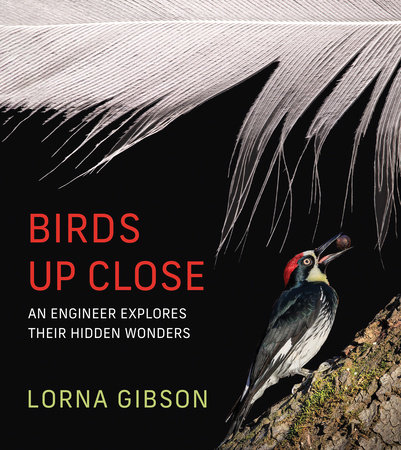
Birds Up Close

An Engineer Explores Their Hidden Wonders

Look inside
Hardcover
$39.95 US
8.25"W x 9.31"H x 0.78"D   | 31 oz | 14 per carton
On sale May 05, 2026 | 288 Pages | 9780262049894

A renowned engineer and lifelong birder reveals the marvel of how birds work—from the tips of their beaks to the sheen of their tailfeathers.

With over 150 full-color illustrations, a unique gift book for everyone from the avid birder to the bird beginner.


Consider feathers: They define birds’ wings, enabling flight. They insulate against cold. They repel water. They even control sound. And how feathers work is just one aspect of the wonders of birds explained by pathbreaking researcher and birder Lorna Gibson in Birds Up Close.

Feathers, bones, bills, eggs, flight: all come in for scrutiny in this engaging book. What produces the iridescence of plumage? How does the internal structure of a bird’s bones make them lightweight? How do different birds use their bills and tongues—from woodpeckers penetrating the holes they drill to hummingbirds imbibing nectar, to sandpipers needling the sand, and to phalaropes drawing water droplets containing plankton into their mouths without sucking (no lips!)?

Drawing on her expertise and personal experience in both engineering and ornithology, the author explores the hidden microscopic structures and engineering principles that keep birds aloft and alive—how an egg is formed, how a bird generates lift; how raptors soar and glide, albatrosses fly thousands of miles, hummingbirds hover, puffins and penguins “fly” underwater. She also considers the longer view of birds in their habitats and natural history. Her up-close look at avian mysteries provides a perspective like no other for the expert ornithologist and curious observer alike.
Lorna J. Gibson is the Matoula S. Salapatas Professor of Materials Science and Engineering and a MacVicar Faculty Fellow at MIT. Her research interests have focused on the mechanics of materials with a cellular structure such as engineering honeycombs and foams, natural materials such as wood, leaves and bamboo, as well as medical materials for regenerating damaged tissues. A lifelong birder, Gibson is a member of the Board of Directors of the Massachusetts Audubon Society.
Contents
Preface
Chapter 1 Fantastic Feathers: Color and Sound
Contour feather structure
Feather color
Pigments
Structural color
Feathers for sound
Creating sound
Suppressing sound
Collecting sound
References
Chapter 2 Fantastic Feathers: Warm and Dry
Water repellency
Thermal insulation
References
Chapter 3 Bones: Light for Flight
Bird skeletons
Sandwich structures
Cylindrical long bones
References
Chapter 4 Bills Woodpeckers: Bills for pecking
Hummingbirds: Tongues for collecting nectar
Calidris sandpipers: Bills for sensing prey
Phalaropes: Bills for capturing plankton
References
Chapter 5 Eggs Ovum to egg
Color
Size and shape of eggs
Strength of eggshells
References
Chapter 6 Flight: Weight, Upward Force and Lift
Weight
Upward force
Lift
References
Chapter 7 Flight: Drag and Thrust Drag
Soaring and gliding
Thrust: Flapping flight
Specialized types of flight
Hovering
Swimming with wings
Murmurations of starlings
References
Epilogue: Sanctuary and Solace
Acknowledgments

About

A renowned engineer and lifelong birder reveals the marvel of how birds work—from the tips of their beaks to the sheen of their tailfeathers.

With over 150 full-color illustrations, a unique gift book for everyone from the avid birder to the bird beginner.


Consider feathers: They define birds’ wings, enabling flight. They insulate against cold. They repel water. They even control sound. And how feathers work is just one aspect of the wonders of birds explained by pathbreaking researcher and birder Lorna Gibson in Birds Up Close.

Feathers, bones, bills, eggs, flight: all come in for scrutiny in this engaging book. What produces the iridescence of plumage? How does the internal structure of a bird’s bones make them lightweight? How do different birds use their bills and tongues—from woodpeckers penetrating the holes they drill to hummingbirds imbibing nectar, to sandpipers needling the sand, and to phalaropes drawing water droplets containing plankton into their mouths without sucking (no lips!)?

Drawing on her expertise and personal experience in both engineering and ornithology, the author explores the hidden microscopic structures and engineering principles that keep birds aloft and alive—how an egg is formed, how a bird generates lift; how raptors soar and glide, albatrosses fly thousands of miles, hummingbirds hover, puffins and penguins “fly” underwater. She also considers the longer view of birds in their habitats and natural history. Her up-close look at avian mysteries provides a perspective like no other for the expert ornithologist and curious observer alike.

Author

Lorna J. Gibson is the Matoula S. Salapatas Professor of Materials Science and Engineering and a MacVicar Faculty Fellow at MIT. Her research interests have focused on the mechanics of materials with a cellular structure such as engineering honeycombs and foams, natural materials such as wood, leaves and bamboo, as well as medical materials for regenerating damaged tissues. A lifelong birder, Gibson is a member of the Board of Directors of the Massachusetts Audubon Society.

Table of Contents

Contents
Preface
Chapter 1 Fantastic Feathers: Color and Sound
Contour feather structure
Feather color
Pigments
Structural color
Feathers for sound
Creating sound
Suppressing sound
Collecting sound
References
Chapter 2 Fantastic Feathers: Warm and Dry
Water repellency
Thermal insulation
References
Chapter 3 Bones: Light for Flight
Bird skeletons
Sandwich structures
Cylindrical long bones
References
Chapter 4 Bills Woodpeckers: Bills for pecking
Hummingbirds: Tongues for collecting nectar
Calidris sandpipers: Bills for sensing prey
Phalaropes: Bills for capturing plankton
References
Chapter 5 Eggs Ovum to egg
Color
Size and shape of eggs
Strength of eggshells
References
Chapter 6 Flight: Weight, Upward Force and Lift
Weight
Upward force
Lift
References
Chapter 7 Flight: Drag and Thrust Drag
Soaring and gliding
Thrust: Flapping flight
Specialized types of flight
Hovering
Swimming with wings
Murmurations of starlings
References
Epilogue: Sanctuary and Solace
Acknowledgments

Live Inspired with Compendium: Now Available from PRH!

Exciting news! Compendium has joined the Penguin Random House family, bringing a proven line of bestselling, sentiment-driven gifts to our extensive and ever-growing catalog. Since 1985, Compendium has been creating meaningful moments with beautiful, thoughtfully made gifts that center connection and celebrate occasions both big and small. From greeting cards to inspirational books to impulse-friendly add-ons, Compendium

Read more