Close Modal

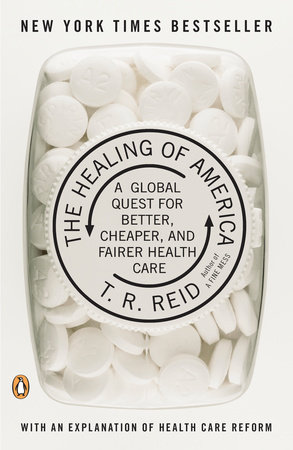
The Healing of America

A Global Quest for Better, Cheaper, and Fairer Health Care

Author T. R. Reid
Look inside
Paperback
$19.00 US
5.46"W x 8.37"H x 0.66"D   | 10 oz | 48 per carton
On sale Aug 31, 2010 | 304 Pages | 9780143118213

A New York Times Bestseller, with an updated explanation of the 2010 Health Reform Bill

"Important and powerful . . . a rich tour of health care around the world." —Nicholas Kristof, The New York Times

Bringing to bear his talent for explaining complex issues in a clear, engaging way, New York Times bestselling author T. R. Reid visits industrialized democracies around the world--France, Britain, Germany, Japan, and beyond--to provide a revelatory tour of successful, affordable universal health care systems. Now updated with new statistics and a plain-English explanation of the 2010 health care reform bill, The Healing of America is required reading for all those hoping to understand the state of health care in our country, and around the world.

T. R. Reid's latest book, A Fine Mess: A Global Quest for a Simpler, Fairer, and More Efficient Tax System, is also available from Penguin Press.

"Important and powerful . . . a rich tour of health care around the world." —Nicholas Kristof, The New York Times

"You don't necessarily realize it while you're reading, but you're talking Comparative Health Economics 101. With a really fun professor." —Daily Kos

"Not many writers of any ilk . . . can match T.R. Reid's ability to bring a light, witty touch to really serious topics—like health policy around the globe." —New America Foundation
© Jon Groner
T. R. Reid is a longtime correspondent for The Washington Post and former chief of its Tokyo and London bureaus. He is a commentator for National Public Radio and has been a correspondent for several PBS documentaries. His bestselling books include The Healing of America, The United States of Europe, The Chip, and Confucius Lives Next Door. View titles by T. R. Reid
PROLOGUE: A MORAL QUESTION

If Nikki White had been a resident of any other rich country, she would be alive today.

Around the time she graduated from college, Monique A. “Nikki” White contracted systemic lupus erythematosus; that’s a serious disease, but one that modern medicine knows how to manage. If this bright, feisty, dazzling young woman had lived in, say, Japan—the world’s second-richest nation—or Germany (third richest), or Britain, France, Italy, Spain, Canada, Sweden, etc., the health care systems there would have given her the standard treatment for lupus, and she could have lived a normal life span. But Nikki White was a citizen of the world’s richest country, the United States of America. Once she was sick, she couldn’t get health insurance. Like tens of millions of her fellow Americans, she had too much money to qualify for health care under welfare, but too little money to pay for the drugs and doctors she needed to stay alive. She spent the last months of her life frantically writing letters and filling out forms, pleading for help. When she died, Nikki White was thirty-two years old.

“Nikki didn’t die from lupus,” Dr. Amylyn Crawford told me. “It was a lack of access to health care that killed Nikki White.” Dr. Crawford is a family physician at a no-frills community health center in an old strip mall in a downscale section of Kingsport, Tennessee. She sees lots of hard cases. Still, she couldn’t stop sobbing as she recalled her late patient Monique White: “I told Nikki that she had lupus. But I also told her that a diagnosis of lupus is not a death sentence. If Nikki had not lost her health insurance, she’d be alive today.”

Later in this book, we’ll take a detailed look at Nikki White’s tragic encounter with America’s health care system. But the larger tragedy is that Ms. White is not alone. Government and academic studies report that more than twenty thousand Americans die in the prime of life each year from medical problems that could be treated, because they can’t afford to see a doctor. On September 11, 2001, some three thousand Americans were killed by terrorists; our country has spent hundreds of billions of dollars to make sure it doesn’t happen again. But that same year, and every year since then, some twenty thousand Americans died because they couldn’t get health care. That doesn’t happen in any other developed country. Hundreds of thousands of Americans go bankrupt every year because of medical bills. That doesn’t happen in any other developed country either.

Those Americans who die or go broke because they happened to get sick represent a fundamental moral decision our country has made. Despite all the rights and privileges and entitlements that Americans enjoy today, we have never decided to provide medical care for everybody who needs it. The far-reaching health care reform that Congress passed in 2010 is designed to increase coverage substantially—but it will still leave about 23 million Americans uninsured. Even when “Obamacare” takes full effect, the American health care system will still lead to large numbers of avoidable deaths and bankruptcies among our fellow citizens. As we saw in the national debate over that bill, efforts to increase coverage tend to be derailed by arguments about “big government” or

“free enterprise” or “socialism”—and the essential moral question gets lost in the shouting.

All the other developed countries on earth have made a different moral decision. All the other countries like us—that is, wealthy, technologically advanced, industrialized democracies—guarantee medical care to anyone who gets sick. Countries that are just as committed as we are to equal opportunity, individual liberty, and the free market have concluded that everybody has a right to health care—and they provide it. One result is that most rich countries have better national health statistics—longer life expectancy, lower infant mortality, better recovery rates from major diseases—than the United States does. Yet all the other rich countries spend far less on health care than the United States does.

Contrary to conventional American wisdom, most developed countries manage health care without resorting to “socialized medicine.” How do they do it? That’s what this book is about. I set out on a global tour of doctors’ offices and hospitals and health ministries to see how the other industrialized democracies organize health care systems that are universal, affordable, and effective.

My global quest made it clear that the other wealthy democracies can show us how to build a decent health care system—if that’s what we want. The design of any nation’s health care system involves political, economic, and medical decisions. But the primary issue for any health care system is a moral one. If we want to fix American health care, we first have to answer a basic question: Should we guarantee medical treatment to everyone who needs it? Or should we let Americans like Nikki White die from “a lack of access to health care”? Once we settle that point, the nations we’ll visit in this book can show us how to manage the mechanics of universal health care. We don’t need a carbon copy of any particular country’s health care system; rather, we can draw valuable lessons from each of the models described in this book. If Americans can find the political will to provide health care for everybody, the rest of the world can show us the way.

CHAPTER ONE: A QUEST FOR TWO CURES


Mrs. Rama came sweeping into my hospital room with the haughty grandeur of a Brahmin empress, wearing a salmon pink sari and leading a retinue of assistants, interpreters, and equipment bearers. It wasn’t exactly medical equipment they were carrying, because Mrs. Rama wasn’t exactly a doctor. Still, her professional services were considered an essential element of the medical regimen at India’s famous Arya Vaidya Chikitsalayam, the Mayo Clinic of traditional Indian medicine. Indeed, Mrs. Rama’s diagnostic work is covered by Indian medical insurance. As she set up her equipment—on a painted wooden board, she carefully arranged a collection of shells, rocks, and statuettes of Hindu gods—Mrs. Rama told me that she was connected to the clinic’s Department of Yajnopathy, an ancient Indian specialty that roughly equates to astrology. Her medical role was to ascertain my place in the cosmos; in that way, she could determine whether the timing was propitious for me to be healed. Any fool could see, she explained in matter-of-fact tones, that it would be a mistake to proceed with medical treatment if the stars in heaven were aligned against me.

For all her majestic self-assurance, Mrs. Rama did not immediately inspire confidence in her patient. After asking some basic questions, she shuffled the stones and statuettes around her checkerboard and launched into my diagnosis. “In the summer of 1986, you got married,” she declared firmly. Well, not exactly. In the summer of 1986, my wife and I celebrated our fourteenth wedding anniversary; by then we had three kids, a dog, and a minivan. “In 1998,” she went on, “you were far from home and were treated for serious illness.” Well, not exactly. Our American family was, in fact, living in London in 1998; but in that whole year, I never saw a doctor.

Mrs. Rama kept talking, but I stopped listening. To me, the stones and shells and statues all seemed preposterous. Still, I kept my mouth shut. If Indian medicine required yajnopathic analysis before health care could begin (and Mrs. Rama did eventually conclude that the timing was propitious for treatment), that was fine with me. I was willing to go along, in pursuit of the greater goal. For I had traveled to the Arya Vaidya clinic—it’s in the state of Tamil Nadu, at the southern tip of the subcontinent, where the Bay of Bengal meets the Arabian Sea—on a kind of medical pilgrimage. I was on a global quest, searching for solutions to two different health problems, one personal and one of national dimensions.

On the personal level, I was hoping to find some relief for my ailing right shoulder, which I bashed badly decades ago as a seaman, second class, in the U.S. Navy. In 1972, a navy surgeon (literally) screwed the joint back together, and that repair job worked fine for a while. Over time, though, the stainless-steel screw in my clavicle loosened; my shoulder grew increasingly painful and hard to move. By the first decade of the twenty-first century, I could no longer swing a golf club. I could barely reach up to replace a lightbulb overhead or get the wineglasses from the top shelf. Yearning for surcease from sorrow, I took that bum shoulder to doctors and clinics—including Mrs. Rama’s chikitsalayam—in countries around the world.

The quest began at home. I went to a brilliant American orthopedist, Dr. Donald Ferlic, a specialist who had skillfully repaired another broken joint of mine a few years back. Dr. Ferlic proposed a surgical intervention that reflects precisely the high-tech ethos of contemporary American medicine. This operation—it is known as a total shoulder arthroplasty, Procedure No. 080.81 on the National Center for Health Statistics’ roster of “clinical modifications”—would require the orthopedist to take a surgical saw, cut off the shoulder joint that God gave me, and replace it with a man-made contraption of silicon and titanium. This new arthroplastic joint would be hammered into my upper arm and then cemented to my clavicle. The doctor was confident that this would reduce my shoulder pain—orthopedic surgeons tend to be confident by nature—but I had serious reservations about Procedure No. 080.81. The saws and hammers and glue made the operation sound rather drastic. It would cost tens of thousands of dollars (like most major medical procedures in the United States, the exact price was veiled in mystery). The best prognosis I could get was that the operation might or might not give me more shoulder movement. And when I asked Dr. Ferlic what could go wrong in the course of a total arthroplasty, he was completely honest. “Well, you have all the risks that go with major surgery,” he answered frankly. And then he listed the risks: Disease. Paralysis. Death.

With that, a certain skepticism crept into my soul about this high-tech medical intervention. I departed my American surgeon’s office and took my aching shoulder to other doctors, doctors all over the globe. Over the next year or so, I had my blood pressure and temperature taken in ten different languages. I ran into a world of different diagnostic techniques, ranging from Mrs. Rama and her star charts to a diligent, studious doctor (we’ll meet him in chapter 9) who told me he couldn’t possibly analyze my medical condition without tasting my urine. In Taipei, an acupuncturist twirled her needles in my left knee to treat the pain in my right shoulder. The shoulder itself was examined, X-rayed, patted, poked, palpated, massaged, and manipulated in countless ways. Some of these treatments worked, more or less; as we’ll see in chapter 9, Mrs. Rama’s colleagues at the chikitsalayam were helpful. Others proved no help at all.

This was not a major disappointment, though, because that aching shoulder was really just a secondary impetus for my medical odyssey. It would be ridiculous, after all, to go all the way to the southern tip of India—not to mention London, Paris, Berlin, Tokyo, and so on—to get treatment for a sore shoulder that isn’t, frankly, all that sore. The stiffness is tolerable most of the time. I have another arm to use for changing lightbulbs or getting glasses off the shelf. I don’t have a golf swing anymore, but even when I could swing a club I was a rotten golfer.

So the shoulder was not my top priority. Rather, the primary goal of my travels was to find a solution to a much bigger medical problem. It’s a national problem—a national scandal, really—that is undermining the physical and fiscal health of every American. With help from many scholars and the Kaiser Family Foundation, I traveled the world searching for a prescription to fix our country’s seriously ailing health care system. As Nikki White’s experience demonstrates, it’s fundamentally a moral problem: We’ve created a health care system that leaves millions of our fellow citizens out in the cold. Beyond the issue of coverage, however, the United States also performs below other wealthy countries in matters of cost, quality, and choice.

Most Americans can remember when our politicians used to boast—and we used to believe—that the United States had “the finest health care system in the world.” Today, any U.S. politician who dared to make that claim—it was last heard in a State of the Union address in 2002—would be hooted out of the room. Americans generally recognize now that our nation’s health care system has become excessively expensive, ineffective, and unjust. Among the world’s developed nations, the United States stands at or near the bottom in most important rankings of access to and quality of medical care. In 2000, when a Harvard Medical School professor working at the World Health Organization developed a complicated formula to rate the quality and fairness of national health care systems around the world, the richest nation on earth ranked thirty-seventh. That placed us just behind Dominica and Costa Rica, and just ahead of Slovenia and Cuba. France came in first. (For more about the WHO’s global ranking, see the appendix.)

The one area where the United States unquestionably leads the world is in spending. Even countries with considerably older populations than ours, with more need for medical attention, spend much less than we do. Japan has the oldest population in the world, and the Japanese go to the doctor more than anybody—about fourteen office

HEALTH EXPENDITURE AS A PERCENTAGE
OF GDP, 2005

USA 16.5
France 11.0
Switzerland 10.8
Germany 10.4
Canada 10.1
Sweden 9.1
UK 8.4
Japan 8.1
Mexico 7.3
Taiwan 6.2

Sources: OECD Health at a Glance, 2009; Government of Taiwan.

visits per year, compared with five for the average American. And yet Japan spends about $3,400 per person on health care each year; we burn through $7,400 per person.

There’s nothing particularly wrong with spending a lot of money on something important, as long as you get a decent return for what you spend. It’s certainly not wasteful to spend money for effective medical treatment. If a dentist who was about to drill a tooth offered her patient a choice between listening to pleasant music for free to lessen the pain, or a shot of Novocain for $50, most people would pay for the shot and would probably get their money’s worth. And there’s nothing wrong with paying more for better performance. Those fifty-two-inch high-definition plasma televisions that people hang on the family room wall these days cost five times what a top-of-the-line set would have cost ten years ago, but buyers are willing to shell out the extra money because the enhanced viewing quality is worth the price.

When it comes to medical care, though, Americans are shelling out the big bucks without getting what we pay for. As we’ll see shortly, the quality of medical care that Americans buy is often inferior to the treatment people get in other countries. And patients know it. Surveys show that Americans who see a doctor tend to be less satisfied with their treatment than Britons, Italians, Germans, Canadians, or the Japanese— even though we pay the doctor much more than they do.

About

A New York Times Bestseller, with an updated explanation of the 2010 Health Reform Bill

"Important and powerful . . . a rich tour of health care around the world." —Nicholas Kristof, The New York Times

Bringing to bear his talent for explaining complex issues in a clear, engaging way, New York Times bestselling author T. R. Reid visits industrialized democracies around the world--France, Britain, Germany, Japan, and beyond--to provide a revelatory tour of successful, affordable universal health care systems. Now updated with new statistics and a plain-English explanation of the 2010 health care reform bill, The Healing of America is required reading for all those hoping to understand the state of health care in our country, and around the world.

T. R. Reid's latest book, A Fine Mess: A Global Quest for a Simpler, Fairer, and More Efficient Tax System, is also available from Penguin Press.

Praise

"Important and powerful . . . a rich tour of health care around the world." —Nicholas Kristof, The New York Times

"You don't necessarily realize it while you're reading, but you're talking Comparative Health Economics 101. With a really fun professor." —Daily Kos

"Not many writers of any ilk . . . can match T.R. Reid's ability to bring a light, witty touch to really serious topics—like health policy around the globe." —New America Foundation

Author

© Jon Groner
T. R. Reid is a longtime correspondent for The Washington Post and former chief of its Tokyo and London bureaus. He is a commentator for National Public Radio and has been a correspondent for several PBS documentaries. His bestselling books include The Healing of America, The United States of Europe, The Chip, and Confucius Lives Next Door. View titles by T. R. Reid

Excerpt

PROLOGUE: A MORAL QUESTION

If Nikki White had been a resident of any other rich country, she would be alive today.

Around the time she graduated from college, Monique A. “Nikki” White contracted systemic lupus erythematosus; that’s a serious disease, but one that modern medicine knows how to manage. If this bright, feisty, dazzling young woman had lived in, say, Japan—the world’s second-richest nation—or Germany (third richest), or Britain, France, Italy, Spain, Canada, Sweden, etc., the health care systems there would have given her the standard treatment for lupus, and she could have lived a normal life span. But Nikki White was a citizen of the world’s richest country, the United States of America. Once she was sick, she couldn’t get health insurance. Like tens of millions of her fellow Americans, she had too much money to qualify for health care under welfare, but too little money to pay for the drugs and doctors she needed to stay alive. She spent the last months of her life frantically writing letters and filling out forms, pleading for help. When she died, Nikki White was thirty-two years old.

“Nikki didn’t die from lupus,” Dr. Amylyn Crawford told me. “It was a lack of access to health care that killed Nikki White.” Dr. Crawford is a family physician at a no-frills community health center in an old strip mall in a downscale section of Kingsport, Tennessee. She sees lots of hard cases. Still, she couldn’t stop sobbing as she recalled her late patient Monique White: “I told Nikki that she had lupus. But I also told her that a diagnosis of lupus is not a death sentence. If Nikki had not lost her health insurance, she’d be alive today.”

Later in this book, we’ll take a detailed look at Nikki White’s tragic encounter with America’s health care system. But the larger tragedy is that Ms. White is not alone. Government and academic studies report that more than twenty thousand Americans die in the prime of life each year from medical problems that could be treated, because they can’t afford to see a doctor. On September 11, 2001, some three thousand Americans were killed by terrorists; our country has spent hundreds of billions of dollars to make sure it doesn’t happen again. But that same year, and every year since then, some twenty thousand Americans died because they couldn’t get health care. That doesn’t happen in any other developed country. Hundreds of thousands of Americans go bankrupt every year because of medical bills. That doesn’t happen in any other developed country either.

Those Americans who die or go broke because they happened to get sick represent a fundamental moral decision our country has made. Despite all the rights and privileges and entitlements that Americans enjoy today, we have never decided to provide medical care for everybody who needs it. The far-reaching health care reform that Congress passed in 2010 is designed to increase coverage substantially—but it will still leave about 23 million Americans uninsured. Even when “Obamacare” takes full effect, the American health care system will still lead to large numbers of avoidable deaths and bankruptcies among our fellow citizens. As we saw in the national debate over that bill, efforts to increase coverage tend to be derailed by arguments about “big government” or

“free enterprise” or “socialism”—and the essential moral question gets lost in the shouting.

All the other developed countries on earth have made a different moral decision. All the other countries like us—that is, wealthy, technologically advanced, industrialized democracies—guarantee medical care to anyone who gets sick. Countries that are just as committed as we are to equal opportunity, individual liberty, and the free market have concluded that everybody has a right to health care—and they provide it. One result is that most rich countries have better national health statistics—longer life expectancy, lower infant mortality, better recovery rates from major diseases—than the United States does. Yet all the other rich countries spend far less on health care than the United States does.

Contrary to conventional American wisdom, most developed countries manage health care without resorting to “socialized medicine.” How do they do it? That’s what this book is about. I set out on a global tour of doctors’ offices and hospitals and health ministries to see how the other industrialized democracies organize health care systems that are universal, affordable, and effective.

My global quest made it clear that the other wealthy democracies can show us how to build a decent health care system—if that’s what we want. The design of any nation’s health care system involves political, economic, and medical decisions. But the primary issue for any health care system is a moral one. If we want to fix American health care, we first have to answer a basic question: Should we guarantee medical treatment to everyone who needs it? Or should we let Americans like Nikki White die from “a lack of access to health care”? Once we settle that point, the nations we’ll visit in this book can show us how to manage the mechanics of universal health care. We don’t need a carbon copy of any particular country’s health care system; rather, we can draw valuable lessons from each of the models described in this book. If Americans can find the political will to provide health care for everybody, the rest of the world can show us the way.

CHAPTER ONE: A QUEST FOR TWO CURES


Mrs. Rama came sweeping into my hospital room with the haughty grandeur of a Brahmin empress, wearing a salmon pink sari and leading a retinue of assistants, interpreters, and equipment bearers. It wasn’t exactly medical equipment they were carrying, because Mrs. Rama wasn’t exactly a doctor. Still, her professional services were considered an essential element of the medical regimen at India’s famous Arya Vaidya Chikitsalayam, the Mayo Clinic of traditional Indian medicine. Indeed, Mrs. Rama’s diagnostic work is covered by Indian medical insurance. As she set up her equipment—on a painted wooden board, she carefully arranged a collection of shells, rocks, and statuettes of Hindu gods—Mrs. Rama told me that she was connected to the clinic’s Department of Yajnopathy, an ancient Indian specialty that roughly equates to astrology. Her medical role was to ascertain my place in the cosmos; in that way, she could determine whether the timing was propitious for me to be healed. Any fool could see, she explained in matter-of-fact tones, that it would be a mistake to proceed with medical treatment if the stars in heaven were aligned against me.

For all her majestic self-assurance, Mrs. Rama did not immediately inspire confidence in her patient. After asking some basic questions, she shuffled the stones and statuettes around her checkerboard and launched into my diagnosis. “In the summer of 1986, you got married,” she declared firmly. Well, not exactly. In the summer of 1986, my wife and I celebrated our fourteenth wedding anniversary; by then we had three kids, a dog, and a minivan. “In 1998,” she went on, “you were far from home and were treated for serious illness.” Well, not exactly. Our American family was, in fact, living in London in 1998; but in that whole year, I never saw a doctor.

Mrs. Rama kept talking, but I stopped listening. To me, the stones and shells and statues all seemed preposterous. Still, I kept my mouth shut. If Indian medicine required yajnopathic analysis before health care could begin (and Mrs. Rama did eventually conclude that the timing was propitious for treatment), that was fine with me. I was willing to go along, in pursuit of the greater goal. For I had traveled to the Arya Vaidya clinic—it’s in the state of Tamil Nadu, at the southern tip of the subcontinent, where the Bay of Bengal meets the Arabian Sea—on a kind of medical pilgrimage. I was on a global quest, searching for solutions to two different health problems, one personal and one of national dimensions.

On the personal level, I was hoping to find some relief for my ailing right shoulder, which I bashed badly decades ago as a seaman, second class, in the U.S. Navy. In 1972, a navy surgeon (literally) screwed the joint back together, and that repair job worked fine for a while. Over time, though, the stainless-steel screw in my clavicle loosened; my shoulder grew increasingly painful and hard to move. By the first decade of the twenty-first century, I could no longer swing a golf club. I could barely reach up to replace a lightbulb overhead or get the wineglasses from the top shelf. Yearning for surcease from sorrow, I took that bum shoulder to doctors and clinics—including Mrs. Rama’s chikitsalayam—in countries around the world.

The quest began at home. I went to a brilliant American orthopedist, Dr. Donald Ferlic, a specialist who had skillfully repaired another broken joint of mine a few years back. Dr. Ferlic proposed a surgical intervention that reflects precisely the high-tech ethos of contemporary American medicine. This operation—it is known as a total shoulder arthroplasty, Procedure No. 080.81 on the National Center for Health Statistics’ roster of “clinical modifications”—would require the orthopedist to take a surgical saw, cut off the shoulder joint that God gave me, and replace it with a man-made contraption of silicon and titanium. This new arthroplastic joint would be hammered into my upper arm and then cemented to my clavicle. The doctor was confident that this would reduce my shoulder pain—orthopedic surgeons tend to be confident by nature—but I had serious reservations about Procedure No. 080.81. The saws and hammers and glue made the operation sound rather drastic. It would cost tens of thousands of dollars (like most major medical procedures in the United States, the exact price was veiled in mystery). The best prognosis I could get was that the operation might or might not give me more shoulder movement. And when I asked Dr. Ferlic what could go wrong in the course of a total arthroplasty, he was completely honest. “Well, you have all the risks that go with major surgery,” he answered frankly. And then he listed the risks: Disease. Paralysis. Death.

With that, a certain skepticism crept into my soul about this high-tech medical intervention. I departed my American surgeon’s office and took my aching shoulder to other doctors, doctors all over the globe. Over the next year or so, I had my blood pressure and temperature taken in ten different languages. I ran into a world of different diagnostic techniques, ranging from Mrs. Rama and her star charts to a diligent, studious doctor (we’ll meet him in chapter 9) who told me he couldn’t possibly analyze my medical condition without tasting my urine. In Taipei, an acupuncturist twirled her needles in my left knee to treat the pain in my right shoulder. The shoulder itself was examined, X-rayed, patted, poked, palpated, massaged, and manipulated in countless ways. Some of these treatments worked, more or less; as we’ll see in chapter 9, Mrs. Rama’s colleagues at the chikitsalayam were helpful. Others proved no help at all.

This was not a major disappointment, though, because that aching shoulder was really just a secondary impetus for my medical odyssey. It would be ridiculous, after all, to go all the way to the southern tip of India—not to mention London, Paris, Berlin, Tokyo, and so on—to get treatment for a sore shoulder that isn’t, frankly, all that sore. The stiffness is tolerable most of the time. I have another arm to use for changing lightbulbs or getting glasses off the shelf. I don’t have a golf swing anymore, but even when I could swing a club I was a rotten golfer.

So the shoulder was not my top priority. Rather, the primary goal of my travels was to find a solution to a much bigger medical problem. It’s a national problem—a national scandal, really—that is undermining the physical and fiscal health of every American. With help from many scholars and the Kaiser Family Foundation, I traveled the world searching for a prescription to fix our country’s seriously ailing health care system. As Nikki White’s experience demonstrates, it’s fundamentally a moral problem: We’ve created a health care system that leaves millions of our fellow citizens out in the cold. Beyond the issue of coverage, however, the United States also performs below other wealthy countries in matters of cost, quality, and choice.

Most Americans can remember when our politicians used to boast—and we used to believe—that the United States had “the finest health care system in the world.” Today, any U.S. politician who dared to make that claim—it was last heard in a State of the Union address in 2002—would be hooted out of the room. Americans generally recognize now that our nation’s health care system has become excessively expensive, ineffective, and unjust. Among the world’s developed nations, the United States stands at or near the bottom in most important rankings of access to and quality of medical care. In 2000, when a Harvard Medical School professor working at the World Health Organization developed a complicated formula to rate the quality and fairness of national health care systems around the world, the richest nation on earth ranked thirty-seventh. That placed us just behind Dominica and Costa Rica, and just ahead of Slovenia and Cuba. France came in first. (For more about the WHO’s global ranking, see the appendix.)

The one area where the United States unquestionably leads the world is in spending. Even countries with considerably older populations than ours, with more need for medical attention, spend much less than we do. Japan has the oldest population in the world, and the Japanese go to the doctor more than anybody—about fourteen office

HEALTH EXPENDITURE AS A PERCENTAGE
OF GDP, 2005

USA 16.5
France 11.0
Switzerland 10.8
Germany 10.4
Canada 10.1
Sweden 9.1
UK 8.4
Japan 8.1
Mexico 7.3
Taiwan 6.2

Sources: OECD Health at a Glance, 2009; Government of Taiwan.

visits per year, compared with five for the average American. And yet Japan spends about $3,400 per person on health care each year; we burn through $7,400 per person.

There’s nothing particularly wrong with spending a lot of money on something important, as long as you get a decent return for what you spend. It’s certainly not wasteful to spend money for effective medical treatment. If a dentist who was about to drill a tooth offered her patient a choice between listening to pleasant music for free to lessen the pain, or a shot of Novocain for $50, most people would pay for the shot and would probably get their money’s worth. And there’s nothing wrong with paying more for better performance. Those fifty-two-inch high-definition plasma televisions that people hang on the family room wall these days cost five times what a top-of-the-line set would have cost ten years ago, but buyers are willing to shell out the extra money because the enhanced viewing quality is worth the price.

When it comes to medical care, though, Americans are shelling out the big bucks without getting what we pay for. As we’ll see shortly, the quality of medical care that Americans buy is often inferior to the treatment people get in other countries. And patients know it. Surveys show that Americans who see a doctor tend to be less satisfied with their treatment than Britons, Italians, Germans, Canadians, or the Japanese— even though we pay the doctor much more than they do.